

1 cent per kWh: How a new salt-based battery from China solves our energy problems – The end of the excuse of low wind and solar power generation
Xpert Pre-Release

Available in 27 languages 📢
Prefer Xpert.Digital on GoogleⓘPublished on: June 26, 2026 / Updated on: June 26, 2026 – Author: Konrad Wolfenstein
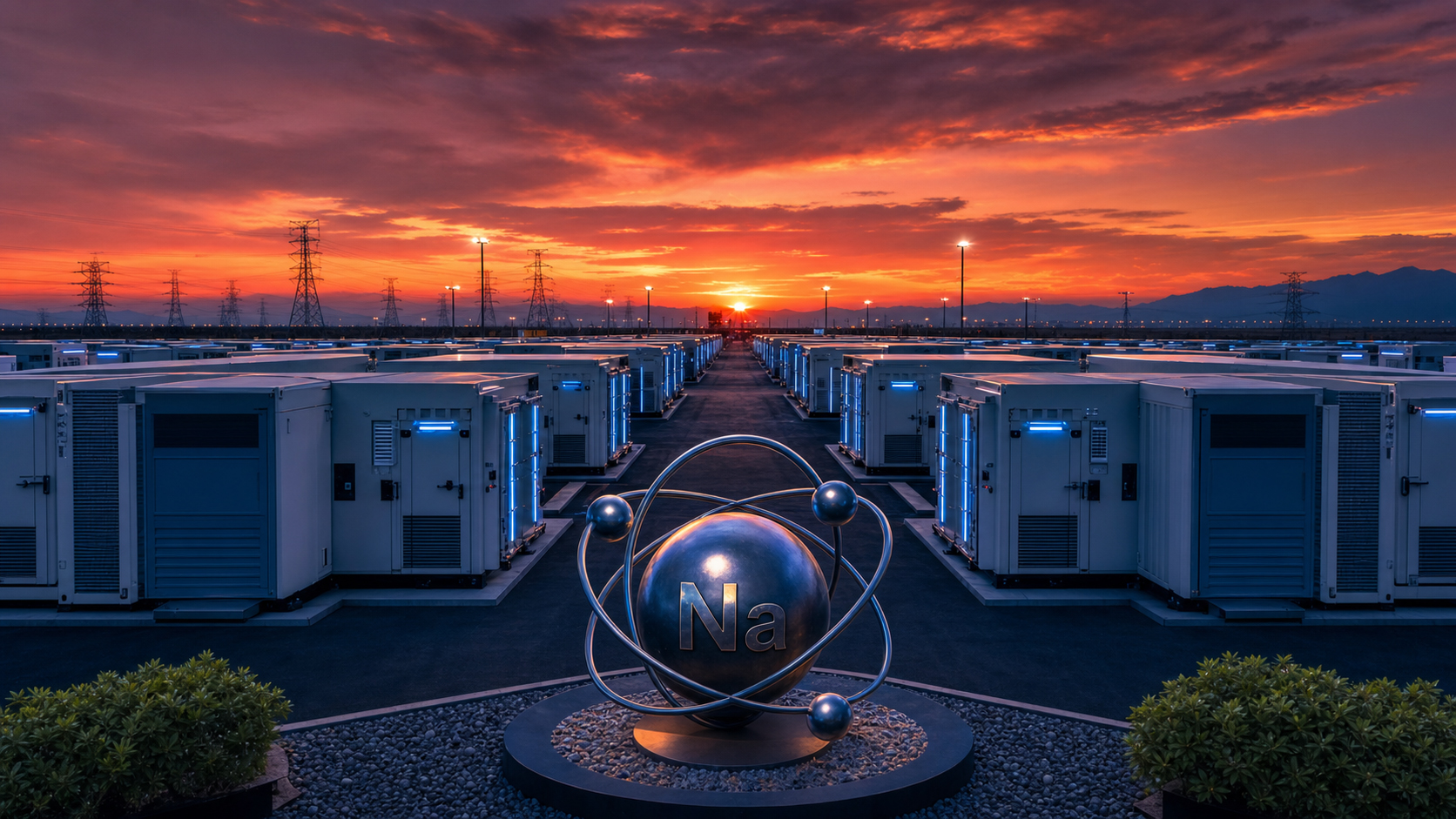
1 cent per kWh: How a new salt-based battery from China solves our energy problems – The end of the excuse of low wind and solar power generation – Image: Xpert.Digital
No lithium, half the price: The battery revolution that gas lobbyists tremble before
CATL Tener Sodium: China's miracle storage technology makes German energy debates obsolete
Electricity storage at bargain prices: Why the dispute over renewable energies ends today
For years, the energy transition has been hampered by a central, seemingly intractable question: What happens when the wind isn't blowing and the sun isn't shining? Until now, the expensive and emissions-intensive answer from policymakers has been: gas-fired power plants as backup. But a technological revolution from China has now definitively rendered this structurally conservative argument obsolete. With "Tener Sodium," the world's largest battery manufacturer, CATL, has presented a large-scale stationary storage system that is completely rewriting the rules of the game in global energy markets. Instead of relying on expensive, geopolitically contested lithium, the system uses simple table salt. The result is a highly scalable mega-storage facility that brings storage costs of a sensational one cent per kilowatt-hour within reach. While Germany is still debating technological openness and fossil fuel baseload power, industry is already creating irreversible facts with gigantic gigawatt-hour contracts. Read here why the question of security of supply has long been technologically solved – and why European policymakers must now fundamentally rethink their energy strategy if they don't want to fall behind.
Related to this:

The excuse of low wind and solar power generation falls away: This mega-storage facility outperforms any gas-fired power plant
When table salt saves the energy transition that politicians didn't want to save
There are moments when a single technological product not only enriches a political debate but simply ends it. June 22, 2026, could be one of those moments. At Intersolar Europe in Munich, CATL, the world's largest battery manufacturer, unveiled the Tener Sodium – a stationary sodium-ion energy storage system whose combination of technological maturity, scalability, and cost structure is unparalleled in the industry's history. Staff at the booth were moved to make a statement that, under normal circumstances, would have been dismissed as mere marketing hype: investment costs of one cent per kilowatt-hour of throughput are within reach. Under normal circumstances. But the figures behind this are real, verified, and backed up by a completed 60-gigawatt-hour contract with the Chinese system integrator HyperStrong.
To understand why this figure has such political implications, one must understand the context. For years, the standard argument against a rapid expansion of renewable energies has been: What happens when the sun isn't shining and the wind isn't blowing? Who will supply the electricity then? This argument has never been purely technical. It has always also been a political, lobbying, and structurally conservative argument, one that safeguards the status quo of the existing fossil fuel infrastructure. With Tener Sodium, CATL has now provided not only a technical answer, but also an economic one that can withstand any comparison with conventional forms of energy generation – and in most cases, far surpasses them.
Sodium instead of lithium: The underestimated raw materials revolution
To understand the significance of the Sodium Tenere, it's helpful to first look at the chemistry. Sodium-ion batteries function according to the same basic electrochemical principle as their lithium-ion counterparts: ions migrate between the anode and cathode during charging and discharging. The crucial difference lies in the ion used – and thus in the raw material. Sodium is the sixth most abundant element in the Earth's crust and can be extracted from common table salt (sodium chloride). It is available in virtually unlimited quantities, is geographically widespread, and is not subject to any critical supply chain dependencies.
Lithium, on the other hand, is a scarce, geopolitically sensitive raw material, mined primarily in Australia, Chile, and the Democratic Republic of Congo. Market prices for lithium carbonate have fluctuated enormously in recent years, making calculations for large-scale storage projects difficult. Cobalt and nickel, other important components of many lithium-based cell chemistries, also contribute to the overall cost. Sodium-ion cells do without both. Furthermore, CATL replaces the copper foil used as an anode current collector with less expensive aluminum, which further reduces material costs.
The downside is well known: sodium-ion cells achieve a lower gravimetric energy density than lithium iron phosphate (LFP). CATL's Naxtra cells – the basis of the Tener Sodium – achieve around 160 to 175 watt-hours per kilogram, while LFP systems reach over 200 Wh/kg. For mobile applications, where every kilogram of weight counts, this is a real disadvantage. For large-scale stationary storage systems, it is completely irrelevant. Nobody lugs around a containerized storage unit. What matters is the price per kilowatt-hour stored – and that's where sodium starts to dominate.
Technical maturity at an industrial level
CATL describes the Tener Sodium as the world's first field-validated sodium battery solution for stationary energy storage. This is more than just marketing: the system has undergone real-world operation before its commercial launch – a rarity in an industry that has often made bold promises before sufficient field testing. The system's technical specifications speak for themselves.
The Tener Sodium achieves a nominal capacity of more than 30 megawatt-hours on a fully modular architecture. A single module weighs approximately 42 tons; only 34 such modules are needed for a one-gigawatt-hour system. CATL specifies a lifespan of 15,000 cycles at 25 degrees Celsius and a conservation value of 70 percent – which corresponds to a service life of 25 to 30 years. At elevated temperatures of 45 degrees Celsius, more than 10,000 cycles are still achievable.
The cooling performance is particularly remarkable. At minus 20 degrees Celsius, the system retains more than 92 percent of its capacity. Lithium iron phosphate cells must be actively heated at sub-zero temperatures before they can even be charged – an energy and cost expenditure that is eliminated with sodium-ion systems. For storage systems in northern European countries, Scandinavia, or at high altitudes, this is a genuine economic advantage.
The Tener Sodium's system architecture, for the first time, completely separates the energy storage system from the power electronics. Previously, both were integrated into a single container. The new modularity allows for configurations with storage durations from one to eight hours – precisely tailored to the requirements of wind or solar farms of varying sizes. CATL has also developed a bidirectional voltage regulation system that increases system efficiency by nearly two percent – which translates to millions of additional kilowatt-hours per year for a one-gigawatt-hour system. Auxiliary power consumption has been reduced to one percent, compared to the industry average of two percent.
One cent per kilowatt hour: The calculation behind it
The claim that storage costs of one cent per kilowatt-hour are within reach initially sounds like a marketing promise. However, the underlying calculation is economically sound. Its predecessor, Tener, based on LFP modules, already stored 6,250 kilowatt-hours per container; with an estimated system price of around €1.5 million and 15,000 cycles, this results in an investment cost per kilowatt-hour of approximately 1.6 cents. According to CATL employees, Tener Sodium is expected to significantly undercut this price.
The calculation is simple: Taking a hypothetical system price of €120 per kilowatt-hour of installed capacity – a figure that is already plausible given current market trends – and multiplying this by 15,000 cycles and an efficiency of around 92 percent, one arrives at investment costs of just over 0.8 cents per kilowatt-hour delivered. Even when generously including operating and capital costs, the figure remains well below two cents per kilowatt-hour. This is not a fanciful calculation – it is a conservative scenario based on real, measurable cost parameters.
For comparison, the global average price for turnkey battery storage systems was $117 per kilowatt-hour at the end of 2025 – a decrease of 31 percent within a year. According to a BloombergNEF analysis, the levelized cost of storage for a four-hour LFP system was $78 per megawatt-hour in 2025, an all-time low since records began. The corresponding figure for gas-fired power plants rose to $102 per megawatt-hour during the same period – an all-time high. The cost gap between renewable energy generation with storage and fossil fuel generation is widening at an accelerating rate.
The 60-gigawatt-hour contract as an industrial turbocharger
Technology only becomes an industrial reality when someone is willing to buy it on an industrial scale. CATL proved this even before Intersolar. On April 27, 2026, CATL and the Chinese systems integrator HyperStrong signed the world's largest single contract for sodium-ion batteries in the history of the technology: 60 gigawatt-hours over three years. This volume corresponds to approximately half of CATL's total energy storage shipments in 2025.
CATL itself is investing 5 billion yuan – roughly US$735 million – in a new production facility in Fujian province, which is expected to add 40 gigawatt-hours of annual capacity within 24 months. This will expand the Fuding plant to a total capacity of 149 gigawatt-hours. In addition, the Jining site in Shandong province is planned to have 160 gigawatt-hours of sodium-ion battery capacity. In total, CATL is approaching a production capacity that could meet global demand for stationary energy storage for years to come. CATL CEO Robin Zeng predicts a long-term market share of 30 to 40 percent for sodium-ion batteries.
The first step into practical application has already been taken. The first Tener sodium systems are scheduled for delivery in China in September 2026; cumulative deliveries of one gigawatt-hour are expected by the end of the year. Global commercial deliveries – including to European and German customers – are planned to begin in June 2027. According to CATL, it has invested nearly 10 billion yuan in research and development of sodium-ion technology since 2016, accumulating more than 1,600 patent families and over 200 patents granted worldwide.
The argument of security of supply put to the test
The central political counterargument against a rapid expansion of renewables has always been: security of supply. At the Bundestag session on May 8, 2026, AfD member of parliament Malte Kaufmann described wind and solar power as systemically incapable of providing baseload power and invoked the argument of necessary backup capacities. It is an argument that has haunted various versions throughout decades of political debate and has an undeniable physical basis: sun and wind are fluctuating. However, anyone who concludes from this that renewable energies therefore cannot provide a reliable, full supply is confusing the physical problem with its technical solution.
The problem isn't that the sun and wind are unreliable – until recently, the problem was that electricity couldn't be stored cost-effectively. This limitation is now being overcome on an industrial scale. An FAU study published in 2026 concludes that hydrogen-capable gas-fired power plants could be systemically valuable for a decarbonized electricity system – as a safeguard against rare periods of low wind and solar power generation. However, even this nuanced scientific position explicitly assumes that the massive expansion of renewables and storage forms the primary pillar of the system. The study describes gas-fired power plants as insurance, not as the foundation.
The crucial cost question here is: How expensive is this insurance? According to calculations by the Forum for Ecological Market Economy, electricity from new gas-fired power plants costs between 23 and 28 cents per kilowatt-hour in pure production costs – with a CO₂ price that only partially reflects the external climate costs. In crises like the 2022 energy crisis, the production costs of natural gas can rise to as much as 53 cents per kilowatt-hour. Including external societal costs, the study arrives at total costs of up to 67 cents per kilowatt-hour. The answer to the question of security of supply is therefore not gas-fired power plants versus storage – the question is which of these options is cheaper, more reliable, and more sustainable in the long term.
In contrast, electricity from new wind and solar power plants costs less than ten cents per kilowatt-hour. Combined with storage costs of around one to two cents per kilowatt-hour, this creates a full-supply scenario that is significantly lower than the cost of new gas-fired power plants. Left Party MP Cezanne aptly put it in the Bundestag: electricity from new gas-fired power plants costs around 30 cents per kilowatt-hour – three times the cost of renewables. An energy system based on fossil fuel storage for peak loads is therefore not only problematic from a climate policy perspective – it is also the more expensive model economically.
Innovative photovoltaic solution for cost reduction (up to 30%) and time savings (up to 40%)

Innovative photovoltaic solution for cost reduction and time savings - Image: Xpert.Digital
More information here:
Technological openness or delaying tactics? The political trap in storage expansion
Europe's political stagnation in the face of China's industrial pace
While China delivers, Germany debates. In April 2026, the Federal Ministry for Economic Affairs and Energy, under Katherina Reiche (CDU), presented a draft bill on securing electricity supply security, which, according to the German Solar Association (BSW), does not provide fair competitive conditions for battery storage systems. The association criticizes the fact that storage systems are structurally disadvantaged compared to fossil fuel power plants, even though their economic viability is already established in most market environments. The Bundestag debated a draft law on security of supply in its first reading in June 2026 – at a time when CATL practically demonstrated at Intersolar that same weekend that the technical and economic foundation for a renewables-centric system already exists.
Related to this:


The concept of technological neutrality, which is repeatedly invoked in German energy debates, deserves a sober analysis. At its best, it means that no technology is excluded by decree; the market decides. In political practice, however, it is frequently used as an argument to postpone decisions – and thus to buy time for existing fossil fuel infrastructure that has not yet paid for itself. If the answer to the question of the world's cheapest storage system is: CATL's sodium-ion batteries for one cent per kilowatt-hour – then technological neutrality is no longer an argument against the energy transition. It is an argument for it.
Europe's dependence on Chinese technology is a real and legitimate political problem – but not an argument against expanding energy storage capacity per se. It is an argument for a European industrial policy that creates its own manufacturing capacity instead of relying on fossil fuels from geopolitically even more uncertain sources. CATL itself is building a European factory in Debrecen, Hungary, to produce cells for customers in the European Union. Anyone who takes technological openness seriously must also answer the question of which technology will be cheaper and more independent in the long run – and the answer is clear.
Related to this:

Global market dynamics and their significance for Germany
Global data on the development of the battery storage market is sobering for anyone who had hoped for a slowdown in the energy transition. The cumulative capacity of grid-connected battery storage worldwide reached 165 gigawatt-hours by the end of 2025 – a 92 percent increase compared to the previous year. In China, system prices for complete battery storage projects are around US$73 per kilowatt-hour; in Europe, they are US$177, and in the US, US$219. This cost gap will narrow as sodium-ion technology matures – but it also demonstrates that European storage projects are dependent on economies of scale in Chinese production.
BloombergNEF forecasts further cost reductions of 25 percent for battery storage by 2035. At the same time, the cost of new combined-cycle gas turbine (CCGT) power plants rose by 16 percent in 2025 to a historic high of $102 per megawatt-hour – despite continued growth in demand from data centers, which is putting pressure on the gas turbine market. The system cost gap between renewables with storage and fossil fuel generation is thus developing in a direction that no political decision can reverse. It is the result of the physical laws of mass production and the learning curve of economics.
For the German large-scale energy storage market, LFP systems remain the short-term standard – certifications and supply chains for sodium-ion systems in Europe are still under development. In the medium term, with CATL's European manufacturing capacity and global deliveries starting in June 2027, the situation will shift. Estimates for investment cost savings with sodium-ion systems compared to current LFP systems range from 15 to 25 percent – and this does not yet include long-term economies of scale. Current cell prices for Naxtra cells are around €47 per kilowatt-hour; economies of scale in mass production are expected to reduce them to between €33 and €38.
A decade of research – and why the results are coming now
It would be a mistake to interpret the Tener Sodium as a sudden breakthrough. It is the result of a systematic, long-term research and development strategy that CATL has pursued since 2016. Around ten billion yuan – nearly 1.5 billion US dollars – has been invested in sodium ion research. More than 300 researchers were involved. More than 100 technical hurdles were overcome, including precise process control of foam formation and moisture management, increasing energy density, and developing suitable anode materials.
The cathode chemistry is based on CATL's proprietary NFPP (sodium iron manganese phosphate) material, the production costs of which are expected to decrease further with increasing scale-up. The battery management system was specifically redesigned for the continuously declining voltage curve of sodium-ion cells and increases the state-of-charge (SOC) overcharge tolerance by 20 percent compared to lithium-ion systems. The system features a self-healing function at the millisecond level: faults are located and isolated within 200 milliseconds; unaffected areas resume operation within 150 milliseconds. Finally, the system generates only 65 decibels of operating noise—ten decibels less than conventional systems—opening up new site options that were previously unavailable due to noise restrictions.
Economic consequences for energy system planning
The economic implications of tener sodium and the broader market maturity of sodium ions extend far beyond the storage market itself. They fundamentally alter the basis for calculating costs in the entire energy system planning process. If storage costs fall to one or two cents per kilowatt-hour, while electricity generation costs from wind and solar remain below ten cents, then a fully renewable, storage-supported system will cost significantly less than twenty cents per kilowatt-hour at full operation – including all system costs. This is a figure that would be considered very affordable for industry and private households in Europe today.
The consequence for investment decisions is clear: New gas-fired power plants, designed for a lifespan of 30 to 40 years, must be justifiable within this cost environment. If their function – ensuring security of supply through dispatchable capacity – can be fulfilled by battery storage at a fraction of the cost, they lose their economic justification. This does not mean that every period of low wind and solar power generation can be covered by battery storage – for very long periods without wind and sun, other flexibility options are necessary. But the argument that battery storage is fundamentally too expensive for ensuring security of supply is simply no longer valid.
The political debate in Germany is lagging behind this reality. While industry associations like the BDEW continue to push for the construction of hydrogen-ready gas-fired power plants, and draft legislation structurally disadvantages battery storage, the market is developing in a direction that increasingly undermines these positions. A system built on fossil fuel peak-load reserves is not strengthened by market developments – it is becoming an ever greater cost factor compared to what is technologically possible and economically feasible.
What Germany needs now
The economic analysis suggests that Germany needs three adjustments to take advantage of the widening cost gap instead of being overtaken by it.
First, a regulatory framework is needed that does not disadvantage battery storage compared to fossil fuel power plants. The current draft bill on security of supply fails to do this. Fair competition in the capacity market would mean that every technology – whether gas, hydrogen, pumped storage, or battery – competes on equal terms. The most cost-effective solution for security of supply should be given preference.
Secondly, we need a European industrial policy that builds up manufacturing capacity for battery storage systems in Europe. Dependence on Chinese imports is real – but it won't be solved by favoring fossil fuels, which also come from geopolitically risky sources. It will be solved by developing our own manufacturing capacity. CATL's factory in Debrecen is a start, but a European manufacturing strategy for sodium-ion cells would be a long overdue next step.
Third, honest political communication about the cost realities is needed. If new gas-fired power plants cost up to 67 cents per kilowatt-hour – including external costs – while renewable energy systems with storage come in at well under 20 cents, then the question of affordability is no longer on the side of fossil fuels. The political narrative that renewables are responsible for high electricity prices is no longer economically tenable in a world where sodium-based electricity can be stored for one cent per kilowatt-hour.
The moment the question was answered
There are technologies that quietly end political debates. Fracking largely rendered the peak oil debate obsolete—albeit with considerable collateral damage. LEDs made the debate about energy-saving light bulbs redundant. And CATL's Tener Sodium ends the debate about whether renewable energies are systemically unsuitable due to storage issues. The answer is no—and it comes at a price that wins any comparison with fossil fuel alternatives.
A crucial distinction must be made here: The storage question has been answered, but it is not the only issue facing the energy transition. Grid expansion, system integration, sector coupling, flexibility markets – all of this remains complex and requires significant investment and political decisions. Anyone who takes the tener sodium as proof that the energy transition is now a sure thing is jumping the gun. But anyone who continues to use the storage question as a fundamental argument against the renewable energy transition, given the current state of the data, is no longer conducting any analysis. They are fighting a rearguard action for an economy that has lost its technological foundation.
Since 2016, CATL has invested around ten billion yuan, filed more than 1,600 patent families, and secured the world's largest single contract for 60 gigawatt-hours – all to make one thing a reality: one cent per kilowatt-hour is within reach. Anyone still asking where the electricity will go when the sun isn't shining isn't asking the wrong question – but they'll receive an answer they wouldn't have gotten five years ago. And that changes everything.
🎯🎯🎯 Data-driven B2B industry hub as a quasi-in-house solution

The quasi-in-house solution: How Xpert.Digital closes operational gaps in B2B marketing and sales – Smart Content-Driven Business - Image: Xpert.Digital
Xpert.Digital is a data-driven B2B industry hub led by Konrad Wolfenstein . The company acts as an external, quasi-in-house solution for industrial partners, closing operational gaps in marketing, content, and sales – without requiring additional resources on the client side.
More information here:
Your global marketing and business development partner
☑️ Our business language is English or German
☑️ NEW: Correspondence in your native language!

Konrad Wolfenstein
I and my team are happy to be available to you as your personal advisor.
You can contact me by filling out the contact form here [email protected]:or simply call me at +49 7348 4088 965. My email address is
I'm looking forward to our joint project.







