
California's energy transition: The central role of battery storage
Xpert pre-release

Available in 27 languages 📢
Prefer Xpert.Digital on GoogleⓘPublished on: October 24, 2025 / Updated on: October 24, 2025 – Author: Konrad Wolfenstein
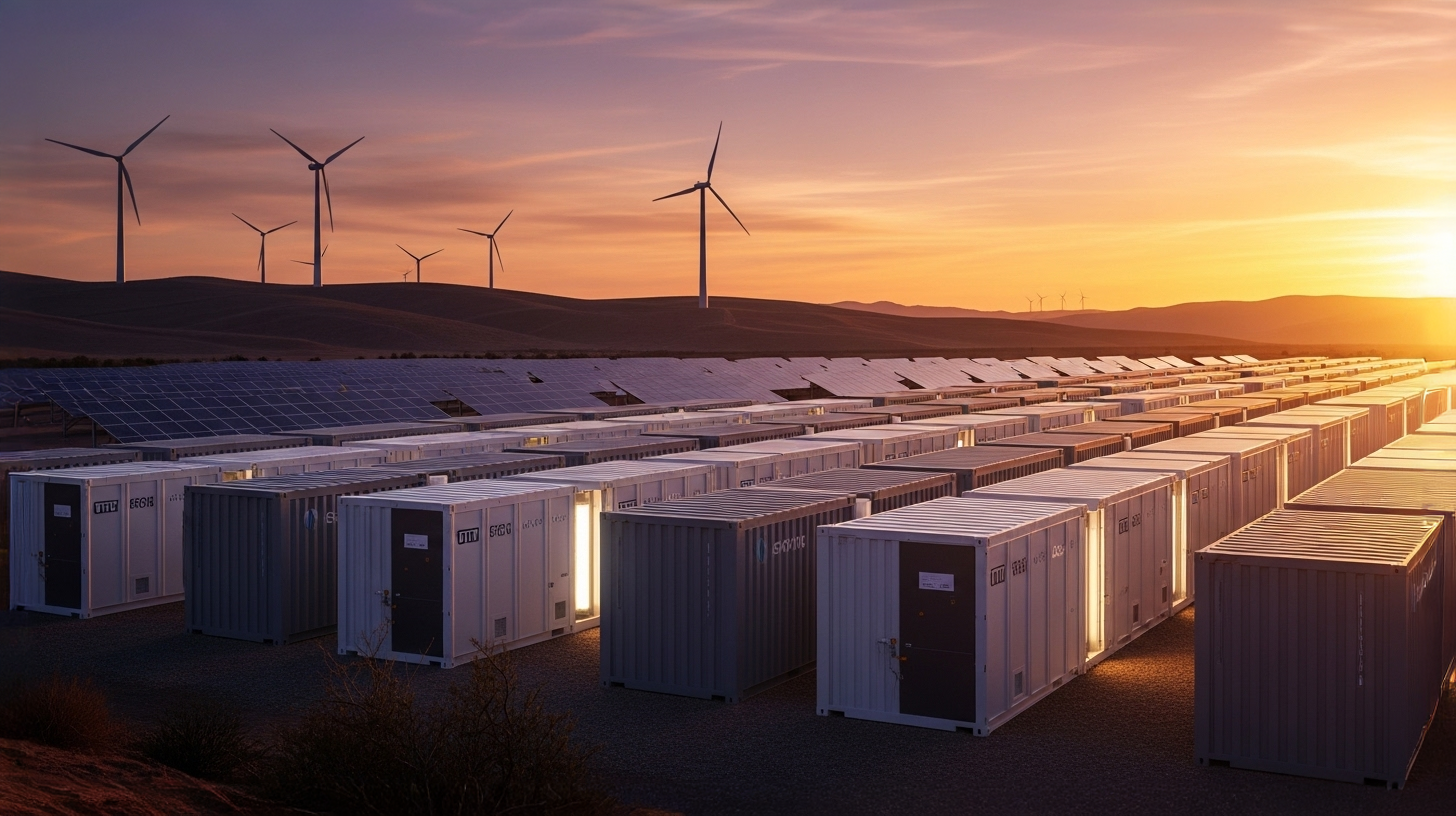
California's energy transition: The central role of battery storage – Image: Xpert.Digital
From the electricity crisis in California to a storage model: The economic restructuring of an entire energy system
From emergency to grid stability: The rapid transformation of California's electricity system
In August 2020, California experienced an energy crisis. Temperatures exceeding 40 degrees Celsius caused the power supply to collapse in a state that sees itself as a pioneer of the energy transition. Nearly half a million households were left in the dark when the California grid operator CAISO resorted to controlled power outages for the first time in nineteen years. The cause lay not in a lack of generation capacity, but in a fundamental planning problem: established energy resources could no longer keep pace with the new reality. Solar panels produced electricity in abundance during the day, but when the sun went down and millions of people returned home from work, capacity suddenly ran out.
Four years later, the picture is completely different. In the summer of 2024, California managed record heat without a single blackout. What has changed is located in inconspicuous containers in the California desert: battery storage systems that have become the backbone of a new electricity system. Installed storage capacity rose from just 500 megawatts in 2018 to over 13,300 megawatts by the end of 2024. By May 2025, this had already reached more than 15,700 megawatts, an increase of 1,944 percent since the beginning of the Newsom administration in 2019. This transformation is far more than a technical success story. It represents a fundamental economic paradigm shift that demonstrates how energy storage not only solves a technical problem but establishes an entirely new business model for energy markets.
Global Dimensions: California's Rise to Storage Superpower
The magnitude of this transformation only becomes clear in comparison. After China, California has the largest battery storage capacity in the world. With over 13 gigawatts, the state surpasses the storage capacity of entire nations. These storage systems now cover about a quarter of the evening peak load, the critical period between 5 p.m. and 9 p.m. when solar production drops rapidly and electricity demand rises massively. In April 2024, batteries reached over 6,000 megawatts of discharge capacity for the first time and were briefly the largest single source of electricity in the Californian grid. What in recent decades could only be managed with quickly ramped-up gas-fired power plants is now being taken over by battery storage systems that can respond to fluctuations in demand almost instantaneously.
The arbitrage principle: How negative electricity prices become a business model
The economic mechanism behind this system follows a compelling logic. California generates so much electricity at midday with its over 46 gigawatts of installed solar capacity that prices regularly become negative. For more than 1,180 hours in 2024, the electricity price was below zero, with a median negative price of minus $17 per megawatt-hour. During such times, producers would theoretically have to pay for someone to take their power. This creates a lucrative arbitrage business for battery storage systems. They charge when electricity is practically free or even when prices are negative, and discharge in the evening when demand is high and gas-fired power plants or more expensive oil-fired power plants would set the market price. The price difference between the cheapest and most expensive hours of the day peaked at over $55 per kilowatt per year in 2023.
Disruption in the energy market: The new logic of flexibility
This business model is changing the entire structure of the energy market. Traditionally, the electricity system operated according to the merit order principle: the cheapest power plants were deployed first, while the most expensive were used only during peak load. Renewable energies with marginal costs close to zero were at the top of the deployment order, while fossil fuel power plants were further back. Battery storage disrupts this linear model. They act as temporal arbitrageurs, redistributing energy not only spatially but, above all, temporally. In doing so, they create a new market for flexibility that operates according to completely different rules than traditional power generation.
Gold rush and market correction: The revenues of storage operators
The economic impact of this shift is profound. Extraordinarily profitable business models have emerged for battery storage operators in recent years. In 2023, average merchant revenues for battery storage in California reached $123,000 per megawatt per year. However, a significant market correction is already evident. By the end of 2024, revenues had fallen to an average of $51,000 per megawatt per year, and in December, to just $24,000. This development reflects the classic dynamic of a saturating market. As storage capacity increases in the grid, price spreads between day and night narrow because more players simultaneously attempt to exploit the same arbitrage opportunities. The energy revenue, which accounted for over 80 percent of total revenue in 2023, fell by 28 percent in 2024.
The economic benefit: Why falling profits are a good sign
However, these revenue declines are not a sign of failure, but paradoxically an indicator of the system's success. Battery storage systems fulfill their precise economic function: they smooth price fluctuations and ensure that oversupply and undersupply are better balanced. From a macroeconomic perspective, this is highly efficient. A study published in 2023 on behalf of the California Public Utilities Commission estimated the net benefit of California's storage portfolios at up to $1.6 billion per year until 2032, assuming installed capacity grows to 13.6 gigawatts as planned. This benefit arises from avoided investments in other grid infrastructure, reduced greenhouse gas emissions, reduced curtailment of renewable energies, and, above all, from the avoidance of expensive peak-load power plants.
Technology and costs: The four-hour standard as a success factor
The cost structure of battery storage has improved dramatically in recent years. While a battery storage system cost over $500 per kilowatt-hour in 2017, the costs for new projects now range between $150 and $250 per kilowatt-hour for a fully installed system. Most California projects rely on lithium iron phosphate batteries with a discharge time of four hours, a standard resulting from regulatory requirements for security of supply. This four-hour rule means that a battery must be able to deliver its rated power for at least four hours to be recognized as a capacity resource. This provides investors with a clear basis for planning, as longer discharge times do not result in additional capacity payments.
Political direction: How laws accelerated storage expansion
California owes the speed of expansion to a consistent subsidy policy. As early as 2013, the AB 2514 law required California's three major utilities to procure a total of 1,325 megawatts of storage capacity by 2020. This early target created planning certainty for investors and enabled the industry to realize cost economies. The AB 2868 law added another 500 megawatts in 2016, with a particular focus on the distribution grid level. However, the decisive factor was the response to the 2020 blackouts. The California government initiated an emergency procurement program that brought several gigawatts of additional storage capacity to the market within a very short time. Projects that would normally have taken years to plan were approved and implemented in months.
Regulatory innovation: Fast-track procedures for megaprojects
This political determination is also reflected in regulatory innovations. The Opt-In Certification Program, introduced in 2022, allows the California Energy Commission to approve certain storage projects with a capacity of over 200 megawatt hours using a fast-track process. The agency has 270 days to complete the environmental review, after which construction can begin. The first project approved under this process, the Darden Clean Energy facility, will be the world's largest battery storage system with 4.6 gigawatt hours. It is designed to store enough energy to power 850,000 homes for four hours. Such megaprojects were unthinkable just a few years ago. They demonstrate how rapidly the scale of this market is shifting.
Diverse revenue streams: From system services to virtual power plants
The economic incentives for private investors are reinforced by various revenue streams. In addition to arbitrage profits from the day-ahead market, battery storage systems receive payments for system services such as frequency control and voltage stability. They can participate in the capacity market, where the availability of secured power is remunerated. And they benefit from increasing integration into virtual power plants, in which thousands of decentralized storage systems are coordinated. In July 2025, over 100,000 home storage systems fed an average of 535 megawatts into the grid in a coordinated test. These distributed resources, aggregated by companies such as Sunrun and Tesla, receive premiums of up to $150 per battery per season. The virtual power plant concept significantly expands the business model because it also makes private households participants in the energy market.
Taming the Duck Curve: How Storage Solves Solar Energy’s Biggest Problem
The transformation of California's energy system can be seen in the famous Duck Curve, the diagram shaped like a duck that visualizes the challenge of variable renewable energy. In the morning and evening, the curve shows high residual demand; at midday, it drops because solar panels produce massive amounts of electricity. The duck's belly represents oversupply, while its neck symbolizes the steep slope in the evening, when solar production collapses and demand explodes. For years, this slope was considered the biggest technical problem of the energy transition. Gas-fired power plants had to ramp up from zero to full capacity within a few hours, a technically demanding and economically expensive process.
Displacement effects: Gas-fired power plants are becoming obsolete
Battery storage systems solve this problem elegantly. They fill up during solar surplus and discharge precisely during that critical evening phase. This noticeably flattens the duck curve. The extreme ramp, which previously amounted to over 13,000 megawatts within three hours, is stretched and mitigated. This effect has far-reaching economic consequences. Gas-fired power plants, once indispensable for evening peak demand, are becoming increasingly redundant. More than 60 percent of California's simple-cycle gas turbines now operate at a capacity below 5 percent. They are idle most of the time and are only kept as a last resort. Their operators are struggling with declining revenues, while battery storage systems are becoming more profitable. Individual gas-fired power plants have already announced their closure or are being replaced by battery storage systems.
New: Patent from the USA – Install solar parks up to 30% cheaper and 40% faster and easier – with explanatory videos!

New: Patent from the USA – Install solar parks up to 30% cheaper and 40% faster and easier – with explanatory videos! - Image: Xpert.Digital
At the heart of this technological advancement is the deliberate departure from conventional clamp fastening, which has been the standard for decades. The new, more time- and cost-effective mounting system addresses this with a fundamentally different, more intelligent concept. Instead of clamping the modules at specific points, they are inserted into a continuous, specially shaped support rail and held securely. This design ensures that all forces occurring—be they static loads from snow or dynamic loads from wind—are evenly distributed across the entire length of the module frame.
More about it here:
Roadmap 2045: California's path to a fully decarbonized grid
Symbol of change: Where gas was once burned, batteries now stand
The most prominent example is Calpine's Nova Power Bank in Menifee, California. A 680-megawatt battery storage facility was built on the site of a decommissioned gas-fired power plant and entered operation in 2024. The project symbolizes the transition from a fossil-fuel-based energy system to a storage-based energy system. Where turbines once burned natural gas, there are now rows of containers with lithium-ion batteries. The investment of over a billion dollars demonstrates that storage is no longer a niche technology, but rather a large-scale industrial project with corresponding volumes. Calpine, traditionally an operator of gas-fired power plants, is now developing approximately 2,000 megawatts of battery capacity, demonstrating the strategic shift of established energy companies.
The price paradox: falling wholesale prices, rising end-customer costs
The economic effects of this shift are ambivalent. On the one hand, wholesale electricity prices are falling. Battery storage increases supply during times of high demand, thus reducing price peaks. In the first half of 2024, the spot price for electricity in California fell by over 50 percent compared to the previous year. This decline is directly attributable to the massive increase in solar and storage capacity. At the same time, gas consumption fell by 40 percent during the period under review. From a climate perspective, this is a tremendous step forward. Less gas combustion means fewer CO2 emissions and better air quality, especially in metropolitan areas like Los Angeles, where gas-fired power plants are a significant source of pollution.
On the other hand, end-user prices in California are at record levels. At an average of 30 to 32 cents per kilowatt-hour, Californian households pay almost twice as much as the American average. Compared to 2008, electricity prices have risen by 98 percent, the highest increase of any US state. The average annual household bill is $1,758, $764 more than in 2010. These price increases have a variety of causes that go far beyond the energy transition. A key factor is the enormous cost of wildfire prevention. After devastating fires caused by faulty power lines, Californian utilities invest billions in transmission line cabling, fire protection systems, and insurance. These costs are passed directly on to end users.
Hidden cost drivers: capacity markets and network infrastructure
Another price driver is the capacity market. California's Resource Adequacy Regulation requires utilities to maintain sufficient secured capacity for peak demand periods. The costs of maintaining this capacity rose by 357 percent between 2017 and 2022, primarily because older gas-fired power plants are becoming increasingly expensive to maintain but are still needed as backups. Battery storage could reduce this cost pressure in the medium term because it is available more cheaply as a capacity resource. Analyses show that battery storage costs between $5 and $8 per kilowatt per month, while older gas-fired power plants incur significantly higher costs. However, it will take years for the new storage facilities to fully replace the older power plants.
The Transition Phase: Why California Households Pay for Two Energy Systems
The electricity price debate in California reveals a fundamental challenge of the energy transition. Restructuring the energy system is a massive infrastructure investment spanning decades. During the transition phase, both the old and new infrastructure exist in parallel, resulting in duplicate costs. Gas-fired power plants cannot be shut down abruptly because they are needed as a fallback option in the event of extreme weather or storage failure. At the same time, enormous costs arise for the expansion of storage facilities, solar power systems, and transmission grids. Californian households are effectively financing two energy systems simultaneously. Only once the transition is complete and fossil infrastructure has been fully depreciated or decommissioned will costs begin to decline.
Debunking a myth: Renewable energies are not the price driver
A 2024 Stanford University study shows that renewable energy itself is not the price driver. On 98 of 116 days examined in spring and early summer 2024, California met more than 100 percent of its electricity demand from solar, wind, hydropower, and geothermal energy without any outages. The spot market price fell by over 50 percent during this period. At the same time, gas consumption fell by 25 percent for the entire year. These data refute the narrative that renewable energy inevitably leads to higher costs. Rather, the high retail prices result from the aforementioned infrastructure costs, wildfire protection, and the sluggish regulatory framework that perpetuates fossil fuel overcapacity.
The long-term vision: A decarbonized system by 2045
California's long-term economic vision calls for a fully decarbonized electricity system by 2045. To achieve this goal, the state is estimated to need approximately 52,000 megawatts of battery storage capacity, nearly four times its current capacity. Assuming four-hour storage, this would equate to a total storage capacity of over 200 gigawatt-hours. The necessary investments are in the range of several hundred billion dollars. Intersect Power, a leading developer of solar and storage projects, has announced investments of $9 billion for the coming years alone. Nationwide, the battery storage industry has committed over $100 billion in investment over the next decade to establish a fully domestic supply chain.
Industrial policy dimension: More than just energy technology
These figures illustrate the economic dimension of the storage revolution. It's not just about energy technology, but about an industrial policy transformation. The development of a storage industry will create hundreds of thousands of jobs in manufacturing, installation, and operations. California is positioning itself as a global center for this industry, similar to what it has done with the computer industry or electric vehicles. The technological spillover effects extend far beyond the energy sector. Battery management systems, power electronics, and grid integration technologies are used in electromobility, industrial processes, and the digitalization of the entire energy system.
New challenges: dependencies and security risks
However, California's approach is not without risks. The high dependence on battery storage creates new vulnerabilities. Lithium-ion batteries degrade with each charge-discharge cycle, their capacity decreasing over the years. After approximately 3,000 to 5,000 cycles, battery systems must be replaced, requiring continuous reinvestment. The supply of lithium, cobalt, and other critical raw materials is concentrated globally, primarily in China. Supply bottlenecks or geopolitical tensions could drastically impact the availability and prices of these materials. California is working to reduce these dependencies through recycling and by diversifying supply chains, but these processes take time.
Another risk lies in the safety of the systems. In January 2023, a severe fire occurred at the Moss Landing Battery Storage Facility, one of the largest battery storage facilities in the world. 300 megawatts of capacity were damaged, and the facility had to remain out of service for months. Such incidents are rare, but they raise questions about the reliability and insurance costs of large storage systems. California has subsequently introduced stricter safety standards, including for gas extraction systems and fire protection technologies. These additional requirements increase investment costs but are necessary to ensure public acceptance of the technology.
No blueprint for everyone: The limits of transferability
The transferability of the Californian model to other regions is limited. California boasts exceptionally favorable conditions. The sunny climate ensures high solar yields, which are one of the basic prerequisites for the arbitrage model. The population density and high electricity consumption create a large volume of demand. Technology-friendly regulations and political support facilitate rapid approval processes. Regions with less sun, lower demand, or more restrictive regulatory frameworks will have to take different paths. Germany, for example, relies more on flexibility through demand management and connections to neighboring European countries. Texas pursues a market-driven approach with minimal government intervention, which has also led to massive storage expansion, but with different pricing and risk structures.
Three key lessons for the global energy transition
Nevertheless, California provides valuable insights for the global energy transition. The most important lesson is that storage is no longer optional, but an integral component of a modern energy system with a high proportion of variable renewable energy. The second lesson is that storage is economically viable if the regulatory framework is right. California has shown that clear political objectives, combined with incentives and rapid approval processes, can mobilize billions in private investment. The third lesson concerns the need for systemic planning. Storage alone will not solve the energy problem. It must be embedded in a comprehensive strategy that coordinates generation, transmission, distribution, and consumption.
A real-time experiment: The unstoppable era of storage
California's battery storage revolution is ultimately a real-time experiment. It demonstrates how a highly developed energy system can be radically transformed without compromising security of supply. The speed of this transformation is remarkable. Within just six years, storage capacity has grown from virtually zero to over 15 gigawatts, a growth rate unparalleled in energy history. This momentum will continue. Thousands more megawatts are in the pipeline for 2025 and 2026, and other states such as Arizona, Nevada, and Texas are following suit. The storage era can no longer be stopped.
The new currency in the power grid: temporal flexibility
What stands in inconspicuous containers in the California desert is more than technology. It is the physical manifestation of a fundamental economic principle: time is money, and those who can shift energy temporally are tapping into a new market. Battery storage systems are the energy system's stockbrokers, buying when the price is low and selling when it's high. They create liquidity in a market that was previously characterized by physical immediacy. Electricity had to be generated in real time, at the very moment it was consumed. This limitation is no longer applicable. Energy becomes storable, plannable, and tradable. This is transforming the entire value chain of the energy industry. The future no longer belongs solely to large producers, but to those who can provide flexibility. California shows what this future looks like.
Look, this little detail saves up to 40% installation time and costs up to 30% less. It's from the USA and patented.

NEW: ready -to -mount solar systems! This patented innovation accelerates your solar construction massively
The heart of ModuRack 's innovation is its departure from conventional clamp fastening. Instead of clamps, the modules are inserted and held in place by a continuous support rail.
More about it here:
Your partner for business development in the field of photovoltaics and construction
From industrial roof PV to solar parks to larger solar parking spaces
☑️ Our business language is English or German
☑️ NEW: Correspondence in your national language!

Konrad Wolfenstein
I would be happy to serve you and my team as a personal advisor.
You can contact me by filling out the contact form or simply call me on +49 7348 4088 965 (Munich) . My email address is: wolfenstein ∂ xpert.digital
I'm looking forward to our joint project.
☑️ EPC services (engineering, procurement and construction)
☑️ Turnkey project development: Development of solar energy projects from start to finish
☑️ Location analysis, system design, installation, commissioning as well as maintenance and support
☑️ Project financier or placement of investors
Our US expertise in business development, sales and marketing

Our US expertise in business development, sales and marketing - Image: Xpert.Digital
Industry focus: B2B, digitalization (from AI to XR), mechanical engineering, logistics, renewable energies and industry
More about it here:
A topic hub with insights and expertise:
- Knowledge platform on the global and regional economy, innovation and industry-specific trends
- Collection of analyses, impulses and background information from our focus areas
- A place for expertise and information on current developments in business and technology
- Topic hub for companies that want to learn about markets, digitalization and industry innovations










