
Decentralized energy transition and small and medium-sized enterprises (SMEs): How this decentralized energy strategy would have saved SMEs
Xpert Pre-Release

Available in 27 languages 📢
Prefer Xpert.Digital on GoogleⓘPublished on: April 27, 2026 / Updated on: April 27, 2026 – Author: Konrad Wolfenstein
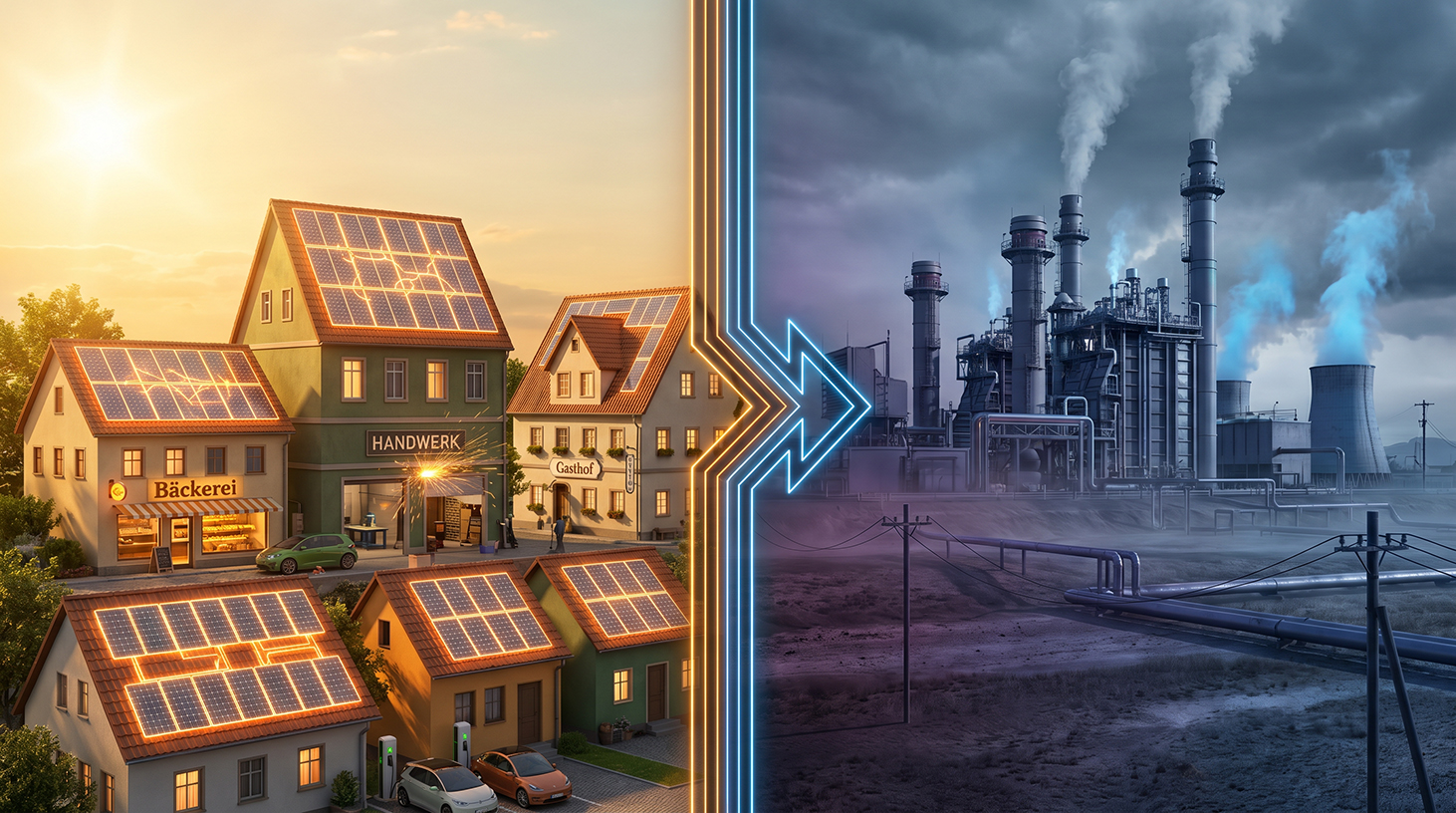
Decentralized energy transition and SMEs: How this decentralized energy strategy would have saved SMEs – Image: Xpert.Digital
Industry benefits, small and medium-sized enterprises and trades pay: The hidden injustice of German electricity prices
Expensive dead end gas power plant: Why German SMEs are footing the bill for the energy transition
The myth of the "dark doldrums": Why new gas-fired power plants are the completely wrong answer for SMEs
In Germany's new energy policy, the burdens of the transition are dramatically unevenly distributed. While large corporations benefit from exemptions, billions in subsidies, and direct supply contracts, traditional small and medium-sized enterprises (SMEs) – from craft businesses to regional bakeries – foot the bill through drastically rising levies and grid fees. The current government's course is at the heart of the criticism: the massive, levy-financed expansion of central gas-fired power plants is declared the only option for ensuring security of supply. However, this strategy is proving to be an expensive dead end for SMEs, creating new dependencies and artificially keeping electricity costs high in the long term.
This article explores why a "bottom-up energy policy"—based on decentralized photovoltaics, smart battery storage, flexible biogas plants, and virtual power plants—would have been a far superior economic and strategic solution. A consistent decentralized energy transition would have given small and medium-sized enterprises (SMEs) precisely what they currently lack most: genuine independence from stock market prices, the reduction of asymmetric market power, and long-term planning security. Read on to discover why clinging to large-scale fossil fuel infrastructure systematically disadvantages weaker market participants and why the technology for a decentralized alternative has long been available.
Related to this:

The missed opportunity of a bottom-up energy policy – Why the path via gas-fired power plants is an expensive dead end
Energy costs as a systemic problem for weaker economic actors
Germany has one of the highest industrial electricity prices compared to other G7 countries. This situation does not affect all market participants equally. Large industrial companies benefit from extensive legal exemptions and can strategically optimize their energy procurement through equity capital, specialized personnel, and direct contracts. Small businesses, such as craft enterprises, hotels, bakeries, restaurants, or medium-sized warehouses, predominantly obtain their electricity at standard rates from the local grid operator or default supplier. These very players, which form the backbone of the German economy and whose profit margins are naturally slim, are hit particularly hard by rising levies and government-induced cost increases.
For decades, the energy policy debate in Germany focused primarily on the question of security of supply for large consumers and energy-intensive industries. This is legitimate, as blast furnaces, chemical plants, and aluminum smelters require a baseload-capable, uninterruptible power supply in quantities and qualities that decentralized small-scale plants simply cannot provide directly. However, a fundamental distinction was overlooked: the vast majority of German companies do not belong to this category. Bakeries, carpentry shops, restaurants, small retail businesses, office service providers, and municipal facilities are neither baseload-critical nor do they possess the geopolitical significance that would warrant special attention in energy policy. They have been systematically neglected.
Related to this:

What decentralized energy supply would have meant specifically for SMEs
Decentralized energy solutions are not abstract technological visions, but rather proven and economically viable systems. At their core, they combine photovoltaic systems on private roofs, stationary battery storage, and intelligent energy management systems, supplemented where possible by heat pumps and combined heat and power (CHP) plants powered by biogas or biomethane. A study conducted by Roland Berger on behalf of the New Energy Alliance estimates the added value of decentralized energy solutions for Germany at up to €255 billion by 2045. For SMEs, this translates into annual savings potential of €1,500 to €2,500, based on a typical annual consumption of 15,000 kWh.
This figure sounds moderate at first glance, but for a bakery or a small craft business with annual profits in the low five-figure range, it is structurally significant. More important than the absolute savings, however, is the qualitative effect: those who generate a substantial portion of their own electricity decouple their cost calculations from the wholesale electricity price, geopolitical gas supply risks, and the regular price increase announcements from transmission system operators. Decentralized systems thus provide something that is priceless for small and medium-sized enterprises: planning security.
The dependence of small businesses on large energy corporations is structural. No gas station, no snack bar, no hair salon can independently negotiate a power supply contract with special conditions, as a corporation like Thyssenkrupp or BASF can. Decentralized energy generation breaks up this asymmetric market structure: Every kilowatt-hour generated on-site is one that doesn't have to be purchased under market-dominating conditions. This is precisely the political promise of a decentralized energy transition – and precisely why its consistent implementation is far more important for weaker market participants than for large corporations.
Planning certainty as a competitive factor – and its systematic undermining
In no other business discipline is planning certainty as fundamental as in investment decisions. A craft business that invests €30,000 in a photovoltaic system with battery storage today does so based on an amortization calculation that must remain valid for ten to twenty years. If this framework is destabilized by regular legal changes, retroactive interventions in feed-in tariffs, or new grid connection regulations, the entire investment calculation collapses.
This very destabilization has been observed in Germany for years. A particularly vivid example is the draft of a so-called grid package, which became public in early 2026 and against which a broad alliance of citizen energy cooperatives, the German Solar Energy Society, and numerous other associations protested. The draft stipulated that grid areas where more than three percent of the electricity fed into the grid was curtailed in the previous year should be considered "capacity-limited." In these areas, new plants would no longer receive compensation for grid-related shutdowns for up to ten years. This would shift a previously calculable grid risk entirely onto the plant operators – and it would hit precisely those smaller, regionally based players the hardest, since they finance on a project basis and cannot spread risks across broad portfolios like large corporations.
Anyone who demands decentralized investments but simultaneously systematically worsens the framework for them is engaging in a self-contradiction in energy policy. The consequence: risk-averse medium-sized businesses shy away from investments that would actually benefit them – and remain in the system of centralized supply by large energy providers, against which decentralized solutions were supposed to protect them.
Related to this:

The bill for gas-fired power plants: New costs instead of fewer
The German Federal Government and the transmission system operators have declared the expansion of new gas-fired power plants to safeguard security of supply a core element of their strategy. The Power Plant Security Act (KWSG) of July 2024 set a target capacity of 12.5 GW, consisting of 5 GW of new hydrogen-ready gas-fired power plants, 2 GW of modernized existing plants, 500 MW of pure hydrogen power plants, and a further 5 GW of conventional gas-fired power plants in a second, levy-financed pillar. The plans currently under discussion by the new Federal Government even envision the construction of up to 20 GW of gas-fired power plant capacity by 2030.
The costs of this approach are considerable. A study by the Forum for Ecological and Social Market Economy (FÖS), commissioned by Green Planet Energy, estimates the total societal costs of a new gas-fired power plant at up to 67 cents per kilowatt-hour – a figure that includes climate costs, government subsidies, and long-term import dependencies. For the initially planned ten gigawatts of gas-fired power plants alone, the FÖS anticipates subsidy costs of around 6.6 billion euros. If these costs are passed on to electricity prices, the surcharge could amount to as much as 1.6 cents per kilowatt-hour.
This mechanism of passing costs on to the electricity price is not new, but rather established practice. For 2026, the transmission system operators have almost doubled the CHP surcharge from 0.227 to 0.446 cents/kWh (an increase of 96.48 percent) and raised the offshore grid surcharge from 0.816 to 0.941 cents/kWh. For a company with an annual consumption of 30 million kWh, this means additional costs of €65,700 compared to 2025, solely due to the CHP surcharge. Such amounts are crucial for the survival of an energy-intensive medium-sized company that cannot claim a special exemption under the special equalization scheme.
The Chamber of Industry and Commerce of Southern Thuringia summed it up perfectly in 2025: “The planned federal subsidy of €6.5 billion for 2026 is necessary now to prevent significant electricity price increases for businesses. But overall, it's just a patchwork solution.” Despite all the promises of relief, the government-influenced components of electricity prices are rising again. What is being presented as a temporary solution is becoming a permanent state of increasing cost burdens, which are systematically passed on to consumers and non-privileged businesses.
A systemic case of making things worse
The term "making things worse" perfectly captures the essence of this energy policy. The actual goal – security of supply with decreasing costs and an increasing share of renewable energies – is not achieved by the gas-fired power plant strategy, but rather structurally undermined. New capacities are promoted, creating overcapacities that are rarely used and yet must be permanently refinanced through the capacity mechanism. Ultimately, the costs of this refinancing are not borne by the large, publicly traded corporation that benefits from special compensation schemes, but by the medium-sized business owner who lacks access to such instruments.
Added to this is the strategic error of technological path dependency. Every newly built gas-fired power plant ties up capital, infrastructure, and political attention for 20 to 30 years. Operating these plants presupposes that gas imports remain available at reasonable prices. The dependence on fossil fuel imports, which the Russian war of aggression against Ukraine so painfully exposed in 2022, is not overcome, but merely shifted geographically – from Russian pipelines to LNG terminals. This offers little comfort to German SMEs, which faced potentially devastating cost increases during the energy crisis of 2021 to 2023.
A decentralized energy strategy, on the other hand, would have focused on the immaterialization of energy procurement: Those who produce their own energy don't pay for imported gas prices, grid usage fees for long transmission distances, or for the refinancing of power plants that only operate infrequently. The Roland Berger study shows that decentralized solutions could reduce redispatch costs (costs for grid stabilization) by around 40 percent – equivalent to €80 to €100/MWh compared to €130 to €150/MWh for conventional supply and reserve power plants. Furthermore, investments in distribution grid expansion could be reduced by 40 to 50 percent, which would have meant further indirect savings in grid fees.
The problem of the dark period of low wind: Put it into perspective, don't overdramatize it
The strongest argument against the decentralized energy transition is the "dark doldrums" argument. When wind and sun fail to appear simultaneously for several days – a rare but meteorologically real phenomenon – photovoltaics and wind power alone are insufficient to meet demand. An LBBW analysis estimates that such dark doldrums, lasting more than 48 hours, occur in Germany approximately twice a year. In extreme scenarios, the energy deficit can reach up to 10.6 TWh – a figure that cannot be bridged by battery storage alone.
This assessment is correct, but it is often used to completely discredit decentralized options instead of integrating them objectively into a comprehensive concept. The question is not whether peak load and residual load problems exist—that is undisputed—but whether the answer to them necessarily has to be the construction of new fossil gas power plants. A more nuanced analysis shows that periods of low wind and solar power generation are a problem of seasonal supply gaps. Decentralized photovoltaics and local battery storage do not solve this seasonal gap. However, this was never the claim made in this analysis.
It's more about the right division of labor between different technologies. Battery storage handles the hourly range – balancing daily fluctuations and reducing peak loads. Pumped-storage power plants cover the daily to weekly range. For the actual seasonal problem of periods of low wind and solar output – meaning periods of one to several weeks – power-to-gas with hydrogen as a seasonal storage medium is the only technology with a credible scaling pathway. The Jülich Research Centre has calculated that around 50 GW of hydrogen gas turbines would be optimal for achieving climate neutrality by 2045, even to withstand a two-week period of low wind and solar output in January.
The crucial point: These hydrogen power plants, which are suitable as a climate-neutral solution, are not the same as the natural gas-fired power plants currently planned. The latter are a short-term solution, but the wrong one in the long run. Investing now in purely gas-fired power plants will block the path to a sustainable hydrogen solution, create path dependencies, and simultaneously burden electricity bills for the next few decades.
Related to this:

New: Patent from the USA – install solar parks up to 30% cheaper and 40% faster and easier – with explanatory videos!

New: Patent from the USA – Install solar parks up to 30% cheaper and 40% faster and easier – with explanatory videos! - Image: Xpert.Digital
The core of this technological advancement is the deliberate departure from conventional clamp mounting, which has been the standard for decades. The new, more time- and cost-effective mounting system addresses this with a fundamentally different, more intelligent concept. Instead of clamping the modules at specific points, they are inserted into a continuous, specially shaped support rail and held securely in place. This design ensures that all forces – whether static loads from snow or dynamic loads from wind – are distributed evenly across the entire length of the module frame.
More information here:
Energy transition policy mistakes: Why decentralized strategies would lower bills for small businesses
Battery storage as an underestimated system service provider
Battery storage as invisible power heroes: How decentralized systems make gas-fired power plants obsolete
Another aspect often overlooked in political debate is that battery storage systems are not merely passive buffers, but also active grid stabilizers. An analysis shows that just 60 GW of installed battery storage, with a capacity of two to four hours, could reduce the need for reliable backup power by 15 to 20 GW. With 100 GW of installed storage capacity, the reduction is up to 24 GW. In other words, investments in decentralized battery storage, which could be supported by millions of small and medium-sized enterprises (SMEs), commercial businesses, and private households, directly replace the need for new centralized power plant capacity.
For commercial enterprises, battery storage systems offer several added value dimensions simultaneously: First, self-consumption optimization, which enables 30 to 60 percent higher self-consumption from their own PV system. Second, peak shaving, i.e., the reduction of peak loads, which can reduce capacity charges by up to 70 percent. Third, emergency power capability, which ensures critical processes such as cooling or IT even during power outages. And fourth, the possibility of bundling flexibilities via virtual power plants (VPPs) and offering them on the balancing energy market – thus transforming the medium-sized enterprise from a mere electricity consumer into an active market participant.
Related to this:

Long-term storage as a strategic backup option: A technology on the rise
A common objection to battery storage is that it's too short-lived for periods of low wind and solar output. While this is true for current short-term storage systems, it's an oversimplification of storage technologies in general – because the long-term storage market is evolving and structurally changing the landscape. Modern lithium iron phosphate (LFP) batteries already achieve 6,000 to 8,000 charge cycles at 100 percent depth of discharge – which corresponds to an operating life of 20 to 25 years with daily charging and discharging. The cost of lithium-ion batteries has fallen by more than 75 percent since 2010, and the large-scale storage market in Germany nearly doubled in 2025 – with almost 2 GWh of new capacity installed in the first quarter of 2026 alone.
However, the real qualitative leap is promised by technologies beyond classic lithium-ion chemistry. Redox flow batteries – so-called liquid batteries – are considered the most technologically convincing answer to the problem of multi-day to seasonal energy storage. Their decisive advantage: Because energy conversion and energy storage are spatially separated – the energy is stored in external liquid tanks, not in the battery itself – there is no electrode degradation. This results in theoretically unlimited cycle stability and extremely low self-discharge. Power and capacity can be scaled independently of each other, making the technology highly flexible for a wide range of application sizes – from municipal neighborhood projects to regional grid storage systems.
In 2025, the Fraunhofer Institute for Chemical Technology (ICT) demonstrated a breakthrough: Europe's largest vanadium redox flow battery, with a power output of 2 MW and a capacity of 20 MWh, located in Pfinztal, fed renewable energy into the grid for the first time in a predictable and weather-independent manner – for over ten hours, controllable according to demand. Simultaneously, the University of Freiburg is researching an all-manganese flow battery that does not require the scarce and price-volatile vanadium and achieves energy densities of up to 74 Wh/L – roughly twice that of previous standard vanadium systems. The goal: more affordable, resource-efficient long-term storage solutions that are also economically viable for medium-sized neighborhood energy systems.
This opens up an important strategic perspective in the context of the decentralized energy transition. Long-term storage will extend the hourly range of LFP batteries to include the daily to weekly range. Combined with seasonal hydrogen storage, they will gradually close the gap that is currently considered an insurmountable argument for new gas-fired power plants. The Federal Network Agency forecasts a total of 41 GW of stationary battery storage capacity in Germany by 2037 – almost twice as much as expected just two years ago. BSW-Solar sees a realistic expansion target of 100 GWh of total capacity by 2030, starting from around 25 GWh today. Anyone who claims today that gas-fired power plants are without alternative systematically underestimates the dynamics of this technology trajectory – and simultaneously commits to an investment decision in fossil fuel infrastructure that will look like an obsolete misinvestment in ten years' time.
Related to this:

Biogas CHP: The decentralized bridging technology that could have been used
The most elegant and systematically underestimated instrument for bridging the residual load gap in a decentralized energy transition is flexible biogas combined heat and power (CHP) plants. Currently, nearly 10,000 decentralized plants in Germany generate biogas with a total installed capacity of 5.9 GW. This capacity could have been increased to 12 GW by 2030 – thus rendering the construction of new fossil gas power plants unnecessary, provided the necessary political and regulatory framework had been established.
Modern, fully flexible biogas plants with multiple combined heat and power (CHP) units, biogas and heat storage systems can react extremely dynamically to small changes in the grid or market situation. They ramp up production when wind and solar power are low and ramp down when renewable energy surpluses drive prices down. In CHP operation, they utilize 80 to 90 percent of the energy input, as electricity and heat are generated simultaneously – this combined heat and power principle makes it the most efficient form of thermal power generation available. Operated with biogas – i.e., based on renewable resources – these plants are not only highly efficient but also climate-friendly.
These decentralized control systems could have fulfilled a dual function: Firstly, they would have ensured short-term grid stability, which, during the transition phase to full decentralization, still relies on reliable, controllable units. Secondly, they would have created regionally anchored added value, secured income sources for farmers and rural communities, and built a decentralized infrastructure that benefits the entire region – instead of channeling billions into large, centralized power plants primarily located at major industrial sites.
Related to this:

Virtual power plants and demand response as a system solution for medium-sized businesses
A crucial component of a decentralized energy supply, which has so far only been adopted hesitantly in Germany, is virtual power plants (VPPs) in conjunction with demand response (DR). The concept is simple in its logic, but complex in its implementation: Many small, decentralized generation and storage units – PV systems, battery storage, combined heat and power plants, controllable loads – are aggregated via digital platforms into a single, market-ready unit. During periods of shortage, they provide balancing power, and during periods of surplus, they absorb energy.
Studies show that variable power plants (VPPs) can be up to 60 percent more cost-effective than conventional peak-load power plants during peak demand. For small and medium-sized enterprises (SMEs), this model means access to a market previously reserved for large corporations: the marketing of flexibility. A small company that is too small to compete on its own in the balancing energy market can join forces with other companies via an aggregator – and receive compensation that improves its investment calculations for storage and PV systems.
Demand response – the intelligent adjustment of one's own consumption to grid signals and electricity prices – is the complementary demand side. A cold storage operator who runs their compressor with cheap surplus PV electricity at midday and reduces it during the evening peak actively contributes to grid stabilization. A carpentry business that preferentially operates its energy-intensive machines when electricity prices are negative – which are occurring more and more frequently in Germany – reduces its energy costs to a minimum. These behavioral patterns, technologically enabled by smart meters, intelligent inverters, and EMS platforms, should have been adopted more broadly by German SMEs.
Related to this:

Timeline for a realistic decentralized transformation
The frequently asked question of how long it would have taken for a consistent decentralized energy transition to guarantee the necessary security of supply for small and medium-sized enterprises and weaker economic sectors can be answered in a differentiated manner based on the available data.
For the bridging phase – i.e., the period in which periods of low wind and residual load gaps still need to be covered by controllable capacities – a period of about five to eight years (approximately 2025 to 2032) would have sufficed, in which an intelligent mix of existing and modernized instruments would have been used: the already installed stock of flexible biogas CHP plants (5.9 GW, expandable to 12 GW by 2030), the rapidly growing battery storage market (60 GW would reduce backup demand by 15 to 20 GW according to the study), modernized pumped storage as short-term storage, demand response and virtual power plants for load flexibility, as well as the temporary, downwardly scaled-down use of existing, already depreciated gas-fired power plants – not as a new investment program, but as a residual bridge.
In parallel, the hydrogen infrastructure necessary for long-term seasonal storage could have been developed. The German government aimed to build 10 GW of electrolysis capacity by 2030. Individual projects with approximately 13.4 GW of installed capacity are already in the planning or construction phase. From around 2032 to 2035, a fully decentralized system architecture—consisting of mass-produced commercial photovoltaic systems, battery storage, flexible biogas plants, and hydrogen power plants at strategic locations—would have achieved the basic stability necessary to guarantee a secure supply, even for small and medium-sized enterprises, without permanent dependence on fossil fuel imports.
The paradox of current German energy policy lies in the fact that this path is known, yet it is being politically and institutionally obstructed by gas-fired power plant investment programs. Promoting new gas-fired power plants for €6.6 billion and more – financed by levies primarily borne by non-privileged companies – while decentralized investments are hampered by regulatory uncertainty, is not a solution. It is a course set in the wrong direction, cementing the status quo of energy dependency for the next two to three decades.
What a consistent decentralized strategy would have done differently
A consistent decentralized energy policy that truly focused on small and medium-sized enterprises and weaker economic sectors would have been characterized by the following principles:
First, it would have established stable investment law. This means: no retroactive changes to feed-in tariffs, no grid packages that transfer the risk of grid-related shutdowns to plant operators without compensation, and no construction cost subsidies that structurally disadvantage decentralized projects. Reliable framework conditions over a period of 15 to 20 years would be the fundamental prerequisite for the willingness of small and medium-sized enterprises without large finance departments to invest.
Secondly, it would have consistently made the biogas sector more flexible and politically secure. Instead of letting biogas plants lose their subsidies at the end of their EEG (Renewable Energy Sources Act) operating period or hindering them with bureaucracy, a forward-looking policy would have actively promoted their transformation into flexible system service providers for the energy transition – with market premiums for demand-oriented operation and reliable follow-up regulation.
Thirdly, it would have actively supported decentralized energy communities and prosumer models. Citizen energy cooperatives, municipal utilities, and neighborhood projects create local added value, increase social acceptance of the energy transition, and anchor energy supply in civil society – instead of in the balance sheets of a few large corporations.
Fourthly, it would have provided stronger tax and regulatory incentives for battery storage and smart meter infrastructure for businesses. With peak-shaving effects of up to 70 percent on capacity charges and the potential to reduce grid expansion by 40 to 50 percent, these would have been systemically valuable investments – which would also directly benefit individual businesses economically.
Fifthly, the costs for backup capacities should have been distributed transparently and according to the polluter-pays principle. If new gas-fired power plants were truly necessary to secure the supply of industrial customers with particularly critical needs, then the costs should have been borne primarily by these customers – and not by a blanket levy on all electricity customers, including the small bakery and the hair salon around the corner.
Energy policy as a distribution issue
German energy policy in recent years has revealed a clear hierarchy: security of supply for large industrial customers, climate targets as a political guideline – and the middle class and the weaker economic sectors as de facto cost bearers of the system transformation, without being its primary beneficiaries.
A decentralized energy transition would have reversed this relationship. It would have made those companies with the least bargaining power and the greatest dependence on external energy costs the first winners of the system change. Their investments in PV, storage, and flexible CHP plants would have simultaneously stabilized the overall system – and this without billion-euro programs that negate, through cost-passing levies, the savings achieved elsewhere.
Instead, citizens and businesses are being burdened with rising levies to finance gas-fired power plants, which primarily improve security of supply for large consumers. Electricity price levies will rise again by eleven percent in 2026, the CHP levy has almost doubled – and further cost increases due to the gas-fired power plant expansion program are foreseeably already factored in. This is not energy policy for small and medium-sized enterprises (SMEs). This is energy policy at their expense.
The honest answer to the question of whether a decentralized energy transition would have strengthened the weaker sectors of the German economy is: Yes – significantly so. The technologies are available, the economic viability has been proven, and the timeframe was and remains realistic. What has been lacking so far is not the possibility, but the political will to consistently align energy policy with the interests of those who ultimately always foot the bill.
Related to this:

Your partner for business development in the fields of photovoltaics and construction
From industrial rooftop PV to solar parks and larger solar parking lots
☑️ Our business language is English or German
☑️ NEW: Correspondence in your native language!

Konrad Wolfenstein
I and my team are happy to be available to you as your personal advisor.
You can contact me by filling out the contact form here or simply call me at +49 7348 4088 965. My email address is : [email protected]
I'm looking forward to our joint project.










