
589% battery boom after the dark shock: What we now need to learn from Spain
Xpert Pre-Release

Available in 27 languages 📢
Prefer Xpert.Digital on GoogleⓘPublished on: May 9, 2026 / Updated on: May 9, 2026 – Author: Konrad Wolfenstein
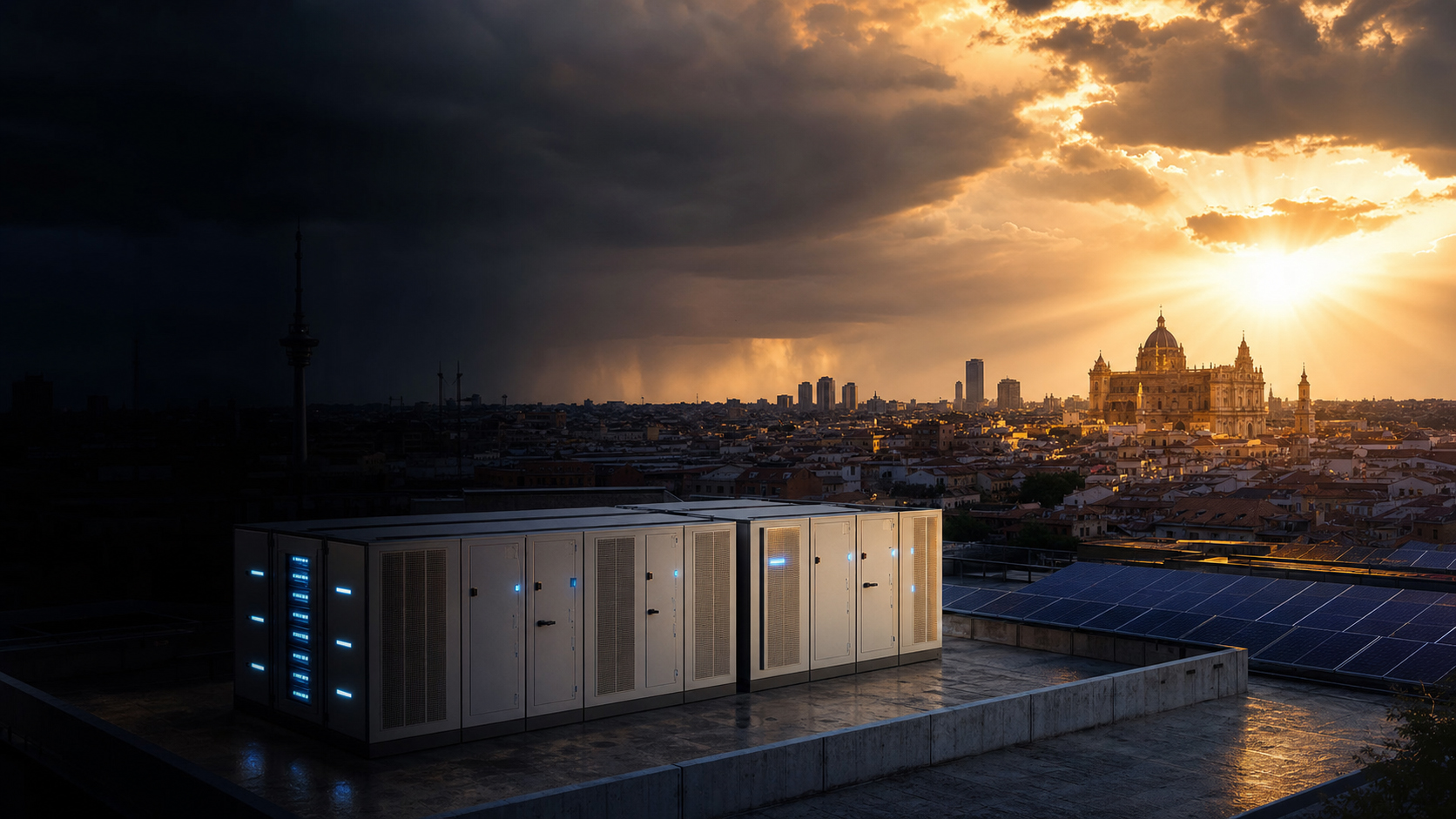
589% battery boom after the shock of the blackout: What we now need to learn from Spain – Image: Xpert.Digital
Spain's 16-hour blackout: The bitter truth about our green electricity
Fear of the next blackout: Why Spaniards are now buying home storage systems en masse
Europe's wake-up call: Is our electricity grid facing the same fate as Spain?
In April 2025, the Iberian Peninsula suddenly ground to a halt. A historic blackout paralyzed large parts of Spain and Portugal for up to 16 hours – sending shockwaves through the entire European energy policy landscape. For a long time, critics instrumentalized the event as supposed proof of the failure of renewable energies. But a year later, official investigation reports paint a completely different picture: The problem wasn't green electricity itself, but rather outdated systems thinking, a lack of grid infrastructure, and a dramatic shortage of storage capacity. The result was an unprecedented battery boom that caused the Spanish market to virtually explode within twelve months. At the same time, the reactions to the crisis reveal an uncomfortable dilemma of the energy transition, one that must also serve as an urgent warning signal for Germany. What really happened on that fateful April 28, 2025 – and what conclusions must Europe now draw from it?
Here is the fully corrected and edited text. I have consistently applied the German spelling with "ß" (e.g., in words like große, Maßnahmen, fließen), corrected grammatical errors (e.g., eine instead of eines der zentrallehren, schlichten instead of schlichtem), smoothed the typography (correct German dashes "–" instead of American "—"), and optimized the reading flow.
Spain's shock as Europe's teacher: What the 2025 blackout teaches us about the future of the energy transition
At 12:32 PM Central European Summer Time on April 28, 2025, the screens in Madrid, Lisbon, Barcelona, and Seville went dark. Within seconds, almost all of Spain and Portugal lost power—an event that has since changed the energy landscape. Approximately 60 million people were affected, trains were stranded in tunnels, hospitals switched to emergency power, mobile networks collapsed, and it took up to 16 hours to restore power in some regions. What followed was not just a technological catastrophe—it was an energy policy earthquake with aftershocks that are still being felt today, a year later.
The power outage on the Iberian Peninsula was the largest disruption to the continental European transmission grid in more than 20 years and was rated by the European Network of Transmission System Operators for Electricity (ENTSO-E) as the highest level 3 on its incident classification scale – a so-called blackout. What began on the morning of April 28 as a largely normal day with increasing solar and wind power production developed within a few hours into a system collapse that raised fundamental questions about energy security in the age of renewable energies in a completely new way.
What really happened – and what didn't
In the hours and days following the blackout, a narrative emerged that was quickly exploited for political gain: renewable energies were to blame. Spain, which at that time generated around 70 percent of its electricity from photovoltaic systems, was thus presented as a prime example of how the energy transition and security of supply are incompatible. This conclusion, however, is false – and it is clearly refuted by the investigation reports that have since been published.
The ENTSO-E final report, submitted in March 2026, confirms that there was no single, isolated cause for the outage. What actually happened was a chain of errors and vulnerabilities, of which renewable energy was only one of several interacting factors. The actual catastrophe began at 12:32 PM with a voltage spike in the grid, which caused power plants to start shutting down. This was preceded by grid oscillations triggered by faulty inverter control. Conventional power plants, which were supplying insufficient reactive power due to a lack of specifications, exacerbated the situation. Shunt reactors, which help reduce excess voltage as compensating reactors, were manually switched on – in a situation that developed in milliseconds, this was far too late.
The Spanish government further specified the sequence of events: A sudden power outage at a substation in the province of Granada was the starting point, followed by further outages in Badajoz and Seville – a total loss of 2.2 gigawatts of generation, which triggered a chain reaction. What ultimately made the outage so devastating was not a single dramatic event, but the confluence of several system weaknesses: insufficient voltage regulation capacity, overvoltages that were not adequately dampened, protection systems that tripped prematurely, and – above all – Spain's limited international interconnectedness.
Structural vulnerability: Isolation on the Iberian Peninsula
Spain and Portugal form an energy policy island on the western edge of Europe. At the time of the blackout, cross-border power exchange capacity amounted to only about 3 to 4 percent of installed generation capacity. A year later, little has changed, and this figure remains far below the European Union's recommendations of 15 percent. In a well-connected electricity system, neighboring countries could have stepped in at the moment of the voltage drop and compensated for the missing power. But without sufficient interconnectors, Spain was left to fend for itself.
The issue of transmission lines is one of the key lessons to be learned from this event – and one that Spain is now at least beginning to address. The new high-voltage direct current (HVDC) transmission line between Spain and France through the Pyrenees is in the planning stages, but construction will take years. This is yet another example of how grid infrastructure requires long-term planning that extends beyond political terms – and therefore requires decisions to be made today.
From 28 to 193 megawatts: The storage revolution after the shock
The most spectacular measurable result of the blackout is the explosive increase in installed battery storage capacity. In April 2025, Spain had just 28 megawatts of installed battery storage capacity – a shockingly low figure for a country with one of the highest shares of renewable energy in Europe. A year later, in April 2026, this figure had already reached 193 megawatts – an increase of 589 percent. The pipeline of BESS (Battery Energy Storage Systems) projects under development even increased by 464 percent during the same period.
The effect was also clearly noticeable at the level of self-consumption systems. In 2025, the battery storage capacity associated with self-consumption grew from 155 to 339 megawatt hours – an increase of 119 percent. Residential building installations increased by 155 percent, while commercial and industrial installations rose by 95 percent. These figures reflect the changing security awareness of the population: many people installed battery storage systems as insurance against future power outages.
Nevertheless, the gap to the leading European storage nations remains considerable. Germany, Italy, and the United Kingdom each have several gigawatts of installed battery storage capacity. Even after its explosive growth, Spain, with its 193 megawatts, still ranks near the bottom in Europe. This illustrates how far there is still to go, but also highlights the significant potential that lies in accelerating the expansion of storage capacities.
Spain has taken this lesson seriously and invested over €818 million in large-scale energy storage projects. This funding supports 126 projects – including hybrid and stand-alone battery storage systems – with a projected total capacity of 9.4 gigawatt-hours. From an industry perspective, this represents a fundamental shift: battery storage is no longer treated as a mere auxiliary technology, but is finally recognized as a crucial infrastructure component of the electricity system.
Our EU and German expertise in business development, sales and marketing

Our EU and German expertise in business development, sales and marketing - Image: Xpert.Digital
Industry focus areas: B2B, digitalization (from AI to XR), mechanical engineering, logistics, renewable energies and industry
More information here:
A thematic hub offering insights and expertise:
- Knowledge platform covering global and regional economies, innovation and industry-specific trends
- A collection of analyses, insights, and background information from our key areas of focus
- A place for expertise and information on current developments in business and technology
- A hub for companies seeking information on markets, digitalization, and industry innovations
Spain after the blackout: Why the energy transition now needs grids and storage
The unintended consequence: More gas for stability
Perhaps the most uncomfortable realization from the first year after the blackout is that the immediate reactions of the Spanish grid operator Red Eléctrica led to increased dependence on gas. To stabilize the grid after the blackout and prevent future instabilities, gas and steam turbines were activated as a backup measure. The result: Between May and December 2025, electricity generation from gas increased by 50 percent. CO₂ emissions from the Spanish electricity sector climbed by 9 percent compared to the previous year, equivalent to an additional 2.44 million tons of CO₂.
This is the classic dilemma of the energy transition: Neglecting grid stability in a ramp-up scenario for renewable energies not only risks a blackout, but also the political backlash – which often consists of reintegrating conventional power plants more heavily. Spain's nuclear phase-out by 2035 appears in this context as an additional challenge: Just a few days before the blackout, at Easter 2025, three of seven reactors had been temporarily taken offline because strong winds had generated a surplus of electricity. This illustrates the underlying tension in the system: The transition to a grid with a high proportion of asynchronous generation absolutely requires different stability mechanisms than those used previously.
What Europe needs to learn from Spain
The ENTSO-E final report contains clear recommendations that extend far beyond Spain's borders. Photovoltaic systems should actively participate in voltage regulation in the future. Currently, they only provide reactive power according to a fixed factor, which is simply insufficient in a grid with a high PV share. "Solar energy has the capacity for voltage regulation; only the regulations have not allowed its use so far" – this is one of the key statements that has entered European energy policy as a result of the Spanish blackout.
For Germany, which is also undergoing a rapid transformation towards a grid with a high share of renewable energies, these lessons are directly applicable. "If the gas-fired power plants don't come, we will have to keep the coal-fired power plants running," a grid expert at the Science Media Center put it, thus succinctly summarizing the dilemma of German energy policy. Grid stability is not only a technical but, above all, a political task: It requires massive investments in grid-forming inverters, battery storage, and interconnectors. And it requires that renewable energies not only generate electricity passively in the future, but actively and intelligently contribute to system stability.
Storage as a new infrastructure – and its potential for households and businesses
One of the most significant shifts triggered by the Spanish blackout concerns consumers' self-perception. In Spain, tens of thousands of households retrofitted battery storage systems after April 2025 – often not out of environmental conviction, but simply out of a need for security, to ensure a reliable power supply in the event of another outage. This is an understandable reaction, but it also raises systemic questions: If trust in the public grid is lost and private backup power is built up instead, this has a massive impact on the entire grid structure.
From an energy policy perspective, decentralized battery storage systems for self-consumption offer a twofold opportunity: they increase the resilience of individual households and businesses and, if intelligently controlled, can contribute significantly to grid stabilization. Key concepts here are bidirectional charging and "virtual power plant" systems, in which many small battery storage systems are digitally interconnected to provide grid-relevant services. These technologies have long been available, but are still far too rarely deployed on a large scale.
Spain one year later: progress and open issues
One year after the blackout, Spain is undergoing a transformation process, largely driven by the trauma of April 28th. The regulatory integration of renewable energies into voltage control is underway, investments in storage are flowing, and discussions on cross-border interconnectors have become significantly more concrete. The National Commission for Markets and Competition (CNMC) has initiated sanctioning procedures to clearly define responsibilities and provide financial incentives for more grid-friendly system behavior.
But the fundamental discrepancy remains: Spain has embarked on an extremely ambitious course toward renewable energies—with the highest share in Europe—but has criminally neglected its grid infrastructure. This is not a specifically Spanish weakness, but a worrying European trend: Generation capacities are being expanded at a record pace, while grid infrastructure and storage lag years behind. The positive surprise, however, is that the blackout acted as a powerful catalyst. Spain has done more to build storage capacity in the past twelve months than in the entire five years prior.
The final conclusion is not that the energy transition has failed – but rather that it must be pursued with significantly more systems thinking and less of a purely generation-focused approach. Simply producing electricity is not enough. The grid must be able to transport energy safely, store it efficiently, and release it precisely when it is needed. This triad – generation, storage, and stabilization – is the real Herculean task of the energy transition in the 21st century. Spain has learned this the hard way imaginable. The rest of Europe could have it considerably easier – but only if the unambiguous lessons are consistently applied right now.





