

Blog/Portal for Smart FACTORY | CITY | XR | METAVERSE | AI | DIGITIZATION | SOLAR | Industry Influencer (II)

Industry Hub & Blog for B2B Industry - Mechanical Engineering - Logistics/Intralogistics - Photovoltaics (PV/Solar)
For Smart FACTORY | CITY | XR | METAVERSE | AI | DIGITIZATION | SOLAR | Industry Influencers (II) | Startups | Support/Consulting

Business Innovator - Xpert.Digital - Konrad Wolfenstein
More information here

Language selection 📢


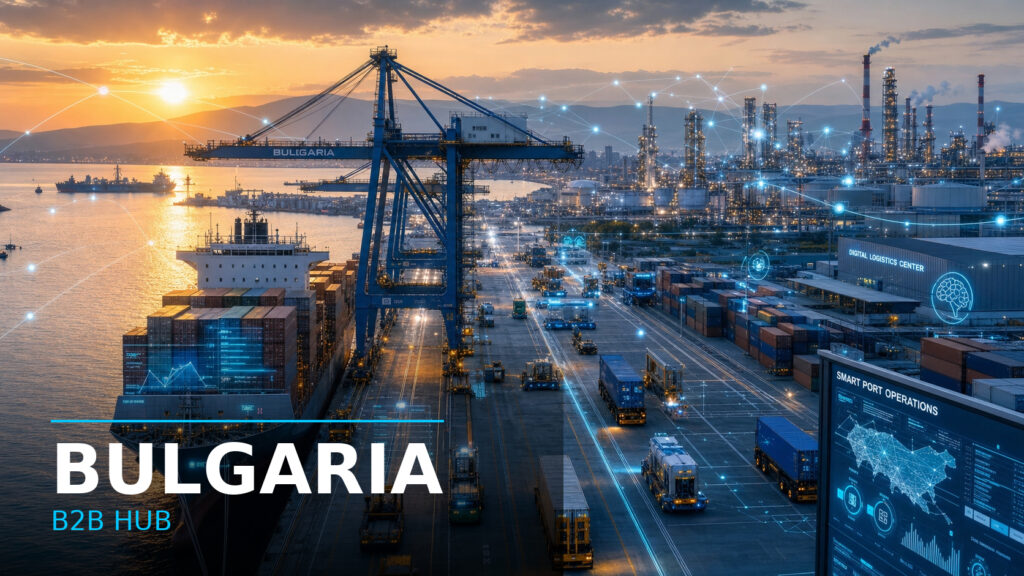
⭐️ Bulgaria: Europe's nearshoring location for industry, SMEs and logistics

Bulgaria: Europe's nearshoring location for industry, SMEs and logistics
Bulgaria: Europe's nearshoring location for industry, SMEs and logistics – Image: Xpert.Digital

spacers

➡️ Bulgaria is transforming from an underestimated EU market into a strategic nearshoring hub for European industrial SMEs. With low location costs, EU legal certainty, the Eurozone, and strong logistics networks on the Black Sea, the country offers robust alternatives to Asian supply chains.

spacers

✅ At the same time, Xpert.Digital acts as a strategic bridge for Bulgarian companies seeking to tap into the DACH market through targeted content and business development. Analyses, trends, and partnerships for a strong European economy.

spacers

Contact us directly ➡️ here or call us on: +49 7348 967 115

spacers

Digital Pioneer - Konrad Wolfenstein

Konrad Wolfenstein

Your B2B contact for Enterprise XR solutions


• Contact: Konrad Wolfenstein
• Tel: +49 7348 4088 961


➡️ LinkedIn


  • Neither India nor China: Why Bulgaria is now becoming Europe's most important manufacturing hub

    ▶️ Neither India nor China: Why Bulgaria is now becoming Europe's most important manufacturing hub

    Bulgaria is becoming Europe's most important manufacturing hub: Low wages and low taxes make it an attractive location. | Favorable energy prices and industrial infrastructure significantly reduce production costs. | Strategic ports and Corridor VIII shorten delivery times to Western Europe. | Euro adoption eliminates exchange rate risks and increases investment security. | High vertical integration: 80% of European automotive sensors come from Bulgaria. | EU membership, Schengen, and the rule of law ensure system compatibility. | Stable GDP growth and low national debt strengthen the economic foundation. | Risks such as skills shortages and institutional shortcomings remain to be considered. | Bulgaria is particularly suitable for energy- and labor-intensive manufacturing as well as buffer storage. | Conclusion: Nearshoring to Bulgaria combines cost advantages with European legal certainty and logistical benefits. [...]

    ▶️ Learn more here


    “Epicenter of the China shock”: How a misconception is ruining our industry

    ▶️ “Epicenter of the China shock”: How a misconception is ruining our industry

    This analysis on Xpert.Digital explains why Germany has become the "epicenter of the China Shock 2.0." | It shows how massive Chinese subsidies, overcapacities, and an undervalued exchange rate threaten German industries. | The study criticizes Berlin's misdiagnoses and its adherence to symptom management instead of strategic industrial policy. | At the same time, the text documents the quiet shift of German value chains to Bulgaria and the consequences for small and medium-sized enterprises (SMEs). | It highlights the three-pronged problem: lost export markets, competition in the domestic market, and declining competitiveness. | Using the solar industry as an example, the danger of strategic dependence on China is vividly illustrated. | The article warns of the symbolic turning point that Germany now imports more capital goods from China than it exports there. | It discusses possible policy responses—from European safeguards to sectoral tariffs—and their limitations. | At the same time, a practical nearshoring alternative to Bulgaria is presented as part of a hybrid reorganization of supply chains. Conclusion: Without a decisive, coherent industrial policy, Germany risks losing its technological leadership. [...]

    ▶️ Read more here


  • From the Adriatic to the Black Sea: Will Corridor VIII solve the EU's biggest infrastructure problem?

    ▶️ From the Adriatic to the Black Sea: Will Corridor VIII solve the EU's biggest infrastructure problem?

    Corridor VIII connects the Adriatic and Black Seas and remains unfinished despite its great strategic importance. | For 30 years, construction progress has been stalled due to bureaucracy, bilateral disputes, and insufficient coordination. | | A continuous rail network would fundamentally transform trade, logistics, and mobility in the Western Balkans. | | The EU now views the project not only as a development project but also as a security infrastructure project. | | Political tensions between Bulgaria and North Macedonia are a key obstacle to completion. | EU funds, EIB and EBRD loans, and NATO interest could accelerate financing and implementation. | Completed ports like Varna and Burgas could attract new trade flows as Eurasian hubs. | | The security policy reassessment since 2022 increases the pressure to strengthen Corridor VIII as a NATO-relevant route. | A completed corridor would strengthen Europe's independence from Bosporus routes and expand geopolitical options. A continuous rail link is realistically not expected until the early 2030s at the earliest, once political and financial barriers are overcome. [...]

    ▶️ Read more here


    Mega-project “ReBirth 28” in Burgas on the Black Sea: How Bulgaria is suddenly becoming the most important hub of world trade

    ▶️ Mega-project “ReBirth 28” in Burgas on the Black Sea: How Bulgaria is suddenly becoming the most important hub of world trade

    The mega-project "ReBirth 28" in Burgas, with its 15.5-meter deep-water quay, is creating new capacity and making Bulgaria a strategic Black Sea hub. | With €85 million in investment and EU funding, a modern, low-emission intermodal terminal has been built. | | Direct rail connections and track upgrades are improving hinterland access and accelerating the Central Corridor. | As an EU and NATO member, Bulgaria is positioning itself as a reliable gateway between Asia and Europe. | | Competition with Constanta remains fierce, but specialization and complementarity offer realistic growth opportunities. | | Risks include the incomplete Corridor VIII connection and the ongoing instability in the Black Sea region. | Sofia is seeking strategic partners, not pure privatization, and is focusing on secure investors with access to freight. | The Central Corridor is growing rapidly and offers diversification options compared to northern routes. Further investment in Varna and the rail network is crucial to unlocking its full potential. | Read the analysis on xpert.digital about the opportunities, risks, and geopolitical significance of Bulgaria. [...]

    ▶️ Learn more here


  • Trans-Caspian Nearshoring and Bulgaria: Why global supply chains need to be rethought in Europe

    ▶️ Trans-Caspian Nearshoring and Bulgaria: Why global supply chains need to be rethought in Europe

    Cargo sous terrain (CST) tells the story of a vision for underground logistics that would relieve congestion on highways and massively reduce CO₂ emissions. Despite its technical feasibility, the 30-billion-euro project failed due to financing and political hurdles. Planned tunnels, hubs, and autonomous systems were intended to enable a seamless, climate-neutral supply chain. The purely privately financed model met with resistance and intimidated institutional investors. Legal regulations such as the German Underground Logistics Act (UGüTG) came too late to provide legal certainty. Life cycle assessments showed significant potential for savings in emissions, noise, and traffic congestion. A later technological shift to cable car systems was intended to reduce costs but further delayed the project. The failure reveals structural problems with megaprojects: risk allocation, cost overruns, and political uncertainties. Nevertheless, CST leaves behind valuable planning knowledge and an important debate on future infrastructure financing. Underground logistics remains a realistic option—it simply needs suitable institutional and financial frameworks. [...]

    ▶️ Learn more here


    Why Europe urgently needs a new model of economic division of labor – and why it's already on its own doorstep

    ▶️ Why Europe urgently needs a new model of economic division of labor – and why it has already been found on its own doorstep

    | Germany as a cumbersome tanker, Bulgaria as an agile speedboat in the European economic partnership. | | Bulgaria's 10% flat tax and booming IT sector make it an attractive nearshoring location for German companies. | The German model heavily taxes labor and spares wealth, which weakens incentives for growth. | A smart, division-of-labor strategy with high and low tax rates can benefit both countries. | | German technology and capital combine with Bulgarian execution quality to create competitive value chains. | Bulgaria is growing rapidly but faces problems such as a shortage of skilled workers, corruption, and population decline. | ​​Tax harmonization would be a mistake; differentiation enables comparative advantages in the single market. | | For lasting success, Bulgaria needs legal certainty, administration, and infrastructure; Germany needs courage in its tax policy. | The partnership can strengthen Europe if cooperation is institutionalized and consciously shaped. | The article calls for a pragmatic EU strategy that promotes partnership instead of confrontation. [...]

    ▶️ Read more here


  • A way out of Asia: Why Bulgaria is becoming the new “extended workbench” of German industry

    ▶️ Way out of Asia: Why Bulgaria is becoming the new “extended workbench” of German industry

    Bulgaria is becoming an extended workbench for German industry and offers attractive nearshoring opportunities. | With corporate and income tax rates of only 10% and low labor costs, production costs are significantly reduced. | EU law, Schengen, and the euro create legal certainty and simplify cross-border supply chains. | Shorter transport routes and reduced geopolitical risks make supply chains more resilient. | The automotive, electronics, and mechanical engineering sectors, in particular, benefit from skilled local manufacturing. | Technical universities and dual vocational training secure skilled workers but do not completely prevent emigration. | Infrastructure improvements and EU funding enhance logistics and industrial parks, but bottlenecks remain. | The division of labor allows Germany to strengthen R&D and high technology, while Bulgaria expands its manufacturing capacity. | Strategically planned relocations create a win-win situation for both countries instead of deindustrialization. | xpert.digital explains how this bilateral industrial alliance strengthens Europe's competitiveness. [...]

    ▶️ Learn more here


    BgGPT instead of ChatGPT: Artificial Intelligence in Bulgaria – Between ambitious vision and structural gap

    ▶️ BgGPT instead of ChatGPT: Artificial Intelligence in Bulgaria – Between ambitious vision and structural gap

    Bulgaria surprises with supercomputers and the open-source language model BgGPT, which addresses local needs. | Despite cutting-edge research, many companies lack digital maturity and AI adoption. | EU funding, the introduction of the euro in 2026, and the AI ​​Act open a strategic window of opportunity for providers. | Government strategy papers exist, but implementation and concrete action plans remain weak. | INSAIT and international partnerships bring research excellence and global visibility. | Banks, healthcare, and public administration, in particular, need GDPR-compliant, auditable AI solutions. | Data sovereignty and privacy-first architectures present clear market opportunities for European providers. | Startups like Payhawk and Dronamics demonstrate niche strength, but the base remains thin. | German companies benefit from nearshoring potential and the need for managed AI services. The crucial question remains whether Bulgaria will translate its strategy into concrete implementation and thus become a serious AI hub. [...]

    ▶️ Read more here


  • 10% off everything: The Bulgarian tax miracle that Germany can only dream of

    ▶️ 10% off everything: The Bulgarian tax miracle that Germany can only dream of

    Bulgaria demonstrates with a 10% flat tax how tax simplification can attract investment. | A thought experiment: What would a 10% tax mean for Germany? | In the short term, massive revenue losses and significant burdens on the welfare state would be imminent. | Long-term dynamics, however, could reduce compliance and broaden the tax base. | For companies, a low rate would mitigate location disadvantages and curb capital flight. | The complexity of the German tax system results in high consulting and administrative costs. | Nevertheless, the transferability is limited, as Bulgaria has a much lower government spending ratio. | Sensible lessons include simplification, trade tax reform, and lower dividend taxation. | Without accompanying measures, a flat tax would exacerbate social inequality. | Conclusion: Adopt the principles, don't blindly copy the figures—a provocative scenario with clear limitations. [...]

    ▶️ Read more here


    Bulgaria's leap into the Eurozone: How the euro is transforming the poorest EU country

    ▶️ Bulgaria's leap into the Eurozone: How the euro is transforming the poorest EU country

    Bulgaria will adopt the euro on January 1, 2026, becoming the 21st member of the Eurozone. This historic step marks its long-awaited entry into the economic heart of Europe. | | The introduction is not only an economic but also a strong geopolitical statement. | But will the euro be a Segen or a curse for the poorest EU country? | The government promises an investment boom and a transformation of the country. | | At the same time, citizens are increasingly worried about skyrocketing prices and a housing bubble. | | Many fear that the new currency could further fuel the ongoing inflation. | Not all Bulgarians are therefore celebrating the departure from the lev and the entry into the "club of the rich." | | Can the euro truly modernize the country fundamentally, or will it merely expose structural weaknesses? | Learn all about the opportunities, risks, and exciting future of Bulgaria in the Eurozone. | ​​| | [...]

    ▶️ Read more here

     

Partner in Germany and Europe - Business Development - Marketing & PR

Your partner in Germany and Europe

  • 🔵 Business Development
  • 🔵 Trade Fairs, Marketing & PR

  • Xpert.Digital Overview
  • Xpert.Digital SEO
Contact/Info
  • Contact – Pioneer Business Development Expert & Expertise
  • Contact form
  • imprint
  • Privacy Policy
  • Terms and Conditions
  • e.Xpert Infotainment
  • Infomail
  • Solar system configurator (all variants)
  • Industrial (B2B/Business) Metaverse Configurator
Menu/Categories
  • Enterprise XR Solution Hub
  • Raw materials, global sourcing & trade
  • Managed AI Platform
  • AI-powered gamification platform for interactive content
  • LTW Solutions
  • Logistics/Intralogistics
  • Artificial Intelligence (AI) – AI Blog, Hotspot and Content Hub
  • New PV solutions
  • Sales/Marketing Blog
  • Renewable energy
  • Robotics
  • New: Economy
  • Heating systems of the future – Carbon Heat System (carbon fiber heaters) – Infrared heaters – Heat pumps
  • Smart & Intelligent B2B / Industry 4.0 (including mechanical engineering, construction industry, logistics, intralogistics) – Manufacturing industry
  • Smart City & Intelligent Cities, Hubs & Columbarium – Urbanization Solutions – Urban Logistics Consulting and Planning
  • Sensors and measurement technology – Industrial sensors – Smart & Intelligent – ​​Autonomous & Automation systems
  • Advanced metal fabrication & joining technology
  • Augmented & Extended Reality – Metaverse Planning Office / Agency
  • Digital hub for entrepreneurship and start-ups – information, tips, support & advice
  • Agri-photovoltaics (Agri-PV) consulting, planning and implementation (construction, installation & assembly)
  • Covered solar parking spaces: Solar carports – Solar carports – Solar carports
  • Energy-efficient renovation and new construction – Energy efficiency
  • Electricity storage, battery storage and energy storage
  • Blockchain technology
  • NSEO Blog for GEO (Generative Engine Optimization) and AIS Artificial Intelligence Search
  • Order acquisition
  • Digital Intelligence
  • Digital Transformation
  • E-commerce
  • Finance / Blog / Topics
  • Internet of Things
  • „Realitätscheck Politik“ (National Affairs Observer)
  • Bulgaria: Europe's nearshoring location for industry, SMEs and logistics
  • USA
  • China
  • Sino-cooperation
  • Hub for Security and Defense
  • Trends
  • In practice
  • vision
  • Cyber ​​Crime/Data Protection
  • Social Media
  • eSports
  • glossary
  • Healthy eating
  • Wind power / Wind energy
  • Innovation & Strategy: Planning, consulting, and implementation for Artificial Intelligence / Photovoltaics / Logistics / Digitalization / Finance
  • Cold Chain Logistics (fresh logistics/refrigerated logistics)
  • Solar power in Ulm, around Neu-Ulm and Biberach: Photovoltaic solar systems – consultation – planning – installation
  • Franconia / Franconian Switzerland – Solar/Photovoltaic Solar Systems – Consulting – Planning – Installation
  • Berlin and surrounding areas – Solar/Photovoltaic systems – Consulting – Planning – Installation
  • Augsburg and surrounding area – Solar/Photovoltaic systems – Consulting – Planning – Installation
  • Expert advice & insider knowledge
  • Press – Xpert Press Relations | Consulting and Services
  • Tables for Desktop
  • B2B procurement: Supply chains, trade, marketplaces & AI-powered sourcing
  • XPaper
  • XSec
  • Protected area
  • Pre-release version
  • English Version for LinkedIn

© June 2026 Xpert.Digital / Xpert.Plus - Konrad Wolfenstein - Business Development