

Attack on Yanbu's oil lifeline – the Middle East is burning: Why the global oil network is on the verge of collapse
Xpert Pre-Release

Available in 27 languages 📢
Prefer Xpert.Digital on GoogleⓘPublished on: September 13, 2026 / Updated on: September 13, 2026 – Author: Konrad Wolfenstein
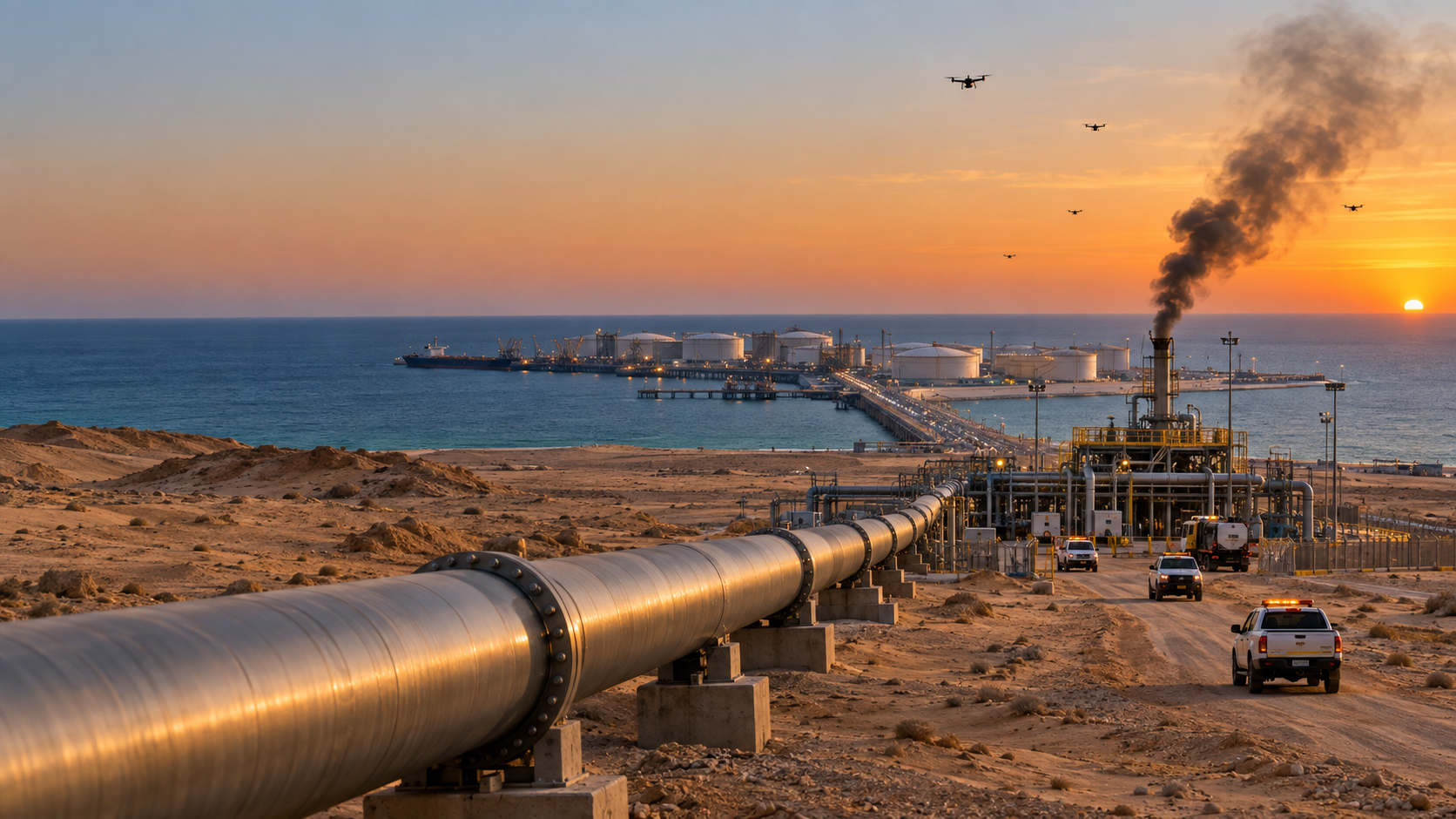
The Middle East is burning – a warning to the global economy: Why the global oil network is on the verge of collapse – Creative image on the topic, created with AI: Xpert.Digital
Warning to the global economy: The illusion of safe havens – Why the new oil crisis is hitting Europe with full force
The Middle East shock: How targeted drone attacks could drastically increase the cost of our lives
Tehran's dangerous game: How a regional conflict is paralyzing the global system
The Middle East is burning – and the flames no longer threaten only regional security, but the lifeblood of the entire global economy. Until now, the prevailing wisdom was: if the strategically vital Strait of Hormuz is blocked, global oil trade will simply shift to alternative pipeline routes and the Red Sea. But recent, targeted attacks on Saudi infrastructure and the shipping lanes at the Bab al-Mandab have brutally shattered this illusion of safe alternatives. What we are currently witnessing is not an isolated incident, but an asymmetric economic war striking the global system at its most vulnerable point. For Europe, which remains heavily dependent on energy imports even after its shift away from Russia, this means a state of high alert: a sustained disruption of these supply chains threatens not only to cause diesel and gas prices to skyrocket, but could also trigger a new, dangerous wave of stagflation. It is time for Europe to wake up and build genuine resilience before the next crisis cripples our economy.
Two bottlenecks, one global risk: The Iran war is becoming an economic stress test for Europe
The recent attacks on Saudi Arabia's East-West pipeline and the simultaneous escalation of the situation at the Bab al-Mandab strait are far more than just a new episode in an already escalating Middle East conflict. The crucial economic factor is not simply whether individual pumping stations have been damaged or how quickly Saudi Aramco can restore a pipeline to operation. The real danger lies in the fact that several transport routes previously considered alternatives are now simultaneously under military pressure. The Strait of Hormuz, the Saudi land bridge to Yanbu, and the sea route from the Red Sea through the Bab al-Mandab no longer constitute independent safety valves. They have become parts of the same vulnerable system.
This is precisely where the new dimension of the crisis lies. As long as a single bottleneck is disrupted, producers, shipping companies, and traders can reroute volumes, utilize existing inventories, and adjust delivery schedules. However, if the main route, the bypass pipeline, and the alternative sea route are threatened successively, a regional security problem transforms into a global supply, price, and confidence shock. The attack, therefore, does not only affect Saudi Arabia. It strikes at the expectation that the global economy still possesses robust alternative routes in the event of the Hormuz pipeline's failure.
Saudi Arabia preemptively shut down the approximately 1,200-kilometer-long east-west pipeline following several drone attacks. The pipeline connects Abqaiq in the east of the country with the Red Sea port of Yanbu. Officially, injuries, property damage, and the origin of the drones on Iraqi territory have been confirmed; however, the perpetrators, the exact extent of the damage, and the repair time remain unclear. So far, no organization has definitively claimed responsibility for the specific attack. Therefore, the assertion, expressed in commentaries, that Tehran directly ordered the attack should be treated as a plausible hypothesis, but not as established fact.
Simultaneously, according to multiple reports, the Iranian-backed Houthis reached the strategically important island of Perim in the Bab al-Mandab Strait. This increases their ability to exert pressure on a route through which Saudi Arabia has been increasingly transporting oil to the world market since the near-disruption of the Hormuz pipeline. The connection between these two developments is economically explosive: a disruption of the pipeline limits the supply to Yanbu, while a threat to the Bab al-Mandab Strait subsequently increases the cost or hinders transport across the Red Sea. The attack is therefore directed not only against a facility, but against the very logic of the diversion itself.
Yanbu is losing its role as a safe haven
Yanbu was the key piece of evidence in the ongoing escalation that Saudi Arabia can organize a portion of its exports independently of Hormuz. The East-West pipeline was originally built precisely for this strategic problem: transporting crude oil from the major production and processing centers in the Persian Gulf across the Arabian Peninsula to the Red Sea. Saudi Aramco puts the expanded capacity at up to seven million barrels per day, while the International Energy Agency points out that sustainable transport at this level is not fully proven under real-world operating conditions. Before the latest attack, market observations indicated that approximately four to five million barrels per day were being moved through the pipeline.
This amount corresponds to roughly four to five percent of the global oil supply. This doesn't mean that it disappears completely from the world market during a shutdown lasting several days. Saudi Arabia can initially utilize existing reserves at Yanbu, adjust maintenance procedures, and restart sections of the plant after a technical inspection. Nevertheless, the scale is considerable. The uncertainty surrounding the restart date alone forces refineries, traders, and shipping companies to factor in scarcer alternative deliveries. The oil market is impacted not only by the physical outage itself, but also by the risk of one.
Furthermore, Yanbu itself has been under repeated threat for months. In March 2026, a ballistic missile aimed at the port was intercepted, while a drone struck the Samref refinery. Further attacks on Saudi energy facilities and transit infrastructure followed in July. In early September, facilities in Jizan, Abha, and other Saudi cities were hit. The latest shutdown is therefore not an isolated incident, but part of a series in which attackers are increasingly targeting refineries, pumping stations, loading ports, and tankers.
Economically, this development is more serious than a single, spectacular attack. Infrastructure can be technically repaired; however, a permanently elevated threat level alters insurance premiums, security costs, maintenance windows, freight routes, and investment decisions. Even if the pipeline is operational again soon, a risk premium will remain. The market must anticipate that the same route will be targeted again in the future, and that not only the pipeline itself, but also port facilities, refineries, the power supply, or maritime access could be attacked.
The illusion of a simple detour is shattered
Before the war, an average of around 20 million barrels of crude oil and petroleum products flowed through the Strait of Hormuz per day in 2025. This represented approximately a quarter of global maritime oil trade. The available alternative routes operated by Saudi Arabia and the United Arab Emirates, according to estimates by the International Energy Agency, offered a combined spare capacity of only 3.5 to 5.5 million barrels per day. Even before the attack on the East-West pipeline, it was therefore clear that no alternative pipeline system could compensate for a complete shutdown of Hormuz.
The actual flows reveal the scale of the problem. According to data from the US Energy Information Administration (EIA), oil transported through the Hormuz Strait fell from 21.6 million barrels per day in the fourth quarter of 2025 to 4.9 million in the second quarter of 2026. At the same time, the flow of oil through the Bab al-Mandab Strait increased from 5.4 to 8.1 million barrels per day because Saudi Arabia diverted volumes via the East-West Pipeline and the Yanbu Strait. Thus, part of the risk was not eliminated, but rather geographically shifted from the Persian Gulf to the Red Sea.
This shift only worked as long as three conditions were met simultaneously: the Saudi pipeline had to transport sufficient oil westward, Yanbu had to be able to load cargo, and the sea route through the Red Sea had to remain usable despite Houthi attacks. Now, all three conditions are in doubt. This is precisely why the situation is more dramatic than the report of a temporarily shut-down pipeline would suggest. The global market has not only partially lost its redundancy; it recognizes that this supposed redundancy itself can become the target of a coordinated, or at least strategically integrated, attack pattern.
Alternatives outside Saudi Arabia are also limited. The UAE's pipeline to Fujairah bypasses Hormuz, but can only handle a fraction of the volumes normally transported through the strait. Iran, Iraq, Kuwait, Qatar, and Bahrain remain dependent on Hormuz for the vast majority of their oil and gas exports. Additional shipments from the US, Brazil, Guyana, Canada, Norway, or West Africa would help, but require time, suitable tankers, appropriate crude oil grades, and available refining capacity. In a tight market, one barrel cannot automatically be replaced by another.
Tehran's strategy of distributed costs
The conflict is increasingly developing into an economic war of attrition. The United States is attempting to financially weaken Iran through attacks on tankers, blockades, and restrictions on its exports. Iran cannot directly counter the US military and economic superiority. Instead, Tehran has the ability to spread the costs: across Gulf monarchies, shipping companies, energy importers, consumers, and Western central banks. Every drone that temporarily halts a pipeline can trigger higher hedging, transportation, and financing costs worldwide.
This is where the asymmetric strength of this strategy lies. A relatively inexpensive unmanned aerial vehicle can threaten a facility whose failure affects raw material flows worth hundreds of millions of dollars daily. Even an intercepted attack is not economically cost-free, because anti-aircraft missiles, operational disruptions, and precautionary measures must be paid for. Even more important is the psychological effect: market participants do not know when and where the next attack will occur. Uncertainty thus becomes a weapon in its own right.
The Houthis play a central role in this system. Their attacks on ships and Saudi oil targets allow Iran to exert pressure on global trade without making each operation appear as a direct Iranian attack. At the same time, Iranian-backed militias in Iraq have geographical proximity to Saudi Arabia. This creates a multidimensional threat space stretching from the Persian Gulf through Iraq and Saudi Arabia's internal infrastructure to Yemen and the Red Sea. Saudi Arabia cannot secure a single corridor but must protect a vast network of fields, pipelines, pumping stations, refineries, ports, and sea lanes.
This analysis, however, should not lead to hasty conclusions. The fact that drones originated in Iraq does not automatically prove direct Iranian control or Houthi involvement in the specific pipeline attack. The Iraqi government has confirmed the launch from its own territory, launched an investigation, and dismissed the responsible commander in Maysan province. For economic risk assessment, the unclear perpetrators are even more problematic: as long as command structures remain unclear, deterrence, negotiation, and crisis management become more difficult.
Washington's gamble will be costly for others
President Donald Trump appears to be continuing his strategy of forcing Iran to back down through military and economic pressure. This approach could prove strategically successful if Tehran's revenues, military capabilities, and domestic stability erode faster than the political staying power of the United States and its allies. However, it could just as easily lead to a protracted conflict of attrition in which Iran does not capitulate but systematically increases the costs for third parties.
For the global economy, even the path to a potential American victory is proving costly. Brent crude oil prices once again surpassed the $100 per barrel mark in September, rising to nearly $108 at one point following the latest escalation. Diesel prices rose particularly sharply, reaching around 90 percent above pre-war levels at the beginning of September. Simultaneously, yields on long-term government bonds increased as investors anticipated higher inflation and tighter monetary policy.
The political sensitivity lies in the fact that the costs are very unevenly distributed. The US is itself a major oil and gas producer and can absorb some of the price shock through higher energy sector revenues. Europe, Japan, South Korea, India, and numerous poorer importing countries, on the other hand, are paying higher bills without generating corresponding export revenues. Around 80 percent of the oil and product volumes transported through the Strait of Hormuz in 2025 were destined for Asia. For liquefied natural gas (LNG), the Asian share of exports through the strait was almost 90 percent.
This conflict has the potential to exacerbate tensions within the Western and Asian alliance system. The longer the crisis lasts, the more governments will question whether the American strategy offers a realistic political endpoint or merely generates global costs. China, in turn, has an incentive to become more diplomatically active because, as the largest oil importer, it depends on stable Gulf exports. Beijing could mediate, protect its own tankers, exert economic pressure on Tehran, or use the crisis to present itself as an indispensable stabilizing force. None of these options is without risk.
Saudi Arabia's strategic isolation
Saudi Arabia faces a fundamental dilemma. The kingdom possesses modern fighter jets, air defense systems, and enormous financial resources, but lacks a comprehensive defense against cheap drones and missile attacks targeting thousands of kilometers of distributed infrastructure. Experience from recent years shows that even a powerful air defense can intercept individual missiles without eliminating the overall risk. Attackers only need to occasionally penetrate the defenses to disrupt operations and erode market confidence.
Furthermore, another major ground offensive in Yemen is hardly attractive from a military or political perspective. Saudi Arabia's intervention from 2015 onward has not permanently defeated the Houthis. An escalation of the war could provoke further attacks on Saudi cities and facilities, cause civilian casualties, and jeopardize Riyadh's modernization strategy. At the same time, passivity would signal that attacks on vital economic centers have only limited consequences.
Formal partnerships do not automatically solve the problem. Turkey and Pakistan can provide diplomatic, technical, or military support, but a defense pact does not necessarily imply a willingness to wage a costly war in Yemen. Israel possesses operational experience against the Houthis and a long-range air force; however, open Saudi-Israeli military cooperation would be highly sensitive in terms of domestic and regional politics. The claim made in the original article that Trump rejected Saudi requests for assistance because of the US midterm elections is not sufficiently substantiated in the public sphere and should therefore not be considered a reliable starting point.
Saudi Arabia's central weakness lies less in a lack of weapons than in the impossibility of completely shielding its extensive energy system. Resilience therefore requires more than air defense. It necessitates redundant pumping stations, decentralized spare parts, rapidly replaceable control technology, a secure power supply, additional storage capacity in Yanbu, alternative loading points, and permanent repair teams. Military deterrence and industrial recovery capability must be considered together.
Our global industry and economic expertise in business development, sales and marketing

Our global industry and economic expertise in business development, sales and marketing - Image: Xpert.Digital
Industry focus areas: B2B, digitalization (from AI to XR), mechanical engineering, logistics, renewable energies and industry
More information here:
A thematic hub offering insights and expertise:
- Knowledge platform covering global and regional economies, innovation and industry-specific trends
- A collection of analyses, insights, and background information from our key areas of focus
- A place for expertise and information on current developments in business and technology
- A hub for companies seeking information on markets, digitalization, and industry innovations
Global supply chains at their limit: Why the attack on oil infrastructure is just the beginning
The price of oil is just the beginning
The most visible transmission channel to the global economy is the price of oil. Higher crude oil costs increase the prices of gasoline, diesel, jet fuel, heating oil, petrochemicals, and numerous plastics. Diesel is particularly critical because it powers trucks, construction equipment, agriculture, mining, shipping, and emergency generators. A diesel shortage therefore has a broader impact on production and food costs than the price of crude oil alone would suggest.
The second effect is via natural gas and electricity. Qatar and other Gulf states export large quantities of liquefied natural gas (LNG) through the Hormuz Strait. If deliveries are disrupted or ships are diverted, Europe and Asia will compete more fiercely for available LNG cargoes. Higher gas prices then impact wholesale prices in European electricity markets via gas-fired power plants. Even companies that consume very little oil can therefore experience higher energy and procurement costs.
The third channel is logistics. If the Bab al-Mandab strait becomes unsafe, ships will circumnavigate the Cape of Good Hope. This lengthens voyages, ties up more ships for the same transport capacity, increases fuel consumption and insurance premiums, and worsens the predictability of supply chains. Previous disruptions in the Red Sea caused freight rates from Shanghai to Europe to temporarily rise by 256 percent. UNCTAD estimates that prolonged high transport costs can significantly increase global consumer prices; historical analyses show that a doubling of freight costs results in an average inflationary impulse of about 0.7 percentage points, with a time lag.
The fourth channel leads via interest rates and financial markets. An energy price shock lowers real household income, squeezes corporate margins, and simultaneously increases inflation. Central banks then face a classic dilemma: interest rate cuts would support the economy but could destabilize inflation expectations; interest rate hikes would dampen second-round effects but exacerbate weak growth. It is precisely this combination of weaker growth and higher inflation that makes the shock more dangerous than a typical drop in demand.
The return of stagflation
The European Central Bank now expects inflation in the eurozone to rise from 2.1 percent in 2025 to an average of 3.0 percent in 2026, peaking at 3.6 percent in the fourth quarter. An inflation rate of almost 15 percent is forecast for energy by the end of the year. This projection, however, assumes that the energy shock will gradually subside. In a severe scenario, the ECB anticipates oil prices around $130 per barrel and European gas prices around €130 per megawatt-hour.
The magnitude of the potential impact on growth is considerable. ECB analyses conclude that a geopolitically driven real oil price increase of ten percent could reduce real GDP growth in the euro area by approximately 0.2 to 0.3 percentage points in each of the first three years. The effect cannot be directly extrapolated because exchange rates, fiscal policy, inventories, and corporate responses all play a role. However, it demonstrates that a prolonged price surge would not be a marginal burden but could significantly impact the already weak European growth base.
Emerging and developing economies worldwide are particularly vulnerable. The World Bank described the decline in global oil supply of an estimated ten million barrels per day observed in March 2026 as the largest supply shock in the available time series. In its baseline scenario, it expects energy prices to rise by 24 percent and total commodity prices by 16 percent in 2026. If disruptions persist, average oil prices could reach between $95 and $115, driving inflation in emerging and developing economies to between 5.3 and 5.8 percent.
This is doubly problematic for poorer countries. They spend a larger share of their foreign exchange earnings on energy and food imports, have smaller strategic reserves, and often have to finance price subsidies through borrowing. Rising dollar interest rates and a stronger dollar further increase the burden of their foreign debt. As a result, an attack on a Saudi pipeline could trigger political instability in distant countries via balance of payments, budget deficits, and food prices.
Europe is hit by the shock at its most sensitive point
Europe is more diversified today than before the Russian invasion of Ukraine, but it is still far from energy self-sufficient. In 2024, the European Union imported 57 percent of its total energy. Oil and oil products accounted for 67 percent of energy imports, and import dependency for oil was 96.6 percent. These figures show that Europe has changed suppliers, but has barely eliminated its physical dependence on external energy flows.
The shift away from Russia was necessary for security policy and reduced vulnerability to unilateral blackmail. The share of Russian gas in EU gas imports fell from 45 percent in 2021 and 2022 to 12 percent in 2025; Russian crude oil dropped to about two percent of EU imports. At the same time, however, the importance of LNG, long sea routes, and new suppliers increased. In 2025, the EU still imported energy products worth €336.7 billion. More than 95 percent of its oil and over 80 percent of its gas came from abroad.
Europe is particularly vulnerable when it comes to refined products. Following the cessation of Russian deliveries, Saudi Arabia, Kuwait, and other producers in the Middle East became important sources of diesel. In 2025, Asia and the Middle East together supplied 23 percent of European diesel imports and 90 percent of aviation fuel imports. Since April 2026, the Mediterranean EU member states have sourced around 24 percent of their diesel imports from Saudi Red Sea ports. A problem in Yanbu therefore affects Europe not only through the global market price for crude oil, but also through the immediate availability of diesel.
This is particularly relevant for Germany and other industrialized economies. Higher diesel prices will impact road freight transport, the construction industry, agriculture, and small and medium-sized enterprises (SMEs). The chemical, glass, paper, and metal processing industries, as well as other energy-intensive sectors, will suffer additionally from higher gas and electricity prices. Since European companies already pay structurally higher energy prices than their competitors in the US and China, a further price shock will pose a significant competitive risk. The Draghi report quantified the price gap at two to three times the US level for electricity and four to five times for natural gas.
Three ways the crisis could develop
In the most favorable scenario, the shutdown of the East-West pipeline remains brief. Repair teams gradually restore operations, Saudi Arabia utilizes reserves in Yanbu, and international shipping keeps the Bab al-Mandab sluice partially open under military protection. While the oil price retains a risk premium, it falls below its recent peaks. The inflationary impact remains primarily limited to energy and transportation. This scenario is technically plausible but requires that no further successful attacks on pumping stations, port facilities, or tankers occur.
In the medium scenario, there are repeated attacks with varying, short interruptions. The pipeline operates, but not reliably at full capacity. Shipping companies avoid parts of the Red Sea or demand high risk premiums, while refineries build up larger safety stocks. Brent crude could remain above $100 for an extended period, diesel would remain particularly scarce, and central banks would have to pursue a more restrictive monetary policy. For Europe, this would likely be the most dangerous scenario because it does not create a clear crisis moment, but rather erodes investment, purchasing power, and growth over many quarters.
In a worst-case scenario, the Hormuz Strait, the Saudi-led western route, and the Bab al-Mandab sluice gate would all be temporarily unavailable as reliable shipping routes. Then, the focus would shift from prices to the actual allocation of scarce quantities. Strategic reserves would be released, governments could limit consumption, airlines could reduce capacity, and energy-intensive industries could curtail production. Oil prices significantly above $130 would be possible under such conditions, although a precise peak could not be reliably predicted. The crucial factor would be the duration: reserves can bridge weeks or a few months, but they cannot replace permanently disrupted production and trade flows.
A fourth, particularly dangerous political scenario is direct regional escalation. Saudi Arabian retaliatory strikes in Iraq or Yemen could provoke counterattacks; visible Iranian involvement could prompt the US to further escalate the conflict. Misinterpretations, technical errors, or attacks by militias that are not fully controlled increase the risk that actors will be drawn into a larger war that no one originally planned. Markets would then price in not only oil shortages but also the potential disruption of further Gulf facilities.
Resilience begins with honest assessments
Europe must first stop equating diversification with security. Ten suppliers are of little help if their tankers sail through the same two straits or if diesel from different countries is produced in the same few refinery and port regions. Resilience must therefore be measured at the level of physical routes, product quality, refinery capacity, ports, pipelines, and power grids. A supplier list alone does not reflect concentration risks.
The EU should develop a binding stress test for oil and product supplies. This test would have to simulate the simultaneous shutdown of the Hormuz and Bab al-Mandab oil fields, a multi-week disruption of the Yanbu oil field, reduced US exports, tanker shortages, and outages at European refineries. Companies and authorities need not only aggregated crude oil figures, but also regional data for diesel, jet fuel, naphtha, and heating oil. The European Commission has already announced that it will review the Oil Stockpiling Directive and consider product-specific requirements. This reform should be accelerated.
The current requirement to maintain stockpiles equivalent to at least 90 days of net imports remains essential, but it is too broad. Crude oil reserves are of limited use if refineries cannot process the required quality or if diesel is suddenly unavailable instead of crude oil. Therefore, Europe needs higher minimum stockpiles of selected finished products, a clear regional distribution system, and guaranteed transport links from storage to consumer. Joint releases must be based on transparent criteria to prevent unilateral national actions and panic buying.
Europe's seven-point program
First, the EU needs to organize its strategic oil reserves more precisely by product. Diesel, aviation fuel, and key petrochemical feedstocks should be recorded separately and held in sufficient quantities. It must be taken into account that landlocked countries and regions with few refineries face different risks than states with large ports. Joint European reserves along key pipeline and rail links could supplement national stockpiles.
Secondly, Europe needs long-term supply partnerships with producers from truly diverse geographical regions. These include Norway, the USA, Canada, Brazil, Guyana, West Africa, and reliable Mediterranean countries. Contracts should regulate not only volumes but also crisis priorities, port rights, tanker capacities, and reciprocal storage access. The goal is not to exchange one dependency for another, but to create a portfolio whose routes do not converge at the same bottleneck.
Third, Europe must treat its refinery and port infrastructure as a strategic asset. For years, refinery capacity was primarily considered a commercial issue in a shrinking fossil fuel market. However, during a transitional phase, it remains relevant to security. Therefore, decommissioning should be assessed for its impact on regional supply. At the same time, investments are needed in flexible facilities that can process different types of crude oil, as well as in ports, pipelines, rail terminals, and inland waterway transport.
Fourth, the electrification of transport must be accelerated, precisely because it has a security policy impact. Electric vehicles, electric heat pumps, rail transport, and industrial electrification reduce direct oil demand. However, the benefits only materialize if electricity grids, storage facilities, and a secure generation supply grow simultaneously. Europe's decarbonization is therefore not merely climate policy, but the most important long-term protection against imported oil and gas crises.
Fifth, the EU needs faster permitting processes and more investment in grids, storage, and reliable power. Wind and solar energy reduce fuel imports, but their fluctuations require high-performance grids, battery storage, flexible demand, pumped storage, dispatchable power plants, and cross-border electricity trading. Nuclear energy can contribute to stable, low-carbon power generation where member states support it politically. Technological openness must not become a pretext for inaction.
Sixth, Europe should prepare a phased plan for reducing consumption before an acute shortage occurs. This includes slower speeds, increased public transport, work-from-home arrangements, optimized freight logistics, time-limited incentives for energy conservation, and priority rules for critical services. Such measures are politically unpopular, but in a severe crisis, they are economically more advantageous than disorderly rationing and production shutdowns. The International Energy Agency explicitly identifies demand reduction and fuel switching, in addition to reserve releases, as components of a crisis response.
Seventh, Europe needs a common economic security strategy. Energy, semiconductors, critical raw materials, cloud infrastructure, submarine cables, ports, and arms production are no longer separate policy areas. The EU should jointly finance risks, exchange data, harmonize security standards, and, if necessary, facilitate key investments through common instruments. National subsidy races increase costs and fragment the single market; coordinated procurement and infrastructure planning, on the other hand, strengthen negotiating power and economies of scale.
No resilience without societal acceptance
The technical agenda alone is insufficient. Energy policy often fails not due to a lack of knowledge, but because of distributional conflicts. Higher prices disproportionately affect low-income households, while blanket price caps also subsidize the wealthy and weaken incentives to save. Europe therefore needs targeted relief measures through transfers, tax refunds, or social tariffs, instead of artificially low consumer prices indefinitely.
Support for businesses should be tied to transformation. Energy-intensive companies of strategic importance can receive temporary aid if they simultaneously expand efficiency, electrification, circular economy practices, and flexible production. Permanently subsidizing every existing business model would be unaffordable and would delay structural change. Conversely, it would be short-sighted to allow key industries to relocate solely due to a temporary geopolitical price shock.
Communication also needs to be more honest. Security of supply costs money, as do defense, warehousing, and reserve capacities. Systems that appear maximally cheap and efficient under normal operating conditions can become extremely expensive in crises. Resilience is therefore not a free add-on, but rather an insurance policy. The crucial question is whether Europe pays this premium systematically through investments or later in a disorderly fashion through inflation, production losses, and political instability.
The crucial shift in perspective
The situation is dramatic, but not necessarily catastrophic. A short-term repair of the Saudi pipeline can alleviate the immediate price pressure. Strategic reserves, additional production outside the Gulf, and declining demand can cushion some of the shock. The global economy has adaptability, and high prices stimulate investment, substitution, and cost-cutting.
However, it would be dangerous to assume that the structural problem is solved after every repair. The attack on the East-West pipeline shows that bypass routes only create resilience if they themselves are protected, redundant, and politically stable. The simultaneous threat to Hormuz, Yanbu, and Bab al-Mandab transforms three geographical points into a coherent global risk.
The rationale, therefore, is this: The current shock is still manageable, but the underlying system is significantly more fragile than governments and markets have long assumed. The greatest danger is not a single attack, but the combination of repeated pinpricks, unclear perpetrators, limited alternative routes, and political escalation. Each further incident could lower the threshold at which insurers, shipping companies, traders, and central banks no longer anticipate a temporary disruption, but rather a longer-term alteration of the risk regime.
For Europe, this translates into a clear priority. In the short term, it must strengthen reserves, product supply, delivery routes, and crisis coordination. In the medium term, it must make refineries, ports, grids, storage facilities, and cross-border infrastructure more robust. In the long term, it must reduce its consumption of imported fossil fuels more quickly. Those who understand resilience merely as a larger reserve are managing dependency. Those who understand it as a combination of diversification, electrification, efficiency, industrial redundancy, and a common security policy are reducing it.
The attack on Yanbu is thus a warning signal to a global economy that has concentrated its efficiency in a few corridors. Europe should not wait until gas stations run dry or factories reduce production to take this signal seriously. The strategic task is to anticipate the next crisis. Otherwise, the continent will continue to pay the price for conflicts over which it has little control, but whose economic consequences it feels particularly acutely in the form of higher prices, weaker competitiveness, and growing political tensions.
📈🚀 From visibility to trust 👀🤝 Your scalable path with Xpert.Digital

From visibility to trust: Your scalable path with Xpert.Digital - Image: Xpert.Digital
In industrial B2B, sustainable business relationships rarely emerge overnight. They develop step by step – through visibility, professional relevance, recurring touchpoints, and growing trust. Xpert.Digital's 4-stage model addresses precisely this: It offers a structured path that begins with a manageable entry point and can evolve into deeper collaboration in business development if needed.
Instead of relying on loud marketing promises, this model puts the relationship at the forefront. Companies start with clearly defined, easily calculable measures and then decide, based on their own experience, how far they want to expand the collaboration. A key factor for this undisturbed trust-building process: The platform completely avoids annoying advertising ads, so the editorial focus remains solely on the companies' expertise.
More information here:
Your global marketing and business development partner
☑️ Our business language is English or German
☑️ NEW: Correspondence in your native language!

Konrad Wolfenstein
I and my team are happy to be available to you as your personal advisor.
You can contact me by filling out the contact form here [email protected]:or simply call me at +49 7348 4088 965. My email address is
I'm looking forward to our joint project.










