
China's automotive industry is undergoing structural change: Huge car graveyards instead of sales miracles – Why China's electric car market is on the verge of collapse
Xpert Pre-Release

Available in 27 languages 📢
Prefer Xpert.Digital on GoogleⓘPublished on: July 9, 2026 / Updated on: July 9, 2026 – Author: Konrad Wolfenstein
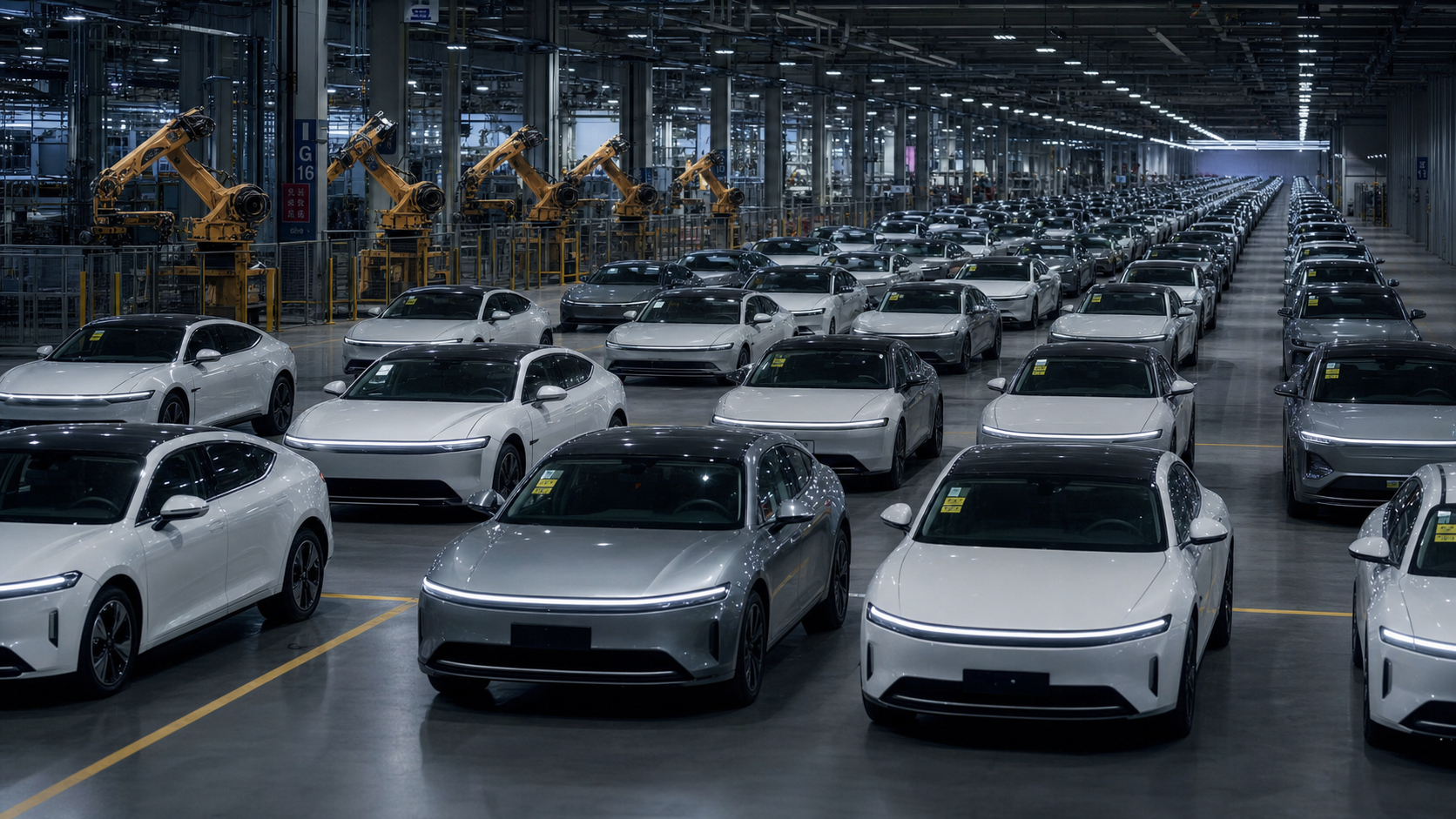
China's automotive industry is undergoing structural change: Huge car graveyards instead of sales miracles – Why China's electric car market is on the verge of collapse – Creative image: Xpert.Digital
The "Evergrande moment" of automakers: Is China's next billion-dollar bubble about to burst?
“Zero Mileage Used Cars”: The absurd subsidy trick behind China’s alleged automotive miracle
China's car crisis affects us all: What happens when the export valve closes forever?
The global automotive industry is looking to the Far East with a mixture of fear and fascination: Chinese manufacturers are flooding world markets with technologically advanced electric cars at rock-bottom prices, putting established market leaders under immense pressure. But this apparent triumph is, in reality, a panicked flight forward. Behind the scenes of the world's largest car market, an unprecedented, ruinous fight for survival is raging. Characterized by gigantic overcapacities, massive price wars, and thousands of brand-new cars gathering dust in vast parking lots, the industry is gradually devouring its own children. The only pressure relief valve for this systemic crisis is global exports. But what happens when this very valve closes due to punitive tariffs and geopolitical barriers? An in-depth analysis of the paradox of an industry that dominates the world while bleeding itself dry at its core.
Related to this:

When the world's largest car market devours its own manufacturers – and what happens when the last resort, exports, becomes blocked?
Fear of the tsunami: Why the fight for survival in China is becoming a real danger for our car manufacturers
The global automotive industry is undergoing profound change. In Germany, factories are shrinking; in the US, trade policy and the bumpy transition to electromobility are causing uncertainty; and in Japan, once untouchable manufacturers like Toyota and Honda are losing global ground. But while the crisis is perceived in the West primarily as an external threat from China, an equally dramatic conflict is raging within the People's Republic itself, one that is internally focused and has systemic roots. The paradox: China is simultaneously the aggressor on the global market and a deeply insecure player on its own.
The Chinese automotive market produced around 31 million vehicles in 2024, with a theoretical total installed capacity of up to 60 million units annually. This translates to a capacity utilization rate of approximately 50 percent – a figure considered a major warning sign in any business theory. In 2025, production and sales each climbed to over 34 million units, setting new records and securing China's 17th consecutive year as the world's leading producer and sales leader. However, behind these record figures lie systemic distortions that fundamentally distort the overall picture.
Related to this:

Overcapacity as a fundamental structural problem
The core problem of the Chinese automotive industry is not short-term; it is the result of decades of state-sponsored misinvestment. Approximately 169 automakers are currently active in China, with more than half holding a market share of less than 0.1 percent. This market structure is reminiscent of the early American auto market at the beginning of the 20th century, when over 100 manufacturers competed for market share before a ruthless wave of consolidation reduced them to a few dominant companies. For China, this consolidation is only just beginning.
The overcapacity is not an abstract accounting problem. It manifests itself in a visually striking phenomenon: drone footage from cities like Hefei, Chengdu, and Weifang shows vast parking lots where thousands of brand-new electric vehicles sit unused, with day-old registrations, dusty, and their odometers showing almost zero. These so-called "zero-mile used cars" are symptomatic of an industry where production has been geared not toward actual demand, but toward government subsidy targets and sales statistics for investors. Many manufacturers registered vehicles without actually selling them in order to receive subsidies and inflate sales figures. The Chinese Ministry of Commerce subsequently summoned executives from BYD, Dongfeng, and other manufacturers to investigate suspected manipulation of sales figures through used car channels.
Production capacity of 55 to 60 million units is contrasted with actual domestic and export demand of just over 40 million units. This gap forces a cutthroat competition unparalleled in modern industrial history.
The ruinous price war and its victims
A direct consequence of overcapacity is a price war that is eroding margins across the entire industry. BYD, the undisputed market leader and the world's largest electric vehicle manufacturer by sales volume, cut prices across its model range by 10 to 30 percent in May 2025, triggering an industry-wide chain reaction. Individual models were subsequently reduced in price by up to 34 percent in the following months. The average net margin of Chinese automakers fell to 4.3 percent in 2024, down from 5 percent in 2023 – and the trend is continuing downward. The average vehicle price in China has fallen from around US$31,000 in 2021 to approximately US$24,000, a decline of 21 percent in just a few years.
Price pressure is now affecting deep into the supply chain. Suppliers are sometimes waiting six to eight months for payment, and outstanding receivables in the industry amount to around 400 billion yuan, equivalent to approximately 50 billion euros. Suppliers operating with a margin of two to three percent who are forced to offer a ten percent discount have no choice but to reduce the quality of the components they deliver. This creates a vicious cycle in which falling prices, declining quality, and increasing bankruptcies reinforce each other.
Great Wall Motor, China's seventh-largest automaker, missed its self-imposed sales target of 4 million vehicles by more than two-thirds in 2025, selling only 1.32 million units. Dongfeng Motor reported a loss of almost €500 million for 2024, while Changan's profit plummeted by nearly 50 percent in the same year. In a public interview, Great Wall Motor's CEO aptly described the situation as the automotive industry's "evergrande moment"—with the difference that, unlike in the real estate sector, a systemic collapse has so far been averted.
The term “Evergrande moment” emerged in the fall of 2021 in response to the liquidity crisis of the Chinese real estate developer Evergrande Group.
Evergrande was China's second-largest real estate company and had financed its massive growth almost entirely through debt. When the Chinese government introduced stricter rules on borrowing (the so-called "three red lines") in 2020 to curb the real estate bubble, the company became insolvent. Evergrande was sitting on a mountain of debt amounting to around US$300 billion and could no longer service interest payments on international bonds.
Subsidy dependency as a structural burden
The rapid development of China's electric vehicle industry was largely state-driven. In the three previous five-year plans, electric vehicles were designated as a strategic industry, prompting Chinese authorities to invest billions in promoting manufacturers and vehicle sales. Purchase incentives for new energy vehicles (NEVs), tax breaks, low-interest loans for factory construction, and direct corporate subsidies created an artificial ecosystem where economic viability was not a necessary condition for survival.
In October 2025, for the first time in over a decade, China removed electric vehicles from its list of strategic industries in its new five-year plan for 2026-2030. Analysts interpreted this as an official signal that Beijing considers the industry mature and intends to leave further development more to market forces. The national purchase incentive program for electric vehicle customers was already discontinued at the end of 2022, and the purchase tax breaks are scheduled to expire completely by 2027.
The withdrawal of subsidies is hitting the industry at a time when many manufacturers are operating with razor-thin margins or are already at a loss. The first quarter of 2026 already showed the consequences: In December 2025, sales in China plummeted by 14.5 percent compared to the same month of the previous year because regional governments, facing a lack of funds, withdrew or completely eliminated subsidies for new car purchases. While the Chinese automotive industry association CPCA reported sales growth of 3.9 percent for the entire year of 2025, this was the lowest growth in three years. The fact that Chinese domestic sales in 2024 were still 9.6 percent below the peak of 2017 demonstrates how little nominal growth reveals about the actual structural situation.
Related to this:

Export as a pressure relief valve – strategy and risk
In this complex situation, the export offensive became the central survival strategy for the Chinese automotive industry. In 2024, China exported a total of 6.41 million vehicles, an increase of 23 percent compared to the previous year. This allowed China to overtake Japan as the world's largest automobile exporter, exceeding the export volume of the second-placed nation by more than 50 percent. By February 2025, exports already accounted for 20.7 percent of all factory deliveries. The first quarter of 2025 saw a 43.9 percent increase in NEV exports to 441,000 units.
The export drive is not solely a result of business calculation, but a systemic necessity. Contrary to the widespread perception that Chinese manufacturers primarily target Europe and the USA, around 75 percent of all Chinese vehicle exports go to developing countries in Southeast Asia, the Middle East, Latin America, and Africa. The geographical distribution of export markets reveals the true expansion strategy: Russia and the Middle East together accounted for 35 percent of Chinese car exports in 2024, thus exceeding the combined deliveries to Europe and North America for the first time. In Thailand, Chinese brands already hold a market share of over 30 percent, as do Chile, while in Brazil the share rose to 9.1 percent and in Australia to 16.7 percent. In Russia, where Western manufacturers left the market following sanctions imposed after the war in Ukraine, the market share of Chinese vehicles climbed from 9 percent in 2021 to 61 percent in 2023.
Chinese manufacturers are specifically adapting their products to local markets: with improved suspension for Latin American terrain, enhanced cooling for the Middle East, and tailored right-hand drive versions for Southeast Asian markets. BYD opened its first NEV plant in Thailand in 2024 with an annual capacity of 150,000 vehicles, followed by GAC Aion with a plant for 50,000 units. Changan and Geely also announced overseas factories in January 2025. Internationalization is shifting from pure export to local production – which will distort export statistics in the long term, but will by no means slow the industrial expansion of Chinese manufacturers.
The geopolitical barriers and the customs regime
However, the global export engine is not running without resistance. The European Union imposed punitive tariffs on Chinese electric cars, ranging from 17 to 38 percent depending on the manufacturer. The US, under President Biden, had already raised tariffs on Chinese electric cars to 100 percent. Under President Trump, this protectionist policy intensified further, effectively closing the North American market to Chinese vehicles.
The EU tariffs led to a compromise: In January 2026, China and the EU agreed to replace the additional tariffs with binding minimum prices at which Chinese manufacturers would be allowed to sell their vehicles in Europe. This instrument is intended to protect European manufacturers on the one hand, and defuse the trade conflict on the other. However, whether minimum prices correct the actual distortions of competition or merely mask the most visible symptoms is a matter of debate among economists.
The political dynamics of tariffs are complex. Higher US tariffs incentivize Chinese manufacturers to push even harder into the European market, provided the barriers there are lower. A DIW analysis explicitly warned of this scenario as early as 2024, describing the looming outcome as the worst of all possible worlds: Chinese electric cars gain market share in Europe despite tariffs, while the Chinese government simultaneously takes countermeasures against European, especially German, companies. Indeed, EU exports to China in the automotive and automotive parts sector fell by 34 percent to €16 billion in 2025, while imports from China rose to €22 billion – a double-digit billion-euro export surplus has turned into a deficit.
Our China expertise in business development, sales and marketing

Our China expertise in business development, sales and marketing - Image: Xpert.Digital
Industry focus areas: B2B, digitalization (from AI to XR), mechanical engineering, logistics, renewable energies and industry
More information here:
A thematic hub offering insights and expertise:
- Knowledge platform covering global and regional economies, innovation and industry-specific trends
- A collection of analyses, insights, and background information from our key areas of focus
- A place for expertise and information on current developments in business and technology
- A hub for companies seeking information on markets, digitalization, and industry innovations
When exports dry up: How China's auto industry is on the verge of collapse
What remains when the export route is blocked?
Herein lies the crucial question: What would happen if the global market for Chinese vehicles were to collapse significantly? This scenario is not hypothetical – it takes on a concrete form when one considers the direction of developments in the most important export markets.
If protectionism increases globally and emerging markets currently open lose absorption capacity due to their own local industries, political countermeasures, or economic instability, the Chinese automotive industry would face a scenario of extreme overproduction with no outlet. Experts estimate that an industry-wide sales slump of 20 to 25 percent could occur if the systemic crisis escalates uncontrollably. The consequences would not be limited to the automotive industry itself.
The automotive and supplier industries in China employ tens of millions of people directly and indirectly. Mass layoffs in this sector would further depress already weak domestic demand and exacerbate a downward spiral that is difficult to break. Even now, the lack of purchasing power among Chinese consumers is weakening domestic demand, and the real estate crisis has significantly damaged the wealth effect that traditionally fueled consumption. Weak domestic demand leads to lower corporate profits, declining government tax revenues, and ultimately less fiscal leeway for new stimulus measures—a classic vicious cycle.
The supplier industry is the first and most direct victim. Even now, suppliers are waiting months for payment, and bad debts are piling up. Should export pressure subside and price competition in the domestic market simultaneously escalate, the wave of bankruptcies in the supplier industry would rapidly spread. Factory closures, mass layoffs, and a credit crunch for medium-sized suppliers would be the immediate consequences.
The consolidation scenario: Who will survive?
Regardless of the external shock, consolidation is already underway. The Chinese government itself has stated that the market cannot realistically support the current number of competing EV brands. Analysts and industry observers expect that of the approximately 129 active electric vehicle brands today, at most 15 will survive until 2030. The question is not whether, but how orderly this consolidation will occur.
The year 2025 revealed a significant divergence among manufacturers: BYD achieved 4.6 million vehicle sales, reaching 83.7 percent of its ambitious target of 5.5 million; Geely even surpassed its plans with 3 million vehicles sold. Newcomers like Xiaomi Auto and Xpeng exceeded their targets. Great Wall Motor, on the other hand, missed its target by more than two-thirds, Li Auto only reached 63.5 percent of its goal, and Nio 74.1 percent. This divergence shows that the market is already differentiating between winners and losers – though not yet with the sharpness that would necessitate a true market shakeout.
The state faces a dilemma: Orderly, state-moderated consolidation could mitigate the worst social upheaval. Uncontrolled bankruptcies of major manufacturers, on the other hand, would trigger supply chain effects that are difficult to contain. The anticipated merger of Dongfeng and Changan into a state-owned mega-corporation is an attempt to manage this consolidation while simultaneously maintaining international clout. By withdrawing NEV subsidies from the Five-Year Plan, Beijing is demonstrating its willingness to allow market forces to play a more significant role – however, it is likely to intervene again quickly in the event of an uncontrolled systemic crisis.
The Neijuan phenomenon: Inner exhaustion as a systemic pattern
The Chinese concept of Neijuan – literally translated as “internal exhaustion” or “inward-directed growth without actual progress” – aptly describes what is happening in the automotive industry. Companies are investing massively, working harder, lowering prices, and increasing production volumes without becoming more profitable or sustainable. Competition is not leading to innovation and efficiency, but rather to mutual attrition. Capital tied up in companies is increasing, returns are falling, and the overall economic efficiency of the system is deteriorating despite impressive output figures.
This pattern didn't arise by chance. It's the result of politically imposed incentives that rewarded production and registration figures without sufficient consideration for profitability and market viability. State-owned banks financed capacity expansions, regional governments subsidized new business development, and national industrial policy prioritized market share and export volumes. The result is an industry that, while truly world-leading in some technological areas—especially battery technology, intelligent driver assistance systems, and vertical integration of the value chain—rests on shaky economic ground.
Related to this:

Global feedback loops: China exports its crisis
What began in China as an internal structural crisis is now impacting the global economy via the export channel. Germany has dramatically lost China as a key market for vehicles and auto parts: Exports have plummeted by more than 54 percent since the record year of 2022, falling to €13.6 billion. German car exports to China declined by a third in 2025 alone compared to the previous year. In the same year, China had become only the sixth most important export market for German manufacturers. At the same time, imports of Chinese automotive products and parts to Europe increased, resulting in a persistent trade deficit.
The chief economist of Hamburg Commercial Bank summed it up succinctly: China's industry is hitting Europe's core industries – automotive, mechanical engineering, chemicals – like a tsunami. The ifo Institute, the Cologne Institute for Economic Research (IW Köln), and other economic research institutes identify the China shock as a structural, not cyclical, factor in the German industrial downturn. Employment in the German automotive industry fell by 6.2 percent in 2025 to around 725,000 – the lowest level in 14 years. In the supplier industry, almost one in four jobs has been lost since 2019.
For Chinese manufacturers themselves, the global backlash is a growing threat. Retreating to emerging markets as an export outlet only works as long as these markets remain receptive, don't seek to protect their own industries, and don't impose tariffs of their own. Brazil, for example, introduced phased import tariffs on Chinese electric vehicles in 2024 to protect its own automotive industry. Indonesia is negotiating similar measures. The global counterattack is not a question of if, but when.
The scenario of a global market collapse for Chinese exporters
A simultaneous collapse of key export markets for Chinese vehicles would exacerbate domestic political tensions many times over. The hypothetical scenario – Russia disappears as a sales market due to the political resolution of the conflict and the return of Western brands; the Middle East and Southeast Asia impose protective tariffs; South America pulls the plug – is not very likely as a simultaneous event, but quite realistic as a gradual erosion.
In this scenario, a production capacity of over 55 million units would meet a combined domestic and export-related demand of perhaps 28 to 30 million units. The consequences would be:
Prices on the domestic market would fall further, driving manufacturers with already negative margins into bankruptcy. The wave of consolidation would accelerate dramatically. The wave of bankruptcies in the supplier industry would trigger an employment crisis, placing the Chinese government under considerable social pressure. Government bailouts would be unavoidable, but given the already high debt burden at the regional and national levels, they would be fiscally limited. The already damaged confidence of Chinese consumers in economic stability, eroded by the real estate crisis, would decline further, further dampening domestic demand.
At the same time, such a shock would destabilize global supply chains. China dominates the production of lithium-ion batteries, electric motors, and critical raw material processing stages for the automotive industry worldwide. A deep crisis in the Chinese automotive industry would also affect Western and Japanese manufacturers, who rely on Chinese components. This mutual dependency works in both directions.
Beijing's strategic response: Controlling the pace of the crisis
Beijing is attempting to maintain control over the consolidation process. The goal is not a free market shakeout, but rather a controlled consolidation into a few nation-state champions. The merger of Dongfeng and Changan, if it goes ahead as expected, would create China's largest automaker. State-owned banks are to ensure financing for viable companies, while unprofitable manufacturers are being forced out. At the same time, China is investing heavily in internationalization through local production facilities to circumvent export tariffs and become permanently embedded in target market structures.
The move away from generous subsidies is not a withdrawal of the state from industry, but rather a transformation of the governance logic: away from broadly distributed purchase incentives and production subsidies, towards targeted support for companies with international competitiveness. Beijing is thus signaling that it can no longer afford the economic luxury of an unprofitable, bloated industry – and that the coming consolidation is politically desired, even if its social costs will be considerable.
Conclusion: A crisis that burns from within
The Chinese automotive industry is in a crisis that is structurally deeper than the downturns experienced by German, American, or Japanese manufacturers. Overcapacity, dependence on subsidies, manipulated sales figures, ruinous price competition, and weak domestic demand form a systemic web from which individual players can hardly escape.
Exports have so far been the most important safety valve in this crisis – allowing domestic political tensions to be exported and overproduction to be partially absorbed. But this valve is closing. Geopolitical barriers are rising, emerging economies are beginning to develop their own protective mechanisms, and the pressure of minimum price agreements with the EU is diminishing margin advantages. If export channels continue to narrow without the domestic market being able to fill the gap, a wave of consolidation of historic proportions threatens – with serious consequences not only for China itself, but for the entire global automotive and supplier industry.
The question is no longer whether China's automotive bubble will correct. It is already correcting. The question is whether Beijing can sufficiently control the pace of this correction to allow for a controlled landing – or whether the accumulated imbalances will force a harder landing.
Your global marketing and business development partner
☑️ Our business language is English or German
☑️ NEW: Correspondence in your native language!

Konrad Wolfenstein
I and my team are happy to be available to you as your personal advisor.
You can contact me by filling out the contact form here [email protected]:or simply call me at +49 7348 4088 965. My email address is
I'm looking forward to our joint project.
☑️ SME support in strategy, consulting, planning and implementation
☑️ Creation or realignment of the digital strategy and digitization
☑️ Expansion and optimization of international sales processes
☑️ Global & Digital B2B trading platforms
☑️ Pioneer Business Development / Marketing / PR / Trade Fairs
🎯🎯🎯 Data-driven B2B industry hub as a quasi-in-house solution

The quasi-in-house solution: How Xpert.Digital closes operational gaps in B2B marketing and sales – Smart Content-Driven Business - Image: Xpert.Digital
Xpert.Digital is a data-driven B2B industry hub led by Konrad Wolfenstein . The company acts as an external, quasi-in-house solution for industrial partners, closing operational gaps in marketing, content, and sales – without requiring additional resources on the client side.
More information here:





