
Wheels instead of legs: Why the industry is temporarily abandoning the dream of the perfect android
Xpert Pre-Release

Available in 27 languages 📢
Prefer Xpert.Digital on GoogleⓘPublished on: June 21, 2026 / Updated on: June 21, 2026 – Author: Konrad Wolfenstein
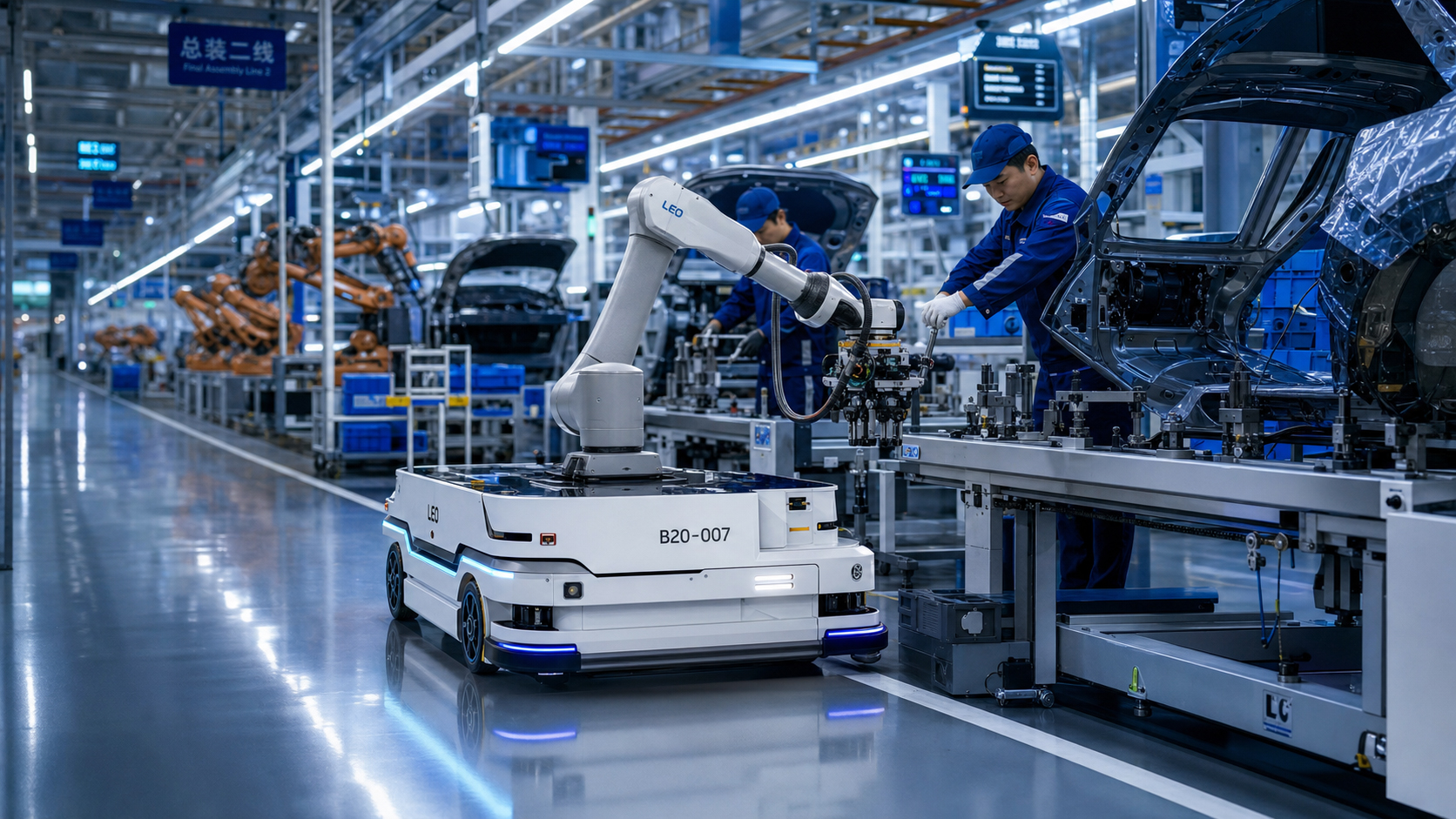
Wheels instead of legs: Why the industry is temporarily abandoning the dream of the perfect android – Image: Xpert.Digital
The secret robot war: Why the battle for factories is really only about data
The $5 scenario: When humanoid robots will work more cheaply than humans
Too expensive, too complex: Why the perfect 5-finger robot hand is failing miserably in industry
The global robotics industry is at a historic turning point: The dream of the perfect, humanoid android is giving way to the stark reality of factory floors. While dancing and talking machines still garner applause at tech trade shows around the world, behind the scenes the focus has long been on something entirely different – tangible industrial viability, profitability, and scalability. At the heart of this radical transformation lies a new pragmatism: The industry is opting for wheels instead of legs and simple grippers instead of prohibitively expensive five-fingered hands. Simultaneously, we are witnessing an unprecedented price collapse, driven by China's aggressive dominance in mass production. But the real power struggle is being decided on an invisible battlefield: the race for real-world training data for artificial intelligence. Those who miss the leap from lab prototype to assembly line now risk being definitively left behind in one of the most lucrative future markets in human history. A sober assessment of the new robotics economy.
From showroom to factory floor – The new reality of humanoid robotics
Beauty is not enough: Why the industry is brutally reducing the robot hype to mere utility
The global robotics industry is currently undergoing a quiet but profound realignment. While the public image of humanoid robots is still dominated by spectacular stage performances—machines that dance, walk, and talk—a sober paradigm shift is taking place in the back rooms of Shenzhen laboratories and Shanghai factory floors: away from the question of what a robot can do and toward what it must deliver economically. Yijun Yu, founder of the Sino-Cooperation Platform, succinctly formulated what is now truly at stake after visiting several Chinese robotics companies at the end of May 2026: not maximum human-likeness, but factory-ready operational capability. This shift in perspective is not a short-term trend—it is a structural moment in industrial history.
Pragmatism beats anthropomorphism: The victory of wheels over legs
A bipedal humanoid robot with a five-fingered, dextrorotatory hand is technologically impressive. However, at least in its current stage of development, it is not a superior system for the majority of industrial applications. Instead, a wheeled robot with a functional gripper arm is emerging as a more realistic option for short-term industrial deployment. According to market participants in China, such systems can already handle between 80 and 90 percent of typical factory tasks—logistics, material handling, machine tending, and repetitive assembly steps. This is a remarkably high coverage rate for a concept whose basic mechanical philosophy is closer to the classic automated guided vehicle (AGV) than to the android from a science fiction film.
The reason for this pragmatic advantage lies in fundamental industrial requirements: reliability, maintainability, cost control, and fail-safe operation. Wheel-based platforms with modular grippers are currently superior in all these dimensions. They are easier to maintain, their sources of error are known, and their integration into existing production lines requires less adaptation than a bipedal system that has to balance and navigate in a human-designed environment. This finding may sound sobering to those waiting for the "true" humanoid robot, but it is a realistic and honest assessment of the technological maturity level in 2026.
However, it would be wrong to conclude that walking on two legs has no future. For tasks within existing human infrastructure—narrow stairwells, uneven floors, workplaces designed for human anatomy—the humanoid form retains its systemic logic. The point is simply this: this future is not yet fully present. Industry cannot afford to wait for a technology that will only be ready for mass production in three to five years when a proven alternative solves 80 to 90 percent of the problem today.
The five-fingered hand as a touchstone: Technology without a short-term market
Few things in the robotics debate illustrate the gap between technological ambition and economic reality as clearly as the fate of the five-fingered Dexterous Hand. This technology is considered a central goal of humanoid robotics development—a mechanical hand that replicates the fine motor skills of human grasping as precisely as possible, including independent finger movements, tactile sensations, and adaptive force application. For universal manipulation, that is, a robot's ability to handle any workpiece and tool, such a hand is indeed indispensable.
The problem isn't technological ambition, but the price industry has to pay. Foreign dexterous hands cost up to US$20,000, and even Chinese manufacturers, who have significantly reduced prices through their own developments like Hitbot's "eHand-6," are still operating far above industrial acceptance thresholds for mass applications. In an analysis conducted jointly with the consulting firm P3, the Fraunhofer IPA explicitly stated that flexible hands currently represent the biggest bottleneck in the humanoid hardware chain. They only inadequately meet industrial requirements regarding robustness, lifespan, and cost structure.
The industrial consequence is clear: Several Chinese manufacturers have deliberately removed the five-fingered hand from their product roadmap for the next three years. This decision deserves a nuanced assessment. It is not a capitulation to complexity – it is a strategic focus. Companies operating in a highly competitive market with scarce resources cannot afford to invest development capacities in technologies that, while technologically appealing, are not yet commercially viable. Technological elegance and industrial feasibility – this is the sobering realization – are two different categories that do not necessarily coincide. Those who try to achieve both simultaneously risk not excelling at either.
This observation has broader strategic relevance: it shows that the Chinese robotics market is currently undergoing a selection process in which the company that most quickly makes the leap from laboratory demonstration to industrial scaling will prevail – not the one that displays the most impressive capabilities at a trade fair. Those who bring simpler, reliable systems into mass production early on will gather real-world production data, generate initial revenue, and be able to expand their technological lead on a solid economic foundation.
The data problem as the real competitive struggle
Behind the question of which robot design or gripping mechanism is the right one lies a more fundamental strategic challenge: the data problem. Embodied AI—that is, artificial intelligence that acts physically in the real world—is essentially dependent on high-quality training data, which differs fundamentally from text-based or purely visual data. A robot model intended to function in a real factory doesn't need pictures of factory floors, but rather real movement sequences, real gripping operations on real workpieces, real disturbances, and real process variations—precise sensor data on force, tactility, proprioception, and spatial perception.
This type of data is rare, difficult to collect, and expensive to produce. A recent study by the MERICS Institute on China's embodied AI strategy explicitly pointed out that multimodal robot data—combining image, speech, tactile, and spatial data—remains extremely scarce. Collecting such data requires either expensive teleoperation by specially trained operators, complex laboratory simulations, or—most valuable—the actual operation of robots in real-world production environments. The latter explains a seemingly paradoxical finding: a significant proportion of the 16,000 humanoid robots installed worldwide in 2025 were not primarily used for production, but for data collection.
This creates a unique aspect of market development: deployment and data generation are two sides of the same coin. AgiBot, the world's largest manufacturer of humanoid robots with a market share of over 30 percent and more than 5,100 deliveries planned for 2025, has explicitly formulated this principle: the more robots are deployed, the more valuable real-world data is generated, and the better the models that can be trained. This is a classic flywheel effect: scaling generates data, data improves models, and better models enable further scaling. Those who initiate this cycle early gain a structural competitive advantage that is difficult to overcome through later capital investment alone.
The real competitive challenge, however, doesn't lie in the recognition that data is important – that's a given. It lies in the business model of data collection itself. If data collection is viewed as a one-off project, it's hardly scalable: too expensive, too slow, too context-dependent. On the other hand, those who establish a repeatable, cost-effective mechanism for the continuous collection of real-world industrial data – whether through Robot-as-a-Service models, partnerships with factories, or open-source strategies like AgiBot's – gain a data advantage that ultimately translates into an AI model advantage. This data acquisition challenge is the most strategically profound problem in the entire embodied AI industry – more fundamental than the question of the right actuator technology or the optimal robot form factor.
🎯🎯🎯 Sino-Cooperation

Sino-Cooperation is a platform based in China and Germany
Sino-Cooperation is a platform based in China and Germany that promotes exchange and cooperation between German and Chinese companies, especially through events, digital formats and an online cooperation exchange for market entry and partnerships.
More information here:
Component scaling as a game changer: This is how robotics mass production is created
Price decline as a catalyst: How Chinese manufacturers are rewriting the economy
Alongside the technological realignment, a remarkable price dynamic is simultaneously taking place, shifting the entire competitive landscape. In 2025, the average selling price of an industrial humanoid robot on the Chinese market was around 800,000 RMB, equivalent to approximately US$103,000 to US$110,000. By 2026, this price had already fallen to around 550,000 RMB – roughly US$75,000 to US$78,000. Even more revealing is the decline in pure material costs: these now stand at around 200,000 RMB, or approximately US$27,000 to US$30,000.
This price drop is not a fire sale, but rather the result of structural changes in manufacturing and supply chain strategy. Two developments are particularly effective: First, the increasing modularization and standardization of actuators and gearboxes. Actuators and gearboxes are the most expensive components in humanoid robot hardware – they can account for up to 60 percent of the total system costs, as McKinsey emphasizes in a recent supply chain analysis. When these components are no longer developed as customer-specific individual parts, but produced as standardized modules in larger quantities, the cost per unit drops considerably – a classic learning curve effect of mass production.
Secondly, the manufacturing philosophy for structural components of the robot frame is changing. Until now, many of these parts have been manufactured using CNC-based single-unit and small-batch processes – a method suitable for prototypes and small production runs, but one that becomes uneconomical as volumes increase. The shift to tool-based series production – that is, to processes such as injection molding, die casting, or sheet metal forming, which require high investment costs but enable extremely low unit costs when scaled up – marks the transition from small-batch development to industrial mass production. It is the same step that the automotive industry took a century ago, and it fundamentally alters the cost structure.
Global market researchers confirm this trend: IDTechEx predicts that the market for humanoid robots in the automotive, logistics, and home sectors will reach approximately $25 billion by the early 2030s and grow to around $29.5 billion by 2036. Mordor Intelligence values the market at $3.93 billion in 2026 and expects a compound annual growth rate of 35.26 percent until 2031, with a market volume of approximately $17.8 billion. RBC Capital Markets goes even further, seeing the long-term market potential at around $9 trillion by 2050 – a figure that makes humanoid robots one of the biggest investment themes of the coming decades.
China's structural dominance and the geopolitical dimension
The price leadership and supply chain acumen of Chinese manufacturers are no accident, but the result of years of strategic industrial policy and a profound systemic advantage in hardware manufacturing. By 2025, China accounted for over 80 percent of all humanoid robots installed worldwide – a level of dominance unparalleled even during the peak of China's solar or battery industries. AgiBot from Shanghai leads the global market with a share of approximately 30 to 39 percent, followed by Unitree from Hangzhou and UBTECH from Shenzhen. This concentration in the hands of a few Chinese players is remarkable, but not surprising: China possesses a complete domestic value chain for the relevant components – from electric motors, gearboxes, and sensors to power electronics and structural materials.
RBC Capital Markets estimates that China alone could capture up to 61 percent of the global humanoid robot market by 2050 – driven by government support, economies of scale in manufacturing, and strong domestic demand from industry and households. This lead is being actively defended politically: China introduced its first technical standards for embodied AI in 2026, while the US is simultaneously working on legislation to restrict the import of robotic systems from certain countries. The global robotics industry is thus increasingly becoming a geopolitical battleground – similar to the semiconductor industry, but with a different starting point: While the US maintains technological leadership in chips, China appears to have already taken a clear lead in humanoid robots.
European and German companies have so far played a subordinate role in this situation. The Ulm-based company Neura Robotics, which is backed by Schaeffler and operates with a cognitive robotics concept, is a bright spot for Europe – but structurally far removed from the scale already achieved by Chinese and American players. Fraunhofer IPA and McKinsey warn European component suppliers of a narrow window of opportunity: those who do not invest now in the standardization and scaling of critical components such as gearboxes, actuators, and touch sensors will miss out – because once established supply chains are established, they are difficult to displace.
Economic efficiency, the labor market, and the actual disruption
Behind all this lies a fundamental economic logic that extends far beyond the robotics industry. The real driving force behind the boom in humanoid robots is not technological pride – it is economic pressure. In highly industrialized economies, the shortage of skilled workers is worsening, labor costs are rising, and the pressure for production efficiency is increasing. In China, in particular, a demographic factor comes into play: the working-age population is shrinking, while the demand for industrial production remains high. Humanoid robots offer a structural answer to these challenges that goes far beyond individual automation projects.
The economic viability calculations are changing rapidly. According to calculations by the management consultancy Horváth, by the end of this decade, a humanoid robot, at a price of around US$55,000, will be approximately 3.5 times more efficient than a human – with a payback period of less than 20 months. Currently, at prices between US$75,000 and US$110,000, these systems are already cost-effective for companies with high production volumes and low product variation. Industry experts estimate that the second wave of industrialization – for tasks with high variation and complex processes – will begin between 2028 and 2030. A humanoid hourly wage of less than US$14 is already realistic according to conservative estimates – and could fall to less than US$5 by 2035.
The societal context of this development deserves a nuanced examination. The use of humanoid robots in factories is no longer an abstract vision of the future – it is already beginning to impact concrete labor market structures. Repetitive, physically demanding, and ergonomically challenging tasks in production and logistics are the focus of initial deployments. These are precisely the professions that are already suffering from a severe shortage of skilled workers in many countries. In this sense, robotization can initially act as a stopgap measure – but in the long term, it will also displace professions that are currently considered the domain of humans. Addressing this dimension, including retraining strategies, social safety nets, and regulatory frameworks, is not yet adequately prioritized on the political agenda.
From prototype to mass-produced product: What the transition really means
The combination of falling prices, growing user experience, and strategic data accumulation marks a transition that the industry itself recognizes as a watershed moment: from systems that perform many tasks with limited capability to systems that reliably fulfill selected tasks. AgiBot has identified this moment as the defining turning point of 2026. It's the difference between a technology that impresses and a technology that delivers a return on investment.
This has concrete implications for investors, industrial companies, and policymakers. Component manufacturers—particularly in the areas of gearboxes, actuators, and touch sensors—face a rare opportunity: a growing market with a still-open supplier structure, where setting standards translates into market power. At the same time, the pressure is mounting on companies that remain passive observers: those who fail to launch pilot projects, collect data, and establish partnerships with robotics manufacturers today will face a fait accompli in just a few years. The barriers to entry increase as standardization progresses.
A clear picture emerges from the global competitive analysis: China leads in volume, price, and deployment experience. The US leads in AI models and software platforms. Europe lags behind in both areas but possesses excellent component expertise—particularly in Germany, Austria, and Switzerland—which holds considerable potential for a supplier-based positioning in the value chain. The question is not whether the market is coming—it's already here. The question is which European players will make the right strategic decision in time to play a part in it.
Yijun Yu's visits to Shenzhen are therefore not mere footnotes from a distant market. They offer a glimpse into an industrial transformation that is currently being decided – quietly, pragmatically, and at a speed that is easily underestimated from the outside. Humanoid robotics has moved beyond the phase of technological fascination. What now matters are production volumes, material costs, data strategies, and amortization periods. This is less glamorous than a robot dancing on a CES stage – and precisely for that reason, so significant.
Your global marketing and business development partner
☑️ Our business language is English or German
☑️ NEW: Correspondence in your native language!

Konrad Wolfenstein
I and my team are happy to be available to you as your personal advisor.
You can contact me by filling out the contact form here [email protected]:or simply call me at +49 7348 4088 965. My email address is
I'm looking forward to our joint project.
☑️ SME support in strategy, consulting, planning and implementation
☑️ Creation or realignment of the digital strategy and digitization
☑️ Expansion and optimization of international sales processes
☑️ Global & Digital B2B trading platforms
☑️ Pioneer Business Development / Marketing / PR / Trade Fairs
Our EU and German expertise in business development, sales and marketing

Our EU and German expertise in business development, sales and marketing - Image: Xpert.Digital
Industry focus areas: B2B, digitalization (from AI to XR), mechanical engineering, logistics, renewable energies and industry
More information here:
A thematic hub offering insights and expertise:
- Knowledge platform covering global and regional economies, innovation and industry-specific trends
- A collection of analyses, insights, and background information from our key areas of focus
- A place for expertise and information on current developments in business and technology
- A hub for companies seeking information on markets, digitalization, and industry innovations









