
Factories on the brink of revolution: Why humanoid robots will change our workplaces as early as 2026
Xpert Pre-Release

Language selection 📢
Published on: March 22, 2026 / Updated on: March 22, 2026 – Author: Konrad Wolfenstein
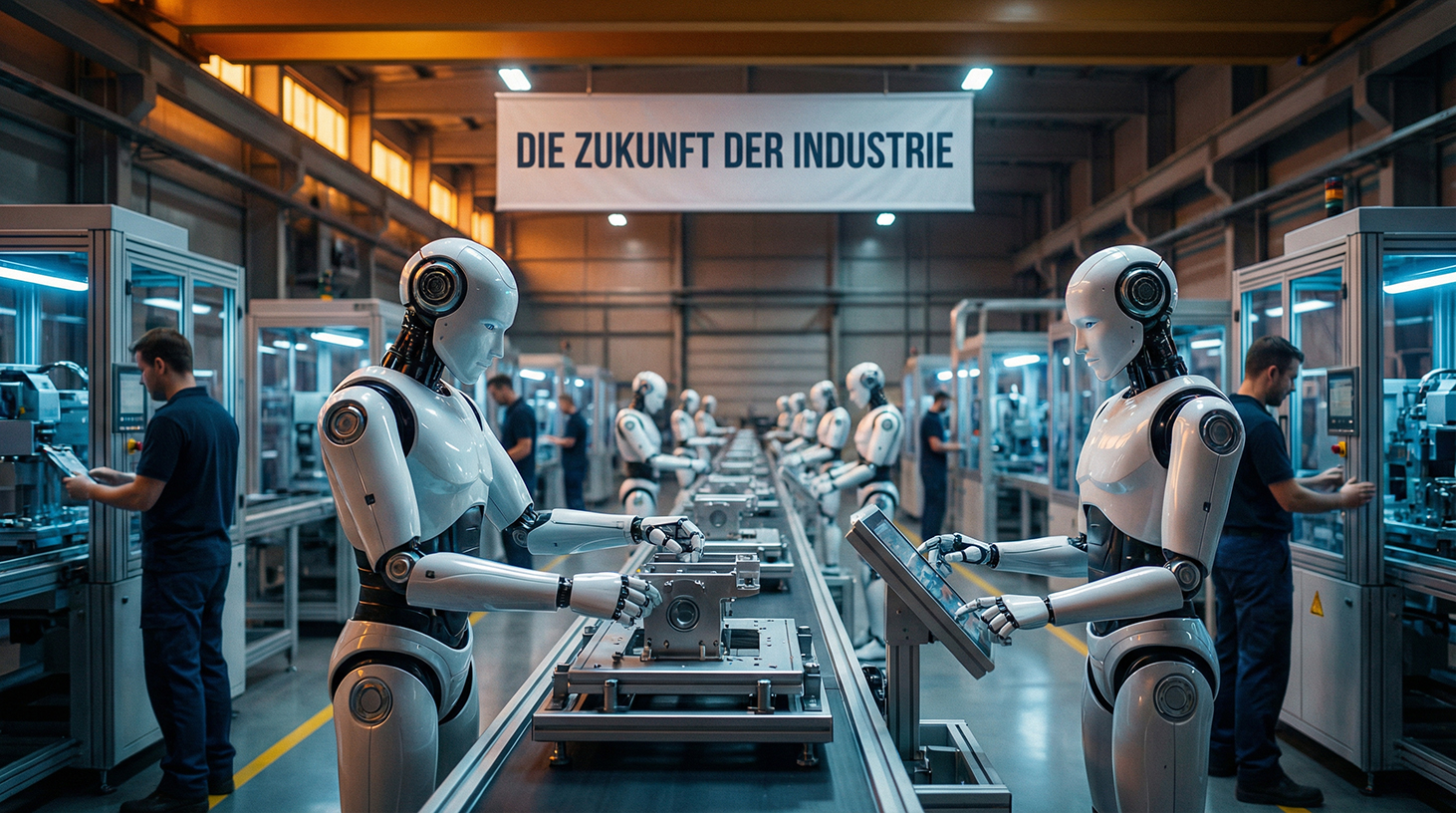
Factories on the brink of revolution: Why humanoid robots will change our workplaces as early as 2026 – Image: Xpert.Digital
Forget industrial robots: This is why the human form is the key to a new trillion-dollar industry
A trillion-dollar market through AI: How humanoid robots from science fiction are suddenly becoming pure reality
For a long time, they were considered pure science fiction or distant future fantasy, but the turning point is imminent: Humanoid robots are leaving isolated research labs and conquering real factory floors. Driven by massive advances in artificial intelligence and fueled by the global, demographically driven shortage of skilled workers, industry is facing a historic paradigm shift in steel and silicon. The decisive economic lever of this new generation of machines is their form. Because they are built like us, they can seamlessly integrate into existing infrastructures designed for humans – without requiring capital-intensive modifications. While tech giants like Tesla are already planning large-scale mass production for 2026 and analysts are predicting a new trillion-dollar market, China has long since maneuvered itself into a dominant position. But with this rapid technological revolution, fundamental questions about safety, liability, and the future of human labor are also surfacing. A deep dive into a technology that will forever change our global economic landscape.
Not sometime in the distant future, not in twenty years – the industrial robot with a human form is already here
The history of industrial automation is a history of the gradual withdrawal of human labor from dangerous, monotonous, and physically demanding tasks. Since the first hydraulic robot arms of the 1960s, machines have taken over more and more tasks in factories. However, this has always occurred in the form of highly specialized tools, optimized for a single task, installed in a precisely defined environment, and requiring costly reinstallations for every production change. In 2026, a new chapter in this story begins, and it bears a name that long sounded like a futuristic exaggeration: the humanoid robot.
Humanoid robots are no longer prototypes confined to isolated research environments, admired by scientists. They work in factories. They grasp components, operate machines, and load conveyor belts. Tesla is already using its Optimus robot in its own production and plans to begin mass production before the end of 2026. The Chinese automaker BYD works with more than 1,500 humanoid units in its manufacturing plants. BMW is testing humanoid systems for inserting sheet metal parts and operating machines. Schaeffler, the German automotive and industrial supplier, has entered into a strategic partnership with the startup Figure (Note: "Humanoid" is an unusual company name; Figure AI is often meant here), which aims to integrate hundreds of robots into production sites worldwide over the next five years.
Why the human form is the decisive strategic advantage
The fundamental economic logic behind the rise of humanoid robots can be summarized in a single sentence: factories, tools, warehouses, and infrastructure were built for the human body, not for specialized industrial robots. Door handles, stairs, hand tools, control panels, safety gates—all of these are designed for an organism with two arms, two legs, grasping hands, and a sense of balance, standing roughly 1.70 to 1.80 meters tall. A conventional industrial robot arm requires a complete redesign of the production environment to operate efficiently: new safety barriers, adapted conveyor belts, and precisely positioned workpiece carriers.
A humanoid robot can use the same environment as the person who previously worked there. This is no small feat; it's a revolutionary economic concept. It means that companies don't need to undertake capital-intensive renovations of their production facilities when integrating humanoid units. They can automate existing processes gradually without altering the entire infrastructure. This adaptability is the decisive advantage over traditional industrial robots, which, while faster, more precise, and more reliable in their specific tasks, only function in the exact environment for which they were designed.
Technological maturity and the role of artificial intelligence
What has enabled the leap from fascinating trade fair exhibits to industrially applicable systems is the convergence of several technological developments. Advances in sensor technology, particularly in cameras, lidar systems, and tactile sensors, now allow humanoid robots to perceive their environment with a precision that was unimaginable just five years ago. Improved actuator technology—the joints and drives that enable limb movement—has raised mobility to a level that, in some dimensions, even surpasses human anatomy. The Unitree G1, for example, has up to 43 joints.
The decisive catalyst, however, is AI. Vision-language models enable humanoid robots to link visual information with verbal instructions and derive context-sensitive action strategies. AI-supported learning mechanisms allow machines to learn new tasks by observing human actions or through repetition, without having to be reprogrammed each time. Siemens and other automation companies are working intensively on improved digital twins and simulation environments. These make it possible to train and configure robots virtually without interrupting ongoing production. This eliminates one of the biggest obstacles to traditional robot integration: the costly and time-consuming physical programming phase.
🎯🎯🎯 Data-driven B2B industry hub as a quasi-in-house solution

The quasi-in-house solution: How Xpert.Digital closes operational gaps in B2B marketing and sales – Smart Content-Driven Business - Image: Xpert.Digital
Xpert.Digital is a data-driven B2B industry hub led by Konrad Wolfenstein . The company acts as an external, quasi-in-house solution for industrial partners, closing operational gaps in marketing, content, and sales – without requiring additional resources on the client side.
More information here:
China's secret dominance: Europe risks losing the most important technology race
Market forecasts: A trillion-dollar potential with extreme valuation ranges
Analysts agree on one point: the market for humanoid robots will be enormous. However, estimates of its precise size vary widely. This reflects both the uncertainty surrounding the exact adoption path and the fundamental conviction that it is a transformative technology. In its study "Humanoid Robots: The AI Accelerant," Goldman Sachs expects the global market to reach a volume of US$38 billion by 2035, with 1.4 million units shipped. Goldman Sachs has already revised this forecast upwards sixfold compared to previous estimates.
Morgan Stanley is considerably more optimistic, predicting a fleet of 63 million humanoid robots in the US alone by 2050, representing a total market of approximately one trillion dollars. Citi GPS, in its long-term analysis, projects 648 million units worldwide by 2050. The investment firm ARK Invest even cites a maximum market potential of 24 trillion dollars. The Macquarie Group sees a potential of three trillion dollars. Barclays Research has identified humanoid robots as the next "frontier of AI" and expects the market volume to explode from two to three billion euros today to 200 billion euros by 2035.
The turning point in 2026: From pilot phase to series production
What forecasts describe in abstract terms will become concrete in 2026 through the investment decisions of key players. In a historic strategic decision, Tesla has announced the discontinuation of series production of the Model S and Model X in order to convert its Fremont factory to mass production of the Optimus robot. The converted production lines are intended to produce up to one million Optimus units per year in the long term. A first small production run is planned for the end of 2026, with commercial availability for external customers scheduled for 2027. Tesla's strategic shift is more than just a corporate announcement; it is a market-driven signal: The company that made electric mobility viable for the mass market is fully committed to the premise that humanoid robots are the next transformative industrial technology at its most important production site.
At the World Economic Forum in Davos, Elon Musk stated that the long-term goal is to produce one million Optimus robots annually at a selling price of under $20,000 per unit. At the same time, he tempered short-term expectations, emphasizing that the robot is still in the research and development phase, although Optimus Gen 3 already demonstrates human-like learning speed. The ability to learn through observation alone is one of the key technological features that will make industrial applications economically viable. According to media reports, Tesla also plans to locate part of the Optimus production at its Gigafactory in Grünheide near Berlin.
Skills shortage as a structural driver
Technological development alone would not be a sufficient catalyst for the widespread adoption of humanoid robots in industry. The decisive societal driver is the demographically driven shortage of skilled workers, which has taken on a structural dimension in Germany and other aging industrial societies. This gap cannot be fully compensated for in the short to medium term through immigration, educational programs, or extended working hours. Goldman Sachs explicitly identifies the shortage of skilled workers as one of the key market drivers for humanoid robots and sees the technology as a structural response to the discrepancy between available labor and industrial demand.
Three-quarters of all robot installations projected worldwide by 2027 will be in logistics, manufacturing, and the automotive industry, according to Counterpoint Research—precisely those sectors where monotonous, physically demanding, or dangerous tasks are still predominantly performed by humans. For companies operating in these sectors, humanoid robots will not merely be one option among many; they will be an absolute necessity if they are to remain competitive in the global market. Currently, standard models for industrial use are available for $25,000 to $50,000, and costs are expected to decrease further as mass production begins.
China's dominant role and the geopolitical race
One aspect that often remains under-represented in Western European discussions is China's dominant role in the current development phase of humanoid robots. In 2025, Chinese companies like AgiBot and Unitree were responsible for over 80 percent of all global humanoid robot installations. China's state industrial policy has declared humanoid robotics a key strategic technology and promotes it with subsidies, regulatory privileges, and research funding on a scale that Western competitors cannot even come close to matching. This is also reflected in the financing dynamics: Between January and October 2024, 69 funding rounds took place in the global humanoid robotics sector, with a total volume equivalent to several billion euros.
The implication for European industrial companies is clear: China's head start in the mass production of humanoid robots will lead to significant cost advantages. European users who quickly adopt the technology can still benefit from this cost development. However, those who wait until the technology is fully mature and completely regulated risk waking up in a changed competitive landscape where competitors operate with cost structures that are simply unattainable without humanoid support.
The open questions: safety, liability, and social acceptance
The enthusiastic tone of many market analyses should not obscure the significant unresolved questions raised by the widespread introduction of humanoid robots into workplaces. Safety issues are central to every new generation of robots, but they are particularly complex for humanoid systems with their mobility and reach in human environments. How can it be ensured that a humanoid robot does not become a danger to human colleagues in its immediate vicinity if it malfunctions? Who is liable if an autonomous action by the robot results in personal injury or property damage? The classic industrial robot is physically separated from humans by safety barriers. The humanoid robot, on the other hand, is designed for shared workspaces, which fundamentally changes the safety requirements.
Added to this is the question of social acceptance and the impact on labor markets. Even if an initial wave of humanoid robots primarily automates those monotonous and dangerous tasks for which human workers are increasingly scarce, the question will arise in the medium term whether the technology will also be used in areas where it displaces socially valuable jobs. The political and regulatory debate on this has only just begun. What is decided in the factories of the next five years will shape the contours of this debate for decades to come.
📈🔵 Ambidexterity or doom: The only management concept that still works in the triple crisis💡

When proven strategies fail: Organizational adaptability in the digital transformation of ambidexterity - Image: Xpert.Digital
We are currently experiencing a period of economic turmoil that differs fundamentally from previous recessions. A deceptive silence prevails in the boardrooms of European and international companies – broken only by the sound of failing strategies that were considered a guarantee of success just yesterday. This is not merely a cyclical downturn, but a profound structural break. The tools with which companies achieved growth for over two decades simply no longer work.
More information here:
Your global marketing and business development partner
☑️ Our business language is English or German
☑️ NEW: Correspondence in your native language!

Konrad Wolfenstein
I and my team are happy to be available to you as your personal advisor.
You can contact me by filling out the contact form here or simply call me at +49 7348 4088 965. My email address is: [email protected]
I'm looking forward to our joint project.









