
Showroom instead of strategy: The dangerous misconception of the “Robot 6S Stores” – and what a real “Robotics Hub” should look like
Xpert Pre-Release

Available in 27 languages 📢
Prefer Xpert.Digital on GoogleⓘPublished on: May 4, 2026 / Updated on: May 4, 2026 – Author: Konrad Wolfenstein
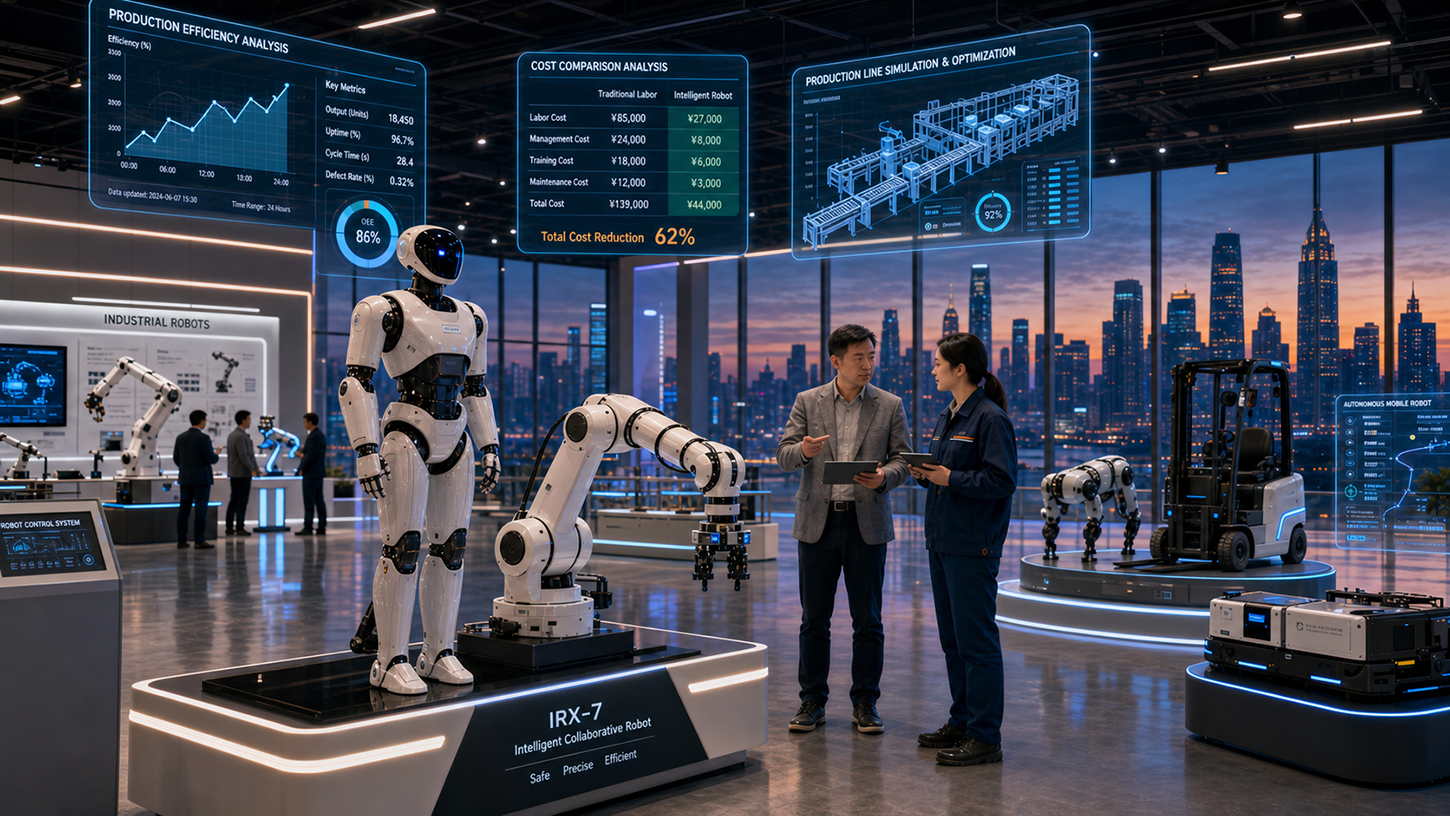
Showroom instead of strategy: The dangerous misconception of the “Robot 6S Stores” – and what a real “Robotics Hub” should look like – Image: Xpert.Digital
The untapped billion-dollar opportunity: What German companies can learn from the robot boom in China's province
Pretty scenery, empty promises — why the world's largest robotics market still doesn't understand its most important customer
China's robotics market is breaking all records, spawning a concept with the new "6S Robot Stores" that aims to make buying automation technology as easy as purchasing a car. But behind the futuristic facades, where humanoid robots perform somersaults and brew coffee, lies a fundamental strategic misstep. While large corporations have long been highly automated, China's small and medium-sized enterprises (SMEs) – the true economic backbone of the country – are left behind due to exorbitant investment costs and a lack of expertise. This article analyzes the structural paradox of the world's largest robotics market. It reveals why gleaming showrooms alone are doomed to failure, how Robotics-as-a-Service (RaaS) and digital twins could save the industry, and where – far from the glittering tech hubs – the real, untapped billion-dollar opportunities lie for global and German automation experts.
From showroom to ecosystem: China's 6S robot stores and the untapped billions of the middle class
On July 28, 2025, what was officially claimed to be the world's first 6S robot store opened in the Longgang district of Shenzhen—operated by Shenzhen Future Times Robotics Co., Ltd. The media response was significant, and indeed the basic concept was remarkable: Building upon the 4S store model familiar from the automotive industry—sales, spare parts, service, and inspection—two new dimensions were added: on-demand leasing and fully customized products. On opening day, 26 robotics companies, including the renowned manufacturer Unitree Robotics, signed cooperation agreements. More than 200 companies from across the industry chain expressed their interest.
The idea caused a stir. Selling robotics technology not as a capital good, but as a service package, inherently lowers the barrier to entry for smaller companies. The leasing model covers a wide range of scenarios—from trade fair receptions and event support to emergency inspections. Shortly afterward, a so-called 7S store opened in Wuhan, expanding this concept even further to include solutions, demonstrations, and training. Within a few months, Chinese cities had begun to replicate the format. An experiment had suddenly become a movement.
But a movement and a functioning business model are two fundamentally different things. Anyone who visits the new showrooms not with the eyes of an enthusiast, but with the analytical gaze of a management consultant, quickly realizes: Most of these stores may look futuristic, but they fail at the crucial point—they are appealing to the wrong customers, with the wrong product, in the wrong way.
A market with global historical implications
To understand why failure means so much to lose, one first needs to look at the sheer size of the playing field. China isn't just an important robotics market. China is the robotics market. In 2024, the country's operational stock of industrial robots reached 2,027,000 units—more than half of global demand coming from a single country. Annual new installations climbed to 295,000 units, a 7 percent increase over 2023 and the highest figure ever recorded.
The industry's total revenue more than doubled in just five years, rising from 106.1 billion yuan in 2020 to 237.89 billion yuan in 2024. In the first three quarters of the following year, growth accelerated further to 29.5 percent year-on-year. The metropolis of Shenzhen alone—the epicenter of China's robotics industry—achieved an industry output of over 242 billion yuan in 2025, a 20 percent increase year-on-year. Shenzhen accounts for approximately 43 percent of all Chinese service robots and nearly a quarter of all industrial robots in the country. With a 10 billion yuan investment program, the city has the explicit goal of achieving an output of over 100 billion yuan in embodied intelligence robotics by 2027 and uniting more than 1,200 companies in this industry cluster.
Globally, the world installed a total of 542,000 industrial robots in 2024—more than double the number from ten years prior. For the fourth consecutive year, more than 500,000 units were installed worldwide. Asia dominated with 74 percent of all new installations, followed by Europe with 16 percent and the Americas with 9 percent. What makes these figures even more remarkable is that Chinese manufacturers surpassed the 50 percent mark for domestic market share for the first time in 2024—rising from 47 percent in 2023 to 57 percent in 2024. Import substitution is complete. The market now belongs, at least in its breadth, to domestic suppliers. Market value forecasts for the Chinese industrial robot segment reach between US$13.8 billion and US$16.5 billion by 2033.
The structural paradox: growth without broad impact
And yet, behind these impressive macro figures lies a fundamental structural paradox. China's robotics market is growing rapidly—but it is growing primarily among large companies, in electronics manufacturing, and in the automotive industry. The electrical and electronics sector alone installed 83,000 units in 2024, followed by the automotive industry with 57,200 units. These sectors are characterized by highly concentrated corporate structures, possessing purchasing departments, investment budgets, and the technical expertise for integration.
The manufacturing sector—those hundreds of thousands of small and medium-sized enterprises that form the economic backbone of entire regions—has been largely left out. The automation rate in the Chinese SME segment remains alarmingly low, and this is not due to a lack of interest. According to one study, 97 percent of the Chinese SMEs surveyed recognize that digitalization can improve operational efficiency. Nevertheless, 35 percent of them cite the high fees charged by technology providers as the biggest obstacle, and 30 percent simply lack the necessary liquidity. The real problem, therefore, is not a lack of information—it is a lack of access.
This access deficit can be precisely described in economic terms: A Chinese SME seeking to acquire a fully automated production cell faces investment costs that, depending on the complexity, can quickly reach millions of yuan. In a market environment characterized by tight working capital, short planning horizons, and unpredictable order volumes, such capital expenditures are simply unaffordable. Furthermore, internal IT teams are often lacking—knowledge-based specialists for system integration are too expensive for SMEs. The technological barriers (high implementation costs, system complexity) correlate with organizational weaknesses (limited digital competence, resistance to change) and are further exacerbated by insufficient government support in accessing subsidies.
The car dealership mentality and its limits
Against this backdrop, the 6S stores' reliance on the car dealership model appears both intuitively obvious and conceptually dangerously short-sighted. A car dealership works because buying a vehicle can be standardized: The customer chooses a model, negotiates the price, signs the contract, and drives off. The decision parameters are limited, the intended use is clear, and after-sales service is largely independent of the buyer's individual operating environment.
An industrial robot is the exact opposite. Its usefulness is entirely context-dependent. A cobot assembling circuit boards in an electronics factory in Shenzhen may be completely unsuitable for a shoe factory in Jinjiang or a plastics foundry in Cixi. The questions that truly concern an SME are not: “Which robot should I buy?” — but rather: “What problem am I solving? Where is the bottleneck in my production? What is the cost of inactivity? How do I integrate the solution into my existing machinery?” A showroom where robots are beautifully illuminated and displayed on pedestals cannot, in principle, answer these questions.
Anyone who spends time exploring several of these new stores will observe a consistent pattern: the presentation aims to amaze, not to foster understanding. There are impressive demonstrations of humanoid robots performing somersaults or brewing coffee—but hardly any structured consultation formats, hardly any ROI calculators, hardly any comparisons between rental and ownership, and hardly any sample lease agreements. The goal seems to be a quick sale, not the long-term development of a customer relationship based on genuine trust and demonstrated added value.
The economic logic of the leasing model: When OpEx triumphs over CapEx
The only way to break through the structural access barrier for SMEs is through a radical rethinking of the financing architecture. The leasing model—or in its further developed form, Robotics-as-a-Service (RaaS)—is not merely a marketing strategy variation, but a fundamental reconfiguration of the economic relationship between technology provider and user.
The difference is clear from an accounting perspective: When purchasing, the entire investment immediately burdens fixed assets, ties up capital for depreciation periods of five to ten years, and requires lengthy internal approval cycles. With the RaaS model, however, the automation solution becomes a predictable monthly operating expense (OpEx)—without blocking capital outflow, without burdening the balance sheet with depreciation risks, and without exposing the business to technological obsolescence risks. Market data shows that monthly RaaS rates for collaborative robots range from $1,500 to $4,000, depending on the manufacturer and feature set. By comparison, directly purchasing a universal robot cobot requires an initial investment of $50,000 to $70,000, plus integration costs.
The principle can be illustrated even more concretely with Chinese market data. In 2024, the average annual earnings of a manufacturing worker in China's private sector were around 71,467 yuan—with monthly costs for the employer, including social security contributions and housing funds, significantly exceeding the gross wage in real terms. Coastal regions like Guangdong, Zhejiang, and Fujian now see hourly wages in private manufacturing of US$4.50 to US$5.50—three times higher than in 2005. The minimum hourly wage in Shanghai is RMB 27.70, and the minimum monthly wage is RMB 2,740. If a leased robot coffee solution costs less than a café employee, the business decision is trivial for the entrepreneur—provided it is explained clearly.
Academic models support this mechanism: The adoption of robotics technology increases significantly when leasing costs fall below 70 percent of equivalent personnel costs. The conversion of capital expenditures (CapEx) to operating expenses (OpEx) is therefore not just a sales gimmick, but a scientifically describable accelerator of adoption. And yet: While most of today's Six Stores formally offer leasing, the level of consultation that explains the actual financing structure and a concrete payment comparison to an SME owner is practically nonexistent.
Our China expertise in business development, sales and marketing

Our China expertise in business development, sales and marketing - Image: Xpert.Digital
Industry focus areas: B2B, digitalization (from AI to XR), mechanical engineering, logistics, renewable energies and industry
More information here:
A thematic hub offering insights and expertise:
- Knowledge platform covering global and regional economies, innovation and industry-specific trends
- A collection of analyses, insights, and background information from our key areas of focus
- A place for expertise and information on current developments in business and technology
- A hub for companies seeking information on markets, digitalization, and industry innovations
AR, leasing models and practical workshops: How automation becomes accessible for SMEs
Beyond the hardware: The digital menu as a sales transformation
The second major shortcoming of existing showrooms is conceptual in nature: they treat the purchasing process for automation technology like buying a television in an electronics store—the customer looks, tests, buys, or doesn't buy. This logic completely ignores the fact that an automation decision in manufacturing companies is fundamentally an operational planning decision that deeply impacts production logistics, factory layouts, and process sequences.
The technological means to solve this problem already exist. Digital twins—dynamic, data-driven virtual representations of physical production environments—make it possible to plan, test, and optimize new automation solutions in a simulated environment before a single machine is delivered. Modern factory planning platforms combine 3D layout editors, material flow simulations, and AR interfaces into an integrated planning tool. Manufacturing suppliers no longer have to guess whether a cobot will fit into their existing plant—they can test it virtually in real time.
Augmented Reality (AR) translates this logic into physical reality: An entrepreneur enters the showroom with a floor plan of their factory displayed on a tablet, and the system projects various robot configurations to scale into their virtual production space. AR and digital twins not only reduce the cognitive load of decision-making—they transform the showroom from a passive exhibition space into an active planning tool. Companies like Siemens and NVIDIA have long since established this approach in their Industry 4.0 solutions. The fact that most SixS stores are not yet using these technologies for customer presentations represents a significant missed opportunity from a market development perspective.
Education as infrastructure: The underestimated third element
There's a dimension almost entirely overlooked in the discussion about robot showrooms: their potential function as educational infrastructure. This may sound academic at first, but it's highly relevant from an economic perspective. The biggest structural barrier to SME automation isn't capital—it's knowledge. Entrepreneurs who don't understand how robotics works, what it can and can't do, won't make informed purchasing decisions. Even worse, they'll make poor purchasing decisions, make bad investments, and subsequently serve as a cautionary tale for others in their network.
The Wuhan 7S Store model has at least recognized this gap: In addition to retail, the store offers training and educational programs for operating and maintenance personnel, as well as programming courses for students. Wuhan simultaneously announced the establishment of a 1 billion yuan industrial investment fund to promote business development in the field of humanoid robotics. The signal is positive—but implementation in most cities remains incomplete.
A robotics hub worthy of the name must understand education as a strategic pillar, not an optional add-on. Practical workshops where SME owners program a cobot together with their skilled workers, conduct ROI simulations, or work through industry-specific use cases—that would be real added value. The hub would then become a center of expertise, not a department store. And an entrepreneur who has their first practical encounter with robotics in such a center is highly likely to become the first leasing customer shortly thereafter.
This is especially true for the next generation. Today's children will grow up in a world where robotics is a standard component of every manufacturing environment. A place where they experience this technology not through a YouTube channel, but through physical interaction, fulfills a social function far beyond its commercial purpose. Combining STEM education and industrial expertise in a single format is a value proposition that resonates with schools, communities, and parents alike—and ensures a sustained foot traffic for the showroom that purely commercially oriented concepts will never achieve.
Quanzhou and Ningbo: The true industrial heartlands of China
If one seriously considers where a true robotics hub can exert the greatest economic leverage, one must set aside the usual suspects. Shenzhen, Shanghai, Beijing—these metropolises are already highly automated, at least in their leading industrial sectors. The truly transformative opportunity lies in the second- and third-tier cities—those places that function as China's industrial backbone regions but are barely present in the global tech narrative.
Quanzhou is the prototype of such a city. With a GDP exceeding 1.38 trillion yuan in 2025, this coastal metropolis in Fujian province is among China's strongest economies. The private sector is the backbone of its economy: industrial value added and private investment grew by 7.8 percent and 5.6 percent, respectively, and the number of businesses surpassed 1.71 million. Quanzhou is home to a national advanced manufacturing cluster for sporting goods, as well as seven nationally recognized specialized industrial clusters for SMEs. The city is not a single-product hub—it encompasses nine key manufacturing clusters, including textiles, petrochemicals, machinery, and electronics.
Ningbo tells a similarly impressive story. The city's total industrial output reached 1.57 trillion yuan in 2022, a 7.2 percent increase year-over-year. The manufacturing sector employs nearly 1.95 million people. With its port, the world's largest handling 1.22 billion tons of cargo, Ningbo is deeply integrated into global supply chains. In robotics, Ningbo holds a position matched by few cities worldwide: it is one of the few locations in China with a complete industrial cluster for all three key robotics components—reduction gears, control systems, and servo motors. Ningbo is home to more than 50 major companies along the robotics value chain, generating an industry output of nearly 8 billion yuan. By 2027, the city aims to become the leading industrial robot manufacturer, with core industry revenue exceeding 10 billion yuan.
What does this mean for a robotics hub? These cities don't have the sleek startup offices, Instagram-worthy product presentations, and international media attention—but they do have real, unadulterated need. A shoe manufacturer in Jinjiang (Quanzhou) that still performs 80 percent of its production steps manually is a far more urgent and serious automation candidate than a Shenzhen tech founder testing their third robot. The density of the need, the seriousness of the users, and the lack of competing offerings make these regions ideal locations for a genuine, transformative robotics hub.
The German technology exporter and the Chinese market opening
For German automation and robotics companies, the Chinese market presents a unique strategic challenge: It is the world's largest growth segment, but also one of the most complex market environments, where regulation, localization pressure, intellectual property and cultural sales logic all work against the unprepared newcomer.
The classic market entry strategy—a sales partner in Shanghai, two trade fairs in Hanover and Shenzhen, then waiting—is hardly yielding results in this environment. The Chinese robotics industry has developed a level of technological independence in just a few years that has made it self-sufficient for many standard solutions, independent of foreign suppliers. The domestic market share of Chinese manufacturers rose from 31.4 percent in 2020 to 58.5 percent in 2024. Foreign technology is therefore not irrelevant—but it must demonstrate a clearly definable superiority in specific niches: precision mechanics, sensor technology, control software, process safety, or industry expertise in regulated sectors.
This is where the true strategic value of a genuine robotics hub in an industrial region like Quanzhou or Ningbo lies for European technology providers. Such a hub functions as a physical testing environment, a curated customer network, and a trust infrastructure in a market where trust is built solely through personal presence, proven expertise, and a long-term commitment to investment. A showroom where medium-sized businesses from the local industrial cluster come and go daily offers something unparalleled: direct access to real-world use cases, the actual customer decision-making process, and feedback loops that no market research firm can replicate.
The concept of free first-year rent—a structured risk reduction for foreign market entrants—is not a philanthropic act, but a clearly calculated strategic investment. A European automation company planning a standard entry into the Chinese market can easily incur €200,000 to €500,000 in start-up costs for sales, localization, trade fair presence, and personnel—without any guarantee of a single sale. Consolidated access to a pre-qualified customer base within an industrial cluster, whose needs are documented and whose purchasing power is proven, has an economic value that far outweighs the lost rental income.
From idea to institutionalization: What makes a true robotics hub
Finally, it is worthwhile to provide a precise functional definition of what distinguishes a true robotics hub from a well-lit showroom — beyond rhetoric and marketing formulas.
A true robotics hub integrates at least four operational levels:
First, the consulting level, where trained automation consultants work with SME owners to conduct process analyses, identify bottlenecks, and calculate concrete ROI models—not based on standard assumptions, but on the customer's actual operating data.
Second, the testing level, where machines are not statically displayed but actively operated—ideally in simulated or real production scenarios representative of the local industrial clusters. The digital testing level complements this with AR-supported factory planning and digital twins, enabling customers to simulate integration even before the first hardware delivery.
Thirdly, the financing level, where leasing models, RaaS options, and hybrid financing strategies are clearly communicated and contractually defined—with real-world comparisons between ownership costs and operating cost models.
Fourthly, the education level: regular training programs for operating and maintenance personnel, industry-specific workshops, and STEM programs for school and university students.
These four levels together transform a place of self-presentation into a place of value creation. Only those who consistently focus on all four build the institutional legitimacy that enables long-term customer relationships and—through word-of-mouth in the closely networked SME landscape of an industrial region—organic growth.
The democratization of automation is not yet complete
The idea behind the 6S robot store was and remains a good one. In a market that still hasn't overcome the technological barrier to entry for a huge portion of its economic players, the leasing model is a real lever. The physical presence of automation technology makes a genuine contribution to knowledge transfer, and the democratization of robotics—not just for corporations, but for the café, the shoe factory, the foundry—is a top-priority economic policy objective.
Most of the stores that have opened so far do not yet meet this requirement. They are well-intentioned but poorly executed, and they unwittingly cater to the audience that needs help the least—the tech-savvy urbanite, not the mid-sized business owner from the industrial cluster who urgently wants to know if they can rent a solution for 5,000 yuan a month that replaces an employee worth 9,000 yuan.
The Chinese industrial robotics market is growing in a way that is historically unprecedented. The question is not whether SME automation will come—but who will build the institutions that will make this transition navigable for the millions of small businesses that account for the lion's share of China's manufacturing output. This is not a philanthropic project, but one of the most attractive value creation opportunities in the global automation market. Whoever replaces the mere showroom with a true hub will occupy a market segment that is still virtually untouched.
Consulting - Planning - Implementation

Konrad Wolfenstein
I would be happy to serve as your personal advisor.
me at wolfenstein∂xpert.digital contact
Just call me on +49 7348 4088 965 .
🎯🎯🎯 Sino-Cooperation

Sino-Cooperation is a platform based in China and Germany
Sino-Cooperation is a platform based in China and Germany that promotes exchange and cooperation between German and Chinese companies, especially through events, digital formats and an online cooperation exchange for market entry and partnerships.
More information here:





