
Embodied AI and Deployment-First Robotics: AI Gets a Body – Why Humanoid Robots Are Now Conquering Our Factories
Xpert Pre-Release

Available in 27 languages 📢
Prefer Xpert.Digital on GoogleⓘPublished on: June 8, 2026 / Updated on: June 8, 2026 – Author: Konrad Wolfenstein
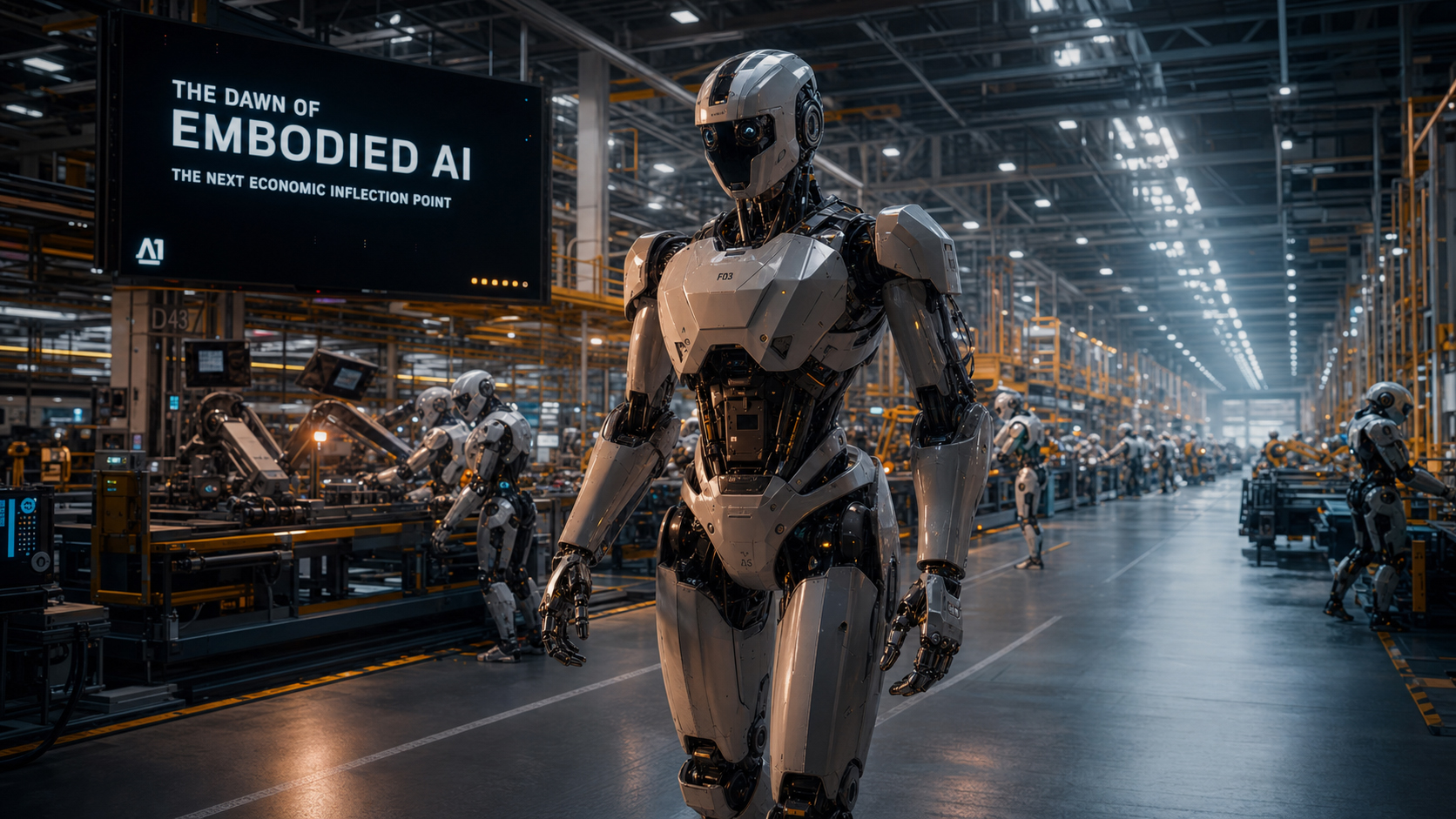
Embodied AI and Deployment-First Robotics: AI Gets a Body – Why Humanoid Robots Are Now Conquering Our Factories – Image: Xpert.Digital
For $2 an hour: How “Embodied AI” is revolutionizing the global job market
Deployment-First: Why China is leaving the West behind in the new robot race
Embodied AI: The trillion-dollar tech trend that German companies cannot afford to miss
Artificial intelligence is leaving the screen and learning to walk. What was recently considered a distant science fiction vision is now assembling real car parts in BMW's factory halls. With the rapid development of so-called embodied AI – artificial intelligence embodied in physical systems – we are currently experiencing a technological revolution that goes far beyond the mere deployment of new machines. Driven by massive cost reductions, new foundation models, and a dramatically worsening demographic labor shortage, humanoid robots are on the verge of breaking through into industrial mass production.
But while Western companies focus on perfection and proprietary data, China is already creating hard facts with a radical "deployment-first" strategy. This article examines the economic logic behind the future trillion-dollar market for humanoid robotics, analyzes the true costs of robot labor compared to the minimum wage, and shows why automation will soon no longer be a strategic option for businesses—but rather the only way to ensure their survival.
Related to this:

The silent revolution in the factory hall
There are technological leaps that announce themselves gradually, and those that, in retrospect, appear as a sudden rupture. The development of so-called embodied AI—that is, artificial intelligence physically embodied in physical systems such as robots, autonomous vehicles, and industrial machines—belongs to the latter category. What was considered a distant vision just a few years ago has become a tangible economic reality by 2026. The global market for embodied AI was estimated at around US$3.48 billion in 2025 and is projected to grow to US$14.34 billion by 2035, with an annual growth rate of over 15 percent. Other, more methodologically diversified market estimates, which also include industrial software ecosystems and physical AI platforms, already anticipate a volume of US$23 billion by 2030, which would correspond to annual growth of 39 percent.
These figures are impressive, but they don't tell the whole story. The truly relevant economic question isn't how large the market for embodied AI products will become, but rather what kind of transformation their use will trigger in industry, logistics, healthcare, and ultimately, the entire labor market. The technology's value lies less in the revenue of robot manufacturers than in the productivity gains of those who use these robots. And these productivity gains, as initial reliable field data shows, are substantial.
From laboratory to assembly line – The first real-world proof
The most convincing proof that Embodied AI has made the leap from the demonstration stage to real-world production was provided by Figure AI in collaboration with the BMW Group plant in Spartanburg, South Carolina. Over a period of eleven months, the humanoid robot Figure 02 was deployed on an active assembly line – and the result was clear: The robot loaded over 90,000 sheet metal parts, logged more than 1,250 operating hours, and contributed to the production of over 30,000 BMW X3 vehicles. The required placement accuracy was five millimeters in less than two seconds per cycle – a requirement that initially seemed almost unimaginable within the scope of a test program.
What makes this example so valuable is not just the technical achievement, but the context. It involves an ongoing series production with clear industrial performance indicators (KPIs): cycle time, placement accuracy, and the number of human interventions per shift. All three parameters were systematically monitored and improved. BMW was not a passive observer in this pilot project, but an active knowledge partner – and as early as 2026, the program was extended to the BMW plant in Leipzig, marking the first productive use of Physical AI in Europe. Hyundai, which owns Boston Dynamics, presented its AI-powered Atlas robot at CES 2026 and immediately committed to its use in its electric vehicle factory in Georgia.
The pattern is clear: The automotive industry is playing the same pioneering role in humanoid robotics today as it once did in the use of conventional industrial robots. Pilot programs are becoming standard installations, and standard installations are becoming scaling strategies.
The Economics of Physical Intelligence – What Robot Work Really Costs
The crucial economic angle in this debate is the comparison between a robot's hourly rate and a human's hourly rate. According to an analysis by Roland Berger, the operational cost per hour for an advanced humanoid robot is approximately two US dollars. This contrasts sharply with hourly wages of 28 US dollars for warehouse workers in the US. In Germany, where industrial workers cost significantly more on average, the cost asymmetry is even more pronounced. RethinkX, an analysis firm specializing in technological disruption, goes even further, predicting that humanoid robots will enter the market in the near future for less than 10 US dollars per hour and could fall below one dollar per hour by 2035 – with long-term potential to be less than ten cents.
The acquisition costs for advanced systems currently range from $20,000 to $50,000 per unit, with Tesla aiming for a medium-term price point of under $20,000 to $30,000 for its Optimus robot. Between 2023 and 2024, manufacturing costs for humanoid robots already fell by 40 percent – from a range of $50,000 to $250,000 to $30,000 to $150,000. This cost reduction is significantly faster than the initially projected 15 to 20 percent per year and is methodologically reminiscent of the early learning curve in the solar industry or with lithium-ion batteries.
A Citibank analysis calculated that a humanoid robot costing $25,000, working 16 hours a day, six days a week, can pay for itself in just 36 weeks – based on the US minimum wage. In regions with higher wages, this period is even shorter. The Boston Consulting Group estimates the ROI of industrial robotization projects at 10 to 15 percent in the first year and 20 to 25 percent over three to five years. Beyond these conservative estimates lies the long-term calculation by RethinkX: An investment of $280 billion in humanoid robots could generate a productivity increase of $66 trillion – a calculated ROI ratio that shatters conventional valuation frameworks.
In its baseline scenario for 2035, Roland Berger projects a market at the OEM level of US$300 billion, and up to US$750 billion in an optimistic scenario. By 2050, the forecast predicts the total market could approach the size of today's automotive industry – meaning up to US$4 trillion annually.
Deployment-First as a Strategy – China's Industrialization Flywheel
The term "deployment-first" doesn't refer to a technical characteristic, but rather a strategic approach: roll out first, then optimize. In contrast to the Western, AI-driven approach, which aims to develop the most universal and robust models possible before mass production, China pursues a volume-centric strategy. China produced more than 15,000 humanoid robot units in 2025 – at least thirty times as many as North America and over 150 times as many as Europe. In the first half of 2026 alone, Chinese robotics companies raised $5.6 billion in venture capital across 176 funding rounds – as much as they raised in the entire year of 2021 at the peak of the previous funding cycle.
In 2025, China produced approximately 12,800 humanoid robots, representing about 90 percent of total global production, and deployed them primarily in training centers, research labs, logistics, and manufacturing. Companies like TARS Robotics, X Square, Spirit AI, and Galaxea AI raised hundreds of millions of dollars in funding rounds within just a few months. The strategic logic behind this is elegant: each deployed robot generates real-world operational data, which is used to improve AI models. The more units are in operation, the faster the software improves—a self-perpetuating data flywheel.
This development is geopolitically significant. China's dominance in the electric vehicle supply chain also gives domestic manufacturers a cost advantage in the robotics sector: According to MERICS, the country controls 63 percent of the key companies in this supply chain. Western regulations—particularly US export controls (ICTS)—are increasingly forcing manufacturers in North America and Europe to use more expensive, non-Chinese component suppliers, resulting in two- to three-fold cost increases for critical components. The global community is thus effectively developing two parallel technological ecosystems with limited mutual interoperability.
The West – particularly North America with Figure AI (valued at $39 billion) and Tesla Optimus – is focusing on deep AI expertise and proprietary data strategies. The bottleneck here lies less in mechanical design than in the availability of high-quality training data for real-world production environments and in scaling to industrial production volumes. North America boasts a startup ecosystem with 25 companies and $3.8 billion in venture capital, but projected production output in 2025 of only around 500 units.
The technological foundation – Physical AI and Foundation Models
The term Embodied AI represents a profound paradigm shift in AI architecture. Conventional industrial robots are programmed machines: they execute pre-coded movement sequences with high precision and repeatability, but cannot adapt to changing environments. Embodied AI systems, on the other hand, combine perception, reasoning, and motor action in a learning cycle. They utilize multimodal inputs—video data, voice commands, proprioceptive sensor data (joint positions, force measurements)—and continuously generate action sequences from them.
NVIDIA plays a key role in the infrastructure of this development, extending beyond simply supplying GPUs. With the launch of Isaac GR00T N1 in March 2025 and the update to N1.5 in May 2025, NVIDIA introduced the world's first open Foundation Model for generalist humanoid robots. These models utilize a dual-system architecture: a slow, planning-based system analyzes the environment and develops strategies; a fast, reactive system translates these plans into precise motor commands. Crucially, synthetic data generation is key: with the GR00T Dreams Blueprint, NVIDIA can generate massive synthetic training datasets from a single real-world recording—a process that enabled the development of GR00T N1.5 in 36 hours, instead of the nearly three months of manual data generation typically required.
Jensen Huang, CEO of NVIDIA, succinctly stated at the Computex 2025 keynote: "Physical AI and robotics will trigger the next industrial revolution." Robotics developers such as Agility Robotics, Boston Dynamics, NEURA Robotics, and XPENG Robotics have already integrated the NVIDIA Isaac platform into their development infrastructure. The key to this technological layer is its horizontal impact: Foundation Models significantly lower the barriers to entry for new use cases, as basic capabilities no longer need to be trained from scratch but can be adapted through domain-specific fine-tuning with relatively small datasets.
Robot-as-a-Service – The Democratization of Automation
One of the most structurally significant developments in the spread of embodied AI is the emergence of the Robot-as-a-Service (RaaS) model. Similar to Software-as-a-Service (SaaS), RaaS allows companies to lease robotic systems on a subscription or usage basis rather than purchasing them outright. This shifts the investment from the balance sheet (Capex) to the operating expenses (Opex) and drastically lowers the barrier to entry, especially for small and medium-sized enterprises (SMEs).
According to a projection by the International Federation of Robotics, the global RaaS market is expected to grow from US$16.18 billion in 2025 to US$125.17 billion by 2034, representing an annual growth rate of 25.52 percent. Other market surveys are more conservative, estimating the current volume at around US$2.2 to US$4.8 billion, but also project strong growth toward US$8 to US$27 billion by the mid-2030s. The range of estimates reflects the uncertainty inherent in a still-young market, but not the trend itself.
Practical examples illustrate the logic: The US company DNX rents out industrial robots at an hourly rate of around US$50 – significantly below the total cost of a human worker, including benefits in high-wage countries, but with flexible scalability. Knightscope offers security robots for 75 cents per hour on a subscription basis. Scythe Robotics uses a pay-per-acre model for autonomous lawnmowers in agriculture. The strategically significant aspect of RaaS is that it spreads the adaptation costs of automation across a broader base, thereby increasing the rate of diffusion throughout the economy.
🎯🎯🎯 Data-driven B2B industry hub as a quasi-in-house solution

The quasi-in-house solution: How Xpert.Digital closes operational gaps in B2B marketing and sales – Smart Content-Driven Business - Image: Xpert.Digital
Xpert.Digital is a data-driven B2B industry hub led by Konrad Wolfenstein . The company acts as an external, quasi-in-house solution for industrial partners, closing operational gaps in marketing, content, and sales – without requiring additional resources on the client side.
More information here:
From hardware hurdles to data monopolies: The reality behind the robotics hype
The demographic imperative – Why automation is not a choice
The economic justification for embodied AI would be weaker if it were based solely on efficiency gains. Its true power stems from the structural labor shortage, which is already noticeable in developed economies and will increase dramatically by 2050. Germany exemplifies this dilemma: The IAB (Institute for Employment Research) predicts that the baby boomer generation will retire by 2035, creating a massive gap in the labor market that cannot be filled by migration and changes in labor force participation alone. According to Roland Berger, around 45 percent of German manufacturing companies are already lacking qualified personnel, and more than 85 percent of companies are experiencing the first operational effects of the labor shortage – on average, positions remain vacant for four months.
The European Union as a whole faces an even more serious problem: By 2050, the working-age population in Germany will shrink by 24 percent, in Romania by 25 percent, in Poland by 25 percent, and in Hungary by 17 percent. China, too—driven by the long-term consequences of its one-child policy—is facing a 24 percent decline in its working-age population by 2050. Japan and South Korea, both pioneers in industrial robotization, have been grappling with the same demographic constraints for years.
The consequence is not that robots can completely compensate for population decline – the societal implications are far more complex. But it shows that automation in these contexts is not an option, but a structural necessity for maintaining economic performance. Companies that do not invest in automation today will simply be unable to maintain their production capacities in ten years – not because of a lack of capital, but because of a shortage of labor.
Related to this:

Technological limitations and an honest assessment of the maturity level
A serious economic analysis of this development cannot do without critical evaluation. Current systems are still far from being able to replace humans on a broad scale. The main limitations concern hardware durability, software maturity, and ecosystem infrastructure.
On the hardware side, the lifespan of advanced robotic hands in high-volume applications is currently less than a year – a significant factor in the total cost of ownership calculation. Current battery runtimes of two to eight hours are insufficient for multi-shift operation; the industry is aiming for a target duration of 16 hours by 2028. Actuators – the most critical components of a humanoid robot – still need to undergo cost reductions of 50 to 90 percent before they are ready for mass production.
The software gap is potentially even more serious. Roland Berger estimates that the software ecosystem lags behind hardware development by three to five years. Vision language models (VLMs) are becoming increasingly reliable in controlled environments, but open, unstructured environments will continue to overwhelm current systems for at least another five to ten years. The fundamental problem is the lack of data: Unlike language models, which have been trained on trillions of text characters, there are hardly any publicly available, high-quality datasets for robotic manipulation tasks. Real-world training data is expensive to collect, proprietary, and is becoming the decisive competitive advantage of market leaders.
There is also considerable regulatory uncertainty. Existing safety standards for industrial robots were developed for stationary, zone-bound machines and do not apply to mobile, humanoid systems that operate dynamically in human work environments. Harmonised global standards are lacking; the US, EU, and China are pursuing diverging regulatory paths. For EU AI Act compliance, this translates into an increased risk of legal uncertainty, particularly regarding liability issues related to AI-induced physical errors.
The investment hype surrounding humanoid robots reminds some observers of the Gartner Hype Cycle: valuations significantly exceed current supply capacity, and a period of disillusionment is quite likely in the coming years – similar to autonomous vehicles, which, despite years of promises, still cannot operate without human oversight. Waymo, for example, currently requires one human remote operator for every three vehicles – illustrating how complex the path from demonstration to true autonomy is.
Sectoral disruption – who benefits, who loses
For investors and corporate strategists, the question of who will be the sectoral winners and losers of the embodied AI wave is crucial. Bank of America forecasts 90,000 humanoid robot shipments in 2026 alone, rising to 1.2 million units by 2030. The global market for humanoid robots was valued at $6.24 billion in 2026 and is projected to grow to $165.13 billion by 2034, representing an annual growth rate of 50.6 percent.
The winners are initially clear: NVIDIA as an infrastructure provider for AI training platforms, specialized component manufacturers (actuators, sensors, high-performance grippers), automotive manufacturers with early implementation experience, logistics companies with scalable pilot programs, and technology companies with proprietary data flywheels. Robot-as-a-Service providers are also opening up the previously under-automated segment of small and medium-sized enterprises.
The situation is more nuanced for traditional workers. Academic studies from the US show that between 1993 and 2014, industrial robotization reduced employment among men by 3.7 percentage points and among non-white workers by 4.5 percentage points more than among women or white workers – a clear indication of unequally distributed disruption burdens. Structural unemployment disproportionately affects routine tasks in physically demanding environments – precisely the segment that embodied AI primarily targets. Without accompanying skills development and social policies, the productivity dividend of robotization threatens to accumulate as profit for capital owners, while a portion of the workforce is structurally displaced.
The World Economic Forum, on the other hand, predicts that while automation will displace 85 million jobs by 2025, it will simultaneously create 97 million new ones – albeit with a significant skills gap between the lost and created positions. The societal challenge lies less in the overall balance of jobs than in the spatial, temporal, and skills-related distribution of disruption and new job creation.
Europe between ambition and structural weakness
Embodied AI presents a particular strategic challenge for the European, and especially the German, economy. While Germany leads the EU in robot automation density, its domestic startup ecosystem for humanoid robotics is weak by international standards. The EMEA region as a whole comprises only 22 startup OEMs with a funding volume of US$0.8 billion and a production output of around 100 units in 2025. By comparison, China, with a single seed investment of US$513 million for TARS Robotics, mobilized more capital than all of Europe in an entire year.
In October 2025, the European Commission presented its "Apply AI Strategy," which aims to reduce Europe's dependence on AI technologies and build its own capacities. The planned AI gigafactories offer opportunities for Germany in principle. However, Bitkom warns that infrastructure projects on a significantly larger scale – €500 billion and more – are planned in the US and China, which Europe cannot compete with without substantial private investment.
Europe's specific risk lies in its dependence on both sides: Chinese hardware and American AI software. This dual dependence can only be overcome strategically through domestic investment in data and training infrastructure, as well as by promoting specialized hardware suppliers. Mechanical engineering, the automotive industry, and the electrical engineering sector—all core German strengths—would be ideally suited to act as data partners for robotics OEMs, thereby contributing to the knowledge cycle.
The investment logic of the near future
Taken together, a coherent economic picture emerges: Embodied AI and deployment-first robotics are not a speculative trend, but a structurally grounded economic transformation driven by demographics and cost parity. The technology is not yet mature – the hardware gaps are real, the software dependencies are significant, and regulatory uncertainty is considerable. But the direction is irreversible because the alternative courses of action – persistent labor shortages, stagnant productivity, international competitive disadvantages – fare worse economically than taking the risk of transformation.
Venture capital invested in humanoid robotics between 2023 and 2025 exceeded seven billion US dollars. China alone had already invested 5.6 billion US dollars in 176 deals by mid-May 2026. The overall market for industrial robots is projected to grow from 22.7 billion US dollars in 2025 to 57.67 billion US dollars by 2035, representing a growth rate of 9.77 percent. According to the IFR, the market value of installed industrial robots has already reached an all-time high of 16.5 billion US dollars.
The strategic recommendation is not to blindly invest in every robotics hype. Rather, it is to monitor developments objectively, launch pilot programs early, recognize data as a competitive asset, and build the organizational capabilities necessary to productively integrate physical AI systems. Companies like BMW, which invest in field trials today, will have a data advantage tomorrow that will be difficult to overcome. Deployment-first is therefore not just a Chinese industrial strategy—it is the economically rational approach to a technology whose learning curve becomes steeper through real-world application than through even the most sophisticated simulation.
The question that leaders in industry and politics must ask themselves is no longer whether humanoid robots are coming. They are here. The question is, who designs them – and who manages them.
Your global marketing and business development partner
☑️ Our business language is English or German
☑️ NEW: Correspondence in your native language!

Konrad Wolfenstein
I and my team are happy to be available to you as your personal advisor.
You can contact me by filling out the contact form here [email protected]:or simply call me at +49 7348 4088 965. My email address is
I'm looking forward to our joint project.
☑️ SME support in strategy, consulting, planning and implementation
☑️ Creation or realignment of the digital strategy and digitization
☑️ Expansion and optimization of international sales processes
☑️ Global & Digital B2B trading platforms
☑️ Pioneer Business Development / Marketing / PR / Trade Fairs
Our EU and German expertise in business development, sales and marketing

Our EU and German expertise in business development, sales and marketing - Image: Xpert.Digital
Industry focus areas: B2B, digitalization (from AI to XR), mechanical engineering, logistics, renewable energies and industry
More information here:
A thematic hub offering insights and expertise:
- Knowledge platform covering global and regional economies, innovation and industry-specific trends
- A collection of analyses, insights, and background information from our key areas of focus
- A place for expertise and information on current developments in business and technology
- A hub for companies seeking information on markets, digitalization, and industry innovations









