
90 percent market share: How China's humanoid robots are leaving the West behind
Xpert Pre-Release

Available in 27 languages 📢
Prefer Xpert.Digital on GoogleⓘPublished on: April 30, 2026 / Updated on: April 30, 2026 – Author: Konrad Wolfenstein
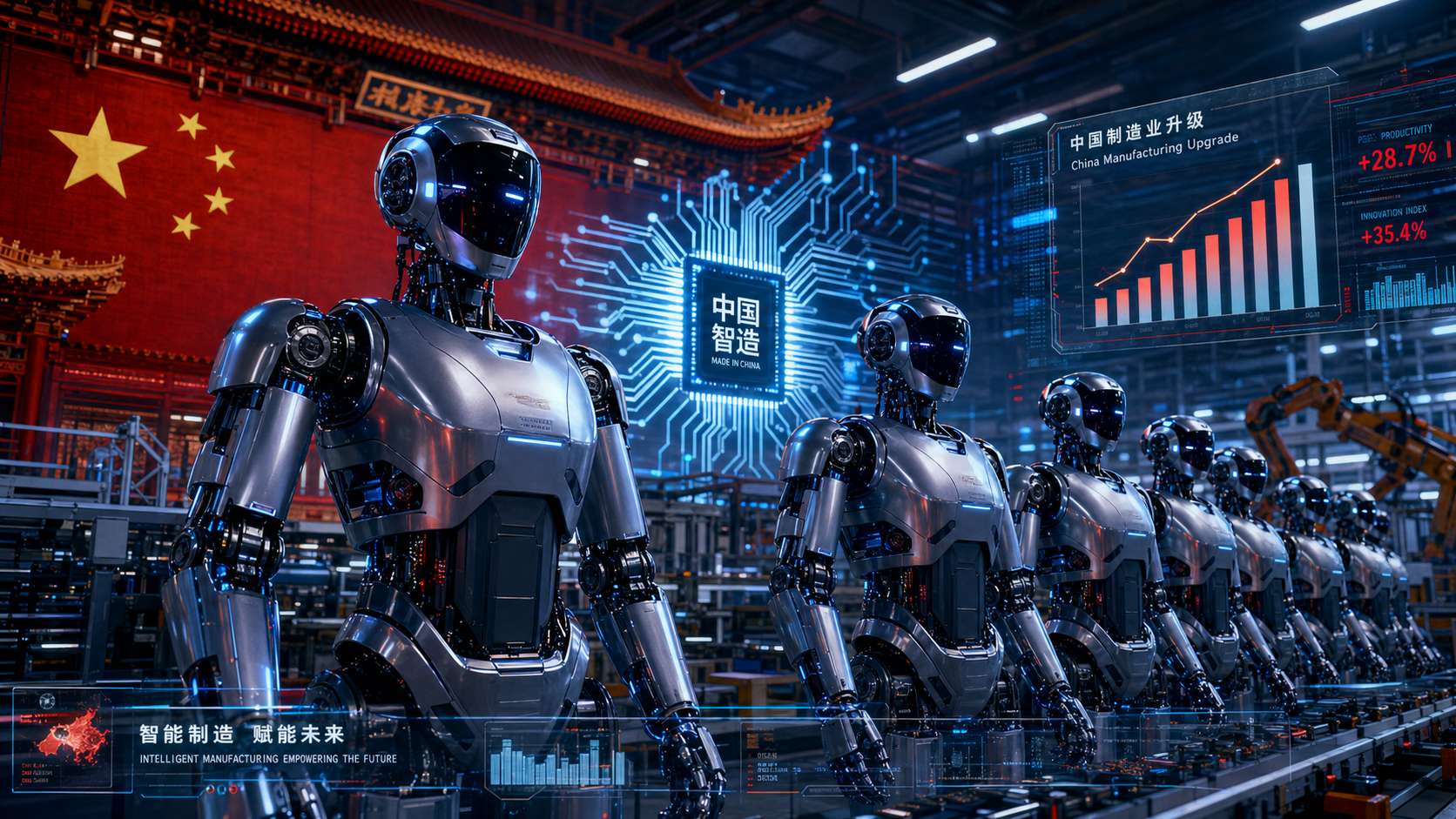
90 percent market share: How China's humanoid robots are leaving the West behind – Image: Xpert.Digital
These 5 Chinese tech giants are bringing robots into mass production
While Tesla is still testing, China is delivering: The uncanny rise of the robot superpower
18,000 units in one year: The moment humanoid robots became suitable for mass production
The year 2025 marks a historic turning point in industrial and technological history: Humanoid robots have finally left the research labs and are conquering global mass production. But while the West—especially prominent US pioneers like Tesla and Boston Dynamics—is still experimenting with prototypes and debating regulations, China has long since established a fait accompli. With an unprecedented combination of government subsidies, billions in private capital, and rapid technological advancements, Chinese manufacturers now control around 90 percent of the global market. From agile models for under $6,000 to robots already working in Airbus production, the rise of Chinese humanoid robotics is unprecedented. This development is far more than an economic boom; it is a tangible geopolitical power shift. Let's take a detailed look at the five giants leading this global automation revolution and the profound strategy that makes them so dominant.
China's Humanoid Robotics Elite: Who is Leading the Global Automation Revolution
From niche to global power: China's strategic rise
In 2025, Chinese humanoid robotics reached a turning point unparalleled in industrial history. What had been a laboratory-level endeavor just a few years prior had matured into market-ready mass production. Over 150 Chinese companies are now developing humanoid robots, and more than 330 new models were unveiled in 2025 alone. The entire industry grew at a rate exceeding 50 percent annually, and the Chinese National Planning Commission declared the sector a key strategic industry within the framework of the 15th Five-Year Plan (2026–2030). This success is not solely due to spontaneous entrepreneurial energy, but rather to the structured interplay of government mandate, private sector risk-taking, and the technological expertise that China has cultivated over decades in industrial automation.
The market volume of the Chinese humanoid robotics sector was approximately US$0.4 billion in 2025; MarketsandMarkets forecasts growth to US$2.8 billion by 2030, representing a compound annual growth rate (CAGR) of 47.6 percent. The long-term projection is even more ambitious: Market Research Future expects a global market volume of US$92.8 billion by 2035, starting from a base value of US$4.9 billion in 2025. China, in turn, has announced its intention to develop the domestic market to 100 billion yuan – roughly US$14 billion – by 2030. These figures are not merely economic estimates; they are political targets backed by subsidies, regulatory incentives, and government contracts.
From laboratory prototypes to series production: The year 2025 as a pivotal year
Industry observers unanimously consider 2025 the first true year of mass production of humanoid robots. Between 13,000 and 18,000 units were shipped worldwide – an increase of approximately 480 to 508 percent compared to the previous year. According to Omdia data, Chinese manufacturers alone accounted for around 90 percent of all global shipments. In comparison, major US companies like Tesla, Figure AI, and Agility Robotics together shipped only about 150 units each – figures that starkly illustrate the discrepancy between American valuation euphoria and the reality of Chinese production.
Behind this dominance lies an industrial policy architecture that deliberately prioritizes speed. In 2025, Beijing opened a so-called Robomall, a kind of showroom and sales center for robots, and established training centers throughout the country where humanoid robots learn warehouse logistics, sorting, and packaging using VR and motion-capture technology. In Shanghai, Wuhan, Hangzhou, and Beijing, infrastructures were thus created that aim for industrial applicability, not mere showpiece displays. Beijing itself announced its intention to achieve an annual production capacity of 10,000 units in the capital region alone by 2027. This is not to be understood as an abstract vision of the future, but as a concrete planning target with allocated budgetary resources.
The five market leaders and their economic power
The total valuation of Chinese humanoid robotics companies has surpassed US$27.8 billion. Within this ecosystem, five companies have emerged as a dominant class, each achieving a valuation of at least US$1.4 billion.
UBTECH Robotics, based in Shenzhen, is the only publicly listed company in the entire sector, giving it a unique position. In 2025, the company achieved total revenue of 2.01 billion yuan, representing a 53.3 percent increase. However, the most impressive figure by far was the growth of its life-size humanoid robot segment: revenue jumped from 35.6 million yuan to 821 million yuan, a rise of more than 2,203 percent. 1,079 units were shipped in 2025, making UBTECH the only company worldwide to deliver more than 1,000 complete humanoid robots in a single year. At the same time, the gross margin increased from 28.7 to 37.7 percent, while the net loss decreased by 31.9 percent to 790 million yuan. Research and development expenditures exceeded 500 million yuan in 2025. A contract with Airbus to provide Walker S2 robots for manufacturing applications underlines the company's global commercial reach.
AgiBot – also known as Zhiyuan Robotics – from Shanghai was the world market leader in unit sales in 2025, holding approximately 38 to 39 percent of the global market. With 5,168 units shipped, the company outperformed all its global competitors. AgiBot's valuation recently climbed to US$2.1 billion following participation from prominent investors such as Tencent and JD.com in recent funding rounds. Reuters reported plans for an IPO on the Hong Kong Stock Exchange with a target valuation between US$5.1 and US$6.4 billion. AgiBot's most affordable model starts at around US$14,500, making commercial scaling feasible even for companies beyond large corporations.
Unitree Robotics, based in Hangzhou, has become an icon of affordable, high-performance robots. With over 4,200 units shipped, Unitree was the world's second-largest robot manufacturer by volume in 2025. The company has been profitable since 2020 and reports revenues exceeding 1 billion yuan. Its planned IPO aims for a valuation of up to 50 billion yuan – approximately 7 billion US dollars. Particularly noteworthy is its pricing strategy: the G1 model starts at the equivalent of around 16,000 US dollars, while the entry-level R1 model is available for under 6,000 US dollars. Unitree demonstrates that humanoid robots don't have to be luxury goods, but can be produced at a cost level that enables widespread industrial application.
DEEP Robotics, based in Hangzhou, originated in quadruped robotics and is rapidly expanding into the humanoid field. The company recently secured 500 million yuan in a funding round that included state-owned telecommunications giants such as China Telecom and China Unicom. Its collaboration with Zhejiang University, through the establishment of a joint postdoctoral research center, underscores the close link between fundamental research and industrial application. DEEP Robotics is considered a technologically ambitious company with strengths in motion dynamics and off-road capability.
Fourier Intelligence, headquartered in Shanghai and Singapore, originally emerged from the field of rehabilitation robotics. The company is valued at approximately US$1.1 billion; its investors include the SoftBank Vision Fund. Fourier's GR-1 robot represents the key lever driving the company's transition from a niche medical technology provider to a general-purpose robot manufacturer. This transformation is strategically significant: Fourier possesses considerable expertise in human movement physiology and applies this knowledge to the development of robots capable of mimicking natural human body movements with exceptional precision.
Our China expertise in business development, sales and marketing

Our China expertise in business development, sales and marketing - Image: Xpert.Digital
Industry focus areas: B2B, digitalization (from AI to XR), mechanical engineering, logistics, renewable energies and industry
More information here:
A thematic hub offering insights and expertise:
- Knowledge platform covering global and regional economies, innovation and industry-specific trends
- A collection of analyses, insights, and background information from our key areas of focus
- A place for expertise and information on current developments in business and technology
- A hub for companies seeking information on markets, digitalization, and industry innovations
Humanoid robots from China: patents, production and the new industrial power
Capital inflow and investor rationality: What's behind the boom?
The Chinese robotics industry raised a total of 57 billion yuan – approximately US$7.9 billion – in 610 transactions in 2025, tripling the figure for 2024. This influx of capital is not a blind herd mentality, but rather follows a discernible investment logic: Humanoid robots are considered the next major platform after smartphones and autonomous vehicles. They promise to automate tasks that were previously deemed too unstructured, too adaptable, or too physically variable for traditional robotic arms.
China's industrial wage development lends economic substance to this logic. Since 2010, wages in the Chinese manufacturing sector have more than tripled, and the demographic gap created by an aging population is exacerbating the labor shortage. This results in a market environment where automation solutions are no longer cost factors but competitive necessities. Morgan Stanley wrote in an analysis that continued government support will be crucial to securing China's long-term leadership in robotics. The convergence of government interest and private capital creates an incentive structure that Western competitors cannot replicate.
Patent power and technological depth as a structural advantage
China's technological substance in humanoid robotics is considerable and often underestimated. According to data from Morgan Stanley, China has filed 7,705 patents in the field of humanoid robotics in the past five years—five times more than the US. At the same time, China accounts for 54 percent of all global industrial robot installations, giving the country a unique wealth of experience in practical implementation. The combination of patent volume, production experience, and government support framework results in an industrial infrastructure that cannot be easily replicated.
The technological differentiation of the leading companies follows different approaches: UBTECH pursues a full-stack approach with its own software, hardware, and AI models. Unitree relies on an aggressive price leadership strategy combined with high motion performance – its H1 robot holds the world record for the walking speed of humanoid robots at 3.3 meters per second. AgiBot, on the other hand, scales via a proprietary simulation framework (AgiBot Digital World) and invests heavily in data generation for training embodied AI models. Fourier leverages its roots in motion theory. DEEP Robotics benefits from its core competencies in quadruped dynamics and applies them to bipedal robots.
Between show and substance: Real-world applications in focus
A critical look at market developments in 2025 also reveals contradictions. According to a report by HelloChinaTech, approximately 75 percent of the delivered robots went to universities and research institutions, not to commercial industrial companies. Actual production use thus remains limited for the time being. At the same time, companies like UBTECH provided concrete commercial references: border security applications on the Chinese-Vietnamese border in Fangchenggang, where Walker S2 robots manage passenger flows and inspect cargo containers, as well as a contract with Airbus for use in aircraft production. Unitree's appearance at the CCTV Spring Festival Gala 2025 was also more than mere entertainment: it was proof of reliability and scalability under public scrutiny.
The crucial question is not whether humanoid robots work – they have already proven that. The question is whether they are capable of passing the total cost of ownership test: that is, operating reliably under real-world industrial conditions for several years, requiring little maintenance, and generating a positive return on investment. The industry is still in its infancy in this regard. Market analyst Lian Jye Su of Omdia summed it up perfectly when she noted that Chinese manufacturers are setting benchmarks in mass production – implicitly signaling that the next stage of competition will be in deployment and service capability, not in production itself.
Geopolitical dimension and the Western dilemma
The rise of Chinese humanoid robotics is not politically neutral. The US has begun to restrict the export of AI chips to China, while China, for its part, is pursuing an indigenous semiconductor strategy that is gaining importance, particularly for robotics-related processors. The involvement of state-owned enterprises like China Telecom and China Unicom as investors in DEEP Robotics, the role of the state-affiliated CRHC fund in financing rounds, and the direct integration of robotics development into national five-year plans—all of this makes it clear that humanoid robotics is a geopolitical resource for Beijing, not merely an economic activity.
Europe and the US face a difficult strategic dilemma: reacting means pursuing massive state-led industrial policies that are ideologically challenging. Not reacting means surrendering a fundamental infrastructure sector of the 21st century without a fight. Omdia projects that global shipments of humanoid robots will grow to 2.6 million units by 2035. Whoever controls the value chain of these millions of robots—from actuators and AI models to the service sector—is likely to hold an economic and strategic position comparable to that of the internet or mobile telephony. China has understood that this position must be secured early on, and its ranking of the top 20 companies reflects the current state of this struggle.
Consulting - Planning - Implementation

Konrad Wolfenstein
I would be happy to serve as your personal advisor.
me at wolfenstein∂xpert.digital contact
Just call me on +49 7348 4088 965 .
🎯🎯🎯 Sino-Cooperation

Sino-Cooperation is a platform based in China and Germany
Sino-Cooperation is a platform based in China and Germany that promotes exchange and cooperation between German and Chinese companies, especially through events, digital formats and an online cooperation exchange for market entry and partnerships.
More information here:





