

Hidden giant of e-mobility: How Japanese cranes and robotic shelves keep America's new battery mega-factories running
Xpert Pre-Release

Available in 27 languages 📢
Prefer Xpert.Digital on GoogleⓘPublished on: August 19, 2026 / Updated on: August 19, 2026 – Author: Konrad Wolfenstein
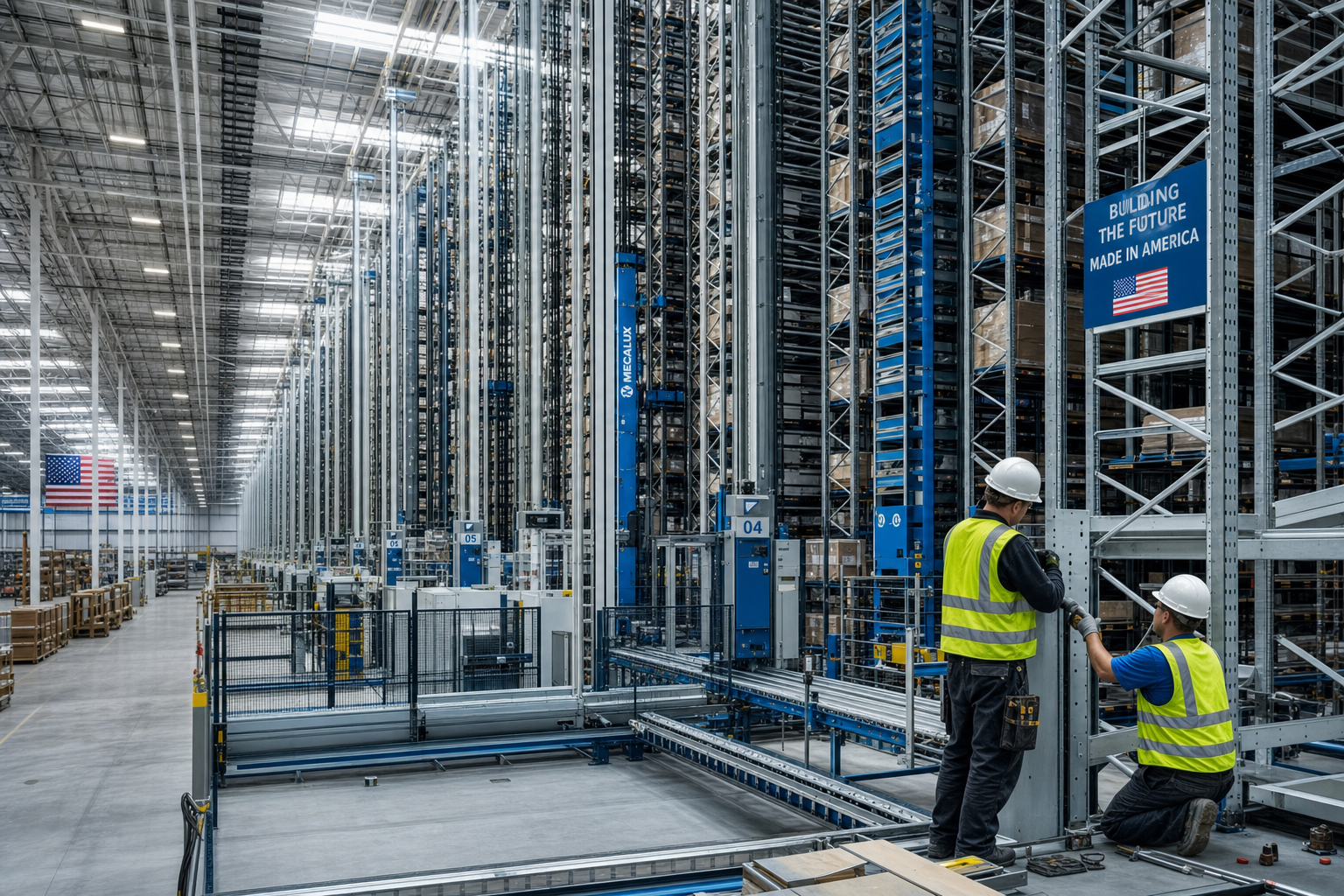
Hidden giant of e-mobility: How Japanese cranes and robotic shelves keep America's new battery mega-factories running – Creative image on the topic, with AI: Xpert.Digital
The new geo-economy: Why corporations are now forced to build their American factories upwards
Cranes, batteries and billions: The geopolitical secret behind Panasonic's gigantic US factory
The expansion of a seemingly ordinary racking system in the heart of rural America might sound like a dry industry announcement at first glance – but it reveals the tectonic shifts of the modern global economy. When the Japanese automation giant Daifuku installs massive racking cranes in DeSoto, Kansas, for one of Panasonic's largest North American battery factories, the crucial economic and political megatrends of our time converge. The global race for dominance in electric mobility, the chronic shortage of skilled workers in Western logistics, and the reshoring of key industries back to the US, fueled by billions of dollars in subsidies, are forcing corporations to make unprecedented investments.
Warehousing is no longer merely a cost factor, but a highly complex, capital-intensive strategic weapon in the battle for global market leadership. Without intelligent robotics, even the most modern gigafactory risks stagnation. The following analysis puts the Kansas project into perspective and shows why automated cranes form the invisible backbone of modern supply chains, how geopolitical upheavals fuel local construction projects, and why a nearly 90-year-old company from Osaka is now becoming a key player in America's reindustrialization.
Why a shelving system in a provincial Midwestern town reveals more about the global economy than any central bank meeting
When cranes become capital – How Daifuku's Kansas project makes the new geoeconomics of warehousing visible
The announcement from DeSoto, Kansas, appears at first glance to be an ordinary corporate news item: Daifuku Intralogistics America, together with its Japanese parent company, is installing an additional automated storage and retrieval system, an AS/RS, complete with new stacker cranes for individual loads. However, a closer look reveals that this seemingly technical expansion is a lesson in the tectonic shifts of the global economy: the reshoring of industrial value creation to the West, the chronic labor shortage in logistics, the capital hunger of the battery and electric vehicle industries, and the quiet but powerful role of Japanese equipment manufacturers as infrastructure architects of this transformation. The following analysis places the project within its economic, technological, and geopolitical context.
The client in the background – A battery factory as a symbol of reindustrialization
Who is really behind the warehouse cranes in Kansas and why that is no coincidence
Although the original report does not name the end customer, all available evidence points to Panasonic Energy's DeSoto site, one of the largest new lithium-ion battery factories in North America. Panasonic has built a state-of-the-art facility there that produces cylindrical 2170 cells for electric vehicles and is expected to reach an annual capacity of around 32 gigawatt-hours in the medium term. This, together with the existing plant in Nevada, will bring the company's total US capacity to approximately 73 gigawatt-hours. The plant is consistently implementing automation, including rail-guided and autonomous transport vehicles, as well as extensive robotics in cathode mixing, coating, cutting processes, and assembly, to achieve around 20 percent higher productivity compared to the Nevada site. In addition, Panasonic Energy has already entered into a multi-year partnership with the data analytics company Palantir to implement a so-called smart factory using the Foundry software platform. In this factory, sensor data, artificial intelligence, and automated decision-making processes control the production lines. Daifuku's expansion of the AS/RS fits perfectly into this picture: A battery factory of this size requires not only automated production lines, but also equally automated warehouse logistics for raw materials, intermediate products and finished goods to ensure a continuous flow of materials without human error.
A corporation with nine decades of experience – The quiet market power of the Japanese technology leader
How a company founded in 1937 became the invisible backbone of global supply chains
Founded in Osaka in 1937, Daifuku developed the world's first AS/RS system in 1966, making it the global market leader in this segment today with over 32,000 installed storage and retrieval machines. The company employs more than 11,000 people worldwide in over 60 subsidiaries across 24 countries and most recently achieved annual sales of approximately US$4.35 billion with an exceptionally high operating margin of around 15 percent for the industry. Daifuku's dominance in two highly specialized niches is particularly noteworthy: In addition to traditional warehouse automation, the company holds an estimated market share of over 40 percent in the semiconductor industry for automated material handling systems for cleanrooms. This dual position in warehouse logistics and semiconductor manufacturing makes Daifuku a company that serves two of today's most strategically important industrial policy trends: the expansion of chip manufacturing capacity outside Asia and the automation of distribution infrastructure for electric vehicles and consumer goods. The close coordination between the Japanese parent company and the American subsidiary, as described in the DeSoto project, is not a side aspect, but rather the company's actual recipe for success: Standardized technology from Japan is installed, maintained, and adapted to regional safety and building regulations by local teams in the USA, allowing Daifuku to combine global economies of scale with local execution expertise.
A market in transition – Why billions are flowing into shelves and cranes
What growth figures show that warehouse automation is no longer a niche topic?
Market estimates for automated storage and retrieval systems vary considerably between different research firms, reflecting methodological differences in definition and segmentation, but the trend is clearly positive across all sources. Depending on the study, the global market is projected to reach a value of between ten and twelve billion US dollars by 2026, with growth rates ranging from seven to more than sixteen percent per year, and an expected doubling to between seventeen and more than twenty-six billion US dollars by approximately 2033 to 2035. North America and Western Europe currently share the largest portion of the global market, with some studies identifying North America as the leading region with a share of nearly forty percent, while the Asia-Pacific region is expected to experience the highest growth rates in the future. In the competitive landscape, alongside Daifuku, Kion subsidiary Dematic, SSI Schäfer, Murata Machinery, Mecalux, and the emerging US providers Symbotic and AutoStore have established themselves as significant players. The five largest companies together account for more than half of global revenue, indicating moderate but growing market consolidation. From an economic perspective, this growth is not simply a result of technological enthusiasm, but rather the direct consequence of three structural forces that converge in the DeSoto project: structural labor shortages, the reshoring of industrial capacity to the West, and the explosive expansion of capacity in the battery and electric vehicle industries.
Humans as the bottleneck – How the American labor market is forcing automation
Why robots in US warehouses don't destroy jobs, but fill gaps
A key economic driver behind investments like the one in DeSoto is the chronic labor shortage in the American warehousing and logistics sector. The sector employs nearly 1.9 million people in the United States, yet the annual turnover rate exceeds 40 percent, while almost 60 percent of companies report difficulties recruiting and retaining staff. At the same time, hourly wages in the transportation and warehousing sector have risen to an average of over $31 by mid-2025, without significantly reducing turnover, as labor costs now account for 50 to 70 percent of total operating expenses, making them one of the biggest financial risk factors for warehouse operators. It is noteworthy that, according to McKinsey research, the automation rate in North American warehouses remains at only around 20 percent, despite the technology being well-established. This suggests that the real bottleneck is no longer technical, but rather financial and skills-related. Paradoxically, automation itself creates a new shortage of skilled workers, namely maintenance technicians and systems engineers who can operate and maintain complex automated storage and retrieval systems (AS/RS), while simple warehouse assistant jobs are increasingly disappearing. For a company like Panasonic, which has to produce at a new location without an established workforce, a highly automated storage and retrieval system is therefore not cost optimization in the strictest sense, but rather a structural safeguard against a labor market risk that is difficult to remedy in the short term.

Expert partner in warehouse planning and construction
Reshoring in industry: Why Kansas is becoming the center of the new global logistics
The Great Relocation – How Geopolitical Upheavals Become Concrete Foundations in Kansas
Why factories are now moving closer to their customers, even if it's more expensive
The DeSoto project is embedded in the broader movement of reshoring and nearshoring, the relocation of production capacity back to the United States or to geographically and politically closer countries. Surveys by Bain & Company show that the percentage of CEOs and plant managers planning to move their supply chains closer to domestic markets has risen from 63 percent in 2022 to 81 percent, while nearly two-thirds of companies are already actively investing in such projects. This trend was further amplified in the US by the 2022 Inflation Reduction Act, which provides targeted subsidies and tax credits for domestic manufacturing in critical sectors such as semiconductors, batteries, and electric vehicles, directly benefiting projects like the Panasonic factory in Kansas. Bank of America Global Research documents that construction investments in US manufacturing facilities increased by 45 percent in 2023 and by a further 21 percent in 2024, reaching a total of $234 billion. This reflects the massive capital inflow into precisely that asset category which includes automated warehouse infrastructure. At the same time, more recent surveys from 2026 show that nearly 70 percent of US manufacturers have already initiated reshoring measures, and investments of around $650 billion in such initiatives are expected over the next three years. Crucially, this relocation is driven by economic logic, which is what makes it competitive: Without the massive deployment of automation, robotics, and artificial intelligence, the higher labor costs in North America compared to Asian locations would be virtually impossible to offset. Therefore, automation technology like the Daifuku AS/RS is not merely an add-on, but the very prerequisite for the economic viability of reindustrialization.
The physics of efficiency – What a storage and retrieval machine can really do
How economic added value is created from vertical space
From a technical perspective, the economic viability of AS/RS systems is based on a simple yet effective principle: the vertical compression of storage space. According to manufacturers, compact racking structures can achieve space savings of up to 90 percent compared to conventional floor storage, while increasing labor productivity by up to 66 percent because storage and retrieval machines cover the distance between storage location and picking point in seconds instead of minutes. For individual loads such as pallets, as used in the DeSoto project, racking heights of up to 131 feet (approximately 40 meters) and load weights between 1,100 and 6,600 pounds per pallet are possible, making these systems particularly suitable for heavy, bulky, or sensitive materials, such as hazardous chemicals or temperature-sensitive products used in battery manufacturing. Such crane systems are often complemented by automated pallet sorting systems, so-called sorting transfer vehicles, which are based on rail-guided vehicles and coordinate the flow of goods between multiple storage aisles and shipping points, thus creating a fully automated material flow from storage to shipping. Economically, this technical efficiency translates into lower land costs, less personnel required per unit moved, lower picking error rates, and greater reliability, since automated systems, unlike manual processes, are not dependent on shift changes, sick leave, or employee turnover.
Security as an economic factor – Why caution is also a matter of capital
How a single accident can bring multi-million dollar projects to a standstill
The repeated emphasis on occupational safety in project communication is by no means mere rhetoric, but reflects a sound economic calculation. Construction sites with heavy lifting and crane equipment in the immediate vicinity of operating or start-up industrial plants are considered particularly accident-prone, and every incident can not only cause human suffering, but also lead to significant delays, insurance claims, and reputational risks, which directly impact the return on investment of a multi-year automation project. For a contractor like Daifuku, which relies on long-term, recurring contracts from major clients like Panasonic, an impeccable safety record is also a strong selling point in the competition for future contracts, especially in a regulatory environment like the USA, where occupational safety and health organizations and insurers increasingly require detailed safety documentation as a contractual condition.
Between cooperation and competition – What the project reveals about global value chains
Why Japanese engineering and American implementation need each other
The close collaboration between Daifuku Japan and its American subsidiary, highlighted in the report, points to a fundamental pattern of today's globalization that could be described as hybrid value creation. Unlike the pure offshoring logic of previous decades, in which manufacturing was entirely relocated to low-wage countries, this model combines high-quality engineering expertise from Japan with local project management, construction, and customer support in the United States. This arrangement allows multinational automation providers to benefit from the reshoring programs of Western economies without completely relocating from Asia, since the actual value creation—system design, software integration, and technical know-how—remains location-independent, while only the physical installation takes place locally. For the Japanese economy, which has been struggling for years with stagnant population growth and a limited domestic market, such large-scale international projects are economically significant because they generate export revenues from intellectual property and specialized technology without requiring additional domestic production capacity. For the American side, access to mature Japanese automation technology represents a competitive advantage over a purely domestic development, which would hardly be competitive given the international technological lead of Japanese and European suppliers.
Batteries as new oil fields – The strategic importance of the electric vehicle supply chain
Why Kansas is as important today as Detroit once was
Panasonic's relocation of battery production to a new site in the American heartland is part of a larger geoeconomic race for control of critical raw materials and components for electric vehicles. Battery cells are now considered strategic goods of comparable importance to fossil fuels, because they determine the technological sovereignty of entire industries, from automotive production to energy storage in the power grid. The US is pursuing targeted support programs to significantly reduce its dependence on Asian battery suppliers, particularly from China, which is why investments like the expansion of capacity in DeSoto to over 30 gigawatt-hours send not only corporate but also industrial policy signals. In this context, warehouse automation takes on an additional strategic dimension, as it allows the enormous quantities of raw materials, cell components, and finished products that a factory of this size handles daily to be managed with the precision and speed that are essential for continuous, uninterrupted mass production. In such an integrated supply chain, a failure of the warehouse logistics would have immediate consequences for the entire downstream automotive production, making investment in redundant, highly available automation systems economically essential.
A look ahead – What the Kansas project suggests for the coming years
Why this trend has only just begun
Despite methodological differences, various market forecasts consistently indicate that the global volume for automated storage and retrieval systems will roughly double within the next eight to nine years, driven by a combination of continued e-commerce growth, the electrification of the automotive industry, and the structural shortage of warehouse labor in Western economies. Analysts at MCF Corporate Finance expect that, following initially moderate single-digit growth rates until 2026, order intake and revenue growth in warehouse automation will accelerate significantly from 2027 onward, potentially reaching double-digit growth rates by 2030. For companies like Daifuku, this represents a comfortable strategic starting position, as the combination of technological market leadership, long-standing customer relationships with major corporations like Panasonic, and broad geopolitical tailwinds from reshoring programs simultaneously leverages several mutually reinforcing growth drivers. At the same time, the central challenge remains unresolved: the widespread adoption of these technologies depends significantly on whether enough qualified specialists can be trained for maintenance and operation. Without this base of expertise, the wave of automation, despite the available capital, risks reaching its practical limits. The project in DeSoto, however unspectacular it may seem at first glance, is thus a microcosm of those larger economic forces that will redraw the industrial landscape of the coming decade.
Your intralogistics experts
Consulting, planning and implementation of complete solutions for high-bay warehouses and automated storage systems - Image: Xpert.Digital
More information here:
Your global marketing and business development partner
☑️ Our business language is English or German
☑️ NEW: Correspondence in your native language!

Konrad Wolfenstein
I and my team are happy to be available to you as your personal advisor.
You can contact me by filling out the contact form here [email protected]:or simply call me at +49 7348 4088 965. My email address is
I'm looking forward to our joint project.
☑️ SME support in strategy, consulting, planning and implementation
☑️ Creation or realignment of the digital strategy and digitization
☑️ Expansion and optimization of international sales processes
☑️ Global & Digital B2B trading platforms
☑️ Pioneer Business Development / Marketing / PR / Trade Fairs
Our global industry and economic expertise in business development, sales and marketing

Our global industry and economic expertise in business development, sales and marketing - Image: Xpert.Digital
Industry focus areas: B2B, digitalization (from AI to XR), mechanical engineering, logistics, renewable energies and industry
More information here:
A thematic hub offering insights and expertise:
- Knowledge platform covering global and regional economies, innovation and industry-specific trends
- A collection of analyses, insights, and background information from our key areas of focus
- A place for expertise and information on current developments in business and technology
- A hub for companies seeking information on markets, digitalization, and industry innovations










