
US ban on robots and inverters: America's new technological curtain – Why the US is banning Chinese robots
Xpert Pre-Release

Available in 27 languages 📢
Prefer Xpert.Digital on GoogleⓘPublished on: July 29, 2026 / Updated on: July 29, 2026 – Author: Konrad Wolfenstein
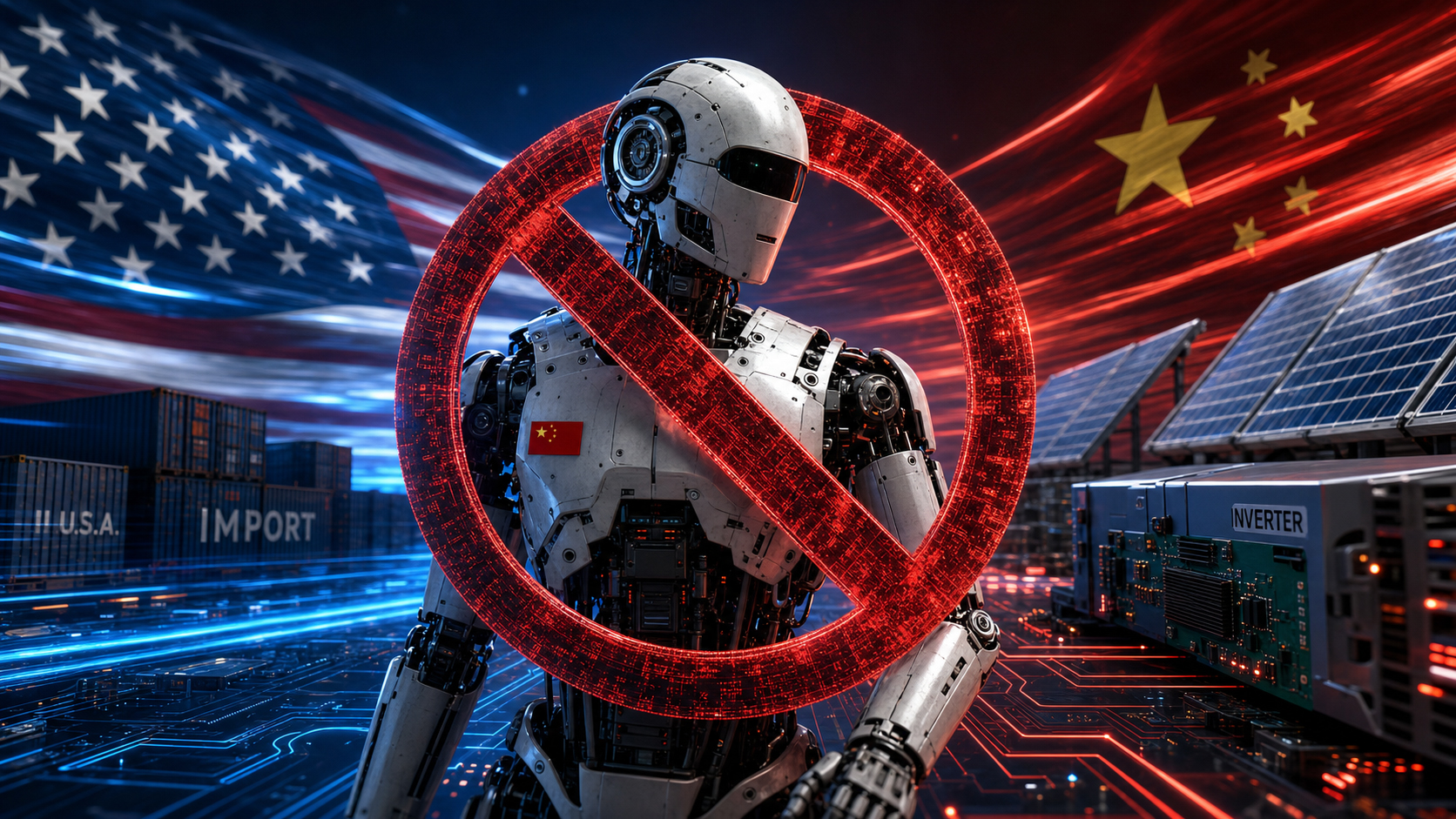
US ban on robots and inverters: America's new technological curtain – Why the US is banning Chinese robots – Image: Xpert.Digital
Secret trade war: The real reason for the US ban on robots and inverters
AI and the energy transition at risk? The US is preemptively blocking China's high-tech industry
Preemptive strike against China: USA blacklists humanoid robots
The US Federal Communications Commission (FCC) is taking drastic action in the global technology race: Chinese humanoid robots and networked inverters will no longer be approved for the American market. Officially justified by national security concerns, the move reveals, upon closer inspection, a ruthless industrial policy strategy. Washington is preemptively shielding key industries of the future to buy domestic manufacturers valuable time in their fight against growing Chinese dominance. But this profound intervention in the robotics and energy technology markets carries enormous risks – not least for the rapid expansion of artificial intelligence and the global energy transition. Read on to discover how security concerns are escalating into a creeping trade war and who the real winners and losers of this new technological landscape are.
When security becomes economic warfare
The decision by the US Federal Communications Commission (FCC) to prohibit future approvals for Chinese humanoid and quadrupedal robots, as well as for networked inverters, marks another step in a policy that systematically classifies economic dependence as a security risk. What at first glance appears to be a technical administrative measure actually has geopolitical implications that extend far beyond the affected product categories. The FCC justifies its action with unacceptable risks to national security, but anyone who examines the chronology of the past twelve months will recognize a pattern that is strategic and by no means spontaneous.
As early as December 2025, the agency banned the import of new drone models and critical components; in March 2026, a similar approach was taken against networked routers; and now, with robotics and inverters, another economically highly relevant category is being included. This gradual expansion of the so-called Covered List demonstrates that Washington is no longer reactively sanctioning individual companies, but rather proactively isolating entire technology categories from its own market before Chinese suppliers can even establish a dominant position there.
The architecture of a creeping trade war
To understand the scope of the current ban, one must understand the legal construct of the Covered List, which includes equipment posing an unacceptable risk to national security. Formally, the measure targets equipment from any foreign country, but in practice, it focuses almost exclusively on Chinese manufacturers, as the vast majority of the affected products originate in China. This seemingly neutral wording allows the US to appear less vulnerable under international law, while the economic impact is asymmetrically disproportionate to a single trading partner.
The list itself now extends far beyond the current expansion. Network equipment manufacturers such as Huawei, ZTE, Hikvision, Dahua, and Hytera have been on it since 2021, and operators China Mobile, China Telecom, and China Unicom were added in 2022. With drones, routers, robots, and inverters, a comprehensive regulatory framework has thus been established within just a few years, encompassing virtually every category of networked hardware of Chinese origin as soon as it plays a critical role in infrastructure, communications, or energy supply.
Robots as a new front in system competition
The inclusion of humanoid and quadrupedal robots in the Covered List is particularly noteworthy because this market is still in a very early technological phase. Current market data shows that six of the ten largest manufacturers of humanoid robots are from China, together accounting for 87 percent of all units shipped. Companies like Unitree, Agibot, and UBTech have quickly achieved a technological leadership position that American competitors such as Figure, Agility Robotics, and Apptronik have so far been unable to match, despite significant investments.
Washington's strategic calculation lies precisely in this early market stage. A ban that only came into effect after Chinese suppliers had reached market maturity would disrupt established supply chains and would be politically difficult to enforce. A preventative ban in the early stages, on the other hand, provides American companies with a protected domestic market where they can catch up without immediate price and innovation pressure from the Far East. The FCC justifies the measure by arguing that advanced robotic systems could collect data that could be used by malicious actors for surveillance or misused by foreign intelligence agencies for remote interception. This justification is technically plausible, as networked, sensor-rich robots do indeed represent potential attack vectors for cyber operations, but it does not fully explain why the measure comes at a moment when American manufacturers are on the verge of important production milestones.
The backbone of the energy transition is coming under pressure
While the robotics component of the ban is primarily future-oriented, the inclusion of networked inverters impacts a supply chain that is already highly dependent. Inverters connect solar power systems, battery storage, and increasingly, the power supply of data centers to the grid, which is why they are considered a critical infrastructure component from both a technical and economic perspective. China has dominated this global market almost uninterrupted for over a decade, with market analyses by Wood Mackenzie showing that the two providers Huawei and Sungrow alone account for around 55 percent of the global inverter market, and nine of the ten largest providers are of Chinese origin.
Huawei has been significantly restricted in the US for years due to sanctions, while Sungrow has so far managed to maintain market share, particularly in the US and Indian markets, despite political tensions. The new FCC regulation is likely to considerably worsen this remaining market position, as new models will no longer receive approval. This creates an immediate supply question for the expansion of American solar energy and, in particular, for the power-hungry data centers needed for the growth of artificial intelligence, since alternative, non-Chinese suppliers have so far failed to match the production capacities or pricing structures of the Chinese market leaders.
Economic security as a new understanding of the state
A US government official told Reuters that economic security is now understood as an integral part of national security, and that independent supply chains, free from China, are to be established. This statement underscores a fundamental shift in the American understanding of the state, which has become increasingly evident since the Trump administration took office. Trade policy is no longer primarily seen as an instrument for maximizing prosperity through open markets, but increasingly as a tool for securing geopolitical power.
FCC Chairman Brendan Carr made this unequivocally clear, emphasizing that the agency, under the president's leadership, would continue working to protect America's vital supply chains, collaborating closely with national security agencies. What is remarkable about this line of reasoning is its deliberate conflation of economic interests and security considerations, allowing any protectionist measure to be legally grounded in the Secure and Trusted Communications Networks Act without requiring a traditional trade debate in Congress.
Beijing's reaction: a mix of outrage and calculation
As expected, the Chinese government reacted sharply to the new measure. The Chinese embassy in Washington called on the United States to listen to rational voices from within its own business community and to stop slandering Chinese companies and threatening them with ever more sanctions. Beijing announced it would take the necessary measures to protect its own interests, though it remains unclear whether this will involve retaliatory sanctions, export restrictions on critical raw materials, or diplomatic channels.
Particularly revealing is the assessment of industry observer Xiang Ligang, quoted by the state-affiliated newspaper Global Times, who interprets the American measures as an expression of deep uncertainty about shrinking technological advantages. This interpretation is not without merit, because the drastic market share advantage of Chinese manufacturers in humanoid robots and inverters demonstrates that the People's Republic now assumes an industrial policy leadership role in both future technologies, a role that Western competitors will find difficult to overcome as long as competition is conducted solely through market mechanisms.
🎯🎯🎯 Data-driven B2B industry hub as a quasi-in-house solution

The quasi-in-house solution: How Xpert.Digital closes operational gaps in B2B marketing and sales – Smart Content-Driven Business - Image: Xpert.Digital
Xpert.Digital is a data-driven B2B industry hub led by Konrad Wolfenstein . The company acts as an external, quasi-in-house solution for industrial partners, closing operational gaps in marketing, content, and sales – without requiring additional resources on the client side.
More information here:
China's technological dominance under pressure: New FCC rules shake global markets
The exceptions and their political logic
For practical purposes, it's important to understand that this measure applies exclusively to new models that haven't yet received market approval. Robots and inverters that are already approved may continue to be imported, marketed, and sold, and consumers who already own such devices are not affected by the regulation. However, the FCC explicitly reserves the right to revoke previously granted approvals on a case-by-case basis, which creates significant legal uncertainty for the companies involved.
Additionally, the regulation includes a process for so-called conditional approval, under which robotics manufacturers can apply for approval through the U.S. Department of Defense, while inverter manufacturers can apply to both the Department of Defense and the Department of Homeland Security. This process allows the government to grant exceptions on a case-by-case basis, for example, to companies that can credibly demonstrate that their supply chains are secure and auditable. Historically, in comparable previous measures against drones and routers, the FCC has regularly exempted many non-Chinese vendors from the restrictions, so a similar practice is to be expected for robots and inverters.
Who actually benefits and who loses
The immediate losers of the new regulation are the established Chinese market leaders, who are effectively cut off from the world's most important and lucrative growth region for humanoid robotics and advanced energy technologies. For companies like Unitree, which made its European market debut last year and had planned an expansion into North America, the ban represents a significant strategic setback, as the American market is crucial for the global scaling of robotics companies.
On the winning side are, first and foremost, American robotics companies, which are currently working intensively on their own humanoid systems. According to market observations, around 180 American companies are now developing approximately 160 different robots or components such as grippers and hands, with this sector having already attracted investments of around 150 billion US dollars. The ban provides these companies with a protected domestic market, which improves their competitive position in the short term, but also carries the long-term risk that reduced international competitive pressure will dampen their own pace of innovation – an effect that has historically been frequently observed with protectionist measures.
Data centers and the energy question of the AI era
A particularly sensitive aspect of the regulation concerns the connection between inverters and the explosive growth of American data centers, which are needed for training and operating artificial intelligence systems. These facilities require a massive and reliable power supply, for which inverters are a key component, as they are what make renewable energy sources and battery storage grid-compatible in the first place. A US government representative explicitly stated that establishing independent supply chains for these components is necessary to avoid making American ambitions in artificial intelligence dependent on potentially insecure foreign hardware.
This line of reasoning reveals a dilemma in American industrial policy. On the one hand, the expansion of data centers and renewable energies is to be accelerated to avoid falling behind in the global race for AI leadership; on the other hand, the ban on Chinese inverters cuts America off from the most affordable and technologically advanced suppliers on the world market. In the short term, this is likely to lead to higher costs and potentially delays in construction projects until alternative suppliers from the US, Europe, or other Asian countries can expand their capacities accordingly.
A model with role models and imitators
The current measure fits into a larger pattern of technological decoupling that by no means only affects the United States. Previous measures against drones and routers already followed the same basic pattern of a gradual but consistent expansion of security-related import restrictions. For drones, for example, since December 2025, existing models have been grandfathered in, while new models are no longer eligible for approval, combined with temporary exceptions for devices on the Department of Defense's so-called Blue List or that meet the criteria of the Buy American Act.
This recurring regulatory architecture demonstrates that American policymakers now possess a standardized set of tools for relatively quickly and legally reliably adding new technology categories to the Covered List. It is therefore likely that further product categories, such as battery storage systems, charging infrastructure for electric vehicles, or certain semiconductor components, could be regulated according to the same pattern in the coming years, once Chinese manufacturers achieve or aspire to a dominant market position in these areas.
Risks to the global supply chain architecture
From an economic perspective, the central danger of such measures lies in the fact that they lead to a permanent fragmentation of global technology markets into competing blocs. Companies that want to serve both the Chinese and American markets will have to maintain different product lines, certifications, and possibly even separate research and development structures, which significantly reduces the economies of scale of globally integrated production. However, this also presents an opportunity for small and medium-sized suppliers outside of China and the US, for example in Europe, South Korea, or Japan, to position themselves as neutral providers that are considered trustworthy by both blocs.
At the same time, there is a risk of an escalation spiral in which China responds to American restrictions with its own export restrictions on critical raw materials such as rare earth elements, which are essential for the production of robots, batteries, and inverters. Since China holds a near-monopoly in the global processing of several of these raw materials, such a countermeasure could significantly hinder American efforts to establish independent supply chains, even if American companies increasingly locate final production domestically or in allied countries.
A sober assessment of the implications
Despite the geopolitical drama, a sober assessment of the immediate economic impact is worthwhile. Since both the market for humanoid robots and the demand for new inverter models continue to grow strongly, the true effect of the ban will only become apparent over several years, while existing, already approved products can continue to be sold without restriction. For the American consumer and most businesses, therefore, little will change in the short term, while the strategic direction for the coming years is all the more significant.
In the long term, the effectiveness of this measure will depend primarily on how quickly American and US-allied manufacturers are able to catch up technologically and in terms of price with the Chinese market leaders. If this catch-up process does not occur at a sufficient pace, higher costs for the expansion of renewable energies and data centers are likely, without the desired technological sovereignty actually being achieved. If, on the other hand, the catch-up process succeeds, the measure could be seen in retrospect as a shrewd industrial policy move that has significantly contributed to the development of an independent American robotics and energy technology industry. Which of these two scenarios unfolds will only become clear in the coming years, but the course has already been set with this FCC decision.
Your global marketing and business development partner
☑️ Our business language is English or German
☑️ NEW: Correspondence in your native language!

Konrad Wolfenstein
I and my team are happy to be available to you as your personal advisor.
You can contact me by filling out the contact form here [email protected]:or simply call me at +49 7348 4088 965. My email address is
I'm looking forward to our joint project.
☑️ SME support in strategy, consulting, planning and implementation
☑️ Creation or realignment of the digital strategy and digitization
☑️ Expansion and optimization of international sales processes
☑️ Global & Digital B2B trading platforms
☑️ Pioneer Business Development / Marketing / PR / Trade Fairs
📈🚀 From visibility to trust 👀🤝 Your scalable path with Xpert.Digital

From visibility to trust: Your scalable path with Xpert.Digital - Image: Xpert.Digital
In industrial B2B, sustainable business relationships rarely emerge overnight. They develop step by step – through visibility, professional relevance, recurring touchpoints, and growing trust. Xpert.Digital's 4-stage model addresses precisely this: It offers a structured path that begins with a manageable entry point and can evolve into deeper collaboration in business development if needed.
Instead of relying on loud marketing promises, this model puts the relationship at the forefront. Companies start with clearly defined, easily calculable measures and then decide, based on their own experience, how far they want to expand the collaboration. A key factor for this undisturbed trust-building process: The platform completely avoids annoying advertising ads, so the editorial focus remains solely on the companies' expertise.
More information here:









