
The robot factory in Foshan: A robot every 30 minutes – China's new mega-factory
Xpert Pre-Release

Available in 27 languages 📢
Prefer Xpert.Digital on GoogleⓘPublished on: April 1, 2026 / Updated on: April 1, 2026 – Author: Konrad Wolfenstein
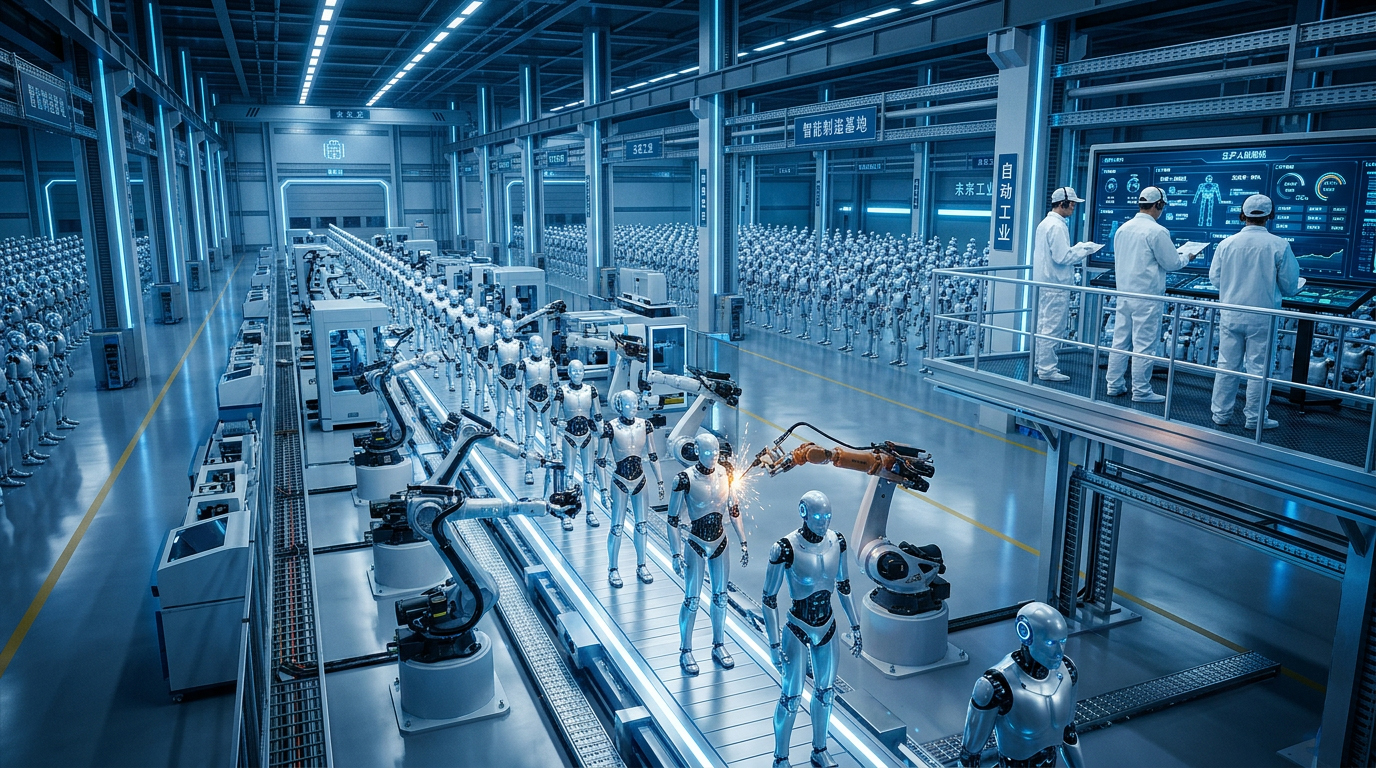
The robot factory in Foshan: A robot every 30 minutes – China's new mega-factory – Image: Xpert.Digital
Price shock for humanoids: Why Tesla and Boston Dynamics now have reason to tremble
For $13,500: China's humanoid robots are pushing into the global market
Steel learns to walk: The robot factory that will forever change our working world
In March 2026, a new industrial age began in the southern Chinese metropolis of Foshan: the world's first fully automated production line for humanoid robots went into operation. What at first glance seems like a scenario from a science fiction film is the result of an unprecedented, state-directed industrial policy. While Western corporations like Tesla or Boston Dynamics are still struggling with enormous development costs and delayed deliveries, China is already scaling up mass production. With competitive prices starting at US$13,500, rapid advances in artificial intelligence, and synergies from its domestic electric vehicle industry, the country is aggressively pushing into the global market. But there is far more behind this robot boom than just economic calculation: it is China's radical response to a rapidly aging society – and a geopolitical show of force that is likely to change global supply chains and labor markets forever.
The term "fully automated" should be used with caution: Chinese state media promote the plant as a "human-free" manufacturing facility, but a critical analysis reveals a different reality. The complexity of humanoid robots currently exceeds the capabilities of purely machine-based assembly
- Engineers manually adjust modular workstations
- Sensitive electronic components are wired by hand
- Finished robots are manually clamped into their test harnesses
The factory is therefore a state-of-the-art manufacturing facility with skilled human workers – not a fully autonomous robot-building-robot plant, even though autonomous transport systems handle the logistics between the stations.
300 Million Machine Workers: China's Radical Plan Against Demographic Collapse (Focus: Gigantic Numbers & Demographics)
Science Fiction Becomes Reality: First Fully Automated Robot Factory Is Online (Focus: Fascination with Technology & Future)
On March 29, 2026, China's first fully automated production line for humanoid robots began operating in Foshan, Guangdong, with an annual capacity of 10,000 units. What at first glance appears to be just another factory opening is, upon closer inspection, a turning point in industrial policy: not only for the Chinese economy, but for the global order of manufacturing technology. To understand what began that day in Foshan, one must analyze the demographic constraints, the geopolitical ambitions, and the economic logic behind this step—and ask oneself what kind of world will emerge when machines perform on a large scale what was previously reserved for humans.
Related to this:

Foshan as a setting: Why the spark ignites here of all places
Foshan is not a city most people in the West know. And therein lies the problem for Western technology observation. Located in the Pearl River Delta in the southern Chinese province of Guangdong, the city is one of the People's Republic's most important industrial centers: In 2021, Foshan's gross domestic product reached 1,215.7 billion yuan, representing more than one percent of the total national GDP – despite occupying just four ten-thousandths of China's land area. The city is home to global corporations such as Midea, KUKA Robotics (Guangdong), and numerous automotive suppliers. Foshan has been a hub of smart manufacturing for decades, and this reputation is no accident.
In 2024, Guangdong Province as a whole produced more than 240,000 industrial robots, representing a 31.2 percent increase year-over-year and making Guangdong China's leading robotics province for the fifth consecutive year. Its share of the national market is 44 percent – nearly half of all industrial robots manufactured in China originate in Guangdong. Furthermore, at the end of 2024, the province was home to over 160,000 robotics-related companies, accounting for 19 percent of all such companies in China. Approximately 57 percent of China's entire supply chain for humanoid robots is located in Guangdong.
The new production line is integrated into this already established industrial ecosystem. The factory features 24 digitized precision assembly processes and produces an average of one humanoid robot every 30 minutes, representing an efficiency increase of over 50 percent compared to conventional manufacturing methods. To ensure the quality of each unit, 77 safety testing procedures are in place. The system is also highly flexible: it supports the assembly of different model types on the same line and can adjust the workstations and line length.
Chronicle of a planned rise: From strategy to mass production
The opening of the production line in Foshan is not a spontaneous entrepreneurial event, but the result of years of state-driven industrial policy. As early as spring 2025, the year was considered the first year of mass production of humanoid robots in China. The factory of the Shanghai-based AI company AgiBot in the Lingang Special Area had already manufactured over 1,500 robots and announced plans for a second factory with an annual capacity of 10,000 units. In January 2026, Eyou Robot Technology in the Pudong Zhangjiang Hi-Tech Park commissioned the world's first automated production line for humanoid robot joints, with a capacity of 100,000 units annually.
The factory in Foshan now marks the next stage of this development: It is the first automated assembly line for complete humanoid robots in China with measurable mass production capacity. The timeframe for this development is precisely embedded in the 15th Five-Year Plan (2026–2030), which the National People's Congress adopted in March 2026. This plan prioritizes artificial intelligence and robotics as core national strategic areas, explicitly names the concept of "embodied intelligence"—that is, the physical integration of AI into the body and environment—as a new growth engine, and includes the word "AI" more than 50 times. The goal is to embed AI in 90 percent of the Chinese economy by 2030.
This integration into state planning is economically significant. China is not a market that develops humanoid robotics purely through market forces. It is a system that utilizes state support, industrial policy coordination, and strategic procurement measures to build a sector before it becomes profitable. Estimated state investment in humanoid robotics recently exceeded US$20 billion, in addition to a trillion-yuan fund for AI and robotics startups. In the first nine months of 2025 alone, 610 investment deals totaling 50 billion yuan were concluded in China's robotics sector—a 250 percent increase compared to the same period of the previous year.
The market is awakening: Figures that describe a new industry
The figures describing the global humanoid robot market in 2025 reveal an industry undergoing tectonic upheaval. According to the International Data Corporation (IDC), worldwide shipments of humanoid robots rose to approximately 18,000 units in 2025 – a year-on-year increase of 508 percent. Global revenue reached about US$440 million. Market research firm Counterpoint Research predicts that 16,000 humanoid robots will be installed worldwide in 2025, with over 80 percent of them being manufactured by Chinese companies. Unitree alone sold 5,500 units, while Tesla failed to sell a single unit in this category.
For 2026, Morgan Stanley revised its forecast for Chinese sales figures to 28,000 units, representing a 133 percent increase year-over-year. Other projections, including one from the OFweek Industrial Research Center, see China's market volume for humanoid robots reaching approximately 220 billion yuan this year. By 2030, China's National Development and Reform Commission (NDRC) and numerous industry analysts expect the market to reach 100 billion yuan, equivalent to roughly US$14.2 billion. The global installed base of humanoid robots is projected to exceed 100,000 units in 2027.
The long-term projections are even more impressive. Morgan Stanley sees 25.4 million humanoid robots in use worldwide by 2036. By 2040, their share of the total robotics market is expected to reach 13 percent, and by 2044, even 42 percent. The global market is estimated to be worth over US$5 trillion annually by 2050 – more than the entire global automotive industry. In China alone, around 300 million humanoid robots could be in use by 2050. For comparison, China has 1.4 billion inhabitants.
The price war as a strategic weapon: How China is opening up the world market
One of the most important economic dynamics in the global robotics competition is pricing. Here, a Chinese strategy familiar from the electric vehicle sector is evident: aggressive cost reduction through economies of scale and vertical integration of supply chains. By 2026, the cheapest fully functional humanoid robot on the market, the Unitree G1, will cost between US$13,500 and US$27,000. The Chinese manufacturer AgiBot offers a more compact model for around US$14,000. By comparison, the Atlas robot from Boston Dynamics, the US market leader, costs between US$150,000 and US$250,000, or even more.
This price divergence is strategically significant and, according to all forecasts, will intensify. Morgan Stanley expects material costs for robot production in China to fall by 16 percent in 2026. Bain & Company anticipates that component prices will decrease by approximately 70 percent worldwide by 2035. By 2050, a humanoid robot is projected to cost around US$21,000 in middle- and lower-income countries, which include China, compared to the current price of US$50,000 for the basic model. In wealthy countries like the US, the price is expected to fall from US$200,000 in 2024 to US$75,000.
AgiBot co-founder Peng Zhihui stated that, with appropriate mass production, robots will cost less than 200,000 yuan—less than a typical family car. A UBTECH robot, costing US$13,500, has an annual labor cost ratio of approximately 1:2.6 compared to an average Chinese factory worker with annual costs of US$35,000. In high-wage countries like the US or Germany, current calculations indicate that the payback period for such a robot would be less than three months. This calculation is the real catalyst behind the factory openings.
The EV revolution as the silent parent industry of robotics
One of the least discussed, yet economically crucial factors driving China's rise in robotics is the synergy with its electric vehicle industry. Over the past decade, China has invested more than $100 billion in building its electric vehicle supply chain. The result is a complete industrial ecosystem encompassing electric drives, battery management systems, sensors, control electronics, and AI software – all components also required for humanoid robots.
Zhang Shaozheng, head of manufacturing at AgiBot, describes this connection precisely: They leveraged synergies with the renewable energy sector, particularly in electric motors and transmissions. It was precisely these sophisticated supply chains that enabled the rapid mass production of humanoid robots. At least 15 Chinese automakers – including GAC, SAIC, XPeng, Chery, and Xiaomi – have now entered the humanoid robot development market. BYD, the world's largest electric vehicle manufacturer, had a production target of 1,500 units for 2025 and plans to scale up to 20,000 by 2026. XPeng is considering investments of up to 100 billion yuan in humanoid robotics.
This industrial convergence is more than just technological. It demonstrates how China is systematically transferring competitive advantages from one sector to the next. The Chinese electric vehicle sector has built a global cost advantage through government subsidies, scaling, and targeted supply chain development. The same playbook is now being applied to humanoid robotics—with the difference that this time the starting point is stronger, and the global robotics market will ultimately be even larger than the electric vehicle market.
Demographics as a catalyst: The invisible hand behind the robot boom
Beyond all market dynamics, there is a structural necessity in China that places robotics within a quasi-existential national context: demographic change. Since 2022, China has been experiencing an absolute population decline, losing 1.39 million inhabitants last year. The over-65 age group already comprises 15 percent of the 1.4 billion inhabitants. Demographers expect China to become a so-called "super-aged" society by 2035, in which more than one in five citizens is over 65 – comparable to Japan and South Korea today.
For an economy that has built its rise over decades on a virtually inexhaustible pool of cheap labor, this development poses a strategic threat. China's coastal regions, particularly Guangdong and Shanghai, have been struggling with labor shortages and rising wages for years. The available pool of factory workers is shrinking, while demand for care services and social security is increasing. At the same time, Stuart Gietel-Basten, a demographer at the Hong Kong University of Science and Technology, warns that without structural change, China risks a severe crisis stemming from the mismatch between population dynamics and its economic model.
In this context, humanoid robots are not merely a growth option, but an industrial policy response to a demographic dilemma. Chinese state media regularly emphasize the potential of humanoid robots in elderly care, 24-hour care, and in jobs where there will be a future shortage of human personnel. China is already installing more factory robots per year than all other countries combined. According to the Center for Strategic and International Studies (CSIS), industrial robot production increased from 4,201 units in March 2016 to a peak of 74,746 units in June 2025. This 17-fold increase within a decade is the result of a coordinated state-industrial project that is now entering a new dimension with humanoid robots.
🎯🎯🎯 Data-driven B2B industry hub as a quasi-in-house solution

The quasi-in-house solution: How Xpert.Digital closes operational gaps in B2B marketing and sales – Smart Content-Driven Business - Image: Xpert.Digital
Xpert.Digital is a data-driven B2B industry hub led by Konrad Wolfenstein . The company acts as an external, quasi-in-house solution for industrial partners, closing operational gaps in marketing, content, and sales – without requiring additional resources on the client side.
More information here:
Job killer or engine of prosperity? The social equation behind robotics
Geopolitical explosiveness: The robot race as a new arena for the power struggle
The technological competition between China and the US has been taking place for years in several fields: semiconductors, AI software, and quantum computing. Robotics opens a new dimension to this conflict, one that is particularly explosive because it involves physical systems operating in the real world. In March 2026, the US House Cybersecurity and Infrastructure Security Committee warned at a hearing about the security risks posed by Chinese humanoid robot manufacturers, especially Unitree Robotics. Executives from Scale AI and Boston Dynamics called on the US Congress to expand export controls on AI chips, launch security investigations into Chinese robotics companies, and restrict government procurement of certain foreign AI technologies.
The reasons for these concerns are not unfounded. China has filed 7,705 patents in the field of humanoid robotics over the past five years – five times more than the US. Chinese products account for 59 percent of the 114 most important humanoid robot models worldwide. Morgan Stanley notes that the Chinese humanoid robotics value chain grew by 27.5 percent in the first half of 2025, significantly outperforming the MSCI China Index. At the same time, US companies face a fundamental cost disadvantage: While Unitree offers its G1 model for $13,500, Boston Dynamics positions its Atlas robot in a price range that is unrealistic for many commercial customers.
In this context, the development of manufacturing capacity in Foshan is not merely an industrial policy decision, but a geoeconomic show of force. Whoever first masters the mass production of humanoid robots and reduces costs to a commercially viable level will define supply chains, set standards, and, in the long term, create the dependencies once associated with the term "Made in China"—but now transferred to a new, more intelligent and agile generation of machines. The Center for Strategic and International Studies warns that with the increasing adoption of Chinese robots, a growing number of manufacturing countries could become dependent on Chinese robotics technology and its technological ecosystems.
Related to this:

Competitors and imitation attempts: What the competition does – and doesn't
To properly assess the significance of the Foshan factory, it's worth looking at what the international competition currently offers. At CES 2026, Boston Dynamics presented the production version of its Atlas robot – fully electric, with 56 degrees of freedom, a 50-kilogram payload capacity, and autonomous battery swapping. All units planned for 2026 are already reserved for deployment at Hyundai Motor Group and Google DeepMind. Hyundai's announced $26 billion investment in US manufacturing includes a robotics factory with a planned capacity of 30,000 units per year. These are impressive figures – but they come from a single factory still under construction, delivering robots at a price many times higher than those of its Chinese competitors.
Tesla, for its part, had originally announced plans to produce between 5,000 and 10,000 Optimus robots by the end of 2025 – yet it hasn't delivered a single unit commercially. Elon Musk is continually postponing mass production of his Optimus, while Chinese manufacturers are already filling shelves. Figure AI, a US startup valued at $39 billion, has deployed several hundred units commercially so far. The gap between announcement and actual delivery is structurally larger for Western competitors – and will widen further with every capacity expansion in China.
While US companies attempt to contain the Chinese market through regulation and export controls, Chinese companies are expanding their supply chains, reducing costs, and increasing production volumes. This is not a short-term dynamic, but a long-term shift in power.
The employment paradox: When robots are supposed to secure prosperity
No economic analysis of humanoid robots would be complete without an honest examination of the employment consequences. China employs around 123 million factory workers – a number unmatched by any other economy in the world. The question of whether humanoid robots will replace or supplement these workers is not only economically but also socio-politically explosive.
Empirical research provides disturbing evidence. A study of Chinese labor markets shows that one standard deviation of higher robot exposure reduces the probability of employment by 5 percentage points, increases market exits by 1 percentage point, and raises reported unemployment by 4 percentage points. Hourly wages fell by around 8 percent, with low-skilled, male, and older workers being particularly affected. These effects are already occurring with first-generation industrial robots—humanoid robots, which can in principle mimic any human bodily function, are likely to be considerably more disruptive.
The official Chinese stance on this issue is clear: robots will not replace workers, but will take over dangerous, monotonous, or physically demanding tasks. Liang Liang, deputy director of the Beijing Economic-Technological Development Area, stated in 2025 that they saw no risk of job losses due to robots, but rather expected increases in productivity and support for tasks that humans could not or did not want to perform. The metaphor of the robot half-marathon in Beijing, in which humans and machines ran on separate tracks without crossing each other's paths, is also part of this communication strategy.
However, economic reality cannot be permanently concealed by metaphors. A UBTECH robot costs US$13,500 and replaces an employee with annual costs of US$35,000 – the amortization period is significantly less than a year. This calculation is understandable to any entrepreneur facing margin and competitive pressure. China's real political challenge lies in building a competitive, high-wage economy while simultaneously managing the social costs of accelerated automation – in a country that lacks robust social safety nets for mass unemployment and where political legitimacy is traditionally tied to economic growth and employment.
The innovation architecture: patents, AI and the question of technological leadership
China's competitiveness in humanoid robotics is not solely based on manufacturing capacity and low prices. Its technological infrastructure is equally remarkable. In the past five years, China has filed 7,705 patents in the field of humanoid robotics—five times more than the US, which filed 1,484, and roughly seven times more than Japan. According to Morgan Stanley, Chinese products represent 59 percent of the 114 most important global humanoid robot platforms. Guangdong alone boasts more than 1,500 core AI companies, including 24 unicorns, 92 publicly listed companies, and 147 national specialty enterprises. The province's core artificial intelligence industry surpassed 220 billion yuan by the end of the first quarter of 2025, ranking first nationally.
What also sets China apart from other countries is the pace of integration between AI software development and hardware scaling. For example, in the spring of 2025, AgiBot launched its own large language model, GO-1, to accelerate the training of its robots. Humanoid robot training facilities have sprung up in Beijing, Shanghai, Wuhan, and Hangzhou, where robots learn warehouse work, sorting tasks, and packaging processes—using VR and motion-capture systems. This infrastructure for training embodied AI is an often overlooked but fundamental building block for commercial success.
The forecast by Hao Lulu, an analyst at CCID Consulting of the Chinese Ministry of Industry and Information Technology, is noteworthy in this regard: China has already reached the global leadership group in key areas such as computer vision and natural language processing, and embodied intelligence is a particularly promising field where these strengths converge. More than 150 developers of humanoid robots are active in China. Analysts expect the consolidation process in this segment to proceed more rapidly than in the electric vehicle industry.
The billion-dollar calculation: When the investment pays off
From a purely business perspective, the question arises as to when and under what conditions the use of humanoid robots becomes economically advantageous – and for whom. The answer depends heavily on labor costs, the robot's price, the amortization period, and the total cost of ownership, which includes not only the purchase price but also maintenance, software, and integration. Current calculations show that in high-wage countries like the USA, a Unitree G1, with a purchase price of US$13,500 and an average annual wage of around US$50,000, pays for itself in less than three months. In China itself, with lower average wages, the calculation is tighter, but still viable with mass production prices below 200,000 yuan.
The total cost share for maintenance, training, and integration is estimated to be 20 to 40 percent higher than the purchase price alone. This means that, under realistic conditions, a robot costing US$13,500 will incur total costs of US$16,000 to US$19,000. Bain & Company anticipates that global parts prices will fall by around 70 percent by 2035 – a development that makes their use economically attractive even in industries with moderately high labor costs. For China, however, the strategic calculation is different: it's not just about operating the robots domestically, but about exporting this technology worldwide – and the economic dependence that this can create.
Systemic risks: What the enthusiasm overlooks
Despite all the euphoria, systemic risks deserve objective assessment. Humanoid robotics, despite all the progress, is still in its early stages of commercial maturity. Technical failures, software errors, and a lack of autonomy in unstructured environments are real limitations. The 77 safety tests conducted at the Foshan factory are not proof of a mature technology, but rather an indication of the complexity and vulnerability of the systems.
Furthermore, geopolitical risks exist: US export controls on advanced AI chips could slow the development of Chinese robotics AI, even though China is making significant efforts to reduce its dependence on US semiconductors. Unitree, the Chinese market leader, is seeking a listing on Shanghai's STAR Market, which it expects to raise around US$610 million – but this move also makes the company more vulnerable to regulatory intervention, both in China and abroad.
Finally, the social dimension must be considered. The simultaneous occurrence of demographic decline, structural automation, and a political legitimacy based on full employment creates a tension that the Chinese leadership can hardly resolve with metaphors and half-marathons. The experience of the taxi driver disruption caused by Baidu's robotaxi expansion in Wuhan and 21 other cities shows how quickly political promises collide with economic realities.
Concluding remarks: Foshan as a coordinate of a new world order
The factory in Foshan is not an endpoint, but a point of reference – a marker on a curve that still rises steeply. The 10,000 robots planned for annual production there are a modest number compared to global forecasts. But the significance of this facility lies not in the units themselves, but in what its existence demonstrates: that China not only plans to mass-produce humanoid robots, but has mastered the art. That the cost structures enable real-world commercial deployment. That the industrial ecosystem – supply chains, components, training infrastructure, capital, government support – is large enough to sustain a global industry.
Morgan Stanley's prediction that Chinese robot sales could exceed 23 million units by 2040, or that a global market worth over $5 trillion will emerge by 2050, with China playing a dominant role with 300 million units, is not an extrapolation of short-term hype. It is the result of an analysis of structural competitive advantages: patents, supply chains, government coordination, economies of scale, and price leadership. The factory in Foshan is the visible symbol of an invisible systemic competition—a competition in which the Western world has yet to fully grasp the true nature of the playing field.
Your global marketing and business development partner
☑️ Our business language is English or German
☑️ NEW: Correspondence in your native language!

Konrad Wolfenstein
I and my team are happy to be available to you as your personal advisor.
You can contact me by filling out the contact form here or simply call me at +49 7348 4088 965. My email address is : [email protected]
I'm looking forward to our joint project.









