
Daifuku – The “silent architect” of the global economy: Why this Japanese intralogistics giant is leaving the German logistics elite behind
Xpert Pre-Release

Language selection 📢
Published on: January 27, 2026 / Updated on: January 27, 2026 – Author: Konrad Wolfenstein
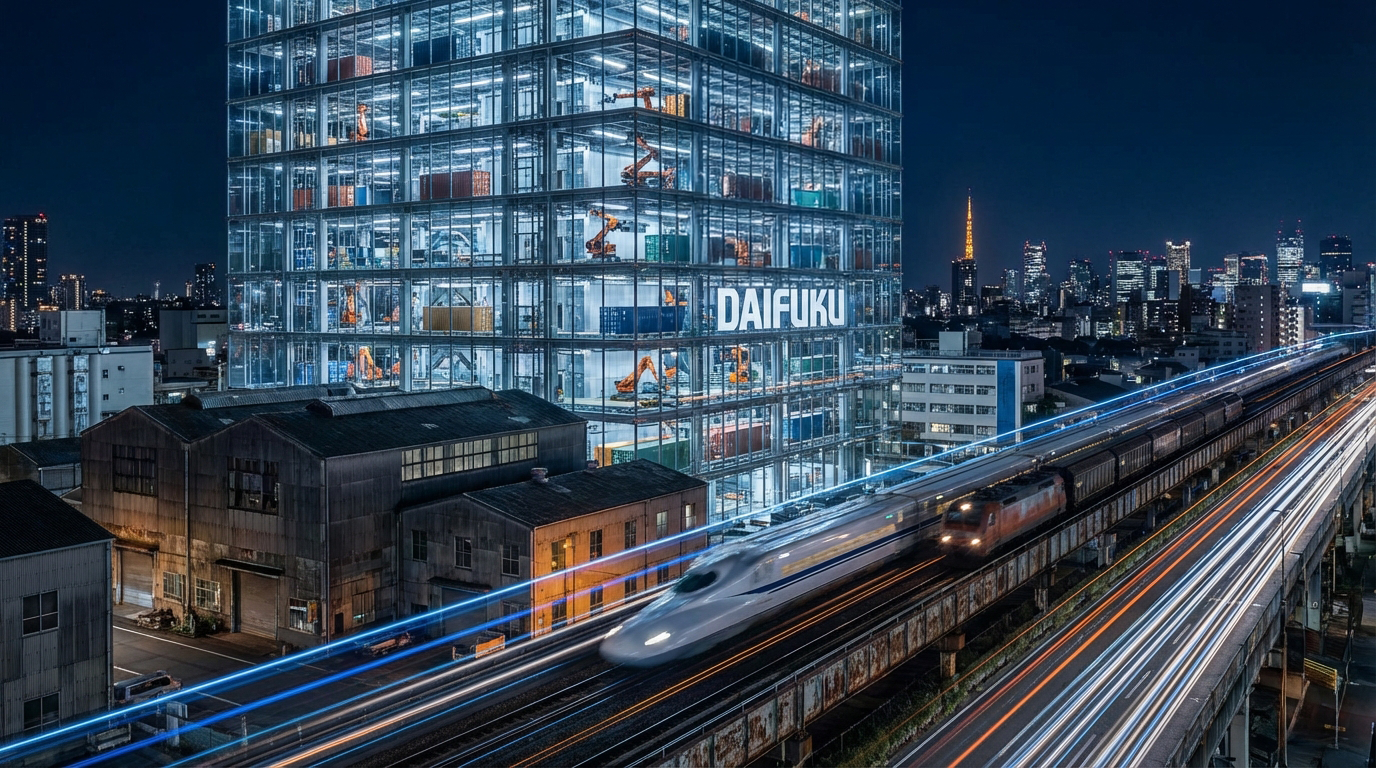
Daifuku – The “silent architect” of the global economy: Why this Japanese intralogistics giant is leaving the German logistics elite behind – Creative image: Xpert.Digital
From Motomachi factory to AI factory: How Daifuku is dominating global intralogistics with "Kaizen"
Vision 2030: How Japan's oldest conveyor technology pioneer is preparing for China's robotics onslaught
In the vast halls of state-of-the-art semiconductor factories and the hectic distribution centers of e-commerce, a precise choreography prevails, often invisible to the naked eye. But behind the smooth flow of goods and data lies a dominant player that has redefined the rules of global intralogistics.
While Germany prides itself on its engineering prowess and industry giants like the KION Group and Jungheinrich, a company in Osaka, Japan, has worked its way to the undisputed top of the global market: Daifuku Corporation. It is far more than just a machine manufacturer; it is the central nervous system of modern supply chains. Whether it's the almost silent gliding of delicate wafers in cleanrooms or the gigantic conveyor systems of the American automotive industry – Daifuku is the “silent architect” that provides the physical foundation of our global economy.
But how did a company founded in 1937 manage to transform itself so successfully from a simple conveyor belt manufacturer to a highly technological system integrator that it now maintains a market share that European competitors can only dream of? The answer lies in a fascinating mix of a cultural “Kaizen” philosophy, aggressive expansion in the USA, and technological hegemony in the Asian chip sector.
The following analysis dissects the economic anatomy of this giant. We look behind the numbers, compare regional strategies from Detroit to Shanghai, and explore why the quiet hum of Japanese conveyor technology often resonates louder today than the pride of German mechanical engineering. Immerse yourself in the world of Daifuku – a story of strategic vision, technological moats, and the battle for the factory of the future.
The global dominance of Japanese intralogistics: A structural analysis of Daifuku Corporation
The global market for intralogistics and material handling systems has transformed in recent decades from a supporting, auxiliary science of production into a central nervous system of the modern global economy. At the heart of this transformation is Daifuku Co., Ltd., an Osaka-based company that has held the undisputed top position in global rankings of system integrators for nearly a decade. The question of whether Daifuku is the world market leader can be answered unequivocally in the affirmative, given the available data. However, understanding why requires an in-depth analysis of the technological, regional, and economic factors that have enabled this rise.
The global intralogistics market was estimated at approximately US$56.22 billion in 2024 and is projected to grow to a remarkable US$131.17 billion by 2033, representing an average annual growth rate of 10.6 percent. In this highly dynamic environment, Daifuku maintains its leading position through a skillful combination of historical depth, technological specialization in cleanroom environments, and an aggressive expansion strategy in the US and Asia. While European competitors such as the KION Group or Jungheinrich dominate in specific segments like material handling equipment, Daifuku has perfected the art of fully automated system integration.
The evolution from machine manufacturer to global systems architect
Daifuku's historical development is closely linked to the rise of the Japanese automotive industry, laying the foundation for its current market leadership. Founded in 1937, the company began its expansion into the complex world of conveyor technology in the 1950s. A pivotal moment came in 1957 when Daifuku formed a technical alliance with the US-based Jervis B. Webb Company, then considered a pioneer of chain conveyors for Henry Ford. This partnership enabled Daifuku to supply the first integrated conveyor articulated system to Toyota's Motomachi plant in 1959—the first factory in Japan designed exclusively for the production of passenger vehicles. This alliance with Toyota formed the economic moat that ensured Daifuku's stable growth for decades and fueled the development of revolutionary technologies such as the High-Intensity Direction (HID) contactless power transmission system in 1993.
Daifuku's economic strength today is manifested in broad diversification across various industries. The company is no longer just a supplier to the automotive sector, but dominates logistics solutions for semiconductor factories, e-commerce distribution centers, and airports worldwide. The following table illustrates Daifuku's position compared to leading global system providers, based on revenues in warehouse automation and material handling systems:
| Rank | Pursue | headquarters | Revenue 2022 (million USD) | Market segment focus |
|---|---|---|---|---|
| 1 | Daifuku Co., Ltd. | Japan | 4.549 | System integration, Automated storage and retrieval systems (AS/RS), cleanroom |
| 2 | Dematic (KION Group) | USA/Germany | 4.063 | Warehouse automation, software |
| 3 | Honeywell Intelligent | USA | 2.336 | Sorting systems, e-commerce |
| 4 | Vanderlande (Toyota) | Netherlands | 2.200 | Airports, parcel logistics |
| 5 | KNAPP AG | Austria | 2.139 | Pharmaceuticals, food, retail |
This market leadership is the result of consistent internationalization. Today, Daifuku generates over 67 percent of its revenue outside Japan. This economic success is supported by a solid operating margin, which reached record levels of 15.7 percent at times in fiscal year 2025, attributable to improved project management and high profitability in the service business.
North America as a strategic anchor point between heritage and innovation
In the North American context, Daifuku is perceived less as a foreign player and more as an integral part of the industrial infrastructure. This perception stems from the strategic acquisitions of Jervis B. Webb Company in 2007 and Wynright Corporation in 2012. Through these acquisitions, Daifuku has blended the legacy of American industrial history with Japanese precision. In the US, the focus is on mega-projects for e-commerce and retail, with subsidiaries like Wynright providing turnkey solutions for distribution centers facing the severe shortage of skilled workers.
The economic driving force in the US is the need for extreme efficiency gains amidst rising labor costs. Daifuku North America is responding by expanding its manufacturing capacities, such as with the new plant in Michigan, completed in 2025, which doubled the production of intralogistics systems. Local perception is shaped by the company's ability to cover the entire value chain – from mechanical hardware to complex warehouse execution systems (WES) that orchestrate robots and automated storage systems. Despite temporary fluctuations in the automotive industry, demand for Daifuku's airport baggage handling solutions remains stable, supported by modernization programs at major hubs like Denver and Dallas.
| Metric for North America | Value / Details | trend |
|---|---|---|
| Revenue share of the total group | approximately 26-30 percent | Stable to rising |
| Key subsidiaries | Wynright, Jervis B. Webb, Elite Line Services | Integration with Daifuku Intralogistics |
| Market share of airport systems | Leading in the USA | Growth through TSA upgrades |
| Investments 2025 | Doubling of production capacity | Focus on e-commerce order processing |
Europe and the German challenge: Quality in a clash with local champions
In the European Union, and particularly in Germany, Daifuku is perceived as having a deep respect for its technological capabilities, coupled with intense competition from domestic industry giants such as Jungheinrich, the KION Group, and SSI Schäfer. The German market is considered the epicenter of intralogistics engineering, and Daifuku is often seen as the global benchmark against which local companies must measure themselves. The German perspective is strongly focused on the integration of Industry 4.0 and software excellence. While Daifuku is the global leader, Jungheinrich led in revenue growth in Germany in 2023, highlighting the enormous strength of local providers.
The economic analysis for Germany shows a market that is projected to grow to a volume of over US$11 billion by 2033. Daifuku scores particularly well in niche markets that demand the highest reliability, such as automotive final assembly or automated cold storage facilities for the food industry. An interesting aspect of the European perception is the comparison of engineering philosophies. While German companies are often praised for their modular flexibility and customer-specific adaptation, Daifuku is valued for its standardized process reliability and the consistent application of the Kaizen principle. Competition in Europe is also intensifying due to industry consolidation, as demonstrated by Jungheinrich's acquisition of the Indian company Storage Solutions, aimed at improving access to the US market and directly challenging Daifuku there.
Japan and the Asian powerhouse of cleanroom technology
In Japan and throughout the Asia-Pacific region, Daifuku is not only a market leader but also a national symbol of technological excellence. Its reputation in this region is inextricably linked to its dominance in the semiconductor industry. Daifuku holds a leading global market share in automated material handling systems (AMHS) for cleanrooms. In the massive wafer fabs of giants like TSMC and Samsung, Daifuku's overhead hoist transport (OHT) systems form the logistical backbone, moving delicate 300 mm wafers with the utmost precision and without contamination.
The economic importance of this segment for Daifuku is immense, as investments in semiconductor fabrication facilities are increasing in the long term despite cyclical fluctuations, driven by the demand for AI chips and high-speed computing. In Asia, Daifuku is perceived as the indispensable partner for the hardware foundation of the digital age. In South Korea and Taiwan, the company recorded steady orders for cleanroom systems in 2025, underscoring its regional strength. The Asian market is also leading the way in the adoption of fully automated systems, as the acceptance of robotic solutions is historically higher there than in Western cultures.
| Semiconductor logistics Asia | Daifuku Market Position | Competitive advantages |
|---|---|---|
| Market share of cleanroom AMHS | approximately 18-30 percent globally | Low-vibration OHT systems, software control |
| Main customers | TSMC, Samsung, Intel, SK Hynix | Long-term qualification processes |
| Technological focus | 300 mm wafer handling | Maximum particle-free operation, predictive maintenance |
| Regional growth | Approximately 7.14 percent CAGR in APAC | Driven by AI applications |

Xpert partner in warehouse planning and construction
More than just efficiency: Why the pharmaceutical industry is investing billions in precision bearings
China: The battle between proven quality and agile robotics
The economic situation in China presents a paradox for Daifuku. On the one hand, China is a key sales market with enormous potential for factory automation; on the other hand, it is experiencing a surge in competition that is radically challenging traditional business models. While the Chinese perception of Daifuku is characterized by a high regard for Japanese quality, it is under pressure in the context of national efforts toward technological self-sufficiency (Made in China 2025).
Local competitors like Geek+ and Hikrobot are increasingly dominating the autonomous mobile robot (AMR) segment, which is being deployed en masse in China to replace conventional conveyor systems. Geek+, for example, holds a global market share of over 9 percent in order fulfillment AMRs, forcing traditional integrators like Daifuku to accelerate the development of their own robotics portfolios. In China, the economic logic is often geared towards extremely short payback periods of less than 36 months, while Daifuku's highly integrated systems are designed for long-term stability and lifecycles of 10 to 20 years. Despite this price pressure, Daifuku remains the preferred partner in China for high-end applications in semiconductor and automotive manufacturing, where fault tolerance is minimal.
A comparative analysis of regional market dynamics
To understand Daifuku's global market leadership, a comparison of regional circumstances is essential. This reveals that the company achieved its dominance not through a monolithic model, but through regional adaptability. The following table provides a comparative overview:
| region | Perception of Daifuku | main competitors | Economic driver |
|---|---|---|---|
| USA | Integrated industry pioneer | Honeywell, Knapp, Dematic | Labor shortage, e-commerce |
| Germany | High-quality rival | Jungheinrich, KION, SSI Schäfer | Industry 4.0, efficiency improvement |
| Japan / Asia | Technological pacemaker | Murata Machinery, SFA Engineering | Semiconductor boom, cleanroom needs |
| China | Quality standard under price pressure | Geek+, Hikrobot, local integrators | Technological self-sufficiency, AMRs |
Daifuku's economic superiority can be mathematically expressed through the interplay of market penetration and profitable service revenues. Considering the market's average growth rate, a robust forecast emerges for the coming years. Applying the formula for compound annual growth (CAGR), the market potential can be quantified as follows:
CAGR = ((V_2033 / V_2024)^(1/9)) – 1 ≈ 10.6%
With a projected market volume of US$131.17 billion in 2033, this means that Daifuku could more than double its revenue in the next decade simply by maintaining its current market share.
Technological unique selling points as economic barriers
A key reason for Daifuku's sustained market leadership is the depth of its technological portfolio, which acts as a competitive moat. While many competitors purchase components from external suppliers, Daifuku is known for its high level of vertical integration. The company offers a complete range of storage and transport systems, including automated storage and retrieval systems (AS/RS), which are considered the fastest and most reliable in the industry. A particular highlight is the Shuttle Rack M system, optimized for high throughput rates in e-commerce and offering seamless integration with robotics components.
Technological differentiation is also evident in the software sector. Daifuku has invested heavily in warehouse management systems (WMS) and warehouse control systems (WCS) that utilize AI-powered algorithms to optimize the flow of goods in real time. This software layer is becoming increasingly important as customers no longer simply purchase hardware but expect guaranteed throughput. Furthermore, the integration of digital twins allows Daifuku to simulate and validate the performance of a system even before physical installation, drastically reducing commissioning times and minimizing project risks.
Another technological advantage lies in contactless power transmission (HID). This technology eliminates mechanical wear and particle generation caused by sliding contacts, which is essential in cleanrooms for semiconductor production. Daifuku has successfully transferred this technology to other areas, such as monorail systems (RAMRUN) in the automotive industry, resulting in quieter and cleaner factory environments.
The economic value of the service model and cyclical resilience
An often underestimated factor in Daifuku's leading position is its robust service and aftermarket business. More than 20 percent of the group's revenue comes from maintenance, spare parts, and system upgrades. In economically uncertain times, when companies are hesitant to make large capital expenditures (CapEx), this segment ensures a stable cash flow. Daifuku's installed base comprises thousands of systems worldwide in airports, automotive plants, and logistics centers, all of which require continuous support.
The economic logic behind this model is compelling. While selling a new system represents a one-time revenue stream with often competitive margins, the service contract offers highly profitable and recurring returns over the entire lifespan of the equipment – often 15 to 20 years. Daifuku utilizes state-of-the-art IoT technologies for remote monitoring and predictive maintenance, reducing customer downtime by up to 30 percent. This fosters strong customer loyalty and positions Daifuku as a partner for the entire lifecycle of an equipment.
The role of research and development in the long-term strategy
Daifuku consistently invests between 1.7 and 1.8 percent of its total revenue in research and development. While this percentage may seem moderate compared to pure software companies, it represents a substantial sum in absolute terms, far exceeding the budgets of smaller competitors. The focus of its R&D activities is on developing solutions that reduce energy consumption and improve ergonomics for employees.
Sustainability is no longer just a buzzword, but has become an economic necessity. Modern logistics centers consume enormous amounts of energy to operate conveyor belts and cranes. Daifuku is therefore developing systems with regenerative drives that feed energy back into the system during braking, as well as lighter mechanical structures that can reduce energy consumption by up to 25 percent. These innovations not only help customers improve their carbon footprint, but also directly reduce operating expenses (OpEx), making Daifuku's solutions more attractive when comparing total cost of ownership (TCO).
Strategic Vision 2030: The Path to the One Trillion Yen Mark
Daifuku's management is pursuing a clear growth path, outlined in its Vision 2030 strategy document. The goal is to increase consolidated revenue to one trillion yen (approximately 7 billion USD) by 2030. This target is to be achieved through a combination of organic growth in new markets such as India and targeted acquisitions. Daifuku plans to significantly expand its presence in Southeast Asia to capitalize on the relocation of production chains away from China.
A core component of this vision is the transformation into a data-driven company. Daifuku no longer wants to simply supply machines, but rather control and monetize the data flows within a warehouse. This includes the development of AI-powered sorting algorithms and autonomous transport systems that communicate with each other without human intervention and independently optimize material flow. The economic perspective shifts from hardware provision to Value-as-a-Service (VaaS), where the customer pays for increased efficiency, not just for the conveyor belt.
| Strategic Goals 2027/2030 | Target value | Focus area |
|---|---|---|
| Consolidated revenue 2027 | 800 billion yen | Geographic expansion, software |
| Consolidated revenue 2030 | 1,000 billion yen | New business areas, sustainability |
| Operating margin (target) | 11.5 – 12.5 percent | Increased efficiency, service share |
| Return on equity (ROE) | 13.0 percent | Capital allocation, profitability |
Cultural competitive advantage: Kaizen as a global management philosophy
Behind the hard economic data lies a corporate culture that gives Daifuku a decisive advantage in project management. The Japanese philosophy of Kaizen, continuous improvement in small steps, is deeply rooted in all levels of the company. This is particularly evident in the execution of complex mega-projects. While many Western companies struggle with massive cost overruns and delays in large-scale projects, Daifuku is known for its high level of discipline in execution.
At Daifuku, the PDCA cycle (Plan-Do-Check-Act) is consistently applied not only in production, but also in sales and service. This leads to continuous error reduction and constant optimization of project timelines. In contrast to German engineering, which often strives for the perfect solution on the first attempt, Kaizen enables greater agility and a faster response to changing customer requirements. This cultural strength is difficult to replicate and forms an invisible yet powerful foundation for global market leadership.
Why Daifuku remains the undisputed champion
The comprehensive analysis shows that Daifuku's global market leadership is not a product of chance, but rather the result of a consistent strategy spanning decades. The company has successfully transferred its historical strength in the automotive industry to the growth markets of the future – e-commerce and semiconductors. The regional analysis illustrates that Daifuku is perceived as a domestic giant in the USA, a technological powerhouse in Asia, and a respected challenger in Europe.
Despite growing pressure from agile Chinese robotics companies and established European champions, Daifuku remains in an excellent position thanks to its enormous installed base, technological depth, and highly profitable service model. The company's economic resilience, coupled with a clear vision for 2030, suggests that Daifuku will maintain its leading position in global intralogistics for the next decade. The key to this success lies in its ability to seamlessly merge the physical world of material handling with the digital world of data and algorithms – a discipline in which Daifuku is currently setting global standards.
In conclusion, Daifuku has achieved the rare feat of combining the scale of a global market leader with the innovative power of a technology leader. As long as the company maintains its operational excellence and successfully manages its transformation into a software-centric solutions provider, it will remain the dominant architect of global supply chains. For investors and market observers, Daifuku is therefore the prime example of a company that not only manages but actively shapes the invisible yet essential foundations of our modern lifestyle.

Xpert.Plus warehouse optimization - high-bay warehouses such as pallet warehouses consulting and planning
Your global marketing and business development partner
☑️ Our business language is English or German
☑️ NEW: Correspondence in your national language!

Konrad Wolfenstein
I would be happy to serve you and my team as a personal advisor.
You can contact me by filling out the contact form or simply call me on +49 7348 4088 965 (Munich) . My email address is: wolfenstein ∂ xpert.digital
I'm looking forward to our joint project.
☑️ SME support in strategy, consulting, planning and implementation
☑️ Creation or realignment of the digital strategy and digitalization
☑️ Expansion and optimization of international sales processes
☑️ Global & Digital B2B trading platforms
☑️ Pioneer Business Development / Marketing / PR / Trade Fairs
Our global industry and economic expertise in business development, sales and marketing

Our global industry and business expertise in business development, sales and marketing - Image: Xpert.Digital
Industry focus: B2B, digitalization (from AI to XR), mechanical engineering, logistics, renewable energies and industry
More about it here:
A topic hub with insights and expertise:
- Knowledge platform on the global and regional economy, innovation and industry-specific trends
- Collection of analyses, impulses and background information from our focus areas
- A place for expertise and information on current developments in business and technology
- Topic hub for companies that want to learn about markets, digitalization and industry innovations










