
The cost collapse: Why Volkswagen can no longer produce competitively in Germany
Xpert Pre-Release

Available in 27 languages 📢
Prefer Xpert.Digital on GoogleⓘPublished on: September 5, 2026 / Updated on: September 5, 2026 – Author: Konrad Wolfenstein
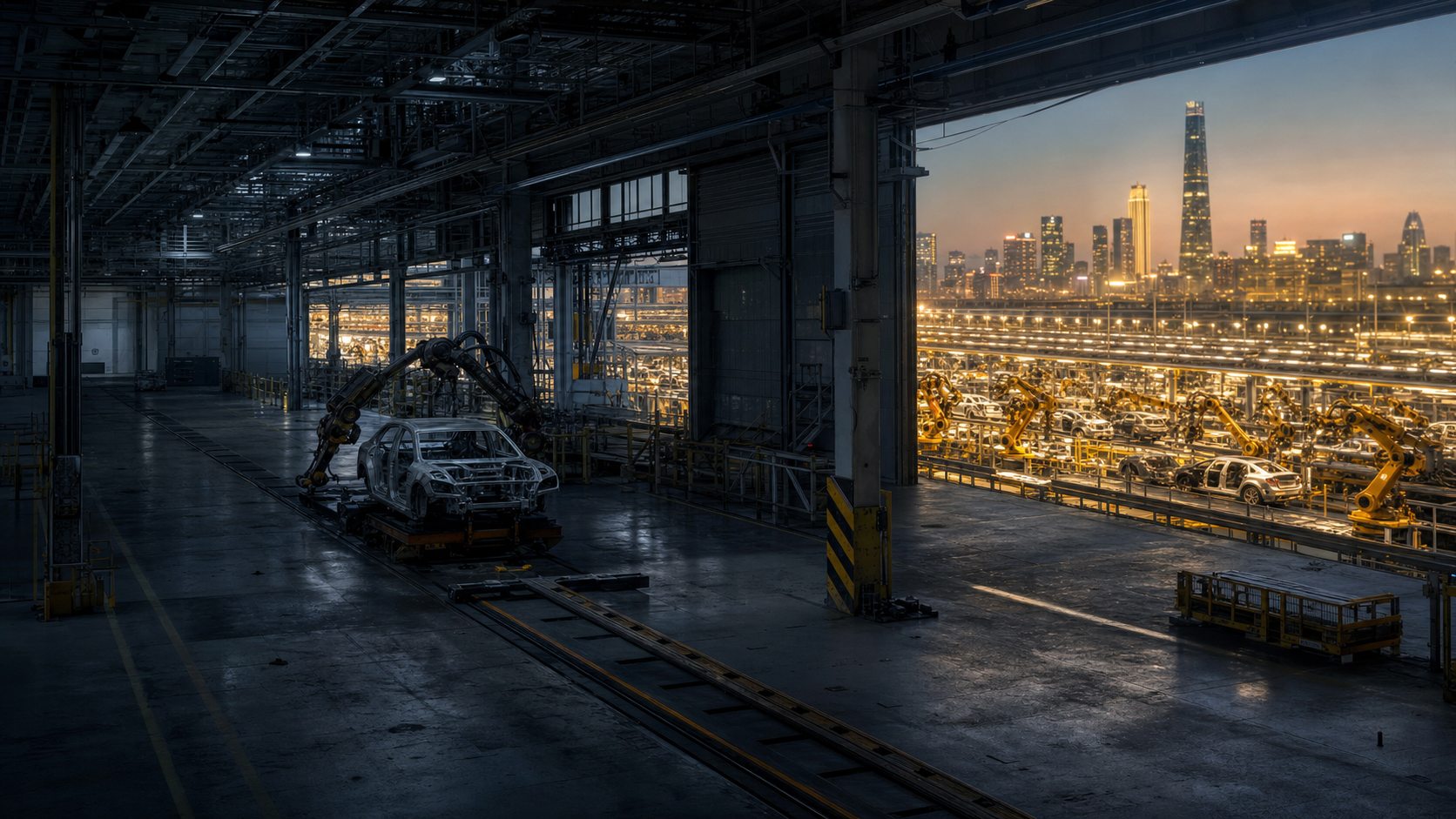
The cost collapse: Why Volkswagen can no longer produce competitively in Germany – Image: Xpert.Digital
Industrial electricity price evaporates: Why the VW earthquake threatens the entire German economy
Shocking VW data shows: Germany has long since lost the price war
Volkswagen is facing a historic upheaval that is shaking the foundations of Germany's industrial base. Leaked internal figures now ruthlessly reveal what has long been discussed behind closed doors or even suppressed in political debates: Production in Germany has simply become too expensive compared to other countries. Extreme differences in personnel and energy costs, as well as structural disadvantages at the German locations, are apparently forcing Europe's largest automaker to completely phase out vehicle production at four traditional German plants by 2034. While politicians grapple with piecemeal relief measures, the production of strategically important electric models is migrating almost unnoticed to Eastern Europe. A sober analysis of the VW data dramatically demonstrates why this development is far more than just a temporary economic downturn – and why it must serve as an urgent warning signal for the entire German industry.
When 74 euros meet 12 euros, Germany has already lost
Internal figures from the Volkswagen Group, leaked shortly before the crucial supervisory board meeting in September 2026, reveal a truth that has long been suppressed in German economic debates. Production in Germany is not only more expensive by international standards, but in several cost categories, it is many times more expensive than in China, the USA, or Eastern European locations. Hourly labor costs for production personnel at the Emden plant amount to €74, while in Tianjin, China, they are only €12, and even the Portuguese plant in Palmela, at €37, fares significantly better than the German site. This difference is not mere statistical noise, but rather the expression of a structural shift in the global competitive order, which is now forcing Volkswagen to phase out production at four German locations between 2031 and 2034.
The stark figures of a lost cost battle
The leaked board documents, initially reported by WirtschaftsWoche and subsequently by numerous other media outlets, paint an alarming picture for Europe's largest automaker. Personnel costs per employee per year in Germany amount to approximately €163,000, while in North America they are €92,000, in China €74,000, and the global average outside these regions is a mere €41,000. This figure alone explains why, purely from a business perspective, every additional vehicle variant that could potentially be manufactured in a plant outside Germany is being steered toward more cost-effective locations.
According to the report, additional factors include energy costs, which are roughly two and a half times higher in Germany than in China, and a sickness absence rate that burdens German plants by about a factor of ten compared to Chinese locations. Factory costs per vehicle produced also reveal the gap. In 2025, these averaged around €6,490 at German plants, while at European plants outside Germany they were only around €2,832, more than doubling the pure location costs. This combination of personnel, energy, and downtime adds up to a cost burden that no productivity advantage of German engineering can offset.
Four factories, one pattern: What the wave of closures looks like in concrete terms
Based on this cost analysis, the Volkswagen board of directors has unanimously decided, according to multiple media reports, to end current vehicle production at four German plants as planned. The timeline stipulates that production will end in Emden and Zwickau in 2031, in Hanover in 2032, and at the Audi plant in Neckarsulm in 2034. Currently, approximately 45,000 employees at these four locations are affected, while around 50,000 jobs are to be cut across the entire group by 2030.
The relocation strategy follows a clear pattern towards Eastern European plants with significantly lower cost structures. The successor to the ID.4, manufactured in Emden and internally designated ID. Tiguan, will be produced at the Škoda plant in Mladá Boleslav, Czech Republic. The successor to the Audi Q4 e-tron, built in Zwickau, will move to Bratislava, Slovakia, while the new electric van, originally intended for Hanover, is slated to roll off the assembly line in Poznań, Poland, starting in 2032. The successor to the Audi A8, currently manufactured in Neckarsulm, will be produced at the Leipzig plant in Saxony. This represents a shift within Germany, but does not resolve the question of the Neckarsulm plant's future.
| Location | Current model | End of production | New location for successor model |
|---|---|---|---|
| Emden | ID.4, ID.7 | 2031 | Mladá Boleslav (Czech Republic) |
| Zwickau | Q4 e-tron, ID.3 | 2031 | Bratislava (Slovakia) |
| Hanover | Multivan, ID.Buzz | 2032 | Poznań (Poland) |
| Neckarsulm | Audi A5, A6, A8 | 2034 | Leipzig (Germany) |
It is noteworthy that, according to reports, the board of directors can implement the so-called "idling down" of plants even without the formal approval of the supervisory board, since the cessation of production is not considered a transaction requiring approval under the company's articles of association, unlike the construction or relocation of production facilities. This legal nuance effectively shifts the balance of power from the supervisory board, where employee representatives have considerable influence, to operational management, further exacerbating the already dire situation for the employees.
The real bombshell: structural costs instead of economic weakness
It's tempting to interpret the plant closures as a consequence of temporary sales weakness or a cyclical decline in demand. However, this interpretation is too simplistic, because the available figures describe not a temporary disruption, but a structural shift in the global cost architecture of the automotive industry. When personnel costs in China are less than half those in Germany and energy costs differ by a factor of two and a half, these are location factors that cannot be resolved by a better economy or higher sales figures.
What makes this particularly explosive is that the plants affected are precisely those currently producing electric vehicles considered to have the potential for the future, such as the ID.4 in Emden or the ID.3 in Zwickau. This refutes the widespread assumption that the primary reason for plant closures is the discontinuation of combustion engine models. Rather, it shows that even strategically important electric models at German locations are not generating sufficient returns under the given cost structures, supporting the theory that the problem runs deeper than individual model decisions.
🎯🎯🎯 Data-driven B2B industry hub as a quasi-in-house solution

The quasi-in-house solution: How Xpert.Digital closes operational gaps in B2B marketing and sales – Smart Content-Driven Business - Image: Xpert.Digital
Xpert.Digital is a data-driven B2B industry hub led by Konrad Wolfenstein . The company acts as an external, quasi-in-house solution for industrial partners, closing operational gaps in marketing, content, and sales – without requiring additional resources on the client side.
More information here:
Germany's industrial cost trap: Why political relief measures often remain ineffective
The anatomy of the German cost burden
To put these figures into perspective, it's worth looking at the individual cost components, which reinforce each other. At the beginning of 2025, energy costs for energy-intensive industrial companies in Germany averaged around 18 cents per kilowatt-hour for non-eligible companies and about 12 cents for eligible companies, which is among the highest industrial electricity prices worldwide. This burden disproportionately affects the automotive industry, a particularly energy-intensive sector with its paint shops, press shops, and body shops.
Furthermore, the German labor market is highly regulated by international standards, which manifests itself in factors such as payroll taxes, vacation entitlements, and dismissal protection, further driving up absolute personnel costs per employee. The extremely high rate of absenteeism due to illness at German plants compared to Chinese locations, as revealed in the VW document, also points to structural differences in healthcare, work organization, and possibly even employee motivation. The precise causes of these differences are not detailed in the publicly released document. The combination of these factors means that a German production site is at a disadvantage compared to a Chinese plant in virtually every relevant cost parameter, without these disadvantages being fully offset by higher productivity, better quality, or greater innovation.
What politics and business have done so far
The German government has recognized the structural competitive disadvantage of energy-intensive industries and has adopted several measures in recent months aimed at reducing energy costs. At the beginning of 2026, the electricity tax for more than 600,000 manufacturing companies was permanently reduced to the European minimum rate, which translates to savings of approximately €200,000 for a company with an annual consumption of ten gigawatt-hours. In addition, the federal government is subsidizing transmission network charges with €6.5 billion annually in 2026 and intends to continue this subsidy with just over €5.5 billion per year from 2027 to 2029. The gas storage surcharge has been completely abolished, further reducing gas prices.
The central instrument, however, remains the so-called industrial electricity price, which is scheduled to apply from 2026 to 2028 and aims for a target price of around five cents per kilowatt-hour for particularly energy-intensive companies from 91 economic sectors. The relief scheme is based on the wholesale electricity price and covers a maximum of half the reference price for half of a production facility's electricity consumption. In return, companies are obligated to invest half of the aid received in decarbonization measures within 48 months. For the 2026 billing year, the actual relief amount is approximately 3.75 cents per kilowatt-hour, with a possible flexibility bonus of ten percent for companies that additionally invest in demand-side flexibility.
However, reactions from the business community and the press to this instrument are considerably more reserved than the official pronouncements of the federal government would suggest. An analysis by the ARD business magazine "Plusminus" calculated that an industrial company previously paying 18 cents per kilowatt-hour would only see its costs reduced to 17.625 cents by the subsidy, a figure described as virtually homeopathic. This discrepancy between the politically announced target price of five cents and the relief actually being felt across the board reveals a fundamental problem with the measures taken so far: while symbolically significant, their real impact on many companies is limited.
Is any real action being taken, or is the ball just being passed back and forth?
A closer look at the political reactions so far reveals a twofold dynamic. On the one hand, there are indeed concrete, budget-effective measures such as the permanent reduction in electricity tax and the multi-billion-euro grid fee subsidy, which are not mere announcements but have already been budgeted and partially disbursed. On the other hand, the case of the industrial electricity price exemplifies how political pronouncements and actual effects can diverge. The target price of five cents per kilowatt-hour, originally communicated by Chancellor Friedrich Merz, was effectively reduced to a fraction of the originally promised relief during its implementation due to the European Commission's state aid regulations and the fifty percent cap.
At the same time, Volkswagen itself exhibits a telling pattern of delay and postponement. As recently as late August 2026, CEO Oliver Blume publicly emphasized during a visit to Emden that plant closures were only a last resort, while internal documents at that time already contained concrete closure dates for precisely that location. Even Lower Saxony's Minister-President Olaf Lies assured the Emden plant of a political guarantee shortly before the plans became public, a guarantee that had already been effectively undermined by the board's internal decision. This simultaneous public reassurance and internal decision can hardly be interpreted as anything other than a deliberate timing of communication, attempting to delay the social and political pressure from the local communities and the IG Metall union for as long as possible, while the actual strategic decisions had already been made.
The IG Metall union has announced its opposition, accusing the board of violating existing company agreements with the planned plant closures. There is also opposition from the state level, for example from Saxony's Minister-President Michael Kretschmer, who does not yet consider the closure of the Zwickau plant to be a done deal. This resistance is likely to delay the timeline in individual cases or lead to renegotiation of specific location decisions, but it will hardly change the fundamental cost logic underlying the board's decision as long as global location factors do not converge significantly.
What would actually be necessary now
Effective countermeasures would have to go significantly beyond the existing relief measures, which primarily focus on energy costs. Firstly, a noticeable acceleration and expansion of the industrial electricity price is needed. In its current form, with a 50 percent cap and retroactive application starting only in 2027, the price is too low and too late for many energy-intensive companies to influence short-term location decisions like the one at Volkswagen. A genuine reform would require advance relief instead of retroactive reimbursement, as well as coverage of full consumption instead of just half.
Secondly, structural labor costs would need to be addressed, which, given the political sensitivity of non-wage labor costs, social security contributions, and working time regulations, is a significantly more difficult policy area than pure energy price subsidies. Without reforms to non-wage labor costs, working time flexibility, and potentially also sick leave regulations, the cost gap of €163,000 to €74,000 compared to China would remain essentially unchanged, even if energy costs were fully equalized. Thirdly, there would be a need for a significant reduction in bureaucracy regarding permitting procedures, environmental regulations, and reporting requirements. While this is regularly cited as a goal in political rhetoric, its practical implementation has so far yielded little noticeable acceleration.
Fourth, European coordination is needed to prevent the relocation of production facilities within the European Union, for example from Germany to Slovakia or Poland, from becoming a zero-sum game between EU member states without improving the EU's overall competitive position vis-à-vis China or the USA. Currently, individual Eastern European locations benefit from these relocations, but the fundamental cost problem compared to non-European competitors like China remains unresolved at the European level as long as there is no common industrial policy with coordinated energy prices, trade protection measures, and innovation promotion.
A sober assessment of the location debate
The figures from the VW report provide a rare, unvarnished glimpse into the true cost reality of German industry and expose many of the previous political relief measures as inadequate in their scope, given the scale of the structural problem. While the electricity tax cut and the grid fee subsidy represent real, budget-effective relief amounting to billions, even ten billion euros in annual relief seems like a drop in the ocean in light of a cost gap that is more than double the Chinese level for personnel costs and sometimes six times higher for manufacturing costs.
The real challenge for German industrial policy lies in honestly acknowledging that complete cost parity with China or even North America is illusory in the foreseeable future, and that location strategy should therefore focus not on cost competition, but on differentiation through quality, speed of innovation, degree of automation, and specialized manufacturing expertise. The Volkswagen plant closures are thus less a singular corporate problem than an early warning signal for the entire energy-intensive German industry, demonstrating how narrow the window of opportunity for effective countermeasures has become before further relocations of this magnitude occur.
📈🚀 From visibility to trust 👀🤝 Your scalable path with Xpert.Digital

From visibility to trust: Your scalable path with Xpert.Digital - Image: Xpert.Digital
In industrial B2B, sustainable business relationships rarely emerge overnight. They develop step by step – through visibility, professional relevance, recurring touchpoints, and growing trust. Xpert.Digital's 4-stage model addresses precisely this: It offers a structured path that begins with a manageable entry point and can evolve into deeper collaboration in business development if needed.
Instead of relying on loud marketing promises, this model puts the relationship at the forefront. Companies start with clearly defined, easily calculable measures and then decide, based on their own experience, how far they want to expand the collaboration. A key factor for this undisturbed trust-building process: The platform completely avoids annoying advertising ads, so the editorial focus remains solely on the companies' expertise.
More information here:
Your global marketing and business development partner
☑️ Our business language is English or German
☑️ NEW: Correspondence in your native language!

Konrad Wolfenstein
I and my team are happy to be available to you as your personal advisor.
You can contact me by filling out the contact form here [email protected]:or simply call me at +49 7348 4088 965. My email address is
I'm looking forward to our joint project.










