
Prime Ministers instead of managers: The state in the VW engine room – How politics steers, slows down and blocks Volkswagen
Xpert Pre-Release

Available in 27 languages 📢
Prefer Xpert.Digital on GoogleⓘPublished on: March 10, 2026 / Updated on: March 10, 2026 – Author: Konrad Wolfenstein
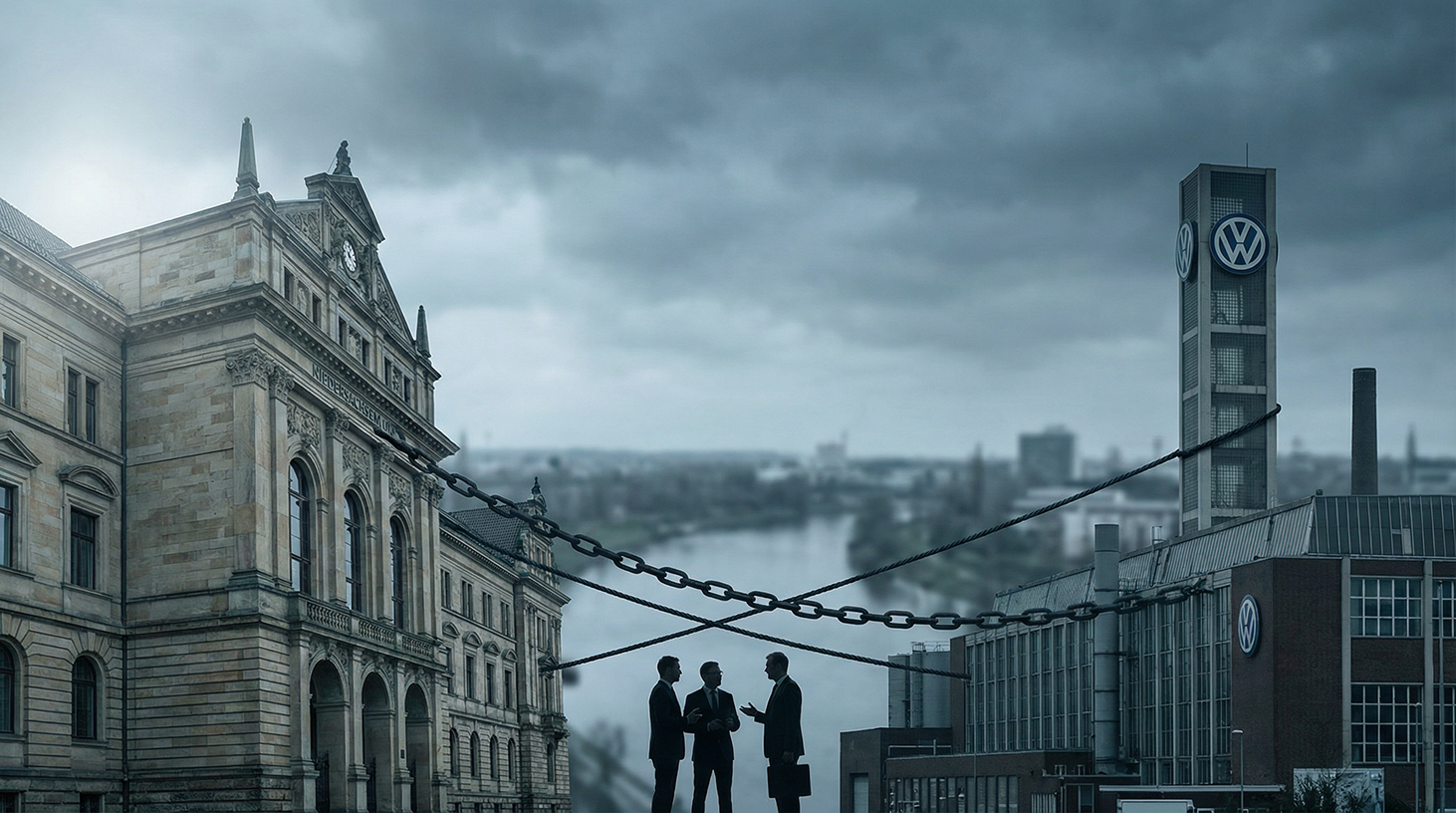
State premiers instead of managers: The state in the VW engine room – How politics steers, slows down and blocks Volkswagen – Image: Xpert.Digital
Power struggle in the supervisory board: Why VW cannot save itself
Blocked factories, falling profits: The bitter truth about the VW law
Volkswagen is undergoing the deepest transformation in its history – but the path out of the crisis will be decided not only on the global market, but above all in the state chancellery in Hanover. With the state of Lower Saxony as a major shareholder and the historically enshrined VW Law, politicians possess a unique veto right at Europe's largest automaker. When state premiers and union representatives jointly decide on plant closures and strategic realignments on the supervisory board, the lines between economic necessity and electioneering become blurred. What was once intended as a shield for hundreds of thousands of jobs is increasingly proving to be an existential threat in the age of e-mobility and shrinking margins. Leading economists have long been warning of an "economic hostage situation" that is slowing down or even preventing the urgently needed restructuring of the company. A deep look into the engine room of a company caught between global competition and regional politics.
Related to this:

When state premiers, rather than managers, decide the future of a global corporation, it's no longer co-determination, but economic hostage-taking
Volkswagen is no ordinary company. It's a corporation unlike any other DAX-listed company: a state premier sits on the supervisory board, a state law grants the government veto power, and the union not only negotiates wages but also helps decide whether factories can be opened, relocated, or closed. This entanglement of state politics, employee representation, and corporate strategy is no accident, but a historically evolved system that has increasingly become a hindrance in recent years. The question of how much politics influences corporate decisions at VW can be answered clearly: to an extent that is unique in German business and is now considered by leading economists to be an existential threat to the corporation's competitiveness.
The VW Law: A relic with real power
The legal basis for political influence at Volkswagen is the so-called VW Law, which came into force in 1960 during the privatization of the formerly state-owned company. It resulted from a compromise between the federal government, the state of Lower Saxony, trade unions, and the buyers of the first publicly traded shares, after the question of ownership of the company, founded in the Third Reich, had remained unresolved for years.
The law contains two core provisions that remain in effect today and determine the power dynamics within the corporation. First, Section 4, Paragraph 3 stipulates that resolutions passed at the general meeting, which normally require a three-quarters majority, require a majority of more than 80 percent at Volkswagen. Since the state of Lower Saxony holds 20.2 percent of the voting rights, it can block any such resolution. The state thus possesses a blocking minority, which elsewhere would only come into effect with a 25 percent shareholding. Second, Section 4, Paragraph 2 stipulates that the establishment and relocation of production facilities require the approval of the supervisory board by a two-thirds majority. Because the supervisory board consists of equal numbers of employee and shareholder representatives, the employee representatives alone can prevent any location decision.
These two mechanisms together create a governance model in which neither plants can be closed nor relocated, neither the articles of association can be changed nor the capital increased, as long as the state of Lower Saxony and the employee representatives are against it.
The supervisory board as a political arena
The Supervisory Board of Volkswagen AG consists of 20 members, ten representing shareholders and ten representing employees. The state of Lower Saxony has a legally enshrined right to appoint two representatives, provided it holds at least 15 percent of the company's ordinary shares. Currently, Minister-President Stephan Weil and his deputy, Julia Willie Hamburg, represent the state on the Supervisory Board.
The unique aspect lies not only in the personnel composition but also in the resulting strategic alliance. In practice, the state representatives frequently act in close cooperation with the ten employee representatives, including works council chairwoman Daniela Cavallo and representatives from the IG Metall union. Together, they form a de facto majority of twelve of the twenty supervisory board members. Automotive expert Stefan Bratzel from the Center of Automotive Management (CAM) describes this alliance with a single word: blocking power.
This blocking power unfolds on several levels simultaneously. At the general meeting level, the state, with its 20.2 percent voting rights, can prevent any resolution amending the articles of association. At the supervisory board level, the state and employee representatives can jointly block any location decision, as the required two-thirds majority cannot be achieved without their consent. And at the informal level, the state premier, as a member of the supervisory board, exerts influence on strategic decisions that do not formally require his approval, because his political weight in the board's deliberations is correspondingly high.
Securing business locations as a political dogma
Nowhere is political influence more tangible than in the question of factory locations. Lower Saxony is Volkswagen's largest production location in Germany, with the main plant in Wolfsburg, the commercial vehicle plant in Hanover, the electric car plant in Emden, the components plant in Braunschweig, the plant in Salzgitter, and the site in Osnabrück. Over 100,000 people work for Volkswagen in Lower Saxony alone. Every job lost is potentially a vote that shifts.
When the VW board first spoke openly about possible plant closures in Germany in the fall of 2024, Minister-President Weil responded with an unequivocal statement. He expected that the negotiations would develop alternatives to plant closures or the dismantling of core industries. In September 2024, at an event at the VW plant in Emden, Weil made it even clearer that he would not accept plant closures and trusted in the tradition of finding solutions together with all parties involved.
Together with the employee representatives on the supervisory board, the state secured a solution that avoids both layoffs and plant closures. The future-oriented collective bargaining agreement concluded in December 2024 instead stipulates the reduction of 35,000 jobs through partial retirement, early retirement, and severance packages by 2030. The waves of warning strikes in December 2024, in which almost 100,000 employees participated, further increased the political pressure.
The question is whether this result made economic sense. The average capacity utilization of European car plants in 2023 was only 60 percent, ten percentage points lower than before the pandemic. In Germany, France, Italy, and Great Britain, it even fell to 54 percent. The VW plant in Emden, the only dedicated electric car factory in Lower Saxony, is far from operating at full capacity. Volkswagen CFO Arno Antlitz admitted that premium prices and mobility for everyone are incompatible, especially at the German plants where the majority of electric vehicles are built.
Our EU and German expertise in business development, sales and marketing

Our EU and German expertise in business development, sales and marketing - Image: Xpert.Digital
Industry focus areas: B2B, digitalization (from AI to XR), mechanical engineering, logistics, renewable energies and industry
More information here:
A thematic hub offering insights and expertise:
- Knowledge platform covering global and regional economies, innovation and industry-specific trends
- A collection of analyses, insights, and background information from our key areas of focus
- A place for expertise and information on current developments in business and technology
- A hub for companies seeking information on markets, digitalization, and industry innovations
Dividends or votes? The billion-dollar dilemma that is paralyzing VW from within
Dividends, voters, and the financial conflict of interest
Lower Saxony's political influence on VW also has a financial dimension that is rarely discussed openly. The state holds approximately 59 million VW ordinary shares, and the dividend income flows partially into the state budget via the Hanoverian holding company. In recent years, the gross dividend that the state is obligated to pass on to the Volkswagen Foundation has ranged between €227 and €272 million annually. In the spring of 2025, Finance Minister Gerald Heere restructured the holdings: around 30 million shares, then worth €3.1 billion, were transferred to a non-profit company to process the payments to the Volkswagen Foundation directly, bypassing the state budget.
This financial dependence creates a conflict of interest that critics have been denouncing for years. Lower Saxony is simultaneously a regulator, a major shareholder, and an employers' lobbyist. As a major shareholder, the state has an interest in high dividends and a rising share price. As a political actor, it has an interest in job security and maintaining production sites. These two goals are directly contradictory in the current transformation phase of the automotive industry. Keeping plants open that are operating below capacity costs money and reduces profit margins, which in turn negatively impacts the share price and dividends.
Ferdinand Dudenhöffer, director of the CAR Institute, calculates that if Lower Saxony were to sell its 59 million ordinary shares, it would bring the state significantly more than five billion euros. Dudenhöffer points to the example of Opel in Bochum, where, after the painful closure of the plant, a thriving new business location emerged, with Deutsche Post DHL Group, a Bosch subsidiary for cybersecurity, and, ironically, also Volkswagen Infotainment.
Related to this:

The European Court of Justice, the European Commission, and a decade of legal battles
The special role played by politicians at Volkswagen also provoked considerable resistance at the European level. The EU Commission considered the VW Law a violation of the free movement of capital and brought a case before the European Court of Justice in 2005. In October 2007, the ECJ largely upheld the Commission's position and declared key provisions of the VW Law incompatible with EU law.
Germany subsequently abolished the exclusive voting rights and the right of the state to appoint representatives to the European Parliament, but retained its crucial blocking minority. The European Commission filed another lawsuit, but lost before the European Court of Justice in 2013, which dismissed the case, although without ruling on the substantive compatibility of the blocking minority with EU law. The Commission then let the matter rest.
The president of the Federation of German Industries (BDI) at the time demanded the complete repeal of the law, arguing that the state should refrain from interfering in genuinely entrepreneurial decisions. Clemens Fuest, president of the ifo Institute, has also repeatedly called for politicians to withdraw from corporate affairs. Ferdinand Dudenhöffer goes even further, describing the VW law as simply fatal. He argues that adjustments at VW have been repeatedly postponed because the politically motivated obstruction slowed down or prevented any restructuring.
How political influence slows down the transformation
The concrete effects of political influence can be traced through several stages in the company's recent history. The excessively high production costs at the German plants have been known for years, yet structural cutbacks were repeatedly postponed. Politicians and unions urged Volkswagen to produce expensive electric vehicles in Germany, which proved problematic from a business perspective, as demand did not meet expectations.
The shift away from combustion engine technology was influenced by political signals: both EU regulations and the Lower Saxony state government pushed for rapid electrification, while the market sent different signals. When Volkswagen presented a master plan for a competitive German automotive industry in March 2025, it was no coincidence that this document was addressed to the CDU, CSU, and SPD, the coalition parties then negotiating. Among other things, the company called for tax incentives for electric mobility, a social leasing model for low-income households, and the obligation for gas stations to install fast-charging stations. This paints a picture of a corporation that is not only controlled by politics but also attempts to instrumentalize politics for its own purposes – a system of mutual dependence.
In September 2024, Volkswagen terminated key collective bargaining agreements, including the job security agreement that had been in place for over 30 years. It was a historic break that immediately triggered political resistance. Works council chairwoman Daniela Cavallo spoke of a historic attack on jobs. Ultimately, a compromise was reached that, while cutting 35,000 jobs, avoided any layoffs and plant closures. Critics like the WSWS reported that the supposed safeguards for locations were pure fantasy and that there was no binding agreement whatsoever on the long-term preservation of all sites.
The governance triangle: families, state, and trade unions
To fully understand the political influence at VW, one must consider the entire ownership triangle. The Porsche and Piëch families hold 53.3 percent of the voting rights through Porsche Automobil Holding SE, making them by far the largest shareholder. The state of Lower Saxony follows with 20.2 percent, and the Qatari sovereign wealth fund holds approximately 17 percent. In theory, the families could determine the company's direction with their majority voting rights. In practice, however, the VW Law significantly limits their options: they require the approval of Lower Saxony for amendments to the articles of association and the approval of the employee representatives on the supervisory board for decisions regarding plant locations.
This balance of power has led to strategic shifts at Volkswagen being slower and more compromise-driven than at other manufacturers. While Toyota, BYD, or Tesla can make location decisions based purely on business criteria, Volkswagen must always negotiate the political and social consequences. Shareholder representative Marc Liebscher of the German Association for the Protection of Investors (SdK) believes it is generally beneficial for employees to have a say, but criticizes the fact that their power, in combination with the state government, is too great, because Lower Saxony, too, always prioritizes the interests of VW employees, who are also voters.
Between protection and paralysis
The question of whether political influence at Volkswagen has a positive or negative effect cannot be answered in a one-dimensional way. There are certainly arguments in favor of the existing system: it has secured jobs, mitigated social disruption, and protected the company from short-term speculative interests. The job guarantee since 1994 has been a successful German model, providing planning security for over 100,000 families.
But the costs of this model are becoming increasingly apparent in times of rapid industrial change. With an operating margin of just 2.8 percent in 2025, the loss of market leadership in China, and a failed software project worth billions, the question arises whether protecting employees might ultimately jeopardize their jobs. A corporation that, out of consideration for political sensitivities, cannot close superfluous plants, reduce costs quickly enough, and restructure investments consistently enough, will ultimately lose its overall competitiveness and, consequently, all jobs, not just some.
Volkswagen has become entangled in a system where the state premier sits at the table for every strategic decision – not as an advisor, but with veto power. Where the union can prevent any plant closure, even if the plant is only operating at 54 percent capacity. Where the corporation addresses its master plan not to its shareholders, but to the coalition negotiators of the next federal government. And where an economist like Ferdinand Dudenhöffer has only one word left to describe this governance model: deadly.
Your global marketing and business development partner
☑️ Our business language is English or German
☑️ NEW: Correspondence in your native language!

Konrad Wolfenstein
I and my team are happy to be available to you as your personal advisor.
You can contact me by filling out the contact form here or simply call me at +49 7348 4088 965. My email address is: [email protected]
I'm looking forward to our joint project.










