
Volkswagen in an existential crisis: profits halved, 50,000 job losses and a VW management that is steadfastly holding on to power
Xpert Pre-Release

Available in 27 languages 📢
Prefer Xpert.Digital on GoogleⓘPublished on: March 15, 2026 / Updated on: March 15, 2026 – Author: Konrad Wolfenstein
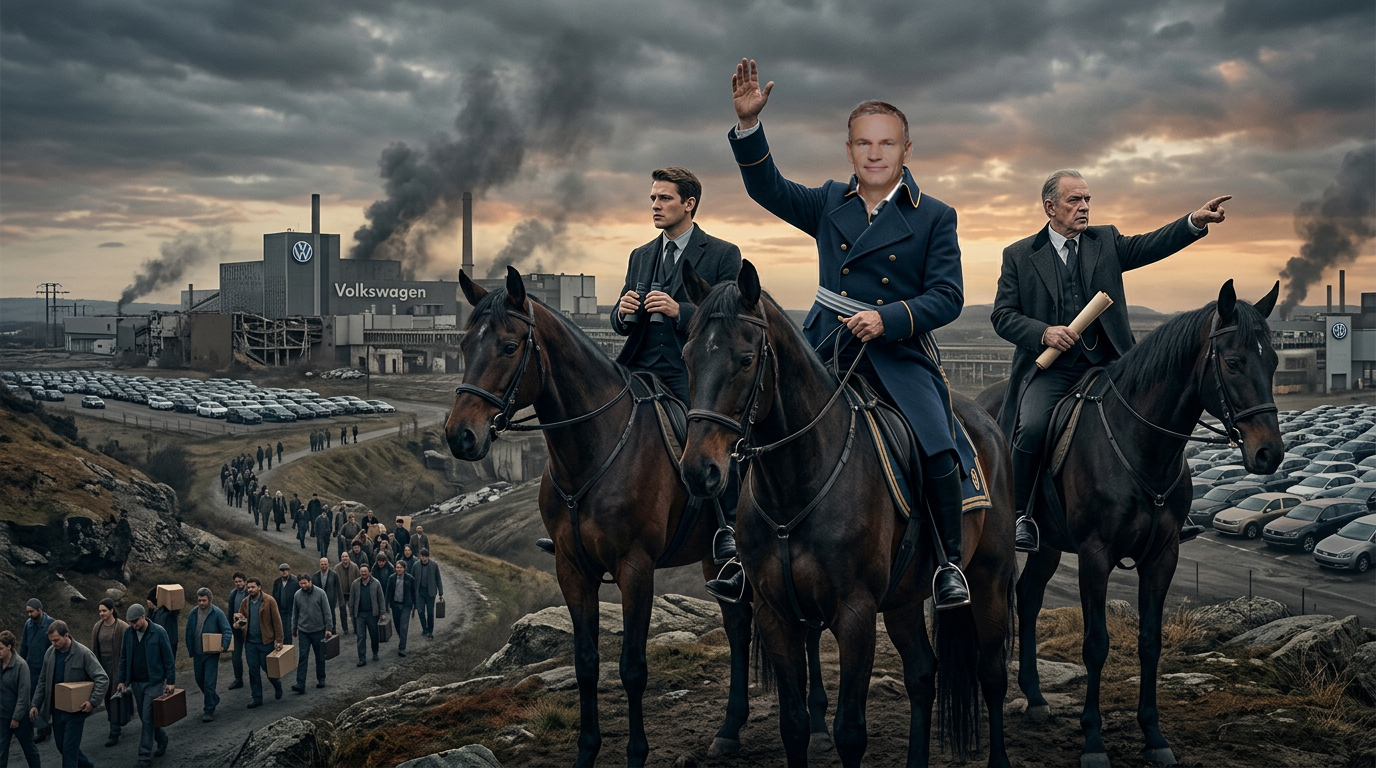
Volkswagen in an existential crisis: profits halved, 50,000 jobs lost, and a VW management team holding firm – Image: Xpert.Digital
When a corporation protects its "key players" – the story of a German industrial giant on its way to irrelevance
Tuesday, March 10, 2026: A black day in the Wolfsburg corporate history
There are balance sheet days that go down in corporate history – not as milestones of success, but as markers of failure. Tuesday, March 10, 2026, was such a day for Volkswagen. VW CEO Oliver Blume faced the public and had to admit what had been apparent in the quarterly figures for months: The operating profit of the world's largest automotive group, measured by sales, had been halved to €8.9 billion. The operating margin fell to a mere 2.8 percent – the lowest level since the height of the diesel scandal in 2016.
The group's net profit after taxes fell from €12.4 billion in the previous year to just €6.9 billion – a decline of 44 percent. This occurred despite group revenue remaining almost stable at around €322 billion and total sales of just under nine million vehicles declining only marginally by 0.5 percent. The message from these figures is unmistakable: Volkswagen continues to produce and sell on a large scale, but it is earning less and less in the process. Costs are eating up revenues.
Blume's response to the grim figures was an announcement he had already made, but which he now emphatically reiterated in an open letter to shareholders: By 2030, around 50,000 jobs are to be cut across the group in Germany. This corresponds to roughly one in five of the current 284,032 employees in the country. This announcement is not a new figure – it has been known since the end of 2024 – but the timing of its repetition shows that management has understood: There is an urgent need for action. The question that is troubling investors, employees, and observers alike, however, is: Is this the right management taking action?
Related to this:

A decade of structural decline
The current crisis at Volkswagen is not a sudden event triggered by external shocks. It is the result of decades of structural decline, which the management was able to mask for a long time with past successes. The origins of today's predicament reach back to 2015, when the diesel scandal shook the entire corporate culture. Millions of vehicles worldwide were equipped with manipulated emissions software. The direct financial consequences for fines, compensation, and legal disputes amounted to more than 30 billion euros. But the real costs ran deeper: Trust in the brand, the reputation of German automotive manufacturing as a whole, and—above all—the necessity of an accelerated transformation toward electromobility were severely impacted by this scandal.
The transition to electromobility was anything but smooth. Blume himself admits internally that they focused on electric vehicles because money can only be invested once. But this strategy had serious side effects: The range of combustion engine vehicles was reduced too early, while the electric vehicles were not yet generating sufficient margins during the crucial growth phase. The result was a dangerous gap in the product portfolio that could not be profitably filled by either combustion engine or electric cars.
The debacle surrounding the software subsidiary Cariad was particularly devastating. Founded in 2020, the company was intended to develop a unified software platform for all group brands, thereby making VW independent of expensive external suppliers. But what began as a visionary digital project turned into one of the most costly failures in German industrial history. McKinsey calculated that the planned software architecture would cost around €3.5 billion more than originally anticipated. In its annual financial statements, Cariad alone posted a deficit of €2.1 billion. The market launch of numerous models had to be postponed for years, including prestigious vehicles such as the electric version of the Porsche Macan.
The cooperation with the US electric vehicle startup Rivian, in which VW invested around five billion euros, was supposed to remedy the situation. However, new reports indicate that this partnership has also stalled – faulty over-the-air updates and a lack of progress raise concerns about further billions in losses. Volkswagen has maneuvered itself into a spiral of dependency with its software strategy: too large and too bureaucratic for the agility of a technology company, too resistant to digitalization for the demands of modern vehicles.
The free fall of the premium subsidiaries
When a brand like Porsche, for years the group's cash cow, experiences a 91 percent drop in profits, it's not an isolated incident – it's a systemic failure. That's precisely what happened in the second quarter of 2025: Porsche generated an operating profit of around €154 million in its automotive segment (excluding financial services), compared to approximately €1.7 billion in the same period of the previous year. Year-on-year, Porsche's profit also plummeted by 91 percent, and the new Porsche CEO, Michael Leiters, who succeeded Blume at the head of the sports car subsidiary at the beginning of 2026, announced further job cuts immediately after taking office.
What triggered this collapse? The diagnosis from within the company is that Oliver Blume, who held the unique dual role of CEO of both the VW Group and Porsche until early 2026, focused the strategy too early and too heavily on electromobility. Combustion engine models, which would still have been profitable, were missing at the crucial moment. Investors and institutional shareholder representatives – including Union Investment and DWS – had already criticized this dual role at the 2025 VW Annual General Meeting as structurally incompatible with a focused restructuring effort. Volkswagen, they argued, had only a "part-time CEO" in Blume, who was hardly capable of simultaneously managing the problems of both companies.
Added to this are external factors, which Blume cites in private as the main arguments for the poor figures: US tariffs under President Donald Trump cost the company around €1.3 billion in the first half of 2025 alone, and on an annual basis, the tariff-related additional costs amounted to around €5 billion. Added to this are write-downs in the battery business and other one-off effects. These explanations are not wrong – but they distract from a fundamental structural problem: a company that is trying to do too many things at once and is losing ground everywhere as a result.
The Phantom of Factory Closures
Nowhere is the power imbalance within the VW Group more evident than in the issue of plant closures. The business logic is clear: Volkswagen is suffering from massive overcapacity in Germany. All German plants missed their cost targets in 2025. While costs at the Wolfsburg, Zwickau, and Emden plants fell by an average of almost 30 percent, this is not enough. According to calculations, further savings of ten to fifteen percent are needed at each location to meet the targets by the end of 2026. The technical production capacity is to be reduced by 734,000 units across the group.
The situation is particularly dire in Emden and Zwickau. The Emden plant, with its approximately 8,000 employees, faces a critical decision: VW intends to decide by the end of 2026 whether the site will be permanently closed in 2032. Its future hinges on whether the successor to the ID.4 will be produced in East Frisia starting in 2031 – a decision likely to be driven more by political than purely economic considerations. Zwickau, VW's first all-electric plant in Europe, is also fighting for its survival.
And yet, nothing happens – or at least far too little. The Transparent Factory in Dresden, a small business with symbolic significance, should have been closed long ago, according to a board decision from 2024. This is not expected to actually happen until late summer 2026. Experience shows that in Germany, it is easier to shut down a nuclear power plant than to close a car factory. In the entire post-war history of the German automotive industry, only one closure has been fully implemented – the Opel plant in Bochum. Volkswagen is soon to be the second.
But why is the decision taking so long? The answer lies in the company's unique political structure. VW is not simply a publicly traded company beholden to its shareholders. It is a political institution. The state of Lower Saxony holds around 20 percent of the voting rights and appoints the Minister-President to the Supervisory Board. The VW Law, which remains in effect in a modified form despite EU intervention, guarantees employee representatives and the state of Lower Saxony strong blocking minorities. Works council chairwoman Daniela Cavallo (50) uses these structural safeguards to great effect – and she also enjoys strong support on the Supervisory Board.
The leadership troika: Three men and their question marks
At the helm of a company in deep structural crisis are three men whose positions are all uncertain by spring 2026. The astonishing thing isn't whether one of them might lose their job. The astonishing thing is that a unique mechanism appears to be keeping all three in office – despite the lack of results.
Hans-Dieter Pötsch (74), chairman of the supervisory board of the Volkswagen Group since October 2015 and thus the most powerful man in Wolfsburg since then, is facing another test: his current term ends with the annual general meeting on June 18, 2026, and he would have to be re-elected. Pötsch took over the supervisory board position in the wake of the diesel scandal, when the legendary Ferdinand Piëch stepped down. Since then, he has led the company through various crises – but even during all these years, VW's fortunes have steadily declined.
Internally, Pötsch is highly regarded by both management and staff. His strength lies in his ability to mediate: he understands, like few others, how to balance the conflicting interests of family shareholders, employee representatives, institutional investors, and the state of Lower Saxony in fragile compromises. But it is precisely this quality that now makes him a problem in the eyes of the most impatient shareholders. Members of the Porsche/Piëch family – above all, the 82-year-old Wolfgang Porsche – believe that the time for diplomacy is over. Plants should have been closed long ago, according to sources close to him. The criticism is that Pötsch has been too accommodating to the demands of the employee representatives and has thus prevented the necessary radical reform.
Wolfgang Porsche therefore suggested the Austrian entrepreneur Siegfried “Siggi” Wolf (68) as a possible successor. Wolf is a hunting friend of Porsche's and enjoys his personal trust. But the proposal quickly failed – for a reason that is not insignificant in the current geopolitical situation in Europe: In 2023, Wolf had offered to help rebuild the Russian automotive industry in a letter to Russian President Vladimir Putin. He proposed reactivating VW plants in Kaluga and Nizhny Novgorod and producing Skoda vehicles there, wanted to revive the Volga brand, and also asked Putin for a loan of 60 billion rubles. VW immediately distanced itself from this initiative. As a result, Wolf is simply not a viable candidate for VW's supervisory board chairman in the eyes of the majority of decision-makers.
The contingency plan therefore envisions a further extension of Pötsch's mandate – for at least another two years, according to sources within the company. The final decision rests with the incumbent himself. No one in Wolfsburg believes he would refuse if asked.
Our EU and German expertise in business development, sales and marketing

Our EU and German expertise in business development, sales and marketing - Image: Xpert.Digital
Industry focus areas: B2B, digitalization (from AI to XR), mechanical engineering, logistics, renewable energies and industry
More information here:
A thematic hub offering insights and expertise:
- Knowledge platform covering global and regional economies, innovation and industry-specific trends
- A collection of analyses, insights, and background information from our key areas of focus
- A place for expertise and information on current developments in business and technology
- A hub for companies seeking information on markets, digitalization, and industry innovations
Trapped in a power triangle: How families, politics and the works council are paralyzing the VW Group
Blume: The man who came as a savior and is considered a problem
When Oliver Blume took over as CEO of the Volkswagen Group from Herbert Diess in September 2022, the relief in Wolfsburg was palpable. Diess, the charismatic strategist, had driven the company so far into the ground with his radical reform demands and confrontational style that he had virtually no support left. Blume, on the other hand, was seen as an integrative figure, a "sunny boy" with a talent for building bridges. His task: to forge the VW Group, with its twelve brands, into a true unit, taking everyone along for the ride – family, works council, and management.
But what was once considered a strength is increasingly becoming a weakness in this crisis. In Wolfsburg, many now believe he is too soft to make the necessary tough decisions. This accusation is not new – Blume was already leveled at it during his time as Porsche CEO. His dual role as CEO of both listed companies, which he held until early 2026, exacerbated the problem: someone who leads two DAX-listed companies simultaneously doesn't truly lead either of them.
The legacy he left behind at Porsche is sobering: Michael Leiters, the new Porsche CEO, clearly stated at his first annual press conference in early March 2026 that the sports car subsidiary was falling short of its own expectations – and announced further job cuts. A 91 percent drop in profits is not a figure that can be fully explained by US tariffs and write-downs. Rather, it demonstrates that fundamental strategic decisions were flawed.
Nevertheless, Blume remains CEO as of today. Internally, management is already speculating whether he will be in his position until the end of the year. Sources close to the owning family say he now has to prove he can lead VW. This assessment is a clear warning signal – but not yet a dismissal. As long as no convincing successor is in sight and the complex balance of stakeholders cannot tolerate a vacuum, Blume will remain in office. The logic is the same as with Pötsch: there is no better alternative, so they stick with the status quo.
Related to this:

The Face Mystery: Six Billion Out of Nowhere
The management trio also includes CFO Arno Antlitz (55), and his story is perhaps the most revealing when it comes to understanding the corporate culture in Wolfsburg. At the end of January 2026, Antlitz announced in a mandatory disclosure that, surprisingly, the company had a net cash flow of six billion euros at the end of the year. Previously, the figure had been considered close to zero internally – according to media reports, even fellow board members and supervisory board members were completely surprised.
The significance of this figure lies in the compensation system: The highest bonus level for the VW board of directors only applies if the cash flow target reaches €5.6 billion – meaning up to an additional €1.75 million per board member. Had the cash flow been zero, the board would have had to forgo large portions of their annual bonus. As it stands, they received the full payout – while at the same time the employee bonus, usually paid out in May, was cancelled for 2026 and 2027.
How did the six billion euros come about? According to sources within the company: Development costs were deferred to 2026, inventories of steel and chips were reduced, and provisions were dissolved. All these measures are legal in themselves. However, some analysts have spoken of "creative accounting," and the works council has publicly demanded clarification: "We share the criticism of the company's information policy to date," a spokesperson stated. The fundamental problem is not the legality of the measures, but their logic: Deferred bills must ultimately be paid. What went into the coffers in 2025 will be missing in 2026.
Antlitz's contract should actually be renewed this year. But the criticism of him continues unabated – not from the works council, not from within his own ranks. The supervisory board intends to discuss a contract extension this year; the decision remains open. The Antlitz enigma is thus symptomatic of the entire leadership failure: a CFO who doesn't communicate transparently with his own colleagues, who seems intent on optimizing the compensation system, and in doing so, squanders the trust of the most important internal auditors.
Systemic paralysis: Corporate governance as a structural problem
Anyone who wants to understand why Volkswagen, despite evident problems, finds it so difficult to take personnel action needs to take a closer look at the company's corporate governance. VW is not a normal company. It is a construct of three power centers that keep each other in check: the owner families Porsche and Piëch, the state of Lower Saxony, and the works council. In addition, there is another major shareholder, the sovereign wealth fund of Qatar, whose interests are not always aligned with those of the family.
The supervisory board consists of twenty members, ten of whom are employee representatives – a peculiarity enshrined in German co-determination law, but further strengthened at VW by the VW Law. Works council chairwoman Daniela Cavallo wields considerable influence on the supervisory board, and decisions that would entail massive plant closures or radical staff reductions regularly fail due to this veto right.
The result is a structural inability to reform, which in normal times is praised as a legacy of social partnership, but in a deep structural crisis becomes a paralyzing obstacle. Ferdinand Piëch, the legendary patriarch, was still able to negotiate a balance of interests from behind the scenes in past decades because the corporation was profitable enough to serve every stakeholder. Those opportunities no longer exist. And yet, all those involved are acting as if yesterday's rules still apply.
International investors have long viewed this with concern. At VW's 2025 annual general meeting, asset manager Union Investment complained that VW was still treading water despite blatant governance deficiencies, instead of finally addressing the problems. Analysts also criticize Pötsch's dual role as chairman of the supervisory board at VW and simultaneously as CEO of Porsche Automobil Holding SE – a situation that creates structural conflicts of interest and undermines the genuine independence of the supervisory board.
The overall industrial dimension: If VW collapses, everything collapses
Volkswagen's economic significance extends far beyond the company itself. Directly or indirectly, hundreds of thousands of jobs in Germany depend on the corporation – through the supply chain, service companies, and regions like Wolfsburg, Emden, and Zwickau, whose economic survival hinges on a single major employer.
Executives at direct competitors are expressing concern. One high-ranking board member, who wished to remain anonymous, put it emphatically: If VW collapses, it will affect everyone – suppliers fill their factories to capacity with VW products, and production for Mercedes, BMW, and other manufacturers is tied to it. Another top manager added: Without VW as the pacesetter for the German automotive industry, things look bleak for everyone.
This assessment is not an exaggeration. Volkswagen is not only Germany's largest private employer – it is also a focal point for German industrial identity. For many Germans, the VW brand is more than just a car: it stands for reliability, mass mobility, and the prosperity of the economic miracle. A decline of VW would also be a symbolic decline of the German industrial model.
At the same time, a look at international competitors reveals just how large the gap already is in some areas. Chinese electric vehicle manufacturers like BYD have built up considerable leads in recent years, not only technologically but also in terms of cost. Tesla continues to dominate the premium segment of electric mobility. And the US tariffs imposed by the Trump administration have massively increased the cost of the transatlantic market for European manufacturers. VW is thus caught in a triple bind: Chinese competition in the low-price segment, US dominance in the premium segment, and European overcapacity in its own domestic market.
What remains: A corporation caught between self-preservation and necessary renewal
The crucial question for Volkswagen in the spring of 2026 is no longer whether there is a crisis. The crisis is manifest and documented in the figures. The crucial question is: Is the current leadership trio capable of leading the company out of this crisis on its own? The evidence emerging from a decade of poor decisions, structural paralysis, and a lack of personnel consequences is bleak.
Oliver Blume is under increasing pressure from the owning family and is fighting to prove his credibility as a turnaround manager. Hans-Dieter Pötsch is waiting for his potential final contract extension because no convincing successor has been found. Arno Antlitz must prove that his cash flow management feat hasn't left any structural damage. All three remain in their positions for the time being – not because their performance is convincing, but because the VW system is structurally incapable of replacing them with better alternatives.
This is the real failure behind the profit slump, the 50,000 job cuts, and the paralyzing debates about plant closures. It's not the failure of individual managers – because managers can fail, that's normal. It's the lack of a functioning mechanism that recognizes and addresses leadership failure and replaces it with new talent. As long as VW's power structure blocks this mechanism, the company will continue to stumble – and with it, a significant portion of Germany's industrial base.
Your global marketing and business development partner
☑️ Our business language is English or German
☑️ NEW: Correspondence in your native language!

Konrad Wolfenstein
I and my team are happy to be available to you as your personal advisor.
You can contact me by filling out the contact form here or simply call me at +49 7348 4088 965. My email address is: [email protected]
I'm looking forward to our joint project.










