
Volkswagen | Billions burned, bosses rake in the cash: The bitter truth behind the VW crash – a systemic failure that was entirely predictable
Xpert Pre-Release

Available in 27 languages 📢
Prefer Xpert.Digital on GoogleⓘPublished on: March 10, 2026 / Updated on: March 10, 2026 – Author: Konrad Wolfenstein
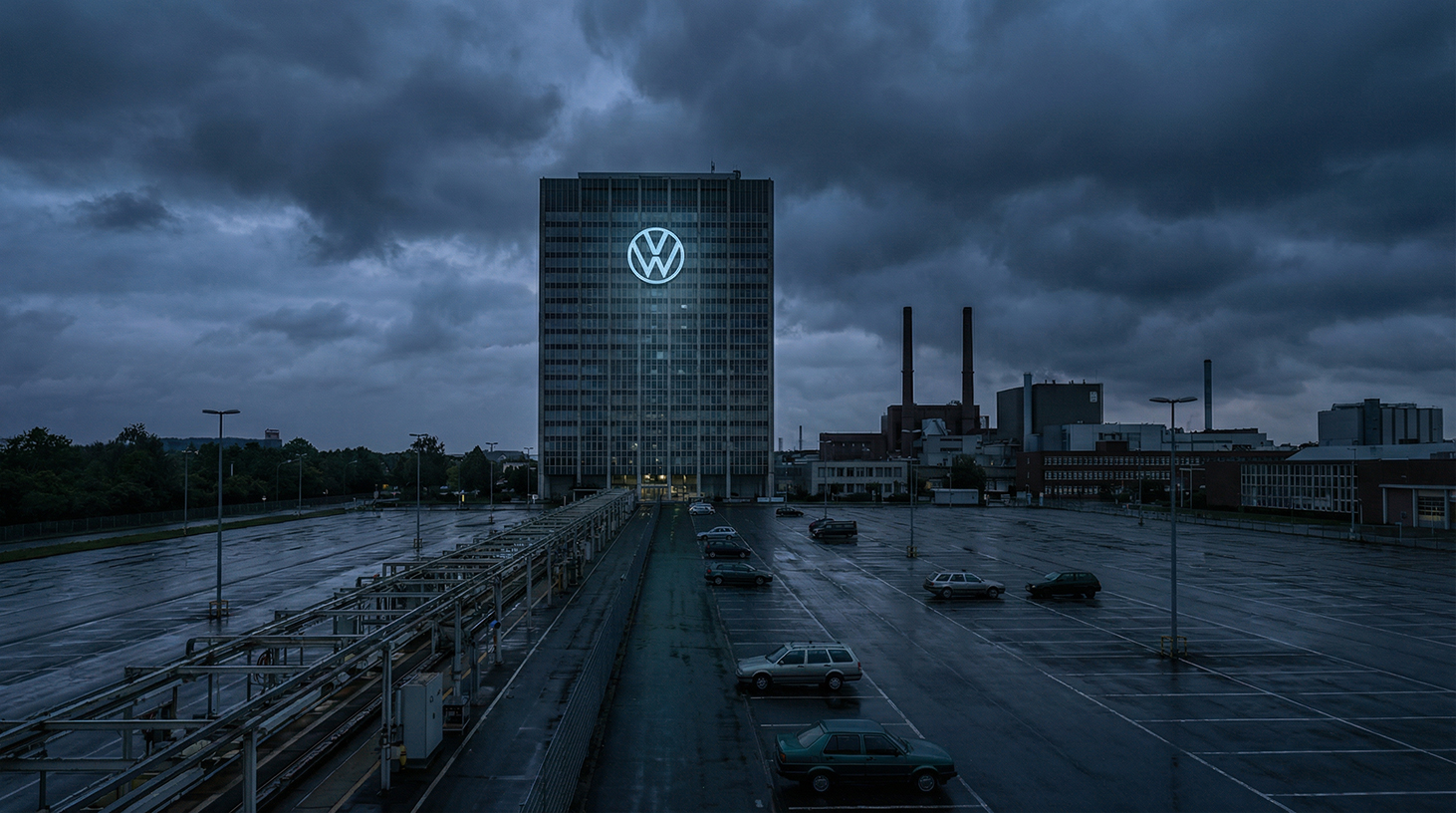
Volkswagen | Billions burned, bosses rake in the cash: The bitter truth behind the VW crash – a systemic failure waiting to happen – Creative image: Xpert.Digital
Despite 322 billion in revenue: Why VW is suddenly only earning pocket money
China shock and software chaos: Why Europe's largest car manufacturer is crashing brutally
The Volkswagen Group is mired in its deepest crisis since the diesel scandal – but this time the enemy is self-inflicted. With an operating margin of a staggering 2.8 percent on nearly €322 billion in revenue, the financial figures for 2025 read like an unprecedented admission of management failure. While top executives continue to rake in princely millions in compensation, Europe's largest automaker is burning through tens of billions of euros due to disastrous software blunders and misguided electric vehicle strategies at its once-profitable flagship brands, Porsche and Audi. Added to this is a dramatic slump in the key Chinese market, where competitors like BYD have long since pulled ahead technologically. Accompanied by paralyzing political interference, a structural systemic failure is revealed: Volkswagen doesn't primarily have a sales problem, but rather a massive deficit in profitability and innovation that seriously threatens the future of the entire group.
Volkswagen's lost year: How Europe's largest car manufacturer squandered its own future
When a corporation with a turnover of 322 billion euros is only earning pocket money, that's not a crisis, but a systemic failure that was entirely predictable
On March 10, 2026, at its annual press conference in Wolfsburg, the Volkswagen Group presented its financial figures for 2025, and they read like an industrial bulletin of helplessness. Net income after taxes plummeted by 44 percent to €6.9 billion, operating profit halved to €8.9 billion, and the operating margin slumped to 2.8 percent. It is the worst result since the diesel scandal ten years ago, and it reveals a pattern that cannot be explained by economic cycles or geopolitical upheavals alone. What is unfolding here is the result of years of strategic missteps, political interference, and a management that, despite princely salaries, has failed to grasp either the speed of the market or the urgency of transformation.
The Arithmetic of Mediocracy
The figures Volkswagen presented today deserve a sober assessment. With revenue of nearly €322 billion, which remained almost stable compared to the previous year, an operating margin of 2.8 percent represents a shocking calculation: For a vehicle worth €40,000, the company retains a mere €1,120 in operating profit. By comparison, in 2023 the group generated an operating profit of €22.5 billion with a margin of almost seven percent. Within just two years, operating profitability has thus more than halved, while revenue has remained virtually unchanged.
This finding is crucial: Volkswagen doesn't have a sales problem in the traditional sense. The group continues to sell nearly nine million vehicles worldwide. The problem lies in the profitability per vehicle, the exploding costs of strategic missteps, and a structure that seems to devour any efficiency gains before they reach shareholders. While the industry-wide EBIT margin also fell to an average of 4.3 percent in the first half of 2025, down from 7.5 percent the previous year, Volkswagen's 2.8 percent margin is still significantly lower and thus far behind Toyota, which continues to achieve an operating margin of over eight percent.
China's brutal lesson for Wolfsburg
For decades, the People's Republic of China was Volkswagen's promised land, a market where the company at times sold one in four new cars and which functioned as a reliable profit engine. That era is irrevocably over. In 2025, sales of the Volkswagen brand in China shrank by 8.4 percent, and the entire group delivered only 2.69 million vehicles there, a decline of eight percent. In the fourth quarter, the decline accelerated even further to minus 17.4 percent.
What makes these figures particularly dramatic is their composition. In China, every second car sold is now an electric vehicle or a plug-in hybrid, and Volkswagen has almost completely lost ground in this segment. The illustration of this is almost grotesque: In January 2025, VW sold a mere nine ID.7s in China. Not 9,000, not 900, but just nine. In the same month, its Chinese competitor BYD sold 296,446 electrified vehicles, which is 63 times Volkswagen's total electric vehicle sales in that market.
BYD not only has larger production volumes, but also a technological lead. The Chinese manufacturer's new Super E platform offers charging capacities of up to 1,000 kilowatts, and its proprietary Hyperchargers even reach 1,360 kilowatts. This allows for a 400-kilometer range to be added in just five minutes, a level comparable to refueling a combustion engine vehicle. Volkswagen cannot offer anything comparable with its current model range. Automotive expert Helena Wisbert from Ostfalia University of Applied Sciences in Wolfsburg sums it up perfectly: Chinese buyers expect seamless interaction between driver and vehicle, smart features, real-time updates, and artificial intelligence, and this is precisely where VW has a significant need to catch up.
Porsche and Audi: The decline of the profit drivers
The real catastrophe within the Volkswagen Group is unfolding at its premium brands, which traditionally generated the highest margins. Porsche experienced a veritable collapse in 2025: In the first nine months, its net income after taxes plummeted by 96 percent. In the third quarter, the sports car subsidiary recorded an operating loss of nearly one billion euros.
The reason for this lies in one of the most expensive strategic U-turns in automotive history. Porsche had initially set ambitious electrification targets, aiming to sell at least 80 percent of its vehicles as electric cars by 2030. Then it turned out that neither the Taycan nor the electric Macan achieved the hoped-for sales figures. In September 2025, Porsche CEO Oliver Blume executed a radical about-face: the ambitious electric vehicle targets were abandoned, the development of a new electric platform was postponed, and popular models like the Panamera and Cayenne were now to remain available as combustion engine vehicles well into the 2030s. This realignment cost around €3.1 billion in special charges in the 2025 fiscal year alone, and the total burden on the group was estimated at €5.1 billion.
The situation at Audi is hardly better. As early as 2024, net income after taxes plummeted by 33 percent to €4.2 billion. In the second quarter of 2025, the Ingolstadt-based company's operating profit collapsed by two-thirds to €550 million. Taken together, Audi and Porsche generated less operating profit in the first half of 2025 than the core Volkswagen brand alone, which almost sextupled its profit in the same period. The group's former cash cows have thus become liability items, while the volume brand, known for its low margins, now has to stabilize its results.
Software: A Billion Dollar Grave
Besides the weakness in China and the Porsche debacle, there is a third, often underestimated factor in Volkswagen's woes: the software chaos. Founded in 2020 under then-CEO Herbert Diess, the software subsidiary Cariad was intended to digitize the company and allow it to catch up with the technologically leading American and Chinese manufacturers. Despite billions in investment, the project failed. The accumulated damage caused by Cariad is likely well over €20 billion by now, considering the delayed model launches, canceled features, and the loss of competitiveness at Audi and Porsche.
In response, CEO Oliver Blume sealed a partnership with the US electric car manufacturer Rivian in 2024 and increased the investment to €5.8 billion. However, this project is also facing massive problems. Model launches are once again being significantly delayed: Audi's Q8 e-tron SUV and the electric A4 have been postponed by at least a year to mid- and late 2028, respectively, and Porsche's electric luxury SUV, the K1, has been delayed indefinitely. The situation becomes even more absurd when one considers that the Rivian software was not originally intended for combustion engine models, yet Volkswagen is now increasingly focusing on combustion engines again.
In the meantime, the company budgeted around €4 billion for the extended use of the old Cariad software and a further €2.5 billion for an internal combustion engine adaptation of the Rivian solution. Together, this resulted in over €6.5 billion in additional costs, without any guarantee that both systems would ultimately function stably. In October 2025, Blume finally admitted what had long been obvious: Cariad would no longer develop its own software, but would only act as an integrator for external partners. A corporation with €322 billion in revenue apparently cannot build its own software.
Our EU and German expertise in business development, sales and marketing

Our EU and German expertise in business development, sales and marketing - Image: Xpert.Digital
Industry focus areas: B2B, digitalization (from AI to XR), mechanical engineering, logistics, renewable energies and industry
More information here:
A thematic hub offering insights and expertise:
- Knowledge platform covering global and regional economies, innovation and industry-specific trends
- A collection of analyses, insights, and background information from our key areas of focus
- A place for expertise and information on current developments in business and technology
- A hub for companies seeking information on markets, digitalization, and industry innovations
A corporation as a social project: How VW is in danger of collapsing under the influence of politics
Princely salaries for princely failure
The question that arises in light of these financial results is as obvious as it is uncomfortable: How can management compensation be justified? Oliver Blume, CEO of both Volkswagen and Porsche, received total compensation of €10.35 million for the 2024 fiscal year, an increase of 6.5 percent compared to the previous year. This was despite his demonstrative decision to forgo five percent of his base salary at Volkswagen. The increase resulted, among other things, from higher long-term bonuses linked to VW's share price performance between 2021 and 2023, when the stock was trading at €245 at one point. Today, the share price is languishing at around €90.
Even more remarkable is that former CEO Herbert Diess, who left the company in 2022, still received €11.2 million for 2024 – more than the current CEO. In total, the nine board members received approximately €40 million. While the board members are supposed to forgo eleven percent of their total compensation in 2025 and 2026, which corresponds to savings of about €4 million per year, this symbolic reduction is hardly worth mentioning in relation to the roughly €10 billion drop in operating profit within two years.
The compensation system reveals a fundamental structural problem: The maximum compensation for the CEO is capped at €15 million, and for regular board members at €8.5 million. These limits may not seem excessive by international standards. However, when a management team receiving these sums simultaneously squanders over €20 billion on a failed software project, loses ground in its most important growth market, and executes a U-turn at Porsche that incurs €5.1 billion in special costs, then the relationship between compensation and performance is clearly out of whack.
The political dimension: A corporation as a social project
Volkswagen is no ordinary company. The state of Lower Saxony holds 20.2 percent of the voting rights and, through the VW Law of 1960, possesses a blocking minority that requires an increased majority of 80 percent for important shareholder resolutions. Minister-President Stephan Weil sits on the supervisory board, as does another government representative. In no other major German corporation does politics exert such direct influence.
What was intended as protection against hostile takeovers has, over the decades, evolved into a blocking force, as automotive expert Stefan Bratzel from the Center of Automotive Management puts it. The state and the unions often act in concert, as neither side has an interest in job cuts, plant closures, or painful efficiency programs. This explains why Volkswagen still operates plants in Germany whose capacity utilization has been insufficient for years, and why every restructuring only comes about after agonizingly long negotiations and with the exclusion of compulsory redundancies.
At the end of 2024, an agreement was reached to reduce 35,000 jobs by 2030, exclusively through phased retirement, early retirement, and severance packages. Plant closures and layoffs were explicitly ruled out. The targeted improvement in earnings: eleven billion euros. However, as early as February 2026, Manager Magazin reported on a new savings program with a volume of 60 billion euros, intended to reduce costs by 20 percent by 2028. It seems clear to all involved that the measures taken so far are insufficient. It is equally clear that political considerations are preventing the company from implementing the necessary steps with the required determination.
Comparison: Why is Toyota so much more efficient? More vehicles with fewer employees (56%)
Toyota produces more vehicles than VW – with just under half the workforce.
The figures in comparison
| Key figure | Toyota | Volkswagen |
|---|---|---|
| Employees (2024/25) | ~383.850 | ~679.500 |
| Annual production (2024) | ~10.8 million vehicles | ~8.95 million vehicles |
| Vehicles per employee | 28,1 | 13,2 |
Toyota employs roughly 56% of VW's workforce, but produces about 20% more vehicles. Per employee, Toyota therefore manufactures more than twice as many cars as VW.
Why is Toyota so much more efficient?
- Toyota Production System (TPS): The legendary lean manufacturing system with continuous improvement (Kaizen) and avoidance of waste is deeply rooted in the company culture.
- Increased standardization: Toyota is focusing on fewer platforms and more standardized high-volume models, which simplifies manufacturing.
- More outsourcing: Toyota is outsourcing more component manufacturing to suppliers, while VW has a significantly higher level of vertical integration.
Why is VW doing worse?
- Brand diversity: VW operates a huge portfolio including Audi, Porsche, Lamborghini, Bentley, Škoda, etc., which massively increases complexity.
- High vertical integration: VW produces more components itself, which increases the number of employees.
- Bureaucracy and structural problems: Observers and former employees report inefficient structures, endless coordination processes and a lack of personal responsibility compared to Toyota.
The diesel scandal: A wound that won't heal
The repercussions of the 2015 diesel scandal continue to weigh on Volkswagen to this day. The affair is estimated to have cost the company over €32 billion, and the final accounting is not yet complete. The 2024 annual report still lists over €10 billion in contingent liabilities, primarily related to legal risks associated with the diesel issue. Also in 2024, VW reached a settlement in the Netherlands, guaranteeing compensation of between €300 and €2,500 to 100,000 diesel drivers.
The €32 billion diesel costs provide a useful benchmark in terms of their magnitude: they represent six times the investment in the Rivian joint venture and sixteen times the budget for the new US brand Scout. This is money the company lacks for its transformation to electromobility and that could have been invested in more innovative technologies, faster software development, or expanding its market position in China. The diesel scandal was not only an ethical failure but has also restricted the company's strategic options for years to come.
BYD, Toyota and the New World Order
While Volkswagen licks its wounds, the global automotive industry is shifting at breathtaking speed. BYD increased its revenue by 29 percent in 2024 to around 99 billion euros and sold 4.25 million vehicles. The Chinese manufacturer is aiming for between five and six million units in 2025. In the first nine months of 2025, BYD, with 3.3 million vehicles sold, was already among the five largest automotive groups worldwide.
Toyota, meanwhile, maintains its global leadership position with an 8.4 percent EBIT margin and 7.1 million vehicles sold. The Japanese corporation benefits from its broad model range, a conservative technology strategy, and comparatively stable sales markets. Volkswagen ranks second in sales with 6.6 million vehicles, but the company's profitability continues to decline.
While the entire industry is under pressure—the combined operating profits of the 13 largest automakers plummeted by 42.6 percent in the first half of 2025—the winners and losers of this consolidation are clearly emerging. Despite declining profit margins per vehicle, BYD is firmly establishing itself among the largest manufacturers and is investing aggressively in technological superiority. Volkswagen, on the other hand, must simultaneously cut costs, transform, restructure its premium brands, and resolve its software issues, all while avoiding political sensitivities in Lower Saxony.
A 60 billion euro feat without guarantees
The task facing Volkswagen is immense. The reported €60 billion savings program aims to reduce costs by a fifth by 2028. At the same time, the company plans investments of €160 billion for the years 2026 to 2030, €5 billion less than originally planned. According to reports, the majority shareholder families Porsche and Piëch were recently appalled by the state of the company, which is understandable given declining dividend income and high write-offs.
Analysts expect a significant recovery in operating profit to around €17 billion in 2026, with a margin of approximately 5.3 percent. However, this forecast assumes that US tariffs do not escalate further, the Chinese market stabilizes, and the ongoing restructuring programs take effect. Each of these assumptions carries considerable risks.
For the current year, 2026, VW sales chief Martin Sander already acknowledged that they expect a challenging market environment overall. Nevertheless, net cash flow in the automotive division surprisingly reached six billion euros in 2025, significantly exceeding their own expectation of around zero billion euros. This suggests that the measures already implemented are beginning to have an effect, at least on the cash side.
Volkswagen's inconvenient truth
Volkswagen's halved profits are not a natural disaster or an unforeseen consequence of geopolitical upheaval. They are the result of a long chain of management errors spanning several CEO tenures. Herbert Diess launched Cariad, a software venture that devoured billions and never worked. Oliver Blume initially switched to Rivian, which cost further billions and is also not performing well. Under the same leadership, Porsche set all-electric targets, which then failed in the first market test, forcing a multi-billion-euro U-turn. In China, management underestimated the rise of domestic competitors and reacted too slowly. And looming over everything is a governance model that prioritizes political considerations over corporate efficiency.
The operating margin of 2.8 percent marks a level last seen in 2016 at the height of the diesel crisis. Back then, the company could justify itself by arguing that it was paying the price for criminal fraud. That argument no longer holds water. Today, the margin is the result of organic decline, fueled by strategic incoherence, excessive complexity, and a corporate culture where billion-dollar missteps have no discernible personal consequences. This isn't a headline, it's a diagnosis, and one that any attentive observer of the industry has been predicting for years.
Your global marketing and business development partner
☑️ Our business language is English or German
☑️ NEW: Correspondence in your native language!

Konrad Wolfenstein
I and my team are happy to be available to you as your personal advisor.
You can contact me by filling out the contact form here or simply call me at +49 7348 4088 965. My email address is: [email protected]
I'm looking forward to our joint project.










