
Volkswagen & Porsche | The Wolfsburg earthquake: 50,000 jobs lost, profit slumps of 44% and 99% – yet dividends are still flowing?!
Xpert Pre-Release

Language selection 📢
Published on: March 10, 2026 / Updated on: March 10, 2026 – Author: Konrad Wolfenstein
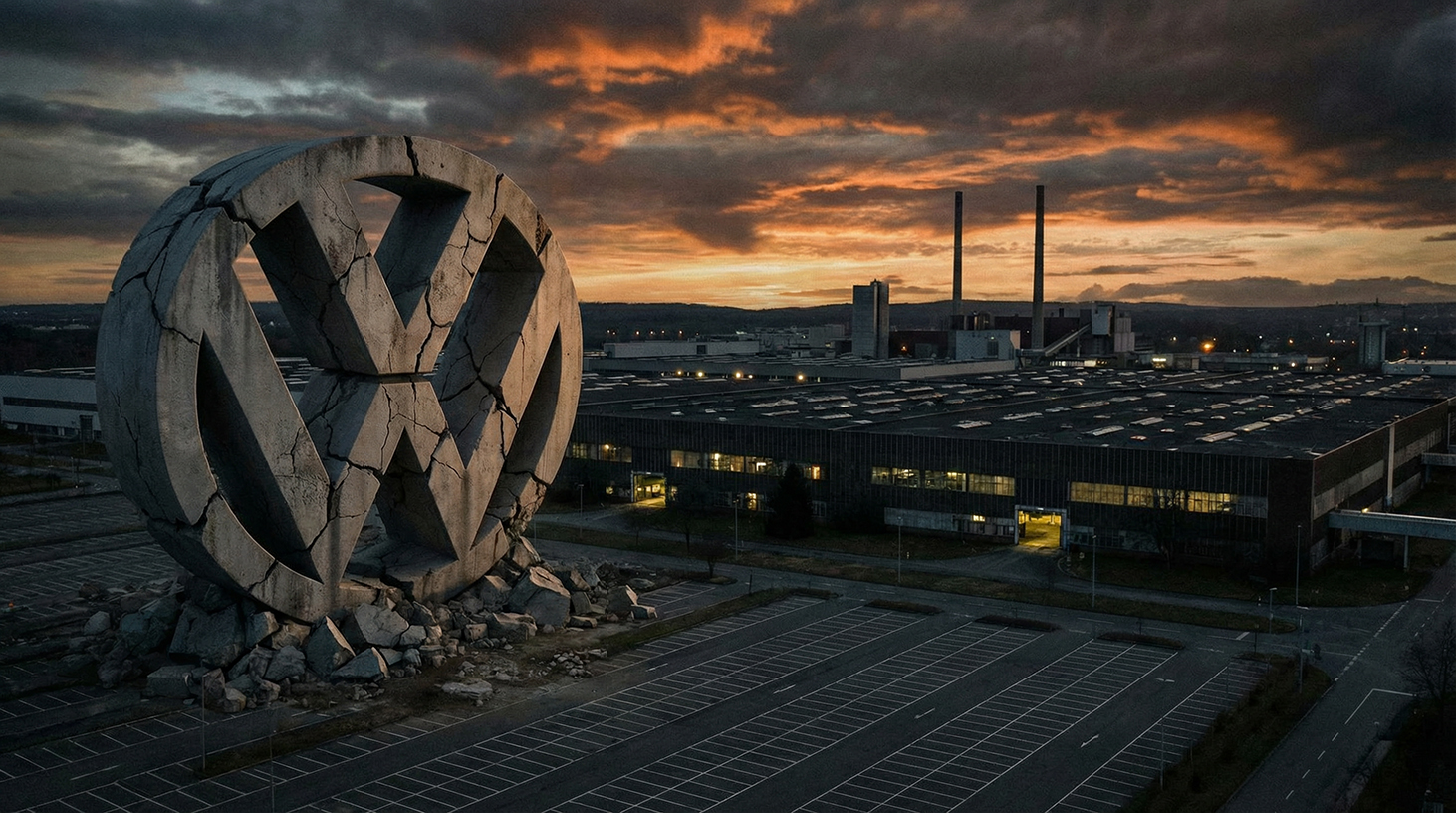
Volkswagen & Porsche | The Wolfsburg earthquake: 50,000 jobs lost, profit slumps of 44% and 99% – yet dividends are still flowing?! – Creative image: Xpert.Digital
Dividends despite the mega-crisis: The absurd system behind the historic VW crash
Porsche's profits plummet by 99 percent: How the Porsche disaster is dragging the entire VW Group down with it
*99%: Operational result 9 months 2025
The Volkswagen Group is experiencing its worst crisis since the diesel scandal – but this time the causes are even more deeply rooted in the company's structure. With profits plummeting by 44 percent at VW and by a dramatic 99 percent at its once highly profitable Porsche, Europe's largest automaker faces an unprecedented test of its resilience. Up to 50,000 jobs are slated to be cut in Germany by 2030, while management grapples with the costly consequences of failed strategies in China and a chaotic, zigzag course in electromobility. The alarming collapse of the financial figures reveals far more than just an economic downturn: it is the result of a toxic mix of strategic failure, political interference, and a rigid corporate culture that has systematically blocked necessary reforms for years. This is an in-depth analysis of how the Volkswagen system is on the verge of collapse.
Related to this:

When Europe's most powerful car company becomes a restructuring case and its cash cow becomes almost worthless, it's no longer a cyclical problem, but a systemic failure
On March 10, 2026, the Volkswagen Group presented its annual figures for the 2025 fiscal year, and the results were as devastating as even pessimists hadn't anticipated. The group's net income after taxes plummeted by 44 percent, from €12.4 billion to a mere €6.9 billion. This is the worst result since the diesel scandal in 2016, and the parallel is no coincidence: then as now, the group faces self-inflicted problems, exacerbated but not caused by external factors. At the same time, Volkswagen subsidiary Porsche AG reported a decline in operating profit from €5.3 billion to a paltry €90 million, representing a 98 percent drop. The group's former cash cow, which for years boasted returns exceeding 15 percent, is now operating with a margin of 0.3 percent. These figures are not merely a temporary low; They mark a tectonic shift in the German automotive industry.
The Volkswagen Group in numbers: Anatomy of a crash
A look at the Volkswagen Group's financial figures reveals the full extent of the crisis. While revenue remained almost stable at nearly €322 billion, declining by only 0.8 percent compared to the previous year, profitability collapsed dramatically. The operating margin fell from 5.9 percent in 2024 to between 2 and 3 percent. VW CFO Arno Antlitz admitted that the current adjusted earnings level of 4.6 percent before restructuring is insufficient in the long term. Behind this diplomatic phrasing lies the realization that the Group's production costs are structurally too high while it is simultaneously losing ground in its most important growth markets.
In the first nine months of 2025 alone, operating profit plummeted by 58 percent, from €12.8 billion to €5.4 billion. In the third quarter alone, the group even recorded an operating loss of €1.3 billion, primarily due to the disastrous performance of Porsche and goodwill write-downs totaling €2.7 billion. Special charges amounting to €7.5 billion weighed heavily on the nine-month results, including up to €5 billion from US import tariffs and €4.7 billion from Porsche-related expenses. Without these special effects, the operating margin would have been a solid 5.4 percent, but these charges are real and, in some cases, structural in nature.
The only bright spots were the net cash flow, which, at around €6 billion, was better than forecast. The Core brand group, which includes the core brands VW, Skoda, SEAT, and CUPRA, also managed to increase sales by 4 percent and improve operating profit by 6.8 percent to €4.7 billion. These core brands are keeping the group operationally afloat, while the premium and luxury segment is facing a precipice.
The Porsche disaster: From cash cow to restructuring case
The most dramatic part of VW's balance sheet bears the name Porsche. Just a few years ago, the Stuttgart-based sports car manufacturer was considered the group's profit engine, an undisputed profitability champion with margins exceeding 15 percent. This picture has been completely reversed in fiscal year 2025. Operating profit collapsed from €5.3 billion to a mere €90 million. Including financial services, Porsche generated €413 million, down from €5.6 billion the previous year, a figure that even fell short of the already lowered analyst expectations of nearly half a billion euros. The operating return on sales plummeted to 0.3 percent, after reaching 14.5 percent the previous year.
The reasons for this unprecedented collapse are multifaceted, but ultimately stem from a toxic combination of strategic failure and market pressure. The most serious factor was the costly strategic shift back to the combustion engine. Under Oliver Blume, Porsche had invested heavily in electromobility, launching the Taycan and electrifying the Macan. When it became clear that many luxury segment customers continued to cling to the combustion engine and that demand for electric vehicles, particularly in the premium segment, was falling short of expectations, management executed a costly U-turn. Porsche budgeted around €3.1 billion in special costs for this realignment, €1.8 billion of which was spent solely on making the product platforms more flexible, so they could now support both combustion and hybrid powertrains.
At the same time, the Chinese market, long one of Porsche's strongest sales regions, collapsed. Luxury demand in China weakened, while Chinese manufacturers like BYD, Nio, and Xpeng intensified competitive pressure with competitive products at significantly lower prices. Porsche had to reduce its dealer network and workforce in China. As early as the third quarter of 2025, the company posted a loss, with an operating result of minus 966 million euros. CFO Jochen Breckner attempted to justify the situation by referring to the strategic realignment, explaining that the company was deliberately accepting temporarily weaker financial figures in order to strengthen Porsche's long-term resilience and profitability. For 2026, Porsche forecasts a return on sales of more than five percent, which, while a significant improvement compared to 2025, is still far below the historical level of over 14 percent.
China's Domino: How the key market collapsed
The situation in China warrants separate consideration, as it reveals a structural failure that extends far beyond short-term economic cycles. In 2025, the Volkswagen Group delivered only 2.69 million vehicles in China, once its most important single market, a decline of 8 percent compared to the previous year. In the fourth quarter alone, sales plummeted by 17.4 percent. Particularly alarming is the fact that Volkswagen is no longer the largest foreign automaker in China, having been overtaken by both BYD and Geely, and now ranks only third. The market share of the two VW joint ventures with FAW and SAIC fell to a combined 10.9 percent, a decrease of 1.3 percentage points.
The situation for electric vehicles in China is nothing short of disastrous. Sales of VW's electric cars there plummeted by 60 percent, with the ID.3, ID.4, ID.6, and ID.7 models together failing to achieve even a one percent market share. In a country where the share of electrified new cars is projected to exceed 50 percent by 2025, this is a devastating indictment. VW's cooperation with the Chinese manufacturer Xpeng is intended to remedy the situation, but the results are yet to materialize. Deliveries in North America also shrank by 10.4 percent to 946,800 vehicles, exacerbated by the import tariffs introduced under the Trump administration. The geopolitical dimension of this tariff policy is costing the company up to 5 billion euros annually, which alone represents a 1.5 percentage point reduction in profit margin.
50,000 jobs: When cost-cutting programs become the norm
The company's reaction to the crisis follows a predictable pattern: job cuts. CEO Oliver Blume announced in a letter to shareholders that a total of around 50,000 jobs are to be cut within the Volkswagen Group in Germany by 2030. This is an increase compared to the 35,000 job cuts agreed upon with the IG Metall union at the end of 2024, which primarily affected the core VW brand. The additional 15,000 job cuts now also affect other group brands such as Audi and Porsche.
The job cuts are progressing faster than planned. By November 2025, more than 25,000 departures had already been contractually agreed upon, representing around 70 percent of the original target of 35,000 job reductions. By the end of 2025, just over 11,000 employees had actually left the company. The reductions are being achieved without compulsory redundancies, instead through phased retirement, early retirement schemes, and severance agreements. Approximately three-quarters of those leaving are utilizing phased retirement programs. Job security has been renewed until 2030, and in return, employees are foregoing wage increases in 2025 and 2026. Overall, VW is aiming for net cost savings of more than four billion euros per year in the medium term, 1.5 billion euros of which will come from labor cost reductions.
This massive job cut is taking place against the backdrop of an industry-wide crisis in the German automotive sector, which lost a total of around 50,000 jobs in 2025. The entire German manufacturing sector cut approximately 124,000 jobs during the same period, the sharpest decline in years. Analysts expect further job losses in 2026, as weak order intake, intense competition, and a rising number of bankruptcies, particularly among automotive suppliers, are exacerbating the situation.
Our EU and German expertise in business development, sales and marketing

Our EU and German expertise in business development, sales and marketing - Image: Xpert.Digital
Industry focus areas: B2B, digitalization (from AI to XR), mechanical engineering, logistics, renewable energies and industry
More information here:
A thematic hub offering insights and expertise:
- Knowledge platform covering global and regional economies, innovation and industry-specific trends
- A collection of analyses, insights, and background information from our key areas of focus
- A place for expertise and information on current developments in business and technology
- A hub for companies seeking information on markets, digitalization, and industry innovations
VW crisis: Why the perpetrators cannot now be the saviors
The management question: treating symptoms instead of structural reform
The critical question of whether management's measures to date are more than cosmetic can be answered by looking at the facts: The measures are gradual, socially acceptable, and largely designed to maintain the status quo of the power structures. While the board has committed to an 11 percent salary reduction in 2025 and 2026, which will then be gradually reduced to 8.5 percent, 6.5 percent, and finally 5.5 percent before being eliminated entirely in 2030, approximately 4,000 managers will have to forgo eight percent of their annual salaries and bonuses. In total, this will result in savings of 300 million euros for management by 2030.
These 300 million euros in management salaries are grotesquely disproportionate to the billions destroyed by strategic missteps. The strategic shift at Porsche alone caused 3.1 billion euros in special costs. The goodwill write-down on Porsche added another 2.7 billion euros. Anyone who first sells electromobility as the only option, then expensively dismantles it while simultaneously switching the product cycle to combustion engines and hybrids, pays twice: in margins and in trust. The Süddeutsche Zeitung summed it up perfectly: the strategic missteps of the Blume era were dramatic, and he was no longer tenable as CEO. The fact that his contract as VW Group CEO was nevertheless extended until 2030 speaks volumes about the decision-making mechanisms within the company.
At least Blume ended his controversial dual role as CEO of VW and Porsche in October 2025, handing over the reins of the sports car manufacturer to Michael Leiters, the former McLaren CEO. This dual role had been increasingly criticized by investors, the works council, and the IG Metall union. At the 2025 annual general meeting, fund manager Janne Werning of Union Investment warned that the glaring governance deficiencies finally needed to be addressed before VW slid even deeper into crisis. Hendrik Schmidt of DWS called the dual role a unique situation in the German corporate landscape that was simply untenable. Personnel changes were also made at Porsche: CFO Lutz Meschke and sales chief Detlef von Platen had to leave. But whether this will be enough is questionable, because the personnel changes address the symptoms, not the root causes.
Related to this:

Political cronyism: Lower Saxony's explosive special role
No other DAX-listed company has such close ties to politics as Volkswagen. The state of Lower Saxony holds 20 percent of the voting rights, thus possessing a blocking minority in key corporate decisions. Two representatives of the state government sit on the 20-member supervisory board, currently Minister-President Stephan Weil and another cabinet member. This structure, enshrined in the VW Law of 1960, was originally intended to secure jobs and prosperity in Lower Saxony. For decades, it did precisely that, but at the cost of distorted corporate governance.
The problem is obvious: when state governments sit on supervisory boards, location decisions are made politically, not economically. Plant closures that would be economically necessary are blocked because no state premier wants to close plants in their state before a state election. This is evident in the fact that in December 2024, after more than 70 hours of marathon negotiations, although 35,000 jobs were cut, no plants were closed. Only the Dresden plant ceased production at the end of 2025; the Osnabrück plant is slated to follow in 2027. Independent analysts strongly doubt whether this will be sufficient to eliminate the structural overcapacity.
The decision regarding who fills the state's second supervisory board seat highlights the absurdity of the system. Instead of considering expertise in automotive or industrial policy, appointments are made according to party-political proportionality. Industry expert Ferdinand Dudenhöffer criticized this practice as arbitrary and driven by political quotas, rather than ensuring the global corporation's management is staffed with appropriate expertise. The state of Lower Saxony is effectively instrumentalizing VW as a labor market policy tool, which is detrimental to its competitiveness. Government statements on the diesel scandal were reviewed by VW, press releases from the State Chancellery were sent to the company in advance, and communication flowed in all directions. This symbiotic relationship between politics and the corporation is one of the reasons why painful but necessary structural reforms have been delayed for years.
The dividend cut: A signal without substance
The dividend policy also reveals the half-heartedness of the restructuring efforts. For the 2024 financial year, the dividend was already cut by 30 percent to €6.36 per preferred share, down from €9.06. The total payout fell by over 50 percent to €5.78 billion. Analysts expect a further slight reduction to €6.26 for 2025. Despite these cuts, the dividend yield remains comparatively attractive at over 6 percent.
The crucial question, however, is whether a corporation shouldering billions in restructuring costs, simultaneously cutting 50,000 jobs and losing its most important markets, should even be able to afford dividend payments of this magnitude. At the same time, the approximately 120,000 unionized employees in Germany still received a bonus payment of almost €4,800 for the 2024 fiscal year, which was even slightly higher than the previous year. From 2026 onward, however, employee profit-sharing will be temporarily suspended. This pattern, in which shareholders and employees are still being rewarded with comparatively comfortable payouts while the corporation is effectively suffering a loss of substance, is typical of a corporate culture that shies away from painful disruption.
The core problem: Those who destroy are not allowed to renovate
The fundamental question arising from this analysis is uncomfortable, but necessary: Are those who maneuvered the company into this situation the right people to lead it out again? Oliver Blume's record is sobering. He first promoted Porsche's electric vehicle strategy as the only option and then initiated a multi-billion-euro restructuring. As a part-time CEO, he simultaneously led two DAX-listed companies, steering both into severe crises. The fact that his VW contract was nevertheless extended until 2030 raises questions about the effectiveness of the supervisory bodies. A survey of employees conducted by the works council revealed that a large majority of staff no longer believe that the board fosters a positive corporate culture.
At the same time, the ownership structures benefit from the lack of willingness to change. The Porsche and Piëch families effectively control the company through Porsche SE and have appointed Blume to this dual role. The state of Lower Saxony, with its blocking minority, protects jobs and locations, even if they are unprofitable. With the December 2024 compromise, the IG Metall union prevented compulsory redundancies, but simultaneously accepted a socially responsible reduction of 35,000 jobs, which is now being increased to 50,000. Each of these actors pursues understandable particular interests, but collectively they are preventing the radical transformation that the company needs.
The outlook for 2026: Between hope and denial of reality
Volkswagen is cautiously optimistic for 2026. Revenue is projected to grow between zero and three percent, the operating margin is expected to be between 4.0 and 5.5 percent, and net cash flow is expected to be between three and six billion euros. This would represent a significant improvement compared to the crisis year of 2025, but still far below the level a company of this size should be achieving. Porsche forecasts a return on earnings of more than five percent, which, measured against the historical average, would at best represent a halving of previous earnings levels.
The biggest risks remain. US tariffs are not going away; CFO Antlitz made it clear that the tariff burden will persist. The Chinese market will continue to be under pressure from intense price competition among local manufacturers. And the transformation to electromobility is being forced in Europe by regulatory requirements, while in China it is already a reality, and VW has fallen behind there. New Porsche CEO Michael Leiters inherits a brand struggling with a structurally weaker business in China, tariff costs without its own US production facilities, and a stripped-down electric roadmap.
An industry in free fall: The German automotive industry as a whole
The Volkswagen crisis is not an isolated incident, but rather the most prominent symptom of an industry-wide erosion. The German automotive industry lost around 50,000 jobs in 2025, and more than 112,000 since the pre-pandemic year of 2019. These job cuts are not limited to VW: Daimler Truck is eliminating 5,000 positions, Bosch 3,500, Continental 1,450, Thyssenkrupp 11,000, and even DHL and Siemens are reducing their workforce by thousands. The consulting firm EY concludes that German industry is in a deep crisis and anticipates further job losses in 2026.
The causes are structural: excessively high energy costs, too much bureaucracy, slow digitalization, a sluggish pace of technological change, and the increasing relocation of production and research abroad. Automotive companies are increasingly shifting manufacturing, research, and development out of Germany, directly impacting domestic jobs. Germany's competitiveness is declining further, as VW CEO Blume himself admitted. This development can no longer be explained by cyclical fluctuations; it is a structural decline accelerated by political inaction and poor business decisions.
The verdict of the numbers is clear
The Volkswagen and Porsche crisis is not a temporary blip on an otherwise healthy balance sheet. It is the result of years of strategic mismanagement, political interference, a lack of competitiveness, and a governance system that systematically blocks change. The measures taken so far, whether job cuts, salary reductions, or management changes, treat symptoms without addressing the root causes. As long as the state of Lower Saxony, as a political player, has a seat on the supervisory board, as long as ownership structures prevent radical reforms, and as long as managers who have squandered billions are rewarded with contract extensions, the company will not overcome its structural deficit. The 50,000 employees who will lose their jobs by 2030 are paying the price for bad decisions for which they bear no responsibility. Whether Volkswagen finds its way back to sustainable profitability depends not on cost-cutting programs, but on the willingness to dismantle the institutional structures that led the company to this situation. The response so far to this question is not encouraging.
Your global marketing and business development partner
☑️ Our business language is English or German
☑️ NEW: Correspondence in your native language!

Konrad Wolfenstein
I and my team are happy to be available to you as your personal advisor.
You can contact me by filling out the contact form here or simply call me at +49 7348 4088 965. My email address is: [email protected]
I'm looking forward to our joint project.










