
Mega-ports & green tugboats: India's Amrit Kaal master plan for maritime supremacy
Xpert Pre-Release

Available in 27 languages 📢
Prefer Xpert.Digital on GoogleⓘPublished on: May 25, 2026 / Updated on: May 25, 2026 – Author: Konrad Wolfenstein
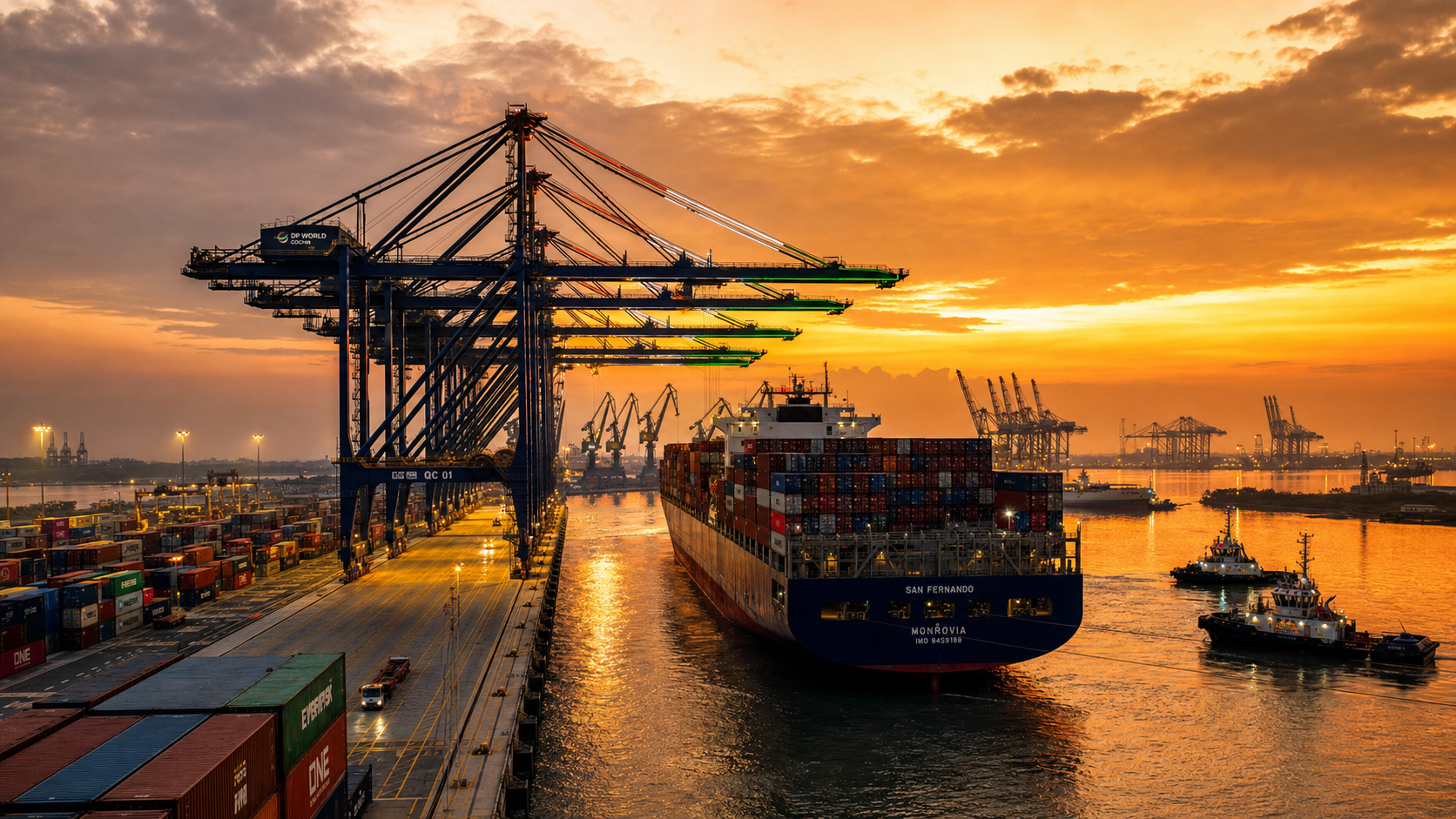
Mega-ports & green tugboats: India's master plan for maritime supremacy – Creative image: Xpert.Digital
216 new ships: The radical breakthrough of the Indian economy – Is Europe's SMEs missing out on India's $135 billion mega-project?
Investment promise or strategic revolution? Why the world must act now – or lose the race
Global shipping is facing a tectonic shift – and the epicenter lies in the Indian Ocean. At India Maritime Week 2025 in Mumbai, India unequivocally demonstrated its claim to absolute maritime sovereignty with investment commitments totaling an astounding 135 billion US dollars. The country, which currently has to rely on foreign shipping companies for roughly 95 percent of its foreign trade, is planning a radical breakthrough: mega-ports, a consistent transition to green technology, and a massively upgraded national merchant fleet are intended to end this fatal economic dependence. But this master plan is far more than just a national infrastructure project. It is a clear geopolitical signal that will reshape global supply chains for decades to come. While logistics giants from Asia and the Middle East are already investing billions, Europe – and especially Germany's small and medium-sized technology companies – risks missing the window of opportunity for this gigantic future market. The following analysis illuminates the strategic depth of India's maritime revolution, explains the industrial policy leverage effects, and shows why international investors must act now to avoid being left behind.
A new era at sea: Why India Maritime Week is changing the global economy
When a trade fair breaks the mold: India Maritime Week 2025 as a global signal
Five days, over 600 letters of intent, more than 100,000 delegates from over 85 countries – India Maritime Week 2025, held from October 27 to 31 at the NESCO Exhibition Centre in Mumbai, was no ordinary industry gathering. It was a financial demonstration. With investment commitments totaling around 12 lakh crore rupees – the equivalent of approximately US$135 billion – the event set a new benchmark in global infrastructure financing.
The comparison to the previous summit is telling: At the Global Maritime India Summit (GMIS) 2023, commitments worth approximately 8.5 million crore were secured. This 41 percent increase within two years signals not only quantitative growth but also a shift in the perception of India within the international investment community. Eleven foreign ministerial delegations, representatives of multilateral organizations such as the IMO and UNESCAP, and CEOs from the largest global port operators participated. For international finance and logistics circles, the event was therefore far more than a political platform – it was a clear market signal.
Prime Minister Narendra Modi personally unveiled key initiatives of the Maritime Amrit Kaal Vision 2047, the government's master plan for transforming India's maritime sector by the country's 100th Independence Day. The signed agreements ranged from green hydrogen and ammonia bunkering infrastructure to container port expansions, shipbuilding collaborations, and digital port systems. This places India Maritime Week 2025 among the select group of events marking a paradigm shift in a strategic infrastructure sector.
Not all billions are equal: The distribution of investments and their structural significance
The impressive total of US$135 billion should not be viewed as a monolithic block. The investment commitments are spread across five key areas, each with very different maturation times, risk profiles, and macroeconomic leverage effects. Approximately 30 percent of the total is allocated to port development and modernization, 20 percent to sustainability and green initiatives, another 20 percent to shipping and shipbuilding, 20 percent to port-led industrialization, and 10 percent to trade and knowledge partnerships.
This allocation reveals a well-thought-out structure: The lion's share flows into hard infrastructure, while significant funds are simultaneously reserved for the green transition and industrial backward integration. Particularly significant is the 20 percent allocation for shipbuilding and shipping, which—in absolute terms—equivalent to approximately US$27 billion. This amount is not a product of political negotiations but rather an expression of strategic national interest: India is now almost entirely dependent on foreign shipping companies. According to official figures, around 95 percent of India's foreign trade is transported on foreign vessels; the share of Indian ships in its own foreign trade has plummeted from 40 percent to just 5 percent today. For this, India pays US$70 to 75 billion annually to foreign shipping companies—a structural outflow of capital that exceeds the total investment volume of India Maritime Week within two years.
Among the individual players, three investor groups stand out. First, international logistics companies such as DP World, which has committed US$5 billion alone, and APM Terminals (Maersk), which has pledged US$2 billion for the expansion of the Pipavav port in Gujarat. Second, India's public oil and gas companies (PSUs), which have jointly placed shipbuilding contracts worth 47,800 crore rupees – approximately US$5.4 billion. Third, regional port authorities such as the VO Chidambaranar Port Authority with 28 Memoranda of Understanding (MoUs) worth 1.27 crore rupees, and the Jawaharlal Nehru Port Authority with 70,000 crore rupees for the expansion of the Vadhavan port. This triad of international private capital, state-owned energy companies, and public port infrastructure forms a resilience-enhancing financing model that reduces one-sided dependencies.
216 ships by 2047: The industrial policy strategy behind the fleet expansion
One of the most concrete and ambitious projects at India Maritime Week is the fleet expansion plan of the Shipping Corporation of India (SCI). The state-owned shipping company, which currently operates approximately 55 vessels, plans to expand its fleet to 216 ships by 2047 – an investment of around 1 lakh crore rupees, equivalent to about US$11.3 billion. An interim target is to initially build up to 100 ships, including chartered vessels.
This plan is not an isolated shipping company strategy, but rather the core of a geopolitically motivated sovereignty strategy. India currently suffers from the structural weakness that virtually its entire maritime trade is controlled by foreign shipowners. In crisis scenarios—whether geopolitical tensions, trade sanctions, or pandemic shocks like those of 2020/21—this results in a significant strategic vulnerability. Consequently, the development of a national merchant fleet is being treated as a matter of economic resilience, similar to the approach taken in Germany after the First World War or in South Korea and Japan during their industrial development phases.
Shipbuilding orders from public oil and gas companies, totaling over 47,800 crore rupees, systematically complement this expansion. SCI is cooperating with state-owned steel mills, fertilizer companies, and energy companies, which are jointly establishing joint ventures (JVs) to order ships for their own use, thus creating a stable workload for domestic shipyards. A program to procure 26 newbuilds worth approximately US$2.3 billion by SCI alone, focusing on medium-sized product tankers and bulk carriers, was already planned. The medium-term target is for Indian-built ships to represent 7 percent of the national fleet by 2030; a figure of nearly 70 percent is targeted by 2047.
These goals are ambitious, but not unrealistic if the political framework holds. The government has launched a 69,725 crore rupee package of three instruments to achieve this: the Maritime Development Fund (MDF) with a capital of 25,000 crore rupees for long-term ship financing; the extended Shipbuilding Financial Assistance Scheme (SBFAS) with a volume of 24,736 crore rupees; and the Shipbuilding Development Scheme (SbDS) with 19,989 crore rupees for the development of mega-shipyard clusters with a capacity of 4.5 million gross tonnage annually.
Green transformation as a competitive strategy: tugboats, coastal shipping and the decarbonization logic
Ecological transformation and economic competitiveness are not treated as opposites in India's maritime strategy, but rather as complementary strategies. This is particularly evident in the Green Tug Transition Programme (GTTP), which aims to completely convert the tug fleet in major Indian ports to low-emission propulsion by 2040. The investment volume for this program amounts to approximately 12,000 crore rupees, equivalent to about US$1.35 billion. The first phase, launched in October 2024, involves four major ports – JNPA, Deendayal, Paradip, and VO Chidambaranar – each of which will acquire or charter at least two green tugs.
The first-generation technology is battery-electric, with provisions for future conversion to methanol or green hydrogen. The strategic added value lies not only in emissions reduction. Port emissions are an increasingly relevant regulatory issue: the EU greenhouse gas tax on ship emissions (FuelEU Maritime and EU ETS for Shipping) is increasing the pressure on all shipping companies calling at European ports. Indian ports that invest early in green infrastructure gain a comparative advantage for ships operating between India and Europe or the Middle East.
DP World is addressing the next level: Through its subsidiary Unifeeder, the company has signed a cooperation agreement with Sagarmala Finance Corporation to develop green coastal and short-sea shipping services. This investment direction is economically significant because coastal shipping in India is considerably underdeveloped – even though it can be 60 to 80 percent cheaper than road or rail transport. In addition, DP World, together with Cochin Shipyard and Drydocks World, has signed an agreement to expand international ship repair capacity in Kochi and is working with Deendayal Port and technology provider Nevomo on India's first automated, low-emission port tracking system.
For international technology providers in the fields of battery and fuel cell systems, digital twins, fleet management software, and green propulsion technology, this opens up a market with decades of potential. The technological learning curve India is experiencing with the tractor conversion is the starting point for a much larger transformation process for the entire national fleet.
Your container high-bay warehouse and container terminal experts

Container high-bay warehouses and container terminals: The logistical interplay – expert advice and solutions - Creative image: Xpert.Digital
This innovative technology promises to fundamentally change container logistics. Instead of stacking containers horizontally as before, they will be stored vertically in multi-story steel racking structures. This not only allows for a drastic increase in storage capacity within the same area, but also revolutionizes all processes at the container terminal.
More information here:
Why investors are now massively investing in India's ports
Risk appetite in the tough sector: What really drives international investors
Maritime infrastructure is among the most capital-intensive and slowest investment categories. Amortization cycles of 20 to 40 years, complex concession agreements, fluctuating freight volumes, and political regulatory risks deter short-term-oriented capital. The fact that commitments in the hundreds of billions have nevertheless been made can be explained by the convergence of several structural investment narratives.
Firstly, India is positioned as a long-term growth story that is hard to surpass in its persuasiveness: the world's largest democracy, soon to be the most populous country, with a GDP that, according to Economy Minister Puri, already exceeds US$4.3 trillion, and a projected economic volume of US$10 trillion by 2032. The maritime economy currently accounts for about 5 percent of this GDP, with considerable upside potential. Nearly 95 percent of India's foreign trade volume and around 70 percent of its value flows via sea – freight volumes that will grow linearly with India's export expansion.
Secondly, geopolitical diversification strategies are driving capital inflows. International logistics companies and infrastructure funds with significant exposure in China are actively seeking investments in another major Asian market with a stable legal system and democratic governance. India's growing role in the Indo-Pacific, its strategic positioning between major trade zones, and its proximity to critical shipping lanes—particularly the Indian Ocean, through which some 80 percent of global oil flows—make the country an attractive hub for multinational supply chains.
Third, port infrastructure offers inflation-like protection: tolls and port charges are typically indexed or negotiable, thus securing real returns even during periods of inflation. This characteristic makes maritime infrastructure more attractive to pension funds, sovereign wealth funds, and specialized infrastructure platforms than in the past. The combination of public-private partnerships (PPPs), which share risks between public and private partners, with multilateral financing instruments—for example, through the World Bank, the Asian Development Bank, or the European Investment Bank—significantly reduces the effective risk exposure of private investors.
Leverage and multiplier effect: What maritime investments mean for India's overall economy
The macroeconomic significance of India Maritime Week extends beyond the directly pledged US$135 billion. According to estimates in the government's 2024/25 Economic Report, the long-term average economic multiplier effect of infrastructure investments in India is between 2.5 and 3.5. This means that every rupee invested in maritime infrastructure generates 2.5 to 3.5 rupees of total economic value added through direct, indirect, and induced effects.
Direct effects arise from employment in the construction and operation of port facilities, shipyards, and shipping companies. The Maritime Amrit Kaal Vision 2047 projects the creation of 1.5 crore (15 million) new jobs in the maritime sector by the target year. India already provides 12 percent of the world's seafarers – a reservoir of maritime human capital that will continue to grow in importance with the expanding fleet. Indirect effects occur along the logistics chains: Improved port infrastructure reduces handling times and freight costs, thus easing the burden on inland companies. India's logistics costs, at around 14 to 19 percent of GDP, are significantly higher than in China (approximately 12.5 percent) or the EU. Even a reduction of just a few percentage points – the goal is to reduce them to 8 percent of GDP by 2030 – would make India's export economy considerably more competitive.
The ongoing Sagarmala program serves as a reference project: Over 550 crore rupees in project volume have already been mobilized; the cargo capacity of major Indian ports has doubled from 1,350 million tons annually to 2,700 million tons; freight transport on inland waterways has increased eightfold since 2014; and turnaround times in major ports have been reduced by 60 percent. Sagarmala 2.0, supported by a budget of 85,482 crore rupees, aims to scale up this transformation and activate further industrial clusters along the coast.
At the same time, a sober assessment of risks is warranted. Memoranda of Understanding (MoUs) commitments are not booked investments. Experience with the GMIS 2023 shows that significant discrepancies can exist between signed Memoranda of Understanding and actual capital flows. Governance challenges—from bureaucratic permitting processes and land rights and environmental regulations to federal jurisdictional conflicts between the central government and states—remain systemic obstacles. Overcapacity risks are not abstract: India's port capacity is growing faster than cargo volume unless the manufacturing sector keeps pace. And the sector's dependence on government will and political continuity makes long-term investments more vulnerable to policy changes.
From niche to systemic position: Europe's and Germany's windows of opportunity
For European companies, and in particular for German SMEs and large corporations in the port, shipbuilding, and automation technology sectors, India Maritime Week 2025 presents a concrete, time-limited window of opportunity. Europe did not play a prominent role in the first wave of capital mobilization – dominated by DP World, Maersk, and Southeast Asian sovereign wealth funds. This is a missed opportunity, but one that can still be remedied structurally.
India's port modernization requires technology produced in Europe and Germany at a world-class level: automation systems for container handling (e.g., from HHLA, Liebherr or Konecranes), low-emission propulsion technology for tugboats and coastal vessels (e.g., from MAN Energy Solutions, Rolls-Royce Power Systems or MTU), digital platforms for port logistics and fleet management, hydrogen and ammonia bunkering technology, and shipyard technology for specialized ship categories such as LNG tankers and offshore units.
However, the Indian market demands a coordinated approach, which is traditionally difficult for the fragmented German Mittelstand (SMEs). Individual companies that reactively respond to tenders will be structurally disadvantaged in competition with integrated Asian offerings from South Korea, China, or Japan. Consortium approaches – for example, through the German Shipbuilding and Ocean Industries Association (VSM), the German Association for Foreign Trade and Transport (DAV), or within the framework of European infrastructure cooperation formats such as the EU-India Connectivity Partnership – provide the institutional framework for competitive market access.
The geopolitical dimension underscores the urgency. In 2020, Germany became the second European country, after France, to adopt Indo-Pacific Guidelines. Nearly 40 percent of German foreign trade outside Europe is conducted with Indo-Pacific economies. Stable, rules-based shipping lanes through the Indian Ocean are not an abstract foreign policy category for the German export industry, but rather an economic lifeline. Therefore, engagement in India's maritime transformation is not only a market opportunity, but also a contribution to securing the infrastructure upon which the German economy is existentially dependent.
The Dutch-Indian agreement on a Green and Digital Sea Corridor, which aims to connect selected Indian ports with the Port of Rotterdam, serves as a model for how European port industry and technological expertise can be integrated into the Indian agenda. Germany, with Hamburg, Bremen, and the maritime technology companies located there, possesses similar prerequisites – but currently lacks comparable diplomatic initiatives.
From periphery to system node: What India Maritime Week 2025 will really change
The crucial question is not whether India has sufficient maritime ambitions. That has been clear for years. The crucial question is whether the transformation from mere discourse to actual capital mobilization will be completed – and whether India Maritime Week 2025 will mark this transition.
The indicators point to a substantial quality upgrade compared to previous announcements. First, the involvement of prominent global private players – DP World, Maersk, APM Terminals – with concrete dollar commitments and signed partnership agreements, is qualitatively different from mere declarations of intent. Second, the government's support instruments – Maritime Development Fund, SBFAS, SbDS – have already been enshrined in parliamentary law and are not merely announced. Third, operational implementation is beginning: Cochin Shipyard is already building green tugs at its own expense in anticipation of conversion contracts; Maersk is registering ships in India; SCI is launching official tenders for product tankers. The transition from intention to action is thus clearly complete, even if the bulk of the $135 billion will only be drawn down over decades.
For shipping companies, this means that India is a market where establishing an early operational presence secures competitive advantages that will be difficult to catch up with later. For logistics providers, infrastructure expansion signals a gradual reduction of the transit bottlenecks that have previously hampered many supply chains at Indian ports. For financial investors, this presents an opportunity to enter infrastructure-related vehicles before asset prices rise with the sector's maturity. And for technology providers, the timing is favorable: India is currently acquiring the blueprints for its maritime future – and those who deliver now will set the standards for decades to come.
India currently ranks 22nd in the world for shipbuilding. The goal of reaching the top 5 by 2047 sounds ambitious. But this is the same India that barely played in the IT world league thirty years ago – and now forms its backbone. Maritime sovereignty is the next strategic long-term project of a nation that has learned to combine vision with institutions and investments. The world has taken notice. The question now is, who will join the fray in time?.
Consulting - Planning - Implementation

Konrad Wolfenstein
I would be happy to serve as your personal advisor.
me at wolfenstein∂xpert.digital contact
Just call me on +49 7348 4088 965 .
Our global industry and economic expertise in business development, sales and marketing

Our global industry and economic expertise in business development, sales and marketing - Image: Xpert.Digital
Industry focus areas: B2B, digitalization (from AI to XR), mechanical engineering, logistics, renewable energies and industry
More information here:
A thematic hub offering insights and expertise:
- Knowledge platform covering global and regional economies, innovation and industry-specific trends
- A collection of analyses, insights, and background information from our key areas of focus
- A place for expertise and information on current developments in business and technology
- A hub for companies seeking information on markets, digitalization, and industry innovations
Your container high-bay warehouse and container terminal experts

Container terminal systems for road, rail and sea transport in the dual-use logistics concept of heavy-lift logistics - Creative image: Xpert.Digital
In a world marked by geopolitical upheavals, fragile supply chains, and a new awareness of the vulnerability of critical infrastructure, the concept of national security is undergoing a fundamental reassessment. A state's ability to guarantee its economic prosperity, the provision of essential goods and services to its population, and its military capability increasingly depends on the resilience of its logistical networks. In this context, the concept of "dual-use" is evolving from a niche category of export control to a broader strategic doctrine. This shift is not merely a technical adjustment but a necessary response to the "paradigm shift" that demands a profound integration of civilian and military capabilities.
Related to this:










