
India builds ports, Europe supplies the operating system – who really holds the upper hand in this division of labor?
Xpert Pre-Release

Available in 27 languages 📢
Prefer Xpert.Digital on GoogleⓘPublished on: May 23, 2026 / Updated on: May 23, 2026 – Author: Konrad Wolfenstein
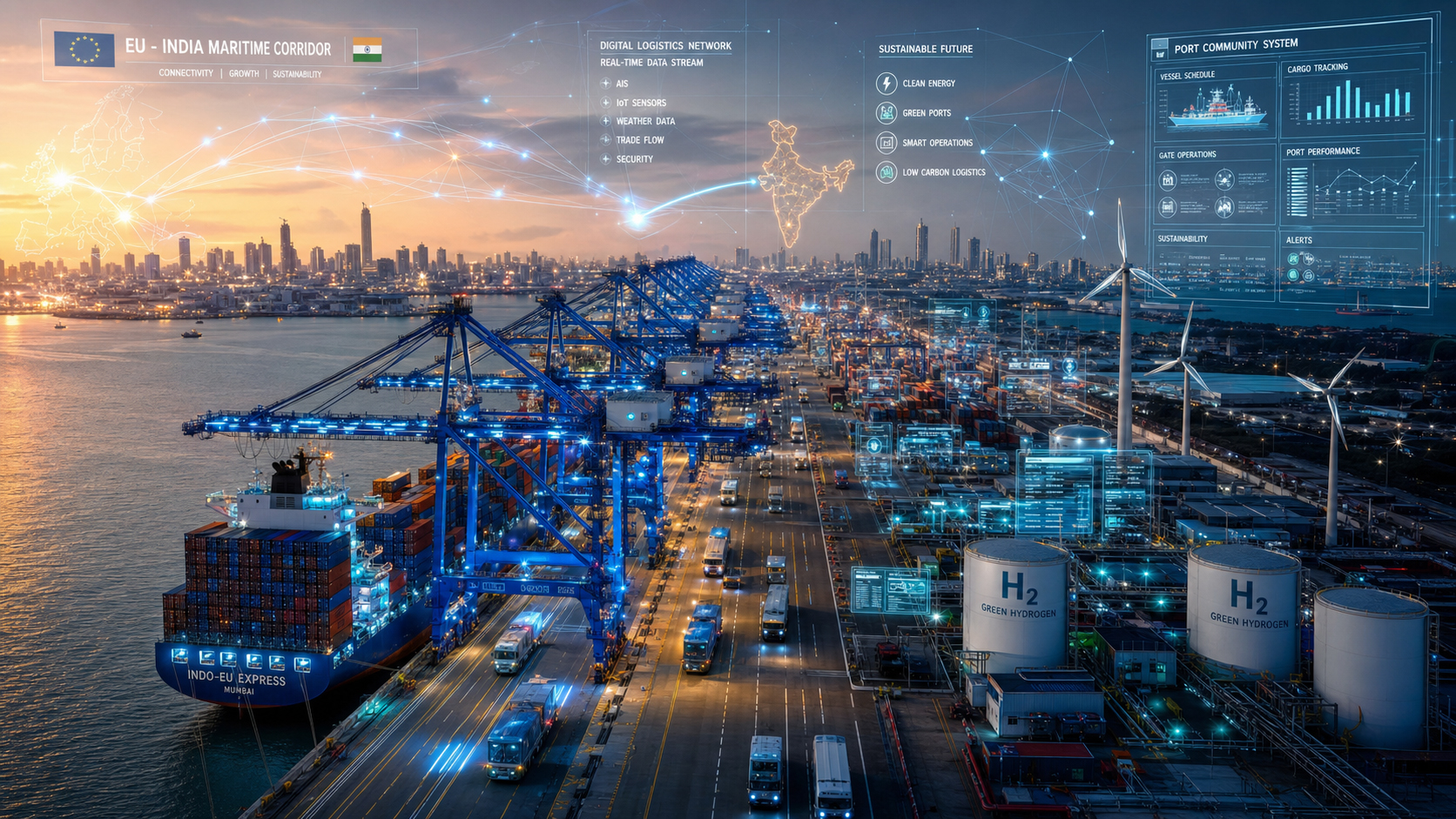
India builds ports, Europe supplies the operating system – who really holds the upper hand in this division of labor? – Image: Xpert.Digital
Countering China's influence: How European technology is upgrading India's new high-tech ports
Multi-billion dollar port tech market: How German companies are making India's logistics green and smart
Ports of the future: Why India is relying on its own resources for construction – and on Europe for IT
India is currently undergoing an unprecedented maritime revolution: Turnaround times in the country's gigantic seaports have almost halved, freight volumes are breaking records, and flagship projects like the Vizhinjam Port are paving the way for full automation. However, to remain competitive in the long term – and especially against its geopolitical rival China – simply building quays and cranes is no longer sufficient. The new bottleneck in India's rise is the digital and environmentally friendly "operating system" of its ports. This is precisely where a historic opportunity arises for Europe and German SMEs. By exporting state-of-the-art Port Community Systems (PCS), pioneering green energy solutions, and pooled automation expertise, the EU can become an indispensable architect of India's port evolution. This marks the beginning of a strategic partnership that extends far beyond logistics – and has the potential to reshape the balance of power in 21st-century global trade.
Europe as a silent pacesetter: How the EU can accelerate India's leap to becoming a maritime high-tech power
Physical modernization alone is no longer enough – India at a crossroads in port development
India has made remarkable progress in the physical modernization of its ports in recent years. The average ship turnaround time at major Indian ports fell from 93.59 hours in 2013–14 to 48.06 hours in 2023–24, a reduction of almost 49 percent. Individual ports stand out in particular: Jawaharlal Nehru Port achieved a turnaround time of just 26 hours, while Cochin Port reached 33.4 hours. This puts major Indian ports ahead of comparable facilities in the US, Australia, and Germany – a development that would have seemed unimaginable just a decade ago. Total cargo volume at major Indian ports increased to approximately 855 million tons in fiscal year 2024–25, representing an annual growth rate of 4.3 percent.
The driving force behind this transformation is the Indian government's Sagarmala program, which has identified 845 projects worth 6.06 lb. crore, of which 315 projects, totaling 1.57 lb. crore, have already been completed. Smart port logistics solutions implemented under this program have reduced port well times by 30 percent. At the same time, the Ministry of Ports, Navigation and Waterways has set an ambitious goal: for India to rank among the world's top five shipbuilding nations by 2047. The ministry plans to complete a total of 150 key projects by September 2025.
But the physical expansion alone doesn't close the chapter. The new systemic bottleneck lies elsewhere: in the seamless digital integration of the port, its hinterland, and government agencies. India has taken important initial steps – the Maritime Single Window (MSW) and the NLP marine system Sagar Setu have been implemented, and the digitalization of port operations is officially a key pillar of the Sagarmala program. But the technological depth and systemic maturity of these solutions are still far from what European port ecosystems like Rotterdam, Hamburg, or Antwerp-Bruges demonstrate today. It is precisely this gap that underscores the strategic relevance of deeper EU-India cooperation – and explains why Europe is not just a supplier of machinery in this story, but potentially the architect of the entire digital operating system.
The invisible backbone of the modern port – what Port Community Systems can really do
A Port Community System, or PCS for short, is essentially a neutral digital platform that connects all stakeholders in a port ecosystem: shipping companies, terminals, freight forwarders, customs authorities, carriers, warehouse operators, and government agencies. Instead of each party exchanging information bilaterally via email, fax, or telephone, all relevant data is entered into the system once and is then available to all authorized participants in real time. This sounds like a simple simplification, but its economic impact is transformative.
The prime example is Portbase, the Port Community System of the Port of Rotterdam. Portbase offers over 40 different services for all links in the logistics chain – from pre-registration of a vessel and shipment status to export documentation, loading/unloading lists, and communication with authorities. The economic impact is quantifiable: using the system generates added value of up to €345 million annually for participating companies and eliminates 30 million phone calls, 100 million emails, and 30 million truck kilometers. These are not abstract efficiency gains, but direct cost savings that are reflected in the profit and loss statements of port users. Portbase was founded in 2009 after the Port Infolink pilot project had tested the optimization of transport chain processes in the Port of Rotterdam for two years; the shareholders are the port authorities of Rotterdam and Amsterdam, meaning the system is explicitly operated in the public interest.
The Port of Antwerp-Bruges is taking things a step further, testing a digital twin of the entire port area – a real-time 3D copy equipped with sensors, autonomous drones, and AI-powered cameras for inspection and incident detection. The Advanced Port Information & Control Assistant (APICA) acts as the control center for this application, providing real-time information on the position of every ship, the operational status of every crane, and even the energy production of the port's own wind turbines. The network consists of 460 cameras and 22 strategically placed radars, all directly connected to the Antwerp coordination center. The Port of Hamburg is pursuing a similar strategy with its 2040 development plan: the goal is to build a network of networks to further expand digital connectivity between privately organized logistics players. Hamburg is also testing private 5G for yard automation and experimenting with network slicing for industry-critical communications.
India's current situation contrasts sharply with these reference models. The Maritime Single Window and Sagar Setu represent significant progress, but they operate primarily as government interfaces, not as comprehensive commercial ecosystem instruments. The crucial difference lies in the depth of integration: European PCS systems connect public and private sector actors equally in a single system that generates real-time data flows, which in turn form the basis for data-driven financial and insurance products. If a financial institution or credit insurer knows that a particular shipment will be released exactly 36 hours after unloading, it can offer trade finance products at lower risk premiums—a systemic effect that extends far beyond mere logistics optimization. The implementation of fully interoperable PCS structures in Indian ports would, according to conservative estimates, have a multiplier effect on foreign trade transaction costs.
The EU-India Trade and Technology Council (TTC), whose second ministerial meeting took place in New Delhi on February 28, 2025, has already laid concrete foundations for this type of cooperation. Both sides agreed to work towards the interoperability of their respective digital public infrastructures (DPIs) and emphasized the need for mutual recognition of e-signatures to facilitate cross-border digital trade. EU-India's bilateral trade in goods reached a record high of €124 billion in 2023, while digital services accounted for €20 billion. The TTC operates through three working groups, of which Working Group 1, on strategic technologies and digital governance, and Working Group 2, on green and clean energy technologies, are directly relevant to the maritime digitalization agenda.
From shore power to emission-free terminal fleets – Europe's lead in green port technologies
The global shipping industry is facing one of its greatest transformations: the transition to low-emission operating models. Ports are not merely passive infrastructure facilities, but active hubs where the decarbonization of supply chains must be operationalized. Europe has built up a considerable technological and conceptual lead in this field – driven by regulatory commitments and substantial political investment – which India can now use as a benchmark.
Shore power, also known as onshore power supply (OPS) or cold ironing, is one of the most directly effective technologies: it allows ships to switch to shore power while docked and to shut down their emission-intensive diesel generators. In 2020, high-voltage shore power facilities were already available in 31 ports across 12 EU member states. EU standards also require that all ports in the core TEN-T network be equipped with LNG bunkering stations by 2025 – in 2020, 59 EU ports already had LNG installations with 71 facilities. LNG as an alternative fuel reduces sulfur oxide emissions by up to 90 percent, particulate matter by up to 90 percent, and nitrogen oxides by up to 80 percent compared to conventional heavy fuel oils.
India has taken initial, albeit incomplete, steps in this area. ABB India has commissioned shore power technology at VO Chidambaranar Port in Tamil Nadu – one of the first implementations of its kind in India. In May 2023, the government published the Harit Sagar Green Port Guidelines, which define a comprehensive framework for the decarbonization of Indian ports. The guidelines cover the use of clean and green energy in port operations, promote the development of capacities for the storage, handling, and bunkering of green fuels such as hydrogen, ammonia, and methanol, and aim for an LNG bunkering standard by 2030 and the transition to hydrogen and ammonia bunkering by 2035. The renewed Indian Ports Act of 2025 institutionalizes these green standards, making them legally binding. The plan for the coastal green shipping corridor on the Kandla–Tuticorin route has already been finalized.
The decisive contribution of European – and especially German – companies lies not only in individual technologies, but in their ability to offer complete system solutions. The German Engineering Federation (VDMA), whose Marine Equipment and Systems working group represents the interests of the German maritime supplier industry, sees considerable growth potential in the Indian market. Hauke Schlegel, Managing Director of VDMA Marine Equipment and Systems, has highlighted the strong demand for green solutions in India as particularly attractive for German companies, which are leaders in sustainable equipment for shipping and ports, as well as digital solutions and automation. German marine suppliers achieved average revenue growth of 5.5 percent and an increase in orders of 4.6 percent in 2024.
The economic argument for higher initial investments in green and efficient port systems is compelling, even if it increases capital requirements in the short term. The operating costs of conventional terminals—energy costs, maintenance, personnel costs, and emissions regulations—will systematically rise as a result of global climate regulations. Electrified terminal fleets, shore power plants, and digital control systems significantly reduce energy consumption per container handle and pay for themselves over a typical plant lifecycle of 15 to 25 years, with increasing economic benefits. For Indian port operators investing in new capacity today, this means that those who rely on energy-intensive conventional equipment now are building tomorrow's cost and competitive disadvantages into their infrastructure.
Vizhinjam as a guidepost, not an endpoint – India's first steps towards port automation
The Vizhinjam Port in Thiruvananthapuram, Kerala, marks a historic turning point in India's maritime history. In July 2024, the country's first automated deep-water container transshipment terminal welcomed the Maersk container ship San Fernando – a 300-meter vessel with a capacity of 8,000 to 9,000 TEU. Built by Adani Ports & SEZ under a public-private partnership model, the port boasts Southeast Asia's most advanced container transshipment technology, including state-of-the-art container handling equipment and sophisticated automation and IT systems. Karan Adani, Managing Director of APSEZ, emphasized that no other port in India, including the cutting-edge Mundra Port, utilizes comparable technologies.
This development is significant, but it would be a mistake to interpret Vizhinjam as a benchmark for the overall state of Indian port automation. The rest of the Indian port system—from major ports like Jawaharlal Nehru Port, through Mumbai and Deendayal, to Chennai—operates predominantly with conventional, only partially mechanized structures. The level of automation that has been standard practice at leading European and Asian terminals for years is still the exception in India. Internationally, fully automated container terminals have been shown to reduce labor costs by up to 50 percent and increase operational efficiency by 25 percent compared to conventional terminals. The global market for automated container terminals was estimated at US$12.15 billion in 2025 and is projected to grow to US$20.11 billion by 2035. Approximately 28 percent of all fully automated container terminals worldwide are located in Europe, with another 32 percent in Asia.
The crucial difference lies not only in the technology itself, but in the surrounding ecosystem. European terminal equipment suppliers and system integrators now offer not just cranes and automated guided vehicles (AGVs), but complete system solutions: operating models, control software, personnel training programs, maintenance contracts, and associated financing structures. This integrated offering is of paramount importance for a market like India because it significantly reduces implementation risk. Instead of building up in-house expertise, which might take ten years for a first generation of automation, an Indian port operator can draw on proven reference projects and drastically shorten the learning curve.
The Vizhinjam model demonstrates that this transfer of know-how works in principle. But to turn a pilot project into a systematic transformation process, more than just individual flagship projects are needed. Scalable concepts are required that can be adapted to different Indian port types, cargo structures, and operating models. This presents one of the greatest strategic opportunities for European system providers: those who support India in developing a modular automation playbook for its diverse port infrastructure will not only secure short-term contracts but also long-term system partnerships based on service, maintenance, and upgrade cycles. The comparison with the automotive sector is apt: entry-level models based on a common platform architecture create customer loyalty and ecosystem dependency that are more commercially valuable than one-off project sales.
In addition, there is the safety and quality aspect: Automated terminals not only reduce costs, they also systematically lower accident rates and improve the working conditions of the remaining workforce. For India, which has a rapidly growing working class and is politically sensitive to employment effects, this is an important side effect of the automation agenda. The socio-political integration – retraining programs, new qualification profiles, income mobility through technological competence – is an integral component of any viable automation concept for the Indian context.
Your container high-bay warehouse and container terminal experts

Container high-bay warehouses and container terminals: The logistical interplay – expert advice and solutions - Creative image: Xpert.Digital
This innovative technology promises to fundamentally change container logistics. Instead of stacking containers horizontally as before, they will be stored vertically in multi-story steel racking structures. This not only allows for a drastic increase in storage capacity within the same area, but also revolutionizes all processes at the container terminal.
More information here:
Pilot projects, training, governance: Roadmap for operationalizing the EU-India partnership
The institutional hinge – free trade agreements and technology councils as levers for the port economy
With the conclusion of negotiations on the EU-India Free Trade Agreement on January 27, 2026, an institutional framework was established that elevates the transformation of bilateral economic relations to a new level. The agreement, considered the largest free trade agreement to date between the two parties, eliminates or reduces tariffs on over 96 percent of EU goods exports and, according to calculations by the European Commission, is expected to increase EU goods exports to India by more than 107 percent by 2032. European companies will save approximately €4 billion annually in customs duties. On the Indian side, tariffs will be eliminated or reduced on 86 percent of tariff lines, corresponding to 93 percent of the trade value.
This is directly relevant for the port and logistics industry for several reasons. First, tariffs on machinery, industrial products, and electrical equipment will be reduced or eliminated – product categories that are crucial for importing European port technology into India. Cranes, automation systems, terminal management software, electric vehicles for port operations, and shore power installations: all of these will become more readily available under the FTA. Second, the agreement facilitates market access for European maritime services and financial products – a significant benefit for engineering firms, systems integrators, classification societies, and trade finance banks, which will play an increasingly important role in port modernization. Third, the FTA creates a more favorable environment for public-private partnerships and joint investment vehicles, which are essential for the realization of major port infrastructure projects.
The EU-India Trade and Technology Council (TTC) complements the Free Trade Agreement (FTA) as a coordinating mechanism at the technology level. The TTC was initially announced in April 2022 by Commission President von der Leyen and Prime Minister Modi and formally established in February 2023. It is the EU's second such format – following the TTC with the US – and the first for India. Its three working groups on strategic technologies, green energy technologies, and trade frameworks create precisely the multidimensional linkage necessary for coherent port technology cooperation: technology, regulation, and trade are addressed in a coordinated rather than isolated manner. At the second ministerial meeting in February 2025, both sides agreed to promote a human-centered digital transformation, build trustworthy AI, and cooperate on semiconductors, high-performance computing, and 6G. The EU-India 2030 Strategic Agenda, published in January 2026, reaffirms the commitment to a comprehensive strategic partnership in the areas of prosperity, technology, security, and connectivity.
For German SMEs, the FTA, in combination with the TTC, opens up concrete market opportunities: access to major port infrastructure projects, participation in public-private partnerships, long-term service and maintenance contracts for installed systems, and the opportunity to participate in joint training and qualification programs. The figures demonstrate the fundamental interest: 90 percent of German mechanical engineering companies in India described their business situation as good or satisfactory in autumn 2024, and the Indo-German trade volume is growing by 8 to 10 percent annually. Under their TEPA agreement with India, which entered into force in October 2025, the EFTA states have already made a collective investment commitment of US$100 billion over 15 years – a signal that also sets standards for EU investments in the maritime sector.
Win-win or hidden asymmetry? – A sober look at the strategic landscape of interests
A sober analysis of the EU-India partnership in port technology must go beyond narratives of mutual benefits and identify the structural asymmetries, risks, and divergences of interest that characterize this cooperation. For despite all the agreement in official communiqués, both sides have different strategic calculations.
From an Indian perspective, the partnership is driven by a broader strategic goal: technology transfer and know-how development to strengthen its own industrial and maritime expertise, coupled with diversifying its partner structure in relation to China. China's growing presence in the Indian Ocean—its 99-year lease of the Hambantota port in Sri Lanka, its 40-year lease of the Gwadar port in Pakistan, and its holdings in Djibouti and elsewhere—is creating political pressure in India to prioritize alternative technology and investment partners. The Indian government, through state-owned enterprises like Mazagon Dock Shipbuilders Ltd., is acquiring a majority stake in the Colombo Dockyard in Sri Lanka for US$53 million to actively counter Chinese influence in the Indian Ocean. In this context, Europe offers India an attractive option: technologically advanced, politically neutral with regard to regional power ambitions, and willing to cooperate as an equal partner.
From a European and German perspective, the calculation is different. The sale of high-tech products in a growth market of 1.45 billion people is the immediate economic interest. Furthermore, the cooperation offers the opportunity to establish European standards and norms in critical infrastructure – an instrument of technological influence that is of increasing importance in the geopolitical competition with China. Europe is trying to develop alternatives to its excessive dependence on Chinese supply chains and markets; India, as the world's most populous democracy and a growing economic power, is the most attractive anchor point for this.
However, the partnership also carries tangible risks. On the European side, there is the structural danger of technology outflow: systems built under license today or implemented with European know-how could form the basis of competing Indian offerings tomorrow. India explicitly pursues a "Make in India" policy that prioritizes local value creation. For European technology suppliers, this means that any cooperation must be carefully structured with regard to IP protection, licensing structures, and technology transfer conditions. The academic findings are clear: technology transfer between the EU and India already takes place through various channels and could be intensified by an appropriate political framework – but the main obstacles lie in insufficient legal enforcement and a lack of technically skilled personnel.
On the Indian side, there is a risk of a new form of technological dependency if proprietary system architectures are introduced without sufficient capacity building. The issue of data sovereignty is particularly sensitive: Who controls the data flowing through a Port Community System? Can this data be used for intelligence purposes, economic policy analyses, or strategic assessments by foreign actors? India has legitimate interests in this regard and will insist on stringent data sovereignty regulations. Tensions regarding technical standards—for example, between Indian IT systems, European PCS architectures, and international IMO standards—are foreseeable and must be addressed proactively. Finally, political volatility on both sides is a factor: Election cycles, shifting government priorities, and trade tensions can put long-term cooperation projects under pressure.
The honest assessment is that there is no pure win-win situation without costs and risks. What is possible is cooperation in which both sides protect their core interests while simultaneously realizing tangible gains from the collaboration – provided that the institutional framework is designed intelligently.
From declaration of intent to reality – What Europe should do in concrete terms
The strategic opportunity has been clearly identified. The institutional foundation – the EU-India FTA and TTC – is in place. Technological expertise is available on the European side, and Indian needs are documented. What is lacking is a consistent operationalization plan. The following courses of action are particularly promising.
Pooling European expertise in structured EU-India programs is the first and most important step. Instead of a multitude of bilateral initiatives where individual countries, companies, or institutions act in an uncoordinated manner, Europe needs a coherent offering structure for the Indian port market. This could take the form of an EU-India Maritime Technology Partnership Fund, pooling resources for demonstration projects, technical consulting, and capacity building. France, Germany, the Netherlands, and Belgium have complementary strengths in this area – Rotterdam for PCS systems and logistics digitalization, Antwerp-Bruges for digital twins and smart port infrastructure, Hamburg for automation and energy management, and German mechanical engineering companies for terminal equipment and green technologies. These strengths can be combined in a coordinated offering package that provides India with attractive, turnkey system solutions.
The development of joint demonstration projects is the second key lever. A pilot PCS modeled on Portbase in a medium-sized Indian port – such as Cochin, New Mangalore, or Kamarajar, all of which already boast comparatively low turnaround times – would prove that the European architecture works in Indian conditions and can be adapted. A joint demonstration terminal for automated container handling, with a clear roadmap for transferring technology, operational know-how, and maintenance expertise to local partners, would demonstrate the scalability of the model. Green corridor pilot projects – India's first coastal green shipping corridor on the Kandla–Tuticorin route is already planned – offer an ideal platform for deploying European green port technologies in a real-world operational context.
Education and training programs are the third, often underestimated dimension. Technology alone does not transform systems; it takes people who can operate, maintain, develop, and regulate it. European maritime academies, technical universities, and vocational schools could partner with Indian institutions to develop structured qualification programs tailored to the specific requirements of automated, digitized, and green port operations. This would not only create the human capital necessary for implementing European technologies but also build long-term institutional links that make collaborations more resilient to political fluctuations.
The TTC should be consistently used as a synchronization platform to align technological cooperation and trade policy frameworks. The interoperability commitments for digital public infrastructures agreed upon at the second TTC Ministerial Meeting must be translated into concrete technical standards for PCS interfaces, API protocols, and data sovereignty arrangements for the port sector. Data sovereignty issues should be addressed proactively through transparent, bilaterally agreed governance models, rather than being treated as obstacles. The FTA's sustainability commitments, which include €500 million in EU support for India's decarbonization efforts, offer direct financing potential for green port technology projects.
From silent pacesetter to strategic partner – the potential of consistently utilized cooperation
The analysis suggests a clear conclusion: EU-India cooperation in the field of maritime port technologies is not only economically attractive, but strategically necessary – for both sides, for different reasons, with different but compatible interests.
India is in a historically unique window of modernization. The physical advances – halved turnaround times, increasing throughput, and the first automated terminals – have created a foundation upon which the next wave of transformation can build. This next wave – digital integration, green transformation, and comprehensive automation – requires technologies and expertise that India cannot, and does not need to, develop entirely from its own resources. Europe possesses precisely these resources and has a strong interest in deploying them in a strategically important partner country.
The institutional framework is more favorable than ever: a finalized free trade agreement, a functioning technology council, a growing number of business partnerships, and increasing mutual strategic trust. What is needed now is the determination to transform these instruments into concrete projects and the willingness on both sides to shape their self-interest in such a way that cooperation remains stable and productive in the long term.
Europe, as a silent pacesetter, has the potential to become a visible co-creator of India's 21st-century port system. This would not only be a business success, but also a geopolitical building block in a world order that increasingly depends on the quality and resilience of strategic partnerships between democracies.
Consulting - Planning - Implementation

Konrad Wolfenstein
I would be happy to serve as your personal advisor.
me at wolfenstein∂xpert.digital contact
Just call me on +49 7348 4088 965 .
Our Asia expertise in business development, sales and marketing

Our Asia expertise in business development, sales and marketing - Image: Xpert.Digital
Industry focus areas: B2B, digitalization (from AI to XR), mechanical engineering, logistics, renewable energies and industry
More information here:
A thematic hub offering insights and expertise:
- Knowledge platform covering global and regional economies, innovation and industry-specific trends
- A collection of analyses, insights, and background information from our key areas of focus
- A place for expertise and information on current developments in business and technology
- A hub for companies seeking information on markets, digitalization, and industry innovations
Your container high-bay warehouse and container terminal experts

Container terminal systems for road, rail and sea transport in the dual-use logistics concept of heavy-lift logistics - Creative image: Xpert.Digital
In a world marked by geopolitical upheavals, fragile supply chains, and a new awareness of the vulnerability of critical infrastructure, the concept of national security is undergoing a fundamental reassessment. A state's ability to guarantee its economic prosperity, the provision of essential goods and services to its population, and its military capability increasingly depends on the resilience of its logistical networks. In this context, the concept of "dual-use" is evolving from a niche category of export control to a broader strategic doctrine. This shift is not merely a technical adjustment but a necessary response to the "paradigm shift" that demands a profound integration of civilian and military capabilities.
Related to this:










