
Heavy-duty logistics and port automation: Mega ports need more space – vertical storage as the answer
Xpert pre-release

Available in 27 languages 📢
Prefer Xpert.Digital on GoogleⓘPublished on: August 1, 2025 / Updated on: August 1, 2025 – Author: Konrad Wolfenstein

Heavy-duty logistics and port automation: Megaports need more space – Vertical storage as the answer – Creative image: Xpert.Digital
Europe's strategic opportunity: How technological leadership in heavy-duty logistics is shaping global logistics
Invisible change: How smart technology is reorganizing the global supply chain
Global supply chains, the beating heart of the global economy, are facing a breaking point. For decades, their growth was based on the principle of horizontal expansion: larger ships, wider canals, and, above all, ever more extensive port areas. But this model is reaching its physical and operational limits. Rising handling volumes, the pressure to decarbonize, and the sheer scarcity of industrial space near urban centers are increasingly turning traditional, space-intensive container yards into a systemic bottleneck, slowing the efficiency of global trade as a whole.
Amidst these challenges, a quiet but all the more profound revolution is emerging. It isn't coming from shipping itself, but from the heart of the world's most advanced industries: heavy-duty intralogistics. The transfer of proven technologies from steel mills, automotive production, or the precast concrete industry to the harsh environment of container terminals is not a mere incremental improvement, but a fundamental paradigm shift. The adaptation of fully automated high-bay warehouses (HBWs), optimized for the storage of standard ISO containers, promises to elevate logistics to a new dimension – the vertical.
This development, often referred to as high-bay storage (HBS), represents a disruptive innovation with the potential to redefine the cornerstones of port logistics: efficiency, space utilization, and sustainability. It is the technological answer to the industry's most pressing problems and simultaneously offers a unique strategic opportunity. Especially for European and German industry, which is playing a leading role in the development of these highly complex facilities, this opens up the possibility not only to solve logistical bottlenecks but also to occupy a new technological domain and strengthen its own geopolitical and economic position.
This report analyzes the technological foundations, innovative applications, and far-reaching strategic implications of this vertical revolution. It covers the proven principles of industrial intralogistics, the engineering feat of adapting it for containers, and a comprehensive analysis of the competitive advantages, geopolitical significance, and societal challenges. It explains why mastering this technology is not just an economic opportunity for Europe, but a strategic imperative for the 21st century.
The Foundation – From heavy-duty intralogistics to automated high-bay warehouses
The principles of modern intralogistics
To understand the scope of the port revolution, one must first analyze the foundation upon which it is built: modern intralogistics. Far from being merely the internal transport of goods, intralogistics is now a highly complex, strategic discipline. It encompasses the holistic organization, control, implementation, and optimization of all material and information flows within the boundaries of a company or facility. It is the invisible nervous system that connects production, warehousing, and distribution into a functioning organism and is thus a decisive factor for the efficiency and competitiveness of every manufacturing or trading company.
The conceptual basis of every intralogistics operation can be reduced to the 7R principle. This principle states that the goal is to deliver the right goods, in the right quantity and in the right condition, to the right place at the right time – and at the right cost for the right customer. These seven criteria form the universal catalog of requirements, the fulfillment of which is to be maximized through the use of automation and intelligent systems. Intralogistics itself is divided into three core areas that must be mastered: material flow and goods movements, which ensure the smoothest and most efficient transport of goods; warehousing and management, which represents strategic buffering to guarantee the constant availability of items; and order processing, including picking, in which products are assembled for individual orders and where speed and accuracy are crucial to success.
Within this field, heavy-duty intralogistics has established itself as a unique specialized discipline. It's not about handling parcels or lightweight consumer goods, but rather the movement of extremely heavy and bulky loads, which can reach weights of up to 10,000 kg (10 tons) and more. This domain is the technological origin of the innovation now reaching container ports. In sectors such as the steel industry, where glowing steel coils weighing up to 50 tons must be moved precisely and around the clock; in the automotive industry, where entire car bodies are transported fully automatically through assembly lines; or in precast concrete production, where wall elements weighing several tons are handled, extreme demands are placed on robustness, reliability, and safety. The technologies developed here over decades and tested under the toughest conditions form the foundation of trust and the technological reservoir for the leap into port logistics.
Optimizing these internal processes is not a purely business exercise; it is a strategic necessity with massive external implications. A company whose internal logistics are inefficient – characterized by long search times, faulty inventories, or slow transport – cannot fulfill its external promises regarding delivery times and costs. Automation comes into play precisely here. Its primary goal is not to reduce labor costs, even though these can account for up to 80% of operating costs in manual systems. Its primary benefit lies in the drastic reduction of errors, downtime, and inefficiencies caused by human interaction. This internal efficiency improvement, for example, through accelerated and error-free order picking, directly leads to greater flexibility and resilience of the entire company in the face of market vagaries. The principles that ensure maximum efficiency in a state-of-the-art factory are exactly the same as those now required in a global seaport. Port logistics is thus not fundamentally reinvented; it adapts and implements proven best practices from the most advanced industrial manufacturing logistics.
The development of the high-bay warehouse (HRL)
At the heart of the technological transformation in industrial warehousing is the automated high-bay warehouse (HBW). It is the physical manifestation of the pursuit of maximum efficiency in minimal space. A HBW is defined as a storage system that enables extremely high storage density through its enormous height, typically between 12 and 50 meters. In a world where industrial space is scarce and expensive, the consistent use of the third dimension is the logical response in logistics.
A modern, automated high-bay warehouse is a complex overall system consisting of several perfectly coordinated core components:
The shelf structure
The warehouse's skeleton is a high-strength steel structure. It can be constructed either as a freestanding system within an existing hall or in a so-called silo design. In the latter case, the racking structure itself serves as the load-bearing element for the building's roof and walls, allowing for maximum space utilization. The racks are designed to accommodate a wide variety of load carriers, from standardized Euro pallets and wire mesh boxes to special cassettes for long or flat goods.
Shelf control units (RBG)
They are the heart of automation. These are rail-guided, fully automated vehicles that move with high speed and precision through the narrow aisles between the rows of racks. Their job is to pick up load units from a transfer point and store them in the storage location assigned by the system, or pick them up from there for retrieval. They completely replace the need for manual forklifts in the warehouse area and are designed for 24/7 operation.
The conveyor technology
This system forms the vital connection between the high-bay warehouse and the outside world (goods receiving, goods issuing, production, picking). It consists of a network of roller or chain conveyors, transfer carriages, lifters, and vertical conveyors that ensures a continuous and seamless flow of materials to and from the stacker cranes.
Load handling equipment (LAM)
These are the specialized "hands" of the stacker crane. Depending on the type of goods to be stored, different gripping systems are used, such as telescopic forks for pallets or special grippers for boxes.
In addition to traditional storage and retrieval systems, alternative technologies have also become established in recent years, promising even greater flexibility and dynamism. So-called pallet shuttles are autonomous, battery-powered vehicles that move directly within the racking channels. An AS/RS or a lift brings them to the correct level, where they then independently store and retrieve load units at multiple depths. This further increases storage density and throughput, as multiple shuttles can operate in parallel.
The benefits of automating high-bay warehouses are transformative for the industry:
- Efficiency and speed: Uninterrupted 24/7 operation, high speeds of the stacker cranes, and optimized driving strategies lead to a huge increase in handling performance and a drastic reduction in throughput times.
- Precision and quality: Computer-controlled systems operate with the utmost precision. This minimizes picking errors, reduces the risk of damaged goods, and enables constant, accurate inventory management in real time.
- Utilization of space and area: The vertical design allows for the storage of a maximum amount of goods in a minimum footprint, resulting in significant savings in land and building costs.
- Safety and ergonomics: Since employees are no longer present in the automated aisles, the risk of workplace accidents is drastically reduced. Workstations in the pre-zones are designed according to the "goods-to-person" principle, where goods are delivered to employees in an ergonomically correct manner, instead of requiring them to travel long distances.
- Cost reduction: Reduced personnel requirements, lower energy costs per movement and high efficiency significantly reduce operating costs per unit handled.
However, these advantages also come with challenges. The high initial investment for the construction of an automated high-bay warehouse is considerable. Planning is extremely complex and requires in-depth expert knowledge. Furthermore, a highly interconnected system with insufficient redundancy and poor maintenance carries the risk of a total failure that can paralyze the entire operation.
An automated high-bay warehouse is far more than just a high shelf. It is a physical, three-dimensional database that can be accessed in real time. In a manual warehouse, the exact position of a pallet is often only vaguely known, access can be blocked by other goods, and inventory information in the system is frequently inaccurate or delayed. In contrast, in an automated high-bay warehouse, every single storage and retrieval operation is controlled, monitored, and logged by the central warehouse management system (WMS). The exact position of each load unit is known to the millimeter and can be retrieved at any time. This 100% transparency, combined with guaranteed direct access to every single item, transforms the warehouse from a passive storage location into an active, highly dynamic, and intelligent buffer. It is precisely this property of "deterministic storage" – ability to know exactly where each item is at any given time and how long access to it will take – that is the crucial technological prerequisite that makes the transfer of this logic to the far more chaotic and complex world of container logistics conceivable and valuable in the first place. Without this feature, a container HRL would be just an impressive steel structure, but not a logistical revolution.
The innovation – The adaptation of high-bay technology for container terminals
The paradigm shift at the quay – From horizontal chaos to vertical order
The way traditional container terminals operate is a direct legacy of the early days of containerization. It is based on the principle of space-intensive block storage on vast, paved areas known as container yards. The dominant technologies are rubber-tired gantry cranes ( – ) or straddle carriers. These devices move the heavy-duty steel containers and stack them in long rows and blocks, typically four to six layers high.
This system, which functioned for decades, is revealing its fundamental weaknesses under the pressure of modern global trade. The biggest and inherent efficiency problem is the so-called "shuffle moves." To reach a specific container located at the bottom of a stack, all containers above it must first be lifted and temporarily stored elsewhere. These unproductive movements, which create no direct value, account for between 30% and 60% of all crane operations, depending on the terminal's capacity utilization. They waste enormous amounts of time and energy, block valuable equipment, and lead to a chain reaction of delays. The consequences are low space efficiency, unpredictable and often long handling times for ships and trucks, high operating costs due to the massive use of diesel-powered equipment, and chronic congestion on the landside of the terminals.
This is where the concept of High-Bay Storage (HBS) comes in, representing a radical departure from this logic. It directly applies the principle of the industrial high-bay warehouse to container logistics. The basic principle is revolutionary in its simplicity: Instead of randomly stacking containers on top of each other, each individual container is stored in an individual, permanently addressable shelf compartment within a gigantic steel structure.
The true revolution lies in the consequence of this principle: 100 percent direct access. Since each container is stored in its own compartment, it can be specifically accessed and retrieved at any time by an automated storage and retrieval machine without having to move a single other container. Inefficient and costly restacking is completely eliminated. Every crane lift becomes a productive, value-adding movement. This concept resolves the fundamental trade-off between high storage density and rapid access efficiency that paralyzes traditional terminals. The container terminal is transformed from a sluggish, reactive warehouse into a highly dynamic, proactive sorting and buffer hub that operates deterministically and with precise planning.
The following comparison illustrates the qualitative and quantitative differences between the traditional systems and the HBS approach.
Comparison of storage solutions: HBS as an innovation for efficiency and environmental protection
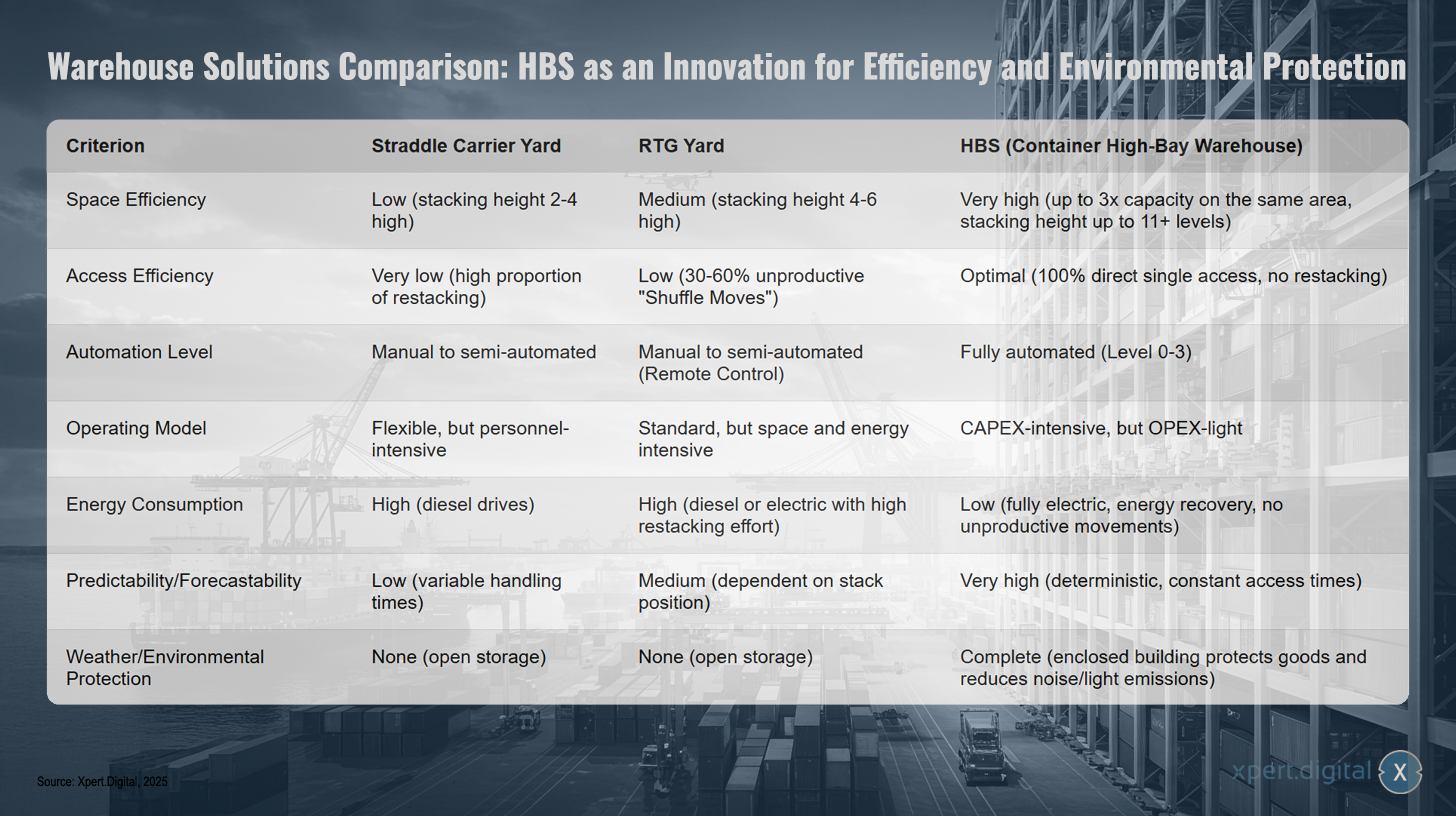
Comparison of storage solutions: HBS as an innovation for efficiency and environmental protection – Image: Xpert.Digital
A comparison of various storage solutions shows that the HBS stands out as an innovation in terms of efficiency and environmental protection. While straddle carrier yards and RTG yards achieve only low to medium capacities in terms of space efficiency with comparatively low stacking heights, the container high-bay warehouse (HBS) offers very high space efficiency with up to three times the capacity in the same space and stacking heights of up to more than eleven levels. In terms of access, the HBS offers optimal efficiency with 100% direct individual access without restacking, whereas conventional storage systems have an above-average number of unproductive restacking. In terms of the level of automation, the HBS is fully automated (levels 0-3), whereas straddle carriers and RTG yards have only manual to partially automated processes. The HBS operating model is capital-intensive (CAPEX), but results in low operating costs (OPEX), in contrast to the labor-intensive or space- and energy-intensive models of the other systems. Energy consumption is also significantly lower with the HBS thanks to all-electric operation and energy recovery, as there are no unproductive trips. The HBS also offers very high predictability, with deterministic and constant access times, whereas the other systems offer variable or rather mediocre predictability. Finally, as an enclosed building, the HBS offers complete protection from weather and environmental influences, protecting goods and reducing noise and light emissions – an advantage that open-air storage-based systems such as straddle carriers and RTG yards do not offer.
Technical metamorphosis – How an industrial warehouse becomes a container terminal
Transferring the high-bay warehouse concept to container terminals is far more than simply scaling up existing systems. It's an engineering feat that requires a profound technical metamorphosis and pushes the boundaries of materials science, control engineering, and structural analysis. The greatest challenge lies in managing the sheer dimensions and weight. While a typical industrial pallet weighs around 1.5 tons, loaded 20-, 40-, or 45-foot ISO containers can weigh up to 36 or even 40 tons. This massive scaling requires a fundamental redesign of all load-bearing components.
The shelf structure
The steel rack structure must be designed to withstand extreme point loads and a massive total load. The structural integrity of such a structure, which can reach heights of over 50 meters, is critical and requires complex calculations and verifications to ensure absolute stability. In addition to vertical loads, the structure must also be able to withstand significant lateral forces caused by wind (especially in the case of self-supporting silo designs), seismic activity, or the dynamic forces of the operating cranes.
The storage and retrieval machines (RBG)
Storage and retrieval machines (SRMs) for containers are not standard equipment, but rather highly specialized heavy-duty cranes. They must be capable of not only safely lifting loads of over 40 tons, but also moving them at high speed and acceleration, and positioning them with millimeter precision. Drive technology is crucial here. Powerful, frequency-controlled drives enable dynamic movements, while energy recovery systems ensure that the energy released when braking or lowering the load is fed back into the system, significantly increasing energy efficiency.
Load handling equipment (LAM)
Highly complex spreaders are replacing simple forks as load handling devices (LHDs). These gripping systems must securely grip the containers at the standardized corner castings. To handle the various standard sizes of 20-, 40-, and 45-foot containers, these spreaders must be telescopic and adjust fully automatically to the respective length.
Interfaces to the port world
Another immense challenge is the design of interfaces to the port environment. A HBS does not operate in a vacuum. It must be seamlessly connected to the waterside processes (loading and unloading by large ship cranes) and the landside transport systems (trucks, rail, inland waterway vessels, automated guided vehicles – AGVs). Since these external processes are often asynchronous and less predictable than the internal processes of the HBS, intelligent buffer zones, special transfer stations, and complex conveyor systems are required to decouple the various processes and ensure a smooth, congestion-free overall process.
Software customization
Finally, the software also requires extensive customization. A warehouse management system (WMS) for a container HBS must do far more than just manage storage locations. It must orchestrate a complex, highly dynamic choreography of thousands of containers, dependent on countless external factors such as ship arrivals, truck time windows, customs regulations, and last-minute schedule changes by shipping companies. It must communicate in real time with the higher-level Terminal Operating System (TOS) and develop forward-looking strategies to optimize storage and retrieval processes.
The technology transfer from industry to the port is therefore no trivial step. The dynamics created by accelerating and decelerating 40 tons at a height of 50 meters generate enormous forces that must be safely mastered by the structure and drives. Despite these enormous masses, positioning accuracy must be in the millimeter range to guarantee safe and damage-free operation. The crucial basis for port operators' trust in making billions of dollars in investments in this new technology lies in the proven expertise of the system manufacturers. Companies that can demonstrate decades of experience in the 24/7 operation of heavy-duty logistics systems for 50-ton steel coils under the harshest industrial conditions possess the necessary credibility and domain knowledge to accomplish this engineering feat. The innovation lies not in the invention of the HRL itself, but in the bold and highly competent application of its principles to a completely new size and weight class – a prime example of incremental innovation with a truly disruptive result.
Overview of solution approaches and system architectures
As the market for automated container high-bay warehouses matures, various strategic approaches and system architectures are emerging. These differ less in their underlying technology – direct access to every container in a racking system – than in their business philosophy, scaling strategy, and degree of customization. A strategic assessment of these approaches reveals the dynamics of an emerging technology field.
Approach 1: The modular precision full-service provider (Example: LTW Intralogistics)
This approach embodies a special variant of the tailor-made approach, characterized by the highest manufacturing quality and complete industry neutrality. LTW Intralogistics GmbH from Wolfurt, Austria, as an established full-service provider with over 40 years of experience, pursues a unique business philosophy: combining precision manufacturing according to the highest standards with fully customized intralogistics solutions.
The uniqueness of this approach lies in manufacturing to the highest quality standards, which means that all moving components – from storage and retrieval machines to vertical conveyors and transfer carriages – are manufactured in state-of-the-art production facilities to extremely tight manufacturing tolerances. This enables exceptional robustness and precision, ensuring precise material handling even at heights of 40 meters or more.
As a full-service provider with over 1,000 successfully implemented projects, LTW has installed more than 2,400 storage and retrieval machines in over 35 countries. The company is distinguished by its complete industry neutrality – from the food industry to the automotive sector and the highly sensitive pharmaceutical industry, customized solutions are developed.
LTW's expertise in heavy-duty and special solutions is particularly noteworthy: The company has already implemented high-bay container warehouses with payloads of 18,000 kg and has specialized expertise for extreme requirements such as 31-meter-long stored goods or stacker cranes with heights of up to 44 meters. The company's proprietary LTW LIOS (LTW Intralogistics Operating System) software family seamlessly integrates all system components.
The strategic advantage of this approach lies in the unique combination of standardization and complete customization: While the core components are produced in precision manufacturing according to proven, highest quality standards, LTW can focus entirely on customer-specific planning, system integration, and solution development. This creates a perfect balance between cost-efficient production and maximum adaptability.
LTW positions itself as a solution-finder for complex requirements – from standard pallet storage and deep-freeze systems to exotic custom solutions such as boat storage or wooden shelving. Its philosophy is "nothing can be done" – an approach made possible by its exceptional manufacturing flexibility and decades of engineering expertise.
This approach is particularly attractive for demanding projects with special technical challenges that require maximum availability, durability and precision – characteristics guaranteed by decades of experience and the highest manufacturing quality.
Approach 2: The standardized, scalable product (example: BOXBAY)
The second approach, prominently represented by the BOXBAY joint venture, a cooperation between the global port operator DP World and the German plant manufacturer SMS group, aims to develop a highly standardized and modular HBS product that can be rolled out efficiently and repeatably worldwide. The philosophy behind this is to reduce planning complexity and accelerate implementation by relying on proven, predefined building blocks. The architecture consists of clearly defined storage blocks or modules that can be combined according to the terminal's capacity requirements and can also be subsequently expanded incrementally without disrupting ongoing operations. To enable flexible integration into different terminal layouts, this approach offers various interface configurations. These include the SIDE-GRID® system, in which containers are transferred to straddle carriers at the front of the aisles, and the TOP-GRID® system, in which automated guided vehicles (AGVs) travel beneath the raised rack structure and are served from above by the stacker cranes. The focus is clearly on global scaling and rapid market penetration through a repeatable product approach, which is particularly attractive for large, globally operating operators and new construction projects (“greenfield”).
Approach 3: The tailor-made, plant engineering approach (Example: Vollert, Amova)
This approach represents the classic strength of European, and particularly German, mechanical and plant engineering: the development of highly customized, tailor-made solutions. Companies such as Vollert and Amova (part of the SMS group, but with its own market presence) pursue the philosophy that every terminal and every customer has unique requirements that require a specific solution. Instead of offering a standard product, each plant is designed as a large-scale, individual project tailored precisely to the local conditions, existing processes, and strategic objectives of the customer. The system architecture is therefore highly flexible in terms of layout, building height, connection to existing infrastructure, and the selection of components used. This approach is particularly well-suited for complex retrofit projects in existing terminals (“brownfield”), where the new technology must be seamlessly integrated into an established and often cramped environment. The focus here is on in-depth, solution-oriented engineering that enables maximum customization and optimal process integration.
Approach 4: The technology partnership (example: Konecranes/Pesmel)
A fourth route to market is strategic cooperation between established specialists. One example is the partnership between Konecranes, one of the world's leading manufacturers of harbor cranes with a global sales and service network, and Pesmel, a Finnish expert in automated high-bay warehouse technology for heavy industry. The philosophy of this approach is the intelligent combination of complementary strengths to shorten time to market and minimize development risks. The resulting solution, marketed as "Automated High-Bay Container Storage (AHBCS)," is based on Pesmel's proven and robust high-bay warehouse technology and combined with Konecranes' advanced crane and control systems to create an integrated package. This approach is a clever "make-or-buy" decision, allowing a large, established player like Konecranes to quickly enter this new, attractive market without having to undergo years of costly in-house development.
This diversity of business models is a clear indication of the vitality and immense potential of the container high-bay warehouse market. There is no single, undisputed silver bullet yet. Instead, competition is taking place not only at the technology level, but equally intensely at the level of business and implementation strategies. The product approach aims for economies of scale and speed, the plant engineering approach for maximum adaptability and problem-solving expertise, and the partnership approach for the clever use of synergies. Which approach will prevail in the long term depends on the specific needs of the various market segments – from global operators building standardized greenfield terminals to regional ports that need to implement complex brownfield modernizations.
The digital nervous system – The role of TOS, WMS and the digital twin in “Port 4.0”
Physical automation through impressive high-bay warehouses is only the visible shell of a much deeper transformation. It is an integral component and, at the same time, a crucial enabler of the more comprehensive concept of "Port 4.0." This digital ecosystem aims to transform a port into a fully transparent, proactive, and highly efficient logistics hub through the intelligent networking of technologies such as the Internet of Things (IoT), artificial intelligence (AI), big data, and blockchain. The HBS is not just an application within this ecosystem, but the fundamental platform that enables its full development.
The digital nervous system of an automated terminal is hierarchically structured:
Terminal Operating System (TOS)
This is the overarching management and planning software for the entire port terminal. The TOS orchestrates the broad processes: It manages ship berths, plans loading and unloading sequences, controls the allocation of time slots for trucks and trains, and performs a broad planning of storage areas in the yard. It is the brain that makes the strategic decisions.
Warehouse Management System (WMS) / Warehouse Control System (WCS)
This specialized software is the operational heart of the high-bay warehouse. It is subordinate to the TOS and is responsible for the microscopic fine-tuning of all processes within the HBS. The WMS manages each individual storage location, optimizes the travel strategies and movement sequences of the stacker cranes to minimize empty runs, and controls all connected conveyor technology. A seamless, bidirectional, and real-time interface between the higher-level TOS and the specialized WMS is crucial for smooth operations.
Sensors (IoT)
A multitude of sensors – cameras, RFID readers, laser scanners, and position sensors on cranes, vehicles, and containers – act as the system's sensory organs. They continuously collect real-time data on the identity, position, weight, and condition of every single container and machine in the terminal.
Automated vehicles (AGVs & RBGs)
They are the "muscle" of the system. They execute the physical transport commands they receive from the WCS. Their movements are coordinated and monitored in real time to avoid collisions and optimize material flow.
Artificial Intelligence (AI)
The AI algorithms are the learning brain of the system. They use the vast amounts of data collected by the IoT sensors to identify patterns and continuously optimize processes. For example, AI can develop forward-looking storage strategies by automatically positioning containers that are expected to be needed again soon in "hotspots" close to the retrieval point. It can predict the optimal time to maintain an SRM (predictive maintenance) before a failure occurs, or minimize the energy consumption of the entire system through intelligent load balancing.
The Digital Twin
The ultimate level of this integration is the digital twin. This is an exact, virtual 1:1 replica of the physical port in a simulation environment, continuously fed with real-time data from operations. Such a digital twin makes it possible to test and optimize new processes, modified layouts, or complex emergency scenarios risk-free before they are implemented in the real world. It can also be used to train staff or demonstrate performance improvements to customers.
The introduction of an HBS is the crucial catalyst for a functioning Port 4.0 ecosystem. Traditional terminals are inherently chaotic and unpredictable. The exact time required to access a specific container is variable and depends on its random position in the stack. A digital twin of such a system could only model its behavior imprecisely and would therefore have only limited value for optimization. AI predictions would be subject to high uncertainties. The HBS, on the other hand, makes the storage process deterministic: Accessing any container has a precisely defined, constant time and an equally defined energy expenditure. This absolute predictability and high data precision create the clean and reliable data foundation that advanced AI models need to perform reliable optimizations and realize their full potential. A digital twin of an HBS terminal can accurately model and predict the behavior of the real system, making simulations and analyses meaningful and valuable. The investment in HBS hardware is thus inextricably linked to an investment in a superior data and software infrastructure. The physical order of the HBS creates the digital order essential for the next level of efficiency improvement through AI and simulation.
Your container high-bay warehouse and container terminal experts

Container high-bay warehouses and container terminals: The logistical interplay – Expert advice and solutions – Creative image: Xpert.Digital
This innovative technology promises to fundamentally change container logistics. Instead of stacking containers horizontally as before, they are stored vertically in multi-tiered steel rack structures. This not only enables a drastic increase in storage capacity within the same space but also revolutionizes the entire processes in the container terminal.
More about it here:
Europe's port revolution: Automated high-bay warehouses lead the way in technology
The strategic imperative – Why Europe must strive for technological leadership
Competitiveness in the global port concert
European seaports are the continent's central gateways for trade, but they are under growing, multidimensional pressure. Forecasts by the European Commission predict that cargo throughput in EU ports will increase by 50% by 2030. At the same time, the trend toward ever larger container ships is leading to extreme throughput peaks that are pushing existing infrastructure to its capacity limits. In this environment, competition is intense. Major hubs such as Hamburg, Rotterdam, and Antwerp compete not only with each other for cargo flows, but also with emerging ports outside the EU, some of which operate with massive state subsidies. In this global concert, efficiency, speed, reliability, and costs are the decisive factors that determine market share and economic success.
The implementation of automated container high-bay warehouses (HBS) proves to be a decisive competitive advantage, transforming the performance of a port on several levels:
Dramatically higher throughput
The core advantage of HBS is the complete elimination of unproductive restacking. Combined with the high speed of the fully automated systems, this results in a significantly higher number of container movements per hour and per hectare of terminal space. Shorter loading and unloading times for increasingly larger ships reduce their expensive layover times in the port. At the same time, truck handling times can be reduced by up to 20%, reducing congestion at the gates and increasing the efficiency of the land-based logistics chain.
Massive capacity expansion on existing space
For many historically established, urban-based European ports, physical expansion is virtually impossible. Space is extremely scarce and expensive. The HBS offers a revolutionary solution: By consistently utilizing verticality, storage capacity can be tripled or even quadrupled on the same footprint. This enables ports like Hamburg or Rotterdam to manage their growth without having to rely on costly and often ecologically and politically controversial port expansions through land reclamation.
Reliability and predictability as a new quality feature
The deterministic processes in the HBS lead to precisely predictable and reliable handling times. A truck driver receives a fixed time window that can be adhered to, and a shipping company can rely on its vessel being dispatched on time. This predictability is an invaluable advantage in today's tightly scheduled, just-in-time supply chains. It improves the port's integration into global logistics networks and increases its attractiveness for freight forwarders and shipping companies that need to optimize their own resources and schedules.
The introduction of HBS technology takes competition to a new level. A port is transformed from a mere cost and transshipment point into a highly integrated, value-added logistics hub. Competitiveness is no longer defined solely by port fees per container handled, but increasingly by the quality, speed, and reliability of the services offered and the depth of integration into customers' supply chains. An HBS-supported port can offer new, data-driven services, such as guaranteed handling times, seamless digital connectivity to the production logistics of industrial companies, or improved real-time shipment tracking. This technological superiority enables European ports to differentiate themselves in global competition and evolve their role from that of a mere infrastructure provider to that of an indispensable strategic partner for global industry. This is a crucial step for long-term survival in competition with heavily subsidized ports in other regions of the world.
Geopolitical sovereignty and technological resilience
The strategic importance of European seaports extends far beyond their economic function. They are critical infrastructures that form the backbone of the European Union's security of supply and economic independence. Against this backdrop, there is growing concern in political and economic circles about the increasing influence of third countries, particularly China, on these sensitive hubs. Over the past two decades, state-controlled or influenced actors have invested heavily in European port terminals, thus securing significant stakes and say.
This development is increasingly perceived as a strategic vulnerability. Dependence on foreign operators and potentially also on foreign technology in critical infrastructure areas could undermine the security, economic sovereignty, and resilience of individual member states and the EU as a whole. The painful experience of unilateral energy dependence on Russia has heightened awareness of such risks and led to the political will to proactively avoid the emergence of new dependencies, this time in the transport sector.
In this geopolitical context, the development and mastery of HBS technology is proving to be an effective tool for strengthening European sovereignty and resilience:
Technological leadership as a guarantee of independence
When European, especially German, companies develop, produce, and export world-leading technology for container port automation, this secures technological sovereignty in a sector of paramount strategic importance. It reduces dependence on non-European technology providers and ensures that standards for security, data protection, and operations are defined by European players.
Strengthening the domestic port industry
The implementation of this superior, European-developed technology enables European port operators to increase their efficiency and competitiveness, strengthening their position in direct competition with terminals controlled by non-European state-owned companies.
A strategic alternative in global system competition
With its "Global Gateway" initiative, the European Union has set the goal of creating a value-based and strategic alternative to China's "One Belt, One Road" initiative. The promotion and export of European cutting-edge port technology is an integral part of this strategy. It enables the development of a global network of partner ports based on European technological standards, transparent business models, and mutual benefits.
Increasing the resilience of global supply chains
HBS terminals also contribute to the physical resilience of supply chains. Their enormous storage capacity allows them to maintain larger buffer stocks, thus better mitigating fluctuations and disruptions in global trade. Their high level of automation also makes them less vulnerable to sudden labor shortages, such as those that can occur during pandemics, thus increasing supply reliability.
The development and export of HBS technology is thus far more than just a lucrative business. It is an active contribution to the implementation of the European strategy for economic security and to strengthening geopolitical capacity for action. Control over critical technologies is a key element in the global competition between systems. Those who supply the technology for the ports of the future not only define technical standards but also have access to crucial data streams and build long-term, strategic partnerships. When European companies supply this technology to ports in Africa, South America, or Asia, they are not just exporting machinery, but a European model for efficiency, sustainability, and operational management. They are creating facts and binding strategic partners to the European economic and value ecosystem. The promotion of HBS technology is thus a highly effective industrial policy and geopolitical instrument that strengthens the European economy from within while simultaneously projecting European influence and European standards outwards – a direct and constructive response to the strategic challenges posed by other global powers.
The “Green Port” as a competitive advantage
At a time when climate change dominates the global agenda, shipping and its associated ports are under enormous pressure to transform. As significant emitters of greenhouse gases and pollutants, they are key targets of the ambitious goals of the EU Green Deal. The vision is clear: ports should evolve from mere transshipment points into central energy hubs of the future, playing a key role in the energy transition. The concept of the automated high-bay container warehouse (HBS) is proving to be a key technology that enables the reconciliation of economics and ecology and transforms the "Green Port" from a vision into a measurable reality.
HBS’s contributions to sustainability are diverse and profound:
Full electrification and elimination of local emissions
The most fundamental contribution is the change in the drive concept. All moving components of a HBS – from the stacker cranes to the connected conveyor technology – are fully electric. This replaces the fleets of diesel-powered RTGs, straddle carriers, and terminal trucks that are responsible for significant emissions of CO2, nitrogen oxides, and particulate matter in traditional ports. Operation in the HBS is thus locally emission-free.
Maximum energy efficiency
The sustainability of the HBS goes far beyond mere electrification. By completely eliminating unproductive restacking movements, the total energy consumption per container handled is drastically reduced. Energy is now only used for value-added transport. In addition, modern electric drives are equipped with energy recovery systems. When the heavy equipment decelerates or when the heavy containers are lowered, the released kinetic and potential energy is converted into electrical power and fed back into the system grid instead of being lost as heat.
Integration of renewable energies
The architecture of the HBS facilities provides ideal conditions for decentralized energy generation. The vast, flat roofs of the warehouse buildings are ideal for the installation of large-scale photovoltaic systems. Depending on the location and solar radiation, such a system can cover a significant portion of the terminal's own electricity needs or even turn the system into a net energy producer, enabling CO2-neutral operation.
Massive land savings and protection of ecosystems
Vertical storage can reduce the space required for the same number of containers by up to 70% compared to conventional yards. This is not only an economic advantage in expensive locations, but also a significant ecological one. Valuable and sensitive coastal ecosystems are protected, and the pressure for further sealing of land is reduced. Freed-up areas can potentially be renaturalized or converted into green spaces.
Reduction of noise and light pollution
All warehouse operations take place within a closed, often soundproof building. This drastically reduces noise pollution for employees and the surrounding residential areas. Because the systems are fully automated, no permanent lighting is required inside the warehouse, which minimizes light pollution, especially at night.
The HBS concept is thus a rare and impressive example of how a technological innovation can radically improve both economic efficiency and ecological sustainability simultaneously and inseparably. It resolves the apparent contradiction between economic growth and environmental protection. Traditionally, increased efficiency in ports often meant more space, more diesel-powered equipment, and consequently more emissions. The HBS reverses this logic. The increase in productivity is achieved through greater intelligence (no re-stacking) and superior resource utilization (verticality, electrification, energy recovery), not through more brute force. The economic benefits – lower operating costs through reduced energy and personnel expenditure – are directly linked to the ecological benefits – no local emissions, less land use, less – . This symbiosis makes HBS technology not only a desirable option, but a key technology for achieving the EU's binding climate targets. A port that uses this technology not only improves its own balance sheet, but also secures its social and political acceptance (“license to operate”) in a world that increasingly makes sustainability a condition for economic success.
Industrial policy opportunities for European mechanical and plant engineering
Europe faces a critical challenge in the global technology landscape. Particularly in high-tech digital fields, the continent is at risk of falling behind the innovation dynamics of the US and China. Analyses show that private spending on research and development in the EU is significantly lower as a percentage of gross domestic product than in the US, and that European industry remains heavily dominated by traditional sectors such as the automotive industry. Avoiding this "technology trap" requires strategic initiatives that build on existing strengths and open up new, globally competitive technology fields.
The development of automated high-bay container warehouses represents precisely such a field – a prime industrial policy opportunity in which European companies currently hold an undisputed global leadership position. The creation and establishment of this new market offers enormous opportunities to strengthen Europe's industrial base:
Export of complex high technology
The global demand for more efficient and sustainable port solutions is creating a huge new market for complex facilities "Made in Europe." Each HBS represents a major project worth hundreds of millions of euros. Success in this segment secures highly qualified jobs in research, development, engineering, production, and project management, and strengthens the export balance.
Use and further development of core competencies
HBS technology is not an alien element, but is deeply rooted in the traditional strengths of German and European mechanical and plant engineering. Virtues such as precision in steel construction, reliability under continuous load, component durability, and the ability to integrate complex mechanical, electrical, and software systems are the key success factors. HBS represents the further development of these core competencies into the digital age.
Creating an innovative ecosystem
Leading plant engineering companies such as SMS group, Vollert, and Konecranes do not operate in a vacuum. A broad and deep ecosystem is emerging around them, comprised of highly specialized suppliers for components such as drives, sensors, and control technology; software developers for WMS and AI solutions; engineering firms for structural analysis and planning; and research institutes working on next-generation technologies. This network strengthens the innovative power of the entire region and creates a self-reinforcing cycle of knowledge and application.
The strategic importance of this sector is also increasingly recognized by policymakers. The European Union and national governments have launched initiatives to strengthen the competitiveness of the maritime economy and promote the development of strategic technologies. A recently announced new EU port strategy, a maritime industrial strategy, and specific funding programs for port innovations, such as the German IHATEC program, are aimed at improving the framework conditions for leading companies and consolidating their position in global competition.
The success story of the HBS development can serve as a blueprint for a modern and successful European industrial policy. It demonstrates a path to transforming established industrial strengths into a completely new, globally leading technology sector through targeted, application-oriented innovation. The starting point is a strong, but in some areas potentially stagnating, traditional industry – heavy-duty mechanical engineering. Instead of attempting to catch up in entirely new fields dominated by non-European players such as social media or consumer electronics, an existing world-class core competency – the precise and reliable handling of extremely heavy loads – is being applied to a new, adjacent, and global problem area, container logistics. This technology transfer leads to a disruptive innovation built on decades of experience and proven reliability – a deeply rooted competitive advantage that new competitors will find very difficult and slow to replicate. The result is the creation of a new global market that European companies can shape and potentially dominate from the outset. Instead of simply lamenting the loss of competitiveness, the HBS example shows a proactive way forward: the intelligent and strategic combination of traditional industrial excellence with forward-looking digitalization and sustainability.
🎯🎯🎯 Benefit from Xpert.Digital's extensive, fivefold expertise in a comprehensive service package | R&D, XR, PR & SEM

AI & XR-3D-Rendering Machine: five times expertise from Xpert.digital in a comprehensive service package, R&D XR, Pr & SEM – Image: Xpert.digital
Xpert.Digital has in-depth knowledge of various industries. This allows us to develop tailor-made strategies that are tailored precisely to the requirements and challenges of your specific market segment. By continually analyzing market trends and following industry developments, we can act with foresight and offer innovative solutions. Through the combination of experience and knowledge, we generate added value and give our customers a decisive competitive advantage.
More about it here:
Innovation in the port: From brownfield projects to greenfield new builds
Market, challenges and social dimensions
Market dynamics and future prospects
The global market for port automation, and especially for advanced solutions such as HBS, is no longer a distant vision but a dynamic and rapidly growing economic reality. Various market analyses confirm its immense commercial potential. One estimate values the global market for automated container terminals at USD 10.89 billion in 2023 and forecasts growth to USD 18.95 billion by 2030, corresponding to a solid compound annual growth rate (CAGR) of 7.8%. Other analyses are even more optimistic, predicting growth for the broader market for port automation solutions from USD 2.37 billion in 2025 to over USD 8 billion by 2033, which would represent an impressive CAGR of 15.6%. Regardless of the exact figures, the trend is clear: demand for port automation technology is massive and will continue to grow significantly in the coming years.
This growth is driven by several fundamental drivers. First and foremost is the relentless growth of global trade, which is leading to ever-increasing cargo volumes. The resulting pressure for efficiency, exacerbated by the use of ever-larger container ships, is forcing terminals to modernize. Added to this are challenges such as the industry-wide shortage of skilled workers and labor, as well as the growing focus on occupational safety and environmental sustainability, all of which favor the use of automation.
Two main strategies can be observed in the implementation of these technologies: brownfield and greenfield projects. Currently, brownfield projects, i.e., the retrofitting and modernization of existing terminals, dominate the market with a share of over 68%. For many established ports, this is the only viable option, as it allows for incremental capacity and efficiency increases without having to completely shut down operations. However, the highest growth rates are expected for greenfield projects, i.e., the construction of new terminals on "greenfield" sites. A CAGR of 9.6% is expected for these projects, as this approach enables a no-compromise, ground-up optimized implementation of automation technology without the constraints of existing infrastructure.
Technological development will also not stand still. Future prospects point to an even deeper integration of artificial intelligence for the self-learning optimization of entire terminal logistics. Seamless connection of automated terminals to future autonomous ships and self-driving trucks is also conceivable, which could lead to a fully automated supply chain from producer to end customer. A particularly promising concept is the physical merging of the HBS with industrial logistics. Instead of transshipping containers at the port and then transporting them by truck to a factory, the HBS could be attached directly to a production plant or a large distribution center, completely eliminating truck transport on the "last mile." This would lead to enormous time and cost savings as well as a further reduction in emissions.
The hurdles of implementation
Despite the enormous potential and positive market outlook, the implementation of automated high-bay warehouses in ports is not a sure-fire success. The path to vertical revolution is paved with significant hurdles and challenges that operators and technology providers must overcome.
Immense investment costs (CAPEX)
Perhaps the biggest barrier is the extremely high initial investment. The construction of a HBS is a major industrial project, the costs of which can quickly reach several hundred million or even over a billion US dollars. Such sums represent a massive financial challenge even for large port operators and are often prohibitive for smaller, regional ports.
Complexity in planning and integration
Planning an HBS terminal is a highly complex, multi-year process that requires in-depth expertise in structural analysis, mechanical engineering, electrical engineering, and software development. A particular challenge is the seamless integration of the new, complex hardware and software into the heterogeneous IT landscapes (especially the terminal operating systems) and physical processes of an existing port, which have often evolved over decades.
Technical risks and reliability
A HBS is a highly interconnected system in which all components must work together perfectly. The failure of a single key component – be it a storage and retrieval machine, a central conveyor, or the control software – can potentially paralyze the entire warehouse area and thus a large portion of terminal operations. The risk of such a total failure must be minimized through complex redundancy concepts (e.g., multiple SRMs per aisle), sophisticated forward-looking maintenance strategies, and emergency plans.
Cybersecurity
As digitally controlled, critical infrastructure, automated terminals are a highly attractive target for cyberattacks. A successful attack could not only disrupt operations but also compromise sensitive data or even cause physical damage. Ensuring the highest level of cybersecurity is therefore not an option, but an absolute necessity.
The productivity controversy
One of the most sobering findings from the world's first automated terminals is that the promised productivity gains do not always materialize immediately or to their full extent. Several studies and field reports indicate that automated equipment, especially during the start-up phase, can be slower than experienced human crane operators. The complexity of the systems can lead to unexpected bottlenecks and downtime. Some operators report that productivity still lags behind that of conventional terminals even after several years. The success of automation is therefore by no means guaranteed and depends heavily on careful planning, perfect implementation, and excellent operational management.
Humans in the automated world – socioeconomic impacts
The technological and economic transformation brought about by port automation has a profound social downside. The debate about the future of ports is inextricably linked to the question of the future of work and social stability in port cities. The socioeconomic impacts are significant and ambivalent.
Transformation and job losses
By definition, automation aims to replace manual processes with machines. This inevitably leads to fundamental change and a potentially drastic reduction in traditional port jobs. Studies suggest that occupations such as crane operators, straddle carrier drivers, and mooring workers, which have shaped the landscape of port work for decades, could lose up to 90% of their current tasks to automated systems. Specific analyses predict that the transition to automation could lead to a 50% reduction in directly affected jobs for brownfield projects and up to 90% for greenfield newbuilds.
Erosion of the local economy
In many regions, dockworker jobs are more than just jobs. They are often well-paid, covered by collective agreements and unionized positions that have formed a stable pillar of the local middle class for generations. Their loss has direct and tangible negative effects on income levels, purchasing power, and tax revenues in the affected port cities and communities. Critics argue that automation ultimately shifts local wages and taxes to the profits of international shipping companies and foreign technology corporations.
Emergence of new, highly qualified job profiles
At the same time, automation is creating new jobs, albeit with a completely different set of requirements. IT specialists, mechatronics engineers, data analysts, software developers, and systems engineers who can plan, operate, monitor, and maintain complex systems are now in demand. A profound shift is taking place from physically demanding work to knowledge-based, highly skilled occupations.
The challenge of the skills gap
The central problem with this transformation is the massive mismatch between the skills of the existing workforce and the requirements of the new jobs. An experienced crane operator can't become a software specialist overnight. This skills gap is one of the biggest hurdles to a socially acceptable transformation. Without massive, targeted, and long-term investments in retraining and continuing education programs, a large portion of the existing workforce is at risk of falling behind.
The need for social partnership and social dialogue
The successful introduction of automation technology depends not only on its technical perfection, but crucially on its social acceptance. This can only be achieved through a proactive and honest dialogue between companies, unions as representatives of employees, and politicians. Joint concepts are needed to cushion the social impact of the negative consequences, to ensure that remaining employees fairly participate in the productivity gains achieved through automation, and to actively shape the new world of work. Resistance and social conflict are inevitable if the transformation is perceived as a purely top-down project to reduce costs.
The debate surrounding port automation is thus characterized by deep ambivalence. At the macro level, the technological, economic, and ecological benefits are compelling, and there is arguably no alternative to the long-term competitiveness of ports. At the local, human level, however, the social costs and anxieties are real and significant. Ignoring these costs would not only jeopardize social acceptance of the technology but also call into question the long-term success of the transformation itself. The real challenge, therefore, is not to prevent automation, but to shape it intelligently, proactively, and socially responsibly. Technological change must be inextricably accompanied by social change that invests in people and ensures that the fruits of progress are distributed as widely and fairly as possible.
Setting the course for the port of the future
The analysis of the transformation from industrial heavy-duty intralogistics to automated high-bay container warehouses paints a picture of a profound and irreversible development. The adoption of high-bay warehouse technology is far more than a technical optimization; it is a strategic response to the cumulative logistical, economic, and ecological challenges facing the global port industry. The ability to create maximum capacity in minimal space, reach every container directly and without unproductive restacking, and fully electrify and digitize operations makes this technology a crucial building block for the port of the future.
However, this technological leap is more than just a tool for increasing efficiency. It is a strategic instrument with significant geopolitical and industrial policy implications. For Europe, and especially for German industry, which plays a leading role in the development of these complex systems, this offers a unique opportunity to strengthen its competitiveness, secure technological sovereignty in a critical infrastructure, and make an active contribution to achieving global climate goals. Mastering this technology provides leverage for exporting European standards around the world and increasing the resilience of its own economy.
However, the path to this future is not an easy one. It requires massive investments, the management of enormous technical complexity, and, above all, the proactive and socially responsible management of the associated societal change. The significant impacts on the labor market and local economies in port cities cannot be ignored; they must be addressed through targeted investments in education, retraining, and strong dialogue between social partners.
The course for the port of the future is being set today. This port will be vertical, automated, intelligent, and green. European industry has a historic opportunity to act not as a passive user, but as a leading architect and global driver of this transformation. Seizing this opportunity requires courage, vision, and the willingness to view technological progress and social responsibility as two sides of the same coin.
Advice – planning – implementation

Markus Becker
I would be happy to serve as your personal advisor.
Head of Business Development
Advice – planning – implementation
Konrad Wolfenstein
I would be happy to serve as your personal advisor.
contact me under Wolfenstein ∂ Xpert.digital
call me under +49 89 674 804 (Munich)











