
The Indian Ports Bill 2025: Why India's new port laws are changing global maritime trade
Xpert Pre-Release

Available in 27 languages 📢
Prefer Xpert.Digital on GoogleⓘPublished on: May 14, 2026 / Updated on: May 14, 2026 – Author: Konrad Wolfenstein
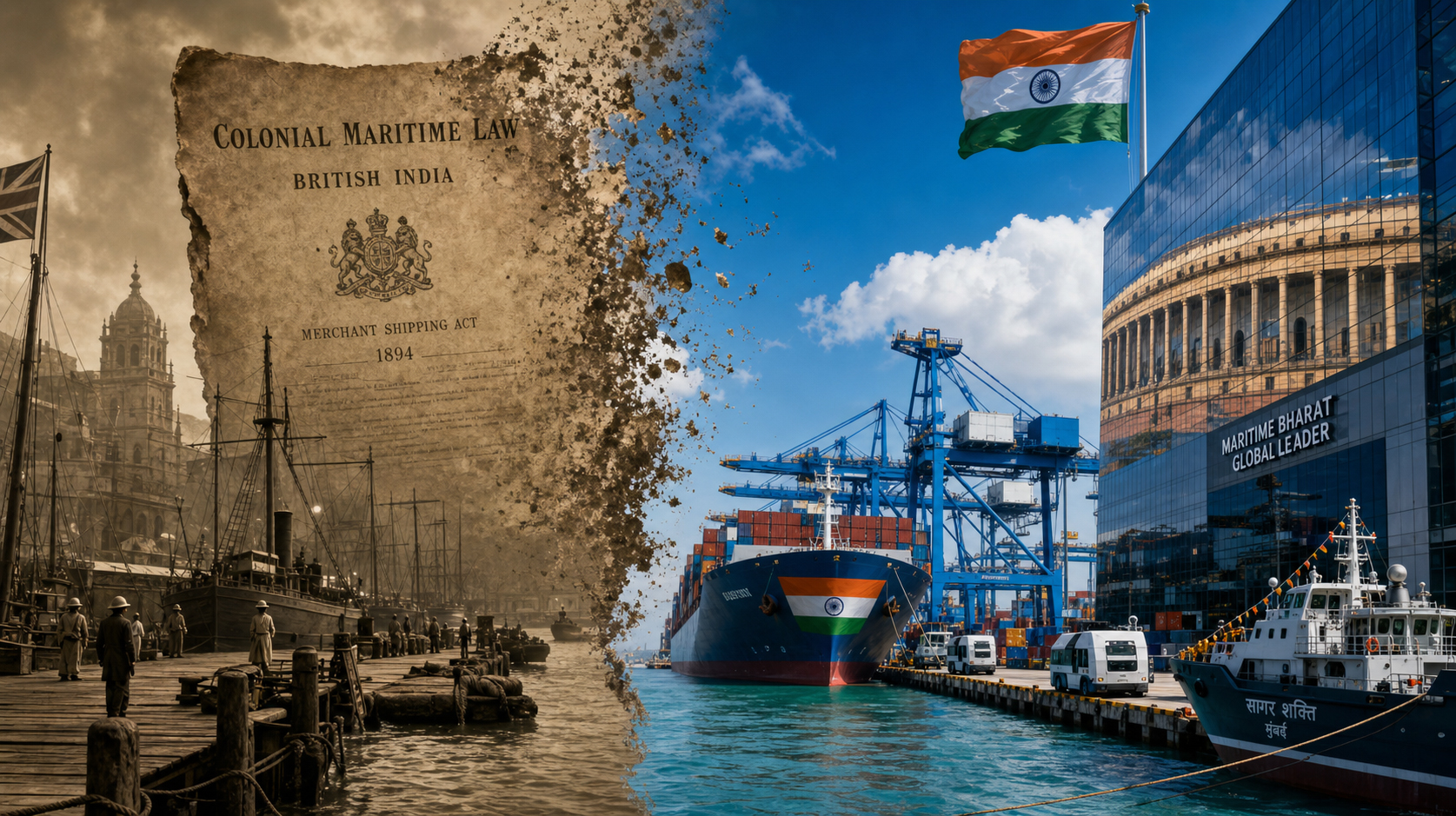
The Indian Ports Bill 2025: Why India's new port laws are changing global maritime trade – Image: Xpert.Digital
The end of the imperial era: How 5 new laws are catapulting India's ports into the 21st century
New rules for 200 forgotten ports: What India's historic shipping reform means for investors
Billion-dollar funds and radical reforms: India's gigantic master plan for shipping
For 117 years, India's port industry remained bound by the constraints of British colonial law – a bureaucratic anachronism that, in the age of megamax container ships and digital customs clearance, had long since become a hindrance to growth. But in August 2025, New Delhi drew a historic line under this. With the new Indian Ports Bill 2025 and four other maritime reform laws, the country is dismantling the old structures and catapulting its regulatory framework into the 21st century with a major leap. The goal is enormous: India wants to stop its foreign exchange losses due to foreign shipping companies, attract billions in investment, and ultimately become a global maritime superpower. What does this unprecedented wave of reform mean for international investors, environmental protection, and global shipping? A deep dive into India's master plan, which is reshaping an entire industry.
Related to this:

A law falls – and with it an era of imperial regulatory logic
There are laws that remain in force long after their expiration, not because they are good, but because no one has the political will to replace them. The Indian Ports Act of 1908 belonged to this category. Enacted under British colonial rule at a time when steamships represented the pinnacle of port operations and regulation primarily served to protect British commercial interests, this law, for decades, formed the foundation of Indian maritime law as an institutional anachronism. In August 2025, the Indian Parliament finally dismantled this foundation. The Lok Sabha approved the Indian Ports Bill 2025 on August 12, followed by the Rajya Sabha on August 18. It was not a purely symbolic act—it marked the beginning of a fundamental reshaping of the regulatory framework that structures India's entire maritime economy.
The historical context gives this reform its full significance. When the Indian Ports Act of 1908 was passed, there were no container ships, no automated crane systems, no digital customs clearance, and no international environmental conventions like MARPOL. Applying regulations from that era to modern, high-performance ports was not only impractical—it was structurally dysfunctional. Investors seeking terminal concessions faced a regulatory framework designed for Edwardian-era coal handling. Disputes between port operators and users were adjudicated through general courts, lacking industry-specific expertise or expedited procedures. The new Indian Ports Act 2025 corrects this structural misalignment at every level simultaneously.
The Maritime State Development Council: Coordination as a constitutional right
The new law establishes an institutional architecture tailored to India's federal reality. The central new element is the Maritime State Development Council (MSDC), which is enshrined in law for the first time by the Indian Ports Bill 2025 – no longer merely as an informal coordinating body, but as a statutory, consultative body with clearly defined powers. The MSDC will be chaired by the Union Minister for Ports and will comprise Ministers of State from coastal states, representatives from the Navy and Coast Guard, and senior ministerial officials.
The MSDC's tasks extend far beyond coordination. It is tasked with creating a National Perspective Plan for Maritime Infrastructure that situates all ports – major and non-major – within an integrated national development framework. All ports will be required to provide real-time data on cargo volumes, shipping traffic, capacity utilization, and hinterland connectivity, enabling the MSDC to make evidence-based, regionally balanced recommendations. The principle is clear: from a fragmented system with 12 federal departments, 200 state departments, and minimal coordination to a system of coordinated, data-driven, comprehensive planning. How profoundly this transformation succeeds in political practice will become clear in the coming years – but the institutional foundation has been laid.
State Maritime Boards: Bringing order to 200 forgotten ports
Perhaps the most practically significant element of the new law concerns the more than 200 non-major ports that have previously been operated under the jurisdiction of individual states—without uniform standards, without coherent regulation, and often resulting in considerable friction for investors and users. The new law authorizes coastal states to establish formal State Maritime Boards (state seaport authorities) with uniform administrative and operational powers. These boards will manage the 217 non-major ports according to a coherent regulatory model that more closely resembles the standards of major ports.
The economic context of this reform is significant. India's non-major ports are not marginal: they handle substantial shares of coastal shipping traffic, serve regional industries and the fishing sector, and—if properly developed—offset capacity for the chronically congested major ports. However, without a clear governance structure, many of these ports have lacked the operational and legal certainty that private investment would have required. The State Maritime Boards create a governance architecture that, for the first time, gives these ports an institutional identity—thus laying the foundation for systematic investment planning. Furthermore, the law stipulates that disputes between port authorities, concessionaires, and users are to be resolved by industry-specific Dispute Resolution Committees, with the possibility of appeal to the respective High Court.
MARPOL and Ballast Water Convention: India's alignment with international standards
A technically important, yet little-discussed element of the reform package is the legal obligation for all Indian ports to comply with international environmental conventions. The new law binds all ports to MARPOL – the International Convention for the Prevention of Pollution from Ships – as well as to the Ballast Water Management Convention, which regulates the introduction of invasive marine organisms through ships' ballast water systems. In addition, all ports must submit periodically audited pollution control and disaster response plans.
These requirements have been standard practice in Europe for years – in India, they were not previously mandatory for non-major ports. Their practical significance is twofold: First, these rules protect the marine environment, which is of considerable national interest for a country with 7,500 kilometers of coastline and a biologically rich marine zone. Second, they open up access for Indian ports to shipping lines and cargo classes that require environmental compliance as a prerequisite for their ports of call – a growing trend in the global container shipping industry, driven by ESG commitments from institutional investors and EU regulations such as the Carbon Border Adjustment Mechanism legislation.
Your container high-bay warehouse and container terminal experts

Container high-bay warehouses and container terminals: The logistical interplay – expert advice and solutions - Creative image: Xpert.Digital
This innovative technology promises to fundamentally change container logistics. Instead of stacking containers horizontally as before, they will be stored vertically in multi-story steel racking structures. This not only allows for a drastic increase in storage capacity within the same area, but also revolutionizes all processes at the container terminal.
More information here:
How the Maritime Development Fund aims to transform India's shipping by 2047
The Maritime Development Fund: 25,000 crore for the Indian fleet
A separate but closely linked element of the maritime reform agenda is the Maritime Development Fund (MDF), announced as part of the 2025 Union Budget. With a total capital of 25,000 crore – structured as a 20,000 crore investment fund and a 5,000 crore interest incentive fund – it is designed to provide long-term, low-interest financing for Indian shipbuilding, fleet expansion, and maritime infrastructure. The government holds 49 percent of the fund, with the remaining 51 percent to be subscribed by major port authorities, state-owned enterprises, financial institutions, and private actors.
The explicit goal of the MDF is ambitious: by 2047, the share of Indian-flagged ships in global cargo volume is to increase to 20 percent – starting from the current 1.2 percent of global tonnage. The logic behind this is economically compelling. India spends around 75 billion dollars annually on chartering foreign ships. This money leaves the country and strengthens the merchant navies of Greece, Japan, China, and South Korea. Every rupee that flows into the development of an Indian merchant navy through the MDF reduces this structural foreign exchange gap. The fund allows loans with maturities of 15 to 25 years – a necessity, because the amortization cycles of merchant ships, with a lifespan of around 30 years, require these long financing horizons.
Related to this:

The package is bigger than one law: Five reform laws in one session
The Indian Ports Bill 2025 is remarkable – but it doesn't stand alone. The Indian Parliament passed a total of five maritime reform bills in the same session: the Coastal Shipping Bill 2025, the Carriage of Goods by Sea Bill 2025, the Bills of Lading Bill 2025, and the Merchant Shipping Bill 2025 – all replacements for colonial legal regimes from the 19th and early 20th centuries. Union Ports Minister Sarbananda Sonowal described the simultaneous passage of all five bills as a historic moment for India's maritime development – and he is right: never before has India's maritime legal system been modernized at such a pace and scale.
The Coastal Shipping Bill 2025 establishes, for the first time, a dedicated law for coastal shipping, unifying support measures, environmental standards, and connectivity rules for coastal traffic along India's 11,000-kilometer coastline. The Carriage of Goods by Sea Bill 2025 replaces a 1925 law and aligns Indian freight law with the Hague-Visby Rules—the international standard for liability in the carriage of goods by sea. The Bills of Lading Bill 2025 modernizes commercial documentation in maritime freight transport. Finally, the Merchant Shipping Bill 2025 replaces the 1958 law and incorporates current international conventions on seafarers' welfare, ship safety, environmental protection, and wreck removal.
What governance reform means for investments
The legal changes have immediate economic consequences. International shipping companies and terminal operators invest in ports not only based on location and water depth – they invest based on regulatory reliability. Accepting a 117-year-old colonial law as the basis for 30-year terminal leases is simply not an option for many institutional investors. With the Indian Ports Bill 2025, its clearly defined dispute resolution mechanisms, its explicit link to international standards, and its transparent governance architecture, India is creating, for the first time, an investment framework that is internationally comparable.
The GIFT City IFSC regime, which already offers attractive tax and regulatory conditions for Indian-flagged shipping SPVs, complements this legislative impetus. Together, the two instruments significantly reduce transaction costs for foreign and domestic investors. India's Ports and Shipping Minister has announced that 100 percent foreign direct investment (FDI) in the port sector will be permitted through the automatic approval process – a signal that, in conjunction with the new law, should be taken seriously.
Gaps, limitations, and the work that remains
No reform is complete. The PRS India analysis of the Indian Ports Bill 2025 identifies significant gaps: The law does not provide sufficient legal recourse against penalties that a port conservator can impose—a discretionary power without adequate oversight. The powers of port officials to conduct inspections and searches are not limited by safeguards in the law, leaving room for arbitrary action. These shortcomings are typical of first generations of new regulatory legislation in emerging economies—and they demonstrate that while the reform project is ambitious, it is not yet finished.
Furthermore, the discrepancy between law and reality in India is traditionally not trivial. Whether State Maritime Boards are actually established nationwide depends on the political will and financial resources of the coastal states – from Gujarat and Maharashtra to Tamil Nadu and Kerala. The Dispute Resolution Committees need to be staffed with competent experts before they can function effectively. And the obligation to provide real-time data transparency to the MSDC requires IT investments in ports that currently lack the necessary basic infrastructure.
A date that counts: August 2025 as a maritime turning point
Overall, the legislative achievement of Parliament in August 2025 is remarkable. Five maritime reform bills in a single session – with this, India created a legal framework in just a few weeks that would have taken decades to develop in other systems. The symbolic value of the end of the Indian Ports Act 1908 should not be underestimated: laws are narratives. They tell a society what it thinks about itself. For 117 years, Indian maritime law said: We administer ports according to the rules of an empire that no longer exists. With the Indian Ports Act 2025, India says: We regulate our maritime economy according to our own rules, in line with the times, geared towards a future as a global maritime trading nation.
The connection to the Sagarmala program, Vadhavan, and Galathea Bay is no coincidence. Concrete and cranes alone don't make a port world-class. It also requires institutional infrastructure: clear title deeds, reliable dispute resolution, transparent tariffs, and uniform environmental standards. The new law provides this foundation. Whether India will actually become one of the world's leading shipping nations by 2047—with a 20 percent share of global freight volume and dozens of ports ranking among the world's top ten—remains to be seen. But the direction is right, and the tools are in place.
Consulting - Planning - Implementation

Konrad Wolfenstein
I would be happy to serve as your personal advisor.
me at wolfenstein∂xpert.digital contact
Just call me on +49 7348 4088 965 .
Our global industry and economic expertise in business development, sales and marketing

Our global industry and economic expertise in business development, sales and marketing - Image: Xpert.Digital
Industry focus areas: B2B, digitalization (from AI to XR), mechanical engineering, logistics, renewable energies and industry
More information here:
A thematic hub offering insights and expertise:
- Knowledge platform covering global and regional economies, innovation and industry-specific trends
- A collection of analyses, insights, and background information from our key areas of focus
- A place for expertise and information on current developments in business and technology
- A hub for companies seeking information on markets, digitalization, and industry innovations
Your container high-bay warehouse and container terminal experts

Container terminal systems for road, rail and sea transport in the dual-use logistics concept of heavy-lift logistics - Creative image: Xpert.Digital
In a world marked by geopolitical upheavals, fragile supply chains, and a new awareness of the vulnerability of critical infrastructure, the concept of national security is undergoing a fundamental reassessment. A state's ability to guarantee its economic prosperity, the provision of essential goods and services to its population, and its military capability increasingly depends on the resilience of its logistical networks. In this context, the concept of "dual-use" is evolving from a niche category of export control to a broader strategic doctrine. This shift is not merely a technical adjustment but a necessary response to the "paradigm shift" that demands a profound integration of civilian and military capabilities.
Related to this:










