
The Sagarmala program: How India is reinventing its ports with 60 billion euros – and why the world is watching
Xpert Pre-Release

Available in 27 languages 📢
Prefer Xpert.Digital on GoogleⓘPublished on: May 13, 2026 / Updated on: May 13, 2026 – Author: Konrad Wolfenstein
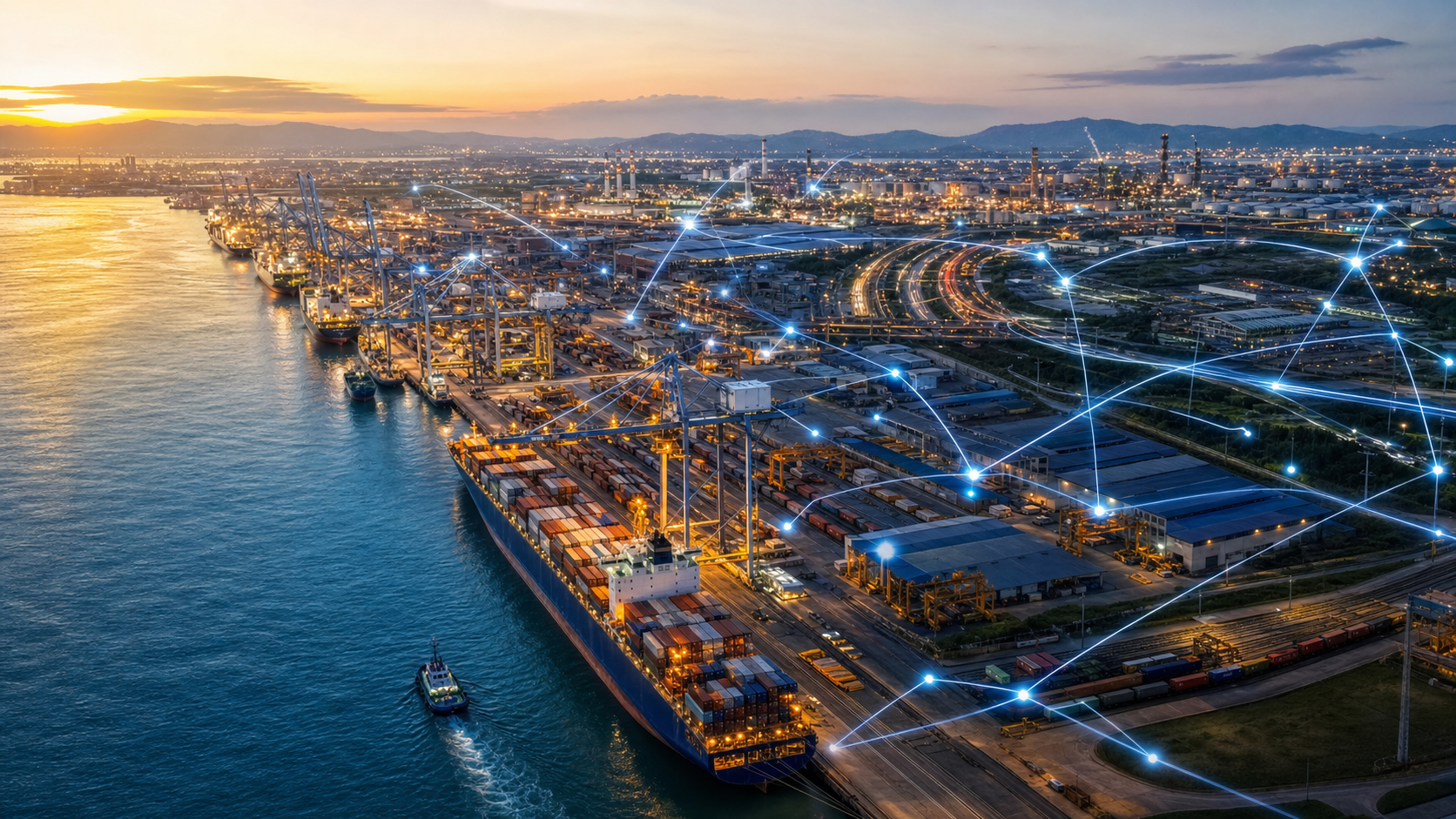
The Sagarmala program: How India is reinventing its ports with 60 billion euros – and why the world is watching – Image: Xpert.Digital
Attack on China's dominance: India's gigantic master plan for the ports of the future
More than just concrete: How India aims to become a maritime superpower with 839 projects
Waiting time of less than one day: Why Indian ports are suddenly overtaking Germany and the USA
For a long time, India's ports were considered a bottleneck in global trade – chronically congested, inefficient, and expensive to maintain. But this image is outdated. With the mega-infrastructure project "Sagarmala," the emerging economy is investing the equivalent of around €60 billion in a radical realignment of its maritime sector. It's no longer just about pouring concrete on the coast: Sagarmala is a highly complex master plan that intelligently integrates port-adjacent industrialization, the development of vast logistics networks, and the promotion of entire coastal regions. After ten years, the Indian government is now presenting its first measurable results, which are quite remarkable. Logistics costs are falling dramatically, port handling times are now even faster than those of Western industrialized nations like Germany and the USA, and the country is climbing steadily in the global rankings. But while the global economy watches India's new maritime rise, one crucial question remains: Is this ambitious undertaking enough to establish it as a true maritime superpower in the shadow of its overwhelming competition from China?
From concrete quays to growth centers – an economic strategy disguised as a construction program
India long viewed port infrastructure as a necessary evil: expensive to maintain, inefficient to operate, and politically neglected. This perception has fundamentally changed in the past decade. Since March 2015, the Sagarmala Program has been the operational centerpiece of a maritime industrial policy that sees ports not merely as transshipment points, but as engines of growth. With 839 identified projects and an investment volume of approximately 5.5 million crore – equivalent to roughly 60 billion euros at current exchange rates – it is one of the most comprehensive infrastructure projects ever undertaken by an emerging economy. The question is no longer whether India will expand its ports. The question is how successfully it will do so and what the global economic consequences will be.
The conceptual core of Sagarmala distinguishes the program from comparable infrastructure initiatives. It is not a singular construction program, but rather a multidimensional economic development strategy that integrates port-related industrialization, community development, coastal shipping, and hinterland connectivity within a unified framework. Ports are conceived as growth centers around which industrial clusters, logistics zones, and employment are to be organized. This approach is based on the model developed by China with its Special Economic Zones and Japan with its export-oriented coastal special zones – adapted for the federal reality of India, where 29 states, twelve major ports, and over 200 non-major ports must be coordinated.
Five pillars, one logic: The architecture of Sagarmala
The program rests on five operational pillars, each representing distinct policy priorities. The first pillar encompasses port modernization and new construction: expanding the capacity of existing ports, digitizing operational processes, and mechanizing cargo handling. The second pillar focuses on improved hinterland connectivity: new rail and road links, dedicated freight corridors (DFCs), and multimodal logistics centers that accelerate the transition between sea and land infrastructure. The third pillar is port-oriented industrialization: 14 planned Coastal Economic Zones (CEZs) and industrial clusters in close proximity to ports, which structurally leverage transport cost advantages.
The fourth pillar concerns the development of coastal communities – a socio-economic approach that distinguishes Sagarmala from a purely growth-oriented program. Fishing communities, dockworkers, and coastal residents are to share in the benefits of maritime development through vocational training, healthcare, and infrastructure improvements. Finally, the fifth pillar focuses on coastal shipping and inland waterway transport: more affordable, lower-carbon alternatives to the chronically congested road and rail infrastructure. It is this multidimensionality that, theoretically, makes Sagarmala a program with far-reaching implications – if its implementation succeeds.
The assessment after ten years: What is measurable and what is not
A program of this complexity cannot be easily quantified – but there are hard figures. By the beginning of 2026, 315 projects with an investment volume of 1.57 crore rupees had been fully completed. India's major ports collectively handled a record 915.17 million tonnes (MT) of cargo in fiscal year 2025–26 – a figure that exceeded the annual target. Coastal shipping more than doubled within a decade – an increase of 118 percent. Even more impressive is the growth in inland waterway transport: 700 percent more cargo movements on India's waterways in ten years. These figures are not marginal – they describe a structural shift in the logistics mix of a country with 1.4 billion inhabitants.
In addition, efficiency gains are reflected in international comparisons. The average dwell time of containers in Indian ports has been reduced to three days – a figure below that of countries like the USA or Germany, where containers wait an average of seven to ten days for onward transport. According to official figures from the Ministry of Ports, the turnaround time, i.e., the time a ship spends in port, has fallen from around four days in 2014 to 0.9 days – a figure that, according to the Union Minister for Ports, Shipping and Waterways, is even below the benchmark figures of Singapore (1.0 days), the UAE (1.1 days), Germany (1.3 days), and the USA (1.5 days). This comparison has been met with critical commentary from experts: Singapore, Hamburg, and Rotterdam handle many times the container volume of India, meaning that a direct efficiency comparison has methodological limitations. Nevertheless, the direction of improvement is undeniable.
Your container high-bay warehouse and container terminal experts

Container high-bay warehouses and container terminals: The logistical interplay – expert advice and solutions - Creative image: Xpert.Digital
This innovative technology promises to fundamentally change container logistics. Instead of stacking containers horizontally as before, they will be stored vertically in multi-story steel racking structures. This not only allows for a drastic increase in storage capacity within the same area, but also revolutionizes all processes at the container terminal.
More information here:
Progress or facade? Why India's port reforms are still being put to the test
The climb in the rankings: From 44th to 22nd place
India's ranking in the container handling index has improved from 44th to 22nd place since 2014, according to the Ministry – an indication of real productivity gains. The World Bank Container Port Performance Index (CPPI) 2024 ranked Jawaharlal Nehru Port 23rd globally and first in India, with a mention among the top 20 improvers for the period 2020–2024. A total of nine Indian ports have achieved a place in the global top 100, with Visakhapatnam even ranking among the top 20 container ports worldwide. The UNCTAD Liner Shipping Connectivity Index (LSCI) shows India in a comfortable position in the global ranking with a score of 398 points in the third quarter of 2025, although behind China (1,300 points) and Japan (429 points). This gap illustrates how much work remains to be done.
Perhaps the most economically significant figure of the Sagarmala decade, however, is one that was long considered a source of shame for India: logistics costs. For a long time, Indian logistics costs were estimated at 13 to 14 percent of GDP—some external studies even cited figures of 14 to 18 percent—far exceeding the level of developed economies and representing a structural competitive disadvantage for Indian industry. A study published in 2025 by the NCAER on behalf of the Ministry of Commerce and Industry, using a revised methodology, now puts logistics costs at 7.97 percent of GDP for the fiscal year 2023–24. The previous year, they were at 8.84 percent, and the year before that at 8.79 percent—the trend is clear. This puts India, for the first time, in the category usually reserved for advanced economies, whose logistics costs range between 6 and 8 percent.
The logistics cost debate: a change of methods or real progress?
The revision history of this figure deserves attention, as it also reflects the political debate. For years, the 13–14 percent figure was cited as a benchmark in government documents, economic reports, and international ratings, serving as justification for every further infrastructure investment. That the same government is now presenting a dramatically lower figure based on a revised methodology is politically expedient—but it also raises questions about the consistency of statistical measurement standards. The Department of Commerce itself acknowledged that previous figures were based on external studies or partial datasets and led to inconsistencies. The new NCAER methodology combines primary data from over 3,500 industry stakeholders with secondary sources from the central bank and the tax administration—a methodologically more robust approach.
For economic policy assessments, this means two things: First, India's logistics costs have indeed decreased – the direction of the trend has been confirmed by several independent measurements. Investments in PM GatiShakti, the dedicated freight corridors, Bharatmala, and Sagarmala are bearing measurable fruit. Second, the starting point should not be overestimated: The widely cited figures of 13–14 percent were partly outside the range of reliable measurements and statistically exaggerated the problem, even though the problem was real. The 7.97 percent figure is therefore less a jump from 14 to 8 percent than a methodologically more accurate classification, accompanied by a real, albeit less dramatic, improvement. For foreign investors considering India as a production location, the revised figure is nevertheless an important signal: The country is catching up to the logistics efficiency of more advanced economies.
Sagarmala 2.0: The next step
The original Sagarmala program has not remained static. With Sagarmala 2.0, the government is specifically focusing on shipbuilding, ship repair, ship recycling, and further port modernization. This expansion is strategically consistent: those who build ports but do not own their own fleet continue to pay charter fees and freight costs to foreign shipping companies. India's current merchant navy holds just 1.2 percent of global shipping tonnage, while the country is responsible for approximately 3 percent of global maritime trade. This asymmetry costs billions annually: India spends around $75 billion per year on chartering foreign vessels alone. The Maritime Development Fund (MDF), with 25,000 crore capital, announced in the 2025 budget, is the financial response to this structural problem.
In the broader economic policy context, Sagarmala is part of a paradigm shift being promoted by the Indian government under the slogan "Make in India": away from an export-dependent service economy and towards an industry-based economy with its own value chain – from raw material extraction and manufacturing to container export. In this model, ports are not endpoints, but rather crucial hubs. The Coastal Economic Zones that Sagarmala is planning as port-adjacent industrial clusters are intended to close this loop: goods are produced in the immediate vicinity of the port, reach ships without detours via congested roads, and from there are shipped to global markets. It is an ambitious model. Its success depends less on concrete and cranes than on the institutional reforms that must be implemented in parallel.
The line between progress and Potemkin village
An honest assessment of Sagarmala must also acknowledge the program's structural limitations. The 272 completed projects, totaling 1.41 crore, are impressive – but compared to the planned 839 projects, totaling 5.5 crore, the completion rate after ten years is around 32 percent. A significant portion of the most ambitious projects – new ports, coastal economic zones, and deep hinterland connections – remain in the planning or permitting stages. India's federal structure, in which coastal states have considerable authority over non-major ports, has systematically hampered coordinated development. This is precisely where the concurrent legislative reform – the Indian Ports Bill 2025 – comes in, by establishing state maritime boards and a national coordination body.
At the same time, competitive pressure is increasing. Over the past two decades, China has built a port infrastructure that easily surpasses India's total capacity: Shanghai's Yangshan port alone handled more TEUs in 2024 than all Indian ports combined. In Southeast Asia, Singapore, Port Klang, and Tanjung Pelepas continue to expand. And even India's smaller neighbors are competing: Sri Lanka has developed Colombo into one of the region's most efficient transshipment hubs. For Sagarmala, this means that the bar for success is rising faster than Indian ports have been able to catch up so far. Ten years of the program are a start. They are not yet enough for a true maritime superpower.
Consulting - Planning - Implementation

Konrad Wolfenstein
I would be happy to serve as your personal advisor.
me at wolfenstein∂xpert.digital contact
Just call me on +49 7348 4088 965 .
Our global industry and economic expertise in business development, sales and marketing

Our global industry and economic expertise in business development, sales and marketing - Image: Xpert.Digital
Industry focus areas: B2B, digitalization (from AI to XR), mechanical engineering, logistics, renewable energies and industry
More information here:
A thematic hub offering insights and expertise:
- Knowledge platform covering global and regional economies, innovation and industry-specific trends
- A collection of analyses, insights, and background information from our key areas of focus
- A place for expertise and information on current developments in business and technology
- A hub for companies seeking information on markets, digitalization, and industry innovations
Your container high-bay warehouse and container terminal experts

Container terminal systems for road, rail and sea transport in the dual-use logistics concept of heavy-lift logistics - Creative image: Xpert.Digital
In a world marked by geopolitical upheavals, fragile supply chains, and a new awareness of the vulnerability of critical infrastructure, the concept of national security is undergoing a fundamental reassessment. A state's ability to guarantee its economic prosperity, the provision of essential goods and services to its population, and its military capability increasingly depends on the resilience of its logistical networks. In this context, the concept of "dual-use" is evolving from a niche category of export control to a broader strategic doctrine. This shift is not merely a technical adjustment but a necessary response to the "paradigm shift" that demands a profound integration of civilian and military capabilities.
Related to this:










