
Container logistics, high-bay warehouses & mega-corridors: How India is preparing for the global trade of the future
Xpert Pre-Release

Available in 27 languages 📢
Prefer Xpert.Digital on GoogleⓘPublished on: May 6, 2026 / Updated on: May 6, 2026 – Author: Konrad Wolfenstein
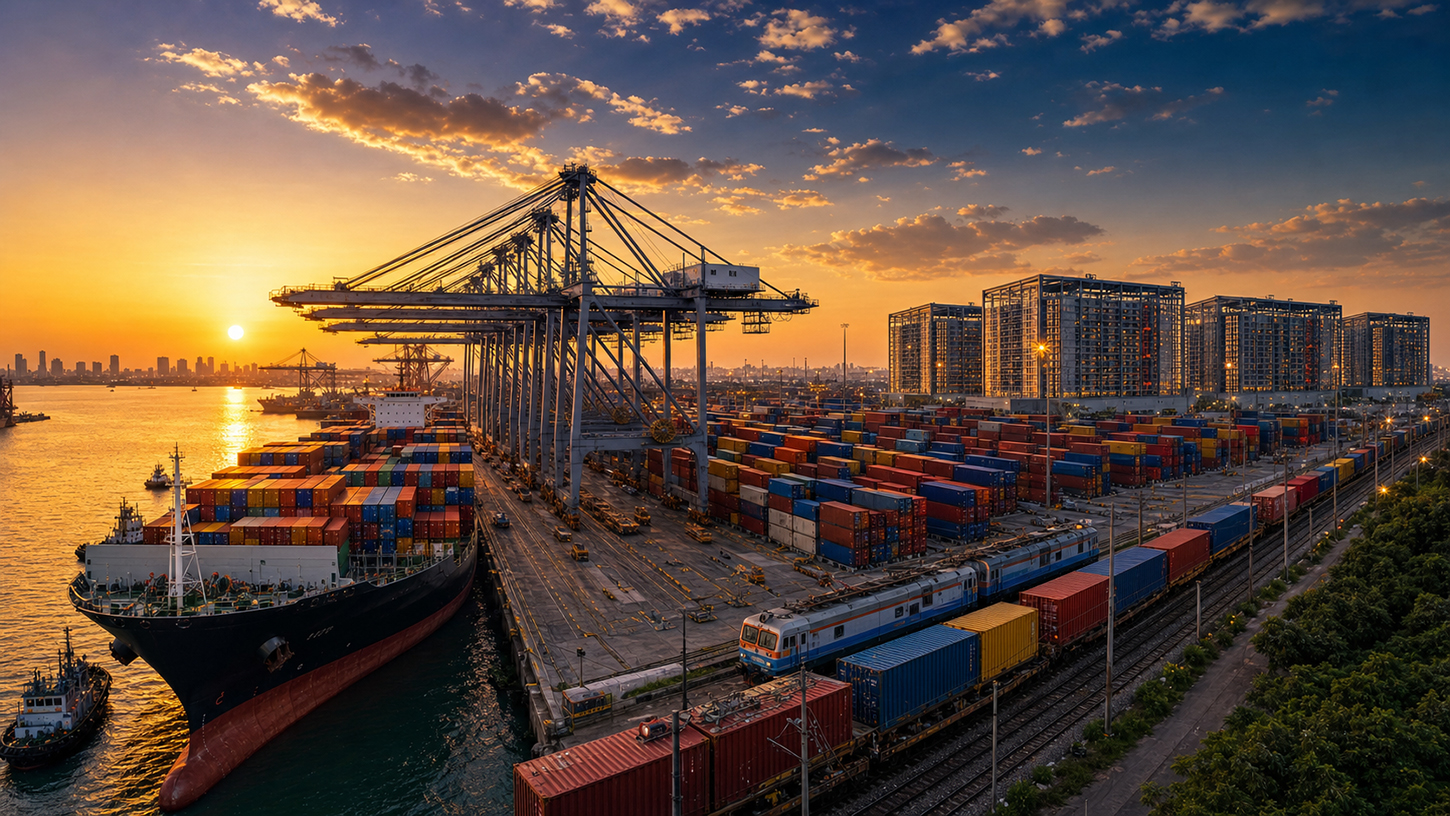
Container logistics, high-bay warehouses & mega-corridors: This is how India is preparing for the global trade of the future – Creative image: Xpert.Digital
New Silk Road competition? How the IMEC corridor is reconnecting Asia and Europe
India vs. China: Can this gigantic mega-port revolutionize global sea freight?
From road to water: India's master plan for a new logistics superpower
India has an ambitious goal: By 2030, the world's most populous country aims to become the world's third-largest economy. However, on its path to becoming a global economic powerhouse, the subcontinent faces a massive, self-inflicted obstacle – its own infrastructure. While global competitors like China dominate world trade with highly efficient mega-ports and seamless supply chains, India's economy is still hampered by structural supply bottlenecks, chronic road congestion, and neglected inland waterways. Particularly in isolated regions like the northeast, logistics has become a matter of economic survival. But the country is changing course: With unprecedented investments of billions in new deep-sea ports, gigantic dedicated freight corridors, state-of-the-art high-bay warehouses, and strategic integration into the new IMEC economic corridor, New Delhi is initiating an unprecedented paradigm shift. This article takes an in-depth look at where India stands today in the global container competition, what enormous potential lies in a trimodal infrastructure, and why the next few years will determine whether India's rise succeeds or gets stuck in a logistics gridlock.
Between a spirit of optimism and structural weakness: Why India must make the logistics leap now or never
India is at a logistical crossroads. The world's most populous country, with an economy projected to become the third largest by 2030, currently possesses a container infrastructure that falls far short of its ambitions. India's largest state-owned port, the Jawaharlal Nehru Port Authority (JNPA) near Mumbai, handled a record 7.3 million TEU in fiscal year 2024/25 – a 13.55 percent increase over the previous year. By comparison, the Port of Shanghai alone handled more than 51.5 million TEU in 2024, surpassing the symbolically significant 50 million TEU mark for the first time in its history. Even when all Indian ports are combined, the country's total container volume falls short of that of a single leading Chinese port. This discrepancy is not just a question of development level – it is the central competitive disadvantage of a nation that wants to rise to the global first league in industrial and trade policy.
Where India stands today: The gap with China, the USA and Europe
The global container hierarchy
Global ports reflect the distribution of economic power with remarkable accuracy. In 2024, the world's 20 largest container ports achieved a combined throughput of 414.6 million TEU, an increase of 7.1 percent compared to the previous year. Asian ports dominated the ranking with 14 ports among the top 20, and Chinese ports occupied four of the top five spots.
China is the undisputed superpower of container logistics. From January to October 2024, Chinese ports handled a total of 276.4 million TEU, a year-on-year increase of 7.6 percent. Shanghai leads the global ranking, followed by Ningbo-Zhoushan with almost 40 million TEU, Shenzhen, and Qingdao. This concentration of handling capacity is not solely due to geographical advantages, but also to decades of targeted infrastructure investment, industrial policy coordination, and the development of highly efficient hinterland logistics corridors.
The US exhibits a different pattern: decentralized across both coasts and geared towards international goods imports. The Port of Los Angeles handled approximately 10 million TEU in 2024, recording almost 20 percent growth compared to the previous year. In total, 110 US ports handled over 45 million loaded TEU annually. The American system is more strongly designed for integration with rail freight and inland waterways, but suffers structurally from an uneven distribution of freight flows between the Atlantic and Pacific coasts, as well as from dockworker strikes and bottlenecks in hinterland connections.
Europe's strength lies in its interconnectedness and the extensive use of its inland waterways. Ports like Rotterdam, Antwerp, and Hamburg act as interfaces between maritime transport, rail, and the dense European inland waterway network. The share of inland waterways in freight transport is around 7 percent in Europe, 8.7 percent in China, and approximately 8 percent in the USA. India, on the other hand, historically kept the share of inland waterways in freight transport below 0.5 percent – a structurally significant underrepresentation that systematically drove up logistics costs.
India's Catch-Up Potential and the Costs of Backwardness
For a long time, India's logistics costs were considered one of the biggest barriers to the economy's competitiveness. For years, estimates circulated that they amounted to 13 to 14 percent of GDP – a figure that made India significantly more expensive than comparable industrialized nations. A reassessment by the National Council of Applied Economic Research (NCAER), commissioned by the Department for Promotion of Industry and Internal Trade (DPIIT), yielded an official figure of 7.97 percent of GDP for the 2023/24 fiscal year, equivalent to approximately 24.01 trillion rupees. This decline is politically significant: it shows that the reforms of recent years are taking effect. At the same time, the gap with the most efficient economies remains. The US, Japan, and South Korea operate at 8 to 9 percent of GDP, while European economies are at 7 to 8 percent. India has closed the gap but has not yet completely closed the gap, and the official figures are based on a methodological reassessment that further complicates international comparisons.
The cost structure by mode of transport is particularly revealing: coastal shipping is the cheapest option at 1.80 rupees per ton and kilometer, followed by rail at 1.96 rupees. Road transport costs 3.78 rupees, and air freight 72 rupees – almost 40 times more expensive than waterway transport. Nevertheless, around 71 percent of Indian freight is transported by road, while rail accounts for only 18 percent and inland waterways a mere 2 percent. This extreme modal split distortion is the root cause of the structural inefficiency.
The port as a bottleneck: Why India's maritime infrastructure is reaching its capacity limits
The JNPA syndrome and private competition
The JNPA near Mumbai is the heart of India's container export and import operations. In fiscal year 2024/25, the authority processed a record 7.3 million TEU, a growth of 13.55 percent. The strongest contributions to this growth came from the BMCT, APMT, and NSFT terminals, all of which reported record figures. Rail freight traffic at the JNPA reached 1,078,315 TEU, the highest figure ever recorded.
In addition, the privately owned Mundra port, operated by the Adani Group, has become the strongest single player. It handles 7 to 8 million containers per year, putting it on par with the state-owned flagship port. This parallel structure of state and private operators creates competition but also leads to coordination problems when integrating into national logistics networks.
India's major ports handled approximately 855 million tons of goods in fiscal year 2024/25, an increase of 4.3 percent compared to the previous year's 819 million tons. Containerized cargo accounted for 193.5 million tons, or 22.6 percent of the total volume. The containerization rate – the proportion of standardized container loads in the total freight volume – remains significantly below the level of developed economies, indicating considerable growth potential.
India's container export volume grew by approximately 5.45 percent in 2024, from 6.08 to 6.41 million TEU, while imports increased by 6.58 percent, from 6.05 to 6.45 million TEU. These are solid growth figures, but given India's economic dynamism, the absolute scale remains modest.
Two ports as transformation catalysts
The Vizhinjam deep-water port in Kerala, commissioned in 2024, marks a strategic turning point for Indian container shipping: For the first time, India can directly call at motherships without having to use foreign transshipment ports like Colombo or Singapore. Operated by Adani Ports and Logistics, Vizhinjam offers 800 meters of quay length, capable of accommodating two large container ships simultaneously, with an initial capacity of one million TEU. After completion of all construction phases by 2028, capacity is expected to increase significantly. Its strategic location near the Strait of Malacca makes Vizhinjam potentially the most important transshipment hub in South Asia.
Even more ambitious is the planned Vadhavan Port north of Mumbai. The Indian Cabinet approved the project in June 2024 with a total investment volume of 762.2 billion rupees (approximately US$9.1 billion). The port, being built as an artificial island in the Arabian Sea, will be able to accommodate ultra-large container ships of up to 233,000 DWT and is projected to reach an annual container capacity of 23.2 million TEU. With nine container terminals, each 1,000 meters long, and direct connections to the national rail network and the Dedicated Freight Corridor, Vadhavan will not only eliminate the bottleneck in port capacity but also, for the first time, elevate India to the level of major Asian container hubs. The port is designed as an integral part of the India-Middle East-Europe Economic Corridor (IMEC).
The Maritime Amrit Kaal Vision 2047
The Indian government has established a strategic framework with its “Maritime Ports Vision 2047,” clearly outlining its ambitions: By 2047, ports are to be able to handle approximately 10 billion tons of cargo annually – compared to today's estimated capacity of 2.8 billion tons. In August 2025, the new “Indian Ports Bill 2025” was passed, replacing the “Indian Ports Act” from 1908 and aiming to improve coordination between the central government and the states through a new Maritime State Development Council. The Sagarmala Programme, the backbone of port development since 2015 with 839 identified projects, will be further developed as an operational implementation platform.
The interior of the country as a blind spot: Regional supply shortages in India
The Northeast: Geography as Destiny and Opportunity
No region of India illustrates the logistical supply problems more drastically than the Northeast. Despite considerable natural resources, the eight states of Arunachal Pradesh, Assam, Manipur, Meghalaya, Mizoram, Nagaland, Sikkim, and Tripura contribute only about 3 percent to the national GDP. The geographical situation is doubly unfavorable: the narrow Siliguri Corridor – often called the “Chicken’s Neck” – is the only land connection between the Northeast and the Indian mainland, only about 20 kilometers wide at its narrowest point. At the same time, adequate rail connections, waterway infrastructure, and especially container terminals are lacking.
The structural problem in the Northeast is a chronic asymmetry between high inbound and low outbound freight volumes. Because return freight is scarce for carriers, trucks and trains return empty or lightly loaded, systematically increasing the cost per unit on the outbound journey. For businesses and consumers, this translates into significantly higher prices for imported goods than in the rest of India. At the same time, local products—tea, textiles, agricultural produce, and potential industrial goods—remain largely uncompetitive internationally.
The infrastructure gaps are clearly identifiable: many states lack a rail network or have only rudimentary connections, cold chain infrastructure is missing, storage capacities are insufficient, roads are vulnerable to climate change, and large parts of the region completely lack container terminals. Mizoram only recently received its first passenger train in the history of independent India, and Manipur and Nagaland only recently gained rail connections.
On the reform front, there are at least some initial substantial steps: In the 2024 LEADS report, Tripura was classified as a “Fast Mover,” Assam and Arunachal Pradesh as “Achievers,” while Manipur was categorized as an “Aspirer” with untapped potential. In March 2024, India officially approved the Northeast Multimodal Connectivity Plan (NMCP), which aims to connect Assam, Arunachal Pradesh, Manipur, Mizoram, and Tripura directly to the rest of India and Southeast Asia – without transit routes through Bangladesh. The flagship project is the Jogighopa Multimodal Logistics Park in Assam, which, with an investment of 693.97 crore rupees, integrates waterways, roads, railways, and air routes under one roof.
Central India: Vast economic corridors without deep-sea access
Central India – the states of Madhya Pradesh, Chhattisgarh, Jharkhand, and parts of Rajasthan and Odisha – is home to the country's largest reserves of natural resources, including coal, iron ore, steel, and aluminum. At the same time, this region lacks direct access to the sea and thus to competitive container shipping routes. Freight transport is predominantly by road, which keeps logistics costs among the highest in India. Small and medium-sized enterprises (SMEs) suffer particularly: the NCAER report put the logistics costs for small firms at 16.9 percent of their turnover, compared to 7.6 percent for large companies – a serious distortion of competition favoring economies of scale.
A positive development is the Nagpur MMLP (Multi Modal Logistics Park), which commenced operations in early 2025 under the PM GatiShakti program. Nagpur is geographically the hub of India, and an efficient multimodal hub here could significantly reduce truck-based hinterland traffic. Its connection to the Dedicated Freight Corridor and the ports of Mumbai creates, for the first time, an integrated alternative to pure road transport.
Northern India and the Delhi-Mumbai Corridor
The core industrial regions of northern India – the capital region of Delhi, the manufacturing centers in Punjab, Haryana, and Uttar Pradesh, and the automotive clusters in Gurgaon and Noida – have traditionally relied on road transport to the ports of Mumbai and Mundra in the west, and to the ports of Kolkata and Chennai in the east and south. These major industrial pressure points manifest themselves in transit times of three to five days for truck transport from Delhi to Mumbai and in heavily congested national highways.
The Dedicated Freight Corridors (DFCs) address precisely this core problem. The Western DFC connects Dadri near Delhi with the JNPA in Mumbai, while the Eastern DFC connects Ludhiana with Dankuni in West Bengal. In fiscal year 2025, an average of 403 trains per day ran on the DFC corridors, compared to 241 the previous year – an increase of 67 percent in a single year. A single DFC freight train can carry the load of 300 to 400 trucks, significantly reducing road congestion and lowering logistics costs. The DFC infrastructure supports double-decker containers, longer freight trains, and heavier axle loads, thus positioning India on par with advanced railway nations.
South India and the Digital Economic Zone
South India – Karnataka, Tamil Nadu, Andhra Pradesh, and Telangana – is the most dynamic growth region in Indian container logistics. Bengaluru, Hyderabad, and Chennai are the anchors of technology exports, the pharmaceutical industry, and textile manufacturing. The ports of Chennai and Ennore (Kamajar Port) handle significant container volumes, including exports of automobiles, electronics, and pharmaceutical ingredients. Logistics park infrastructure is comparatively well-developed in South India, with automation installations in Sriperumbudur and growing high-bay warehouse clusters around the ports.
Your container high-bay warehouse and container terminal experts

Container high-bay warehouses and container terminals: The logistical interplay – expert advice and solutions - Creative image: Xpert.Digital
This innovative technology promises to fundamentally change container logistics. Instead of stacking containers horizontally as before, they will be stored vertically in multi-story steel racking structures. This not only allows for a drastic increase in storage capacity within the same area, but also revolutionizes all processes at the container terminal.
More information here:
Intermodal to intelligent: Why European technology can close India's logistics gap
The Dedicated Freight Corridor: Backbone of a new systems thinking
More than just rails: A paradigm shift in freight culture
The Dedicated Freight Corridors (DFCs) are the most ambitious railway project in the history of independent India. With World Bank support (first phase: US$975 million), the Eastern and Western DFCs have been nearly completed. Their transformative impact extends far beyond mere capacity. By handling 90 percent of parallel freight traffic on conventional lines, the EDFC relieves the congested rail network on the Delhi-Howrah and Delhi-Mumbai lines, which, prior to the DFCs' introduction, operated at 115 to 150 percent of their capacity. This creates, for the first time, reliable time slots for high-speed freight trains and predictable hinterland logistics.
The economic logic is compelling: The Western DFC is expected to reduce transit time between Delhi and the ports in Gujarat by 40 to 50 percent. For sectors like automotive, electronics, pharmaceuticals, and e-commerce, which rely on just-in-time supply chains, this predictability is of strategic importance. At the same time, there are substantial limitations: The DFCs are primarily designed for bulk goods such as coal, steel, and fertilizers, and the container share of the DFC volume still has room for improvement. Integration into multimodal logistics parks at the endpoints—that is, the “last mile” between the railway station and the port or factory—remains the greatest technological and organizational challenge.
Trimodal logistics: Finally taking the potential of inland waterways seriously
A slumbering giant awakens
India's inland waterway network spans a total length of 14,500 kilometers, of which approximately 5,200 kilometers are rivers and 4,000 kilometers are canals suitable for freight transport. This is a network of continental dimensions – yet it carries only 2 percent of the national freight volume. By comparison, in Europe it's 7 percent, and in the USA and China over 8 percent. The economic irrationality is evident: waterway transport in India costs only about 50 paise per ton-kilometer, compared to 1 rupee by rail and 1.50 rupees by road. It is thus by far the cheapest mode of transport – and the least used.
The 2024/25 fiscal year marked a turning point: the volume of goods transported via national waterways increased to more than 145.53 million tons, compared to 18.1 million tons in the 2013/14 fiscal year – an eightfold increase in a decade. This is impressive, but still far from realizing its full potential. The first multimodal terminal on the Ganges River in Varanasi, opened in 2018, symbolically marked the beginning of a new era in river container logistics. The Haldia-Varanasi section of National Waterway 1 now enables direct container transport from eastern Indian ports to the hinterland.
In the northeast, the Brahmaputra (National Waterway 2) and Barak (National Waterway 16) rivers are already in year-round operation for freight transport, with terminals in Pandu, Dhubri, Jogighopa, Karimganj, and Badarpur. These terminals are currently particularly important for bulk goods such as crude oil, cement, and heavy industrial equipment. The crucial next step would be the systematic expansion to include standardized container loads.
Trimodality as a system response: port, rail, waterway
Trimodal logistics – the seamless integration of seaports, rail, and inland waterways – is no longer an innovation in developed economies, but rather operational standard practice. In Europe, for example, containers are regularly unloaded from ocean-going vessels in ports like Rotterdam or Antwerp, transferred to inland waterway vessels, and transported upstream to the hinterland, where they are loaded onto rail or trucks. This systems approach is still largely lacking in India, but its necessity is increasingly recognized.
The Multi-Modal Logistics Park (MMLP) model, promoted under PM GatiShakti, is the institutional approach to implementing trimodal logistics chains. More than 35 such parks are planned, bundling rail, road, and waterway connections under a single infrastructure umbrella, complemented by customs clearance, transshipment terminals, and warehousing. Specific examples include Mundra (Gujarat, integrating port, rail, and road), Jogighopa (Assam, linking river and rail for the Northeast), and Nagpur (Central India as an intermodal hub). The MMLP planned for Nashik in Maharashtra, with an investment volume of 850 crore rupees, is designed to complement the JNPT and relieve urban freight traffic in the Mumbai metropolitan area.
The Kaladan multimodal transit route – which connects Kolkata by sea with the port of Sittwe in Myanmar and from there to Mizoram by river and road – exemplifies how trimodal logistics can overcome geopolitical isolation. Once this route becomes fully operational, the northeastern states will gain competitive access to maritime trade for the first time.
High-bay warehouses as an urban logistics solution: Vertical density instead of horizontal urban sprawl
The changing warehousing practices in India
The Indian warehousing landscape is undergoing a profound structural transformation. The introduction of the nationwide Goods and Services Tax (GST) in 2017 eliminated the historically established state-border-based warehouses that companies had operated across the country for tax reasons. As a result, the average warehouse space per site increased from 50,000 square feet in 2023 to over 200,000 square feet by 2025, significantly improving the economic basis for high-bay racking systems and automated warehouse technology.
The Indian warehouse automation market had a volume of US$822.4 million in 2025 and is projected to grow to US$2.836 billion by 2034, representing an average annual growth rate of 14.75 percent. This growth is driven by the explosive expansion of the e-commerce sector, which is expected to exceed US$200 billion by 2026, as well as the demands of the pharmaceutical, automotive, and electronics industries.
A prime example is the delivery in February 2026 by Godrej Enterprises Group of the first 120-foot automated clad-rack high-bay warehouse to a leading Indian pharmaceutical company. This silo-style high-bay warehouse, with a footprint of 11,490 square feet and 6,316 pallet positions at a height of over 36 meters, demonstrates that the technological prerequisites for high-bay logistics exist in India. In Dahej (Gujarat), clad-rack projects have already reached heights of 40 meters.
The market for industrial racking systems in India was valued at US$593.8 million in 2024, with significant growth potential driven by the e-commerce boom and the government's Production Linked Incentive (PLI) programs. Western and southern states account for over 60 percent of warehouse automation installations. Maharashtra benefits from Mumbai's port and Pune's automotive corridor, Gujarat from petrochemical and emerging battery clusters, and Karnataka from Bengaluru's technological expertise.
High-bay warehouse combined with intermodal transport
The systemic added value of high-bay warehouses only unfolds fully when they are designed as an integrated component of intermodal logistics clusters. Located near a container port or DFC terminal, a high-bay warehouse enables the direct transfer of container loads from rail transport, fully automated storage according to product, destination, and urgency, and demand-driven retrieval for the last mile. This is the operating principle of the mega-distribution centers that are now standard in Europe and the USA.
For India, the combination of DFC connectivity, MMLP infrastructure, and an automated high-bay warehouse represents a significant leap in logistics efficiency. McKinsey analyses show that AI-powered warehouse automation can reduce warehousing costs by up to 35 percent and increase throughput by over 40 percent. Falcon Autotech reported in 2025, based on real-world data from Indian operations, that its goods-to-person system handles up to 650 units per station per hour.
The market is already reacting: In Bhiwandi (Maharashtra) and Sriperumbudur (Tamil Nadu), two of India's most important logistics clusters, brownfield facilities have deployed automated high-bay racking systems to quadruple pallet density on existing footprints. The solution to the urban land shortage – land near major economic centers is extremely expensive – lies in vertical expansion: Instead of growing horizontally, warehouses are growing vertically.
The geopolitical context: IMEC as a strategic realignment of container trade routes
The India-Middle East-Europe Economic Corridor
At the G20 summit in September 2023, the India-Middle East-Europe Economic Corridor (IMEC) was announced, supported by the EU, Germany, France, Italy, the UAE, Saudi Arabia, India, and the USA. IMEC is designed as a multimodal network integrating rail and port connections from India through the UAE, Saudi Arabia, Jordan, and Israel to Europe. Initial estimates suggest that the land transport route could reduce transit times by 30 to 40 percent and significantly lower logistics costs compared to the Suez Canal route. More extensive research estimates the potential time savings at over 50 percent.
For India, IMEC is a strategic priority: it diversifies trade routes away from dependence on Chinese-controlled supply chains and creates new direct connections to Europe. Vadhavan Port is designed as a strategic anchor point for the Indian section of IMEC. IMEC could generate over 2 million jobs in India by 2030 in the logistics, infrastructure, IT, and construction sectors.
The geopolitical dimension should not be underestimated. The Red Sea crisis of 2023/24, which led to a massive rerouting of freight routes around the Cape of Good Hope due to Houthi attacks on merchant ships, painfully demonstrated the vulnerability of Suez-dependent supply chains. Freight costs from India to Europe rose sharply at times, with spot prices on the Northern Europe route reaching US$1,380 per TEU in 2025, 11 percent higher than the previous year. IMEC and the parallel strengthening of deep-sea port capacities in Vizhinjam and Vadhavan represent India's structural response to this volatility.
Where expansion is most urgent and efficient
Priority Level 1: High-urgency regions with the greatest impact
Northeast India has the largest unmet logistics needs in the country. Here, the only viable system solution is the use of trimodal infrastructure – river (Brahmaputra, Barak), rail (expansion of the DFC feeder lines), and road (new highways under the Bharatmala) – combined with the construction of automated transshipment terminals with cold chain capabilities and moderate high-bay racking capacities. Jogighopa is the nucleus of this system, which must be systematically developed. The Tata Semiconductor Assembly in Assam, which handled its river logistics via the Brahmaputra in 2025, is proof of the industrial feasibility of this approach.
Central India – the resource-rich regions around Chhattisgarh, Jharkhand, and Odisha – urgently needs the completion of the DFC feeder corridors and the development of multimodal logistics parks to connect the region's bulk exports to the ports of Paradip and Vizag. The combination of rail and inland waterways (Mahanadi, Brahmani) could significantly reduce transport costs for coal and ore.
Priority level 2: Highly efficient expansion areas along existing corridors
The Delhi-Mumbai Corridor, which already has a rail infrastructure through the Western DFC, is the priority location for automated high-bay warehouses on a scale comparable to European standards. The Dadri, Rewari, Palanpur, and Vadodara hubs are suitable for large intermodal terminal facilities that transfer container traffic directly from the port to fully automated warehouses.
For the Eastern DFC, the Khurja, Kanpur, and Dankuni hubs should be developed as locations for high-bay and deep-freeze logistics centers, particularly with regard to agricultural exports from the Ganges Basin. The integration of an inland waterway connection (Yamuna, Ganges) into these terminals would complete the system triangle.
In the South Indian cluster, Chennai and the Ennore port should be strengthened as transshipment hubs with direct MMLP connections. The Bengaluru MMLP is the strategic link between South India's technology exports and its seaports.
Priority level 3: Long-term transformation corridors
The Great Nicobar Island Port Initiative – a strategically planned container port near the Strait of Malacca in the Andaman Islands – is the most ambitious long-term component of India's transshipment architecture. Combined with Vizhinjam, India could become a serious competitor to Colombo and Singapore as a regional container hub.
Structural change with considerable catching up to do
India's container logistics sector is undergoing a historic transformation. Its fundamental weaknesses – an extreme modal split favoring road transport, inefficient and capacity-limited ports, a lack of multimodal integration, and geographically isolated regions with dramatic supply shortages – have been documented for years and are now being addressed with an unprecedented investment program. The investments in Vadhavan, Vizhinjam, the Dedicated Freight Corridors, the PM-GatiShakti program, and the Multi Modal Logistics Parks are not cosmetic reforms, but rather structural rebuilds.
Nevertheless, the gap with China and Western standards remains considerable. Shanghai alone handles seven times more containers annually than all Indian ports combined. The goal of the Maritime Amrit Kaal Vision 2047 – a tenfold increase in port capacity by the centenary of independence – is not utopian, but it requires a consistency in political implementation that India has so far only demonstrated to a limited extent. The combination of state infrastructure, private operation, digital platform integration (Unified Logistics Interface Platform, PM-GatiShakti Portal), and the development of previously unused inland waterways is the only viable way to overcome the logistical disparity between the prosperous coastal regions and the neglected hinterland – especially the northeast.
High-bay warehouses are not an end in themselves within this systemic context, but rather the logistical link between rapid intermodal transshipment at ports and DFC terminals and demand-driven distribution to the growing urban and semi-urban consumer markets. If India succeeds in linking trimodal logistics – seaport, rail, waterway – with fully automated high-bay warehouses at key hubs, a systemic network will emerge that will not only permanently reduce logistics costs to the level of developed economies, but also revitalize regional economic development across the entire subcontinent. The alternative is a continuation of structural underperformance – and thus the greatest economic risk India faces on its path to becoming the world's third-largest economy.
Consulting - Planning - Implementation

Konrad Wolfenstein
I would be happy to serve as your personal advisor.
me at wolfenstein∂xpert.digital contact
Just call me on +49 7348 4088 965 .
Our global industry and economic expertise in business development, sales and marketing

Our global industry and economic expertise in business development, sales and marketing - Image: Xpert.Digital
Industry focus areas: B2B, digitalization (from AI to XR), mechanical engineering, logistics, renewable energies and industry
More information here:
A thematic hub offering insights and expertise:
- Knowledge platform covering global and regional economies, innovation and industry-specific trends
- A collection of analyses, insights, and background information from our key areas of focus
- A place for expertise and information on current developments in business and technology
- A hub for companies seeking information on markets, digitalization, and industry innovations
Your container high-bay warehouse and container terminal experts

Container terminal systems for road, rail and sea transport in the dual-use logistics concept of heavy-lift logistics - Creative image: Xpert.Digital
In a world marked by geopolitical upheavals, fragile supply chains, and a new awareness of the vulnerability of critical infrastructure, the concept of national security is undergoing a fundamental reassessment. A state's ability to guarantee its economic prosperity, the provision of essential goods and services to its population, and its military capability increasingly depends on the resilience of its logistical networks. In this context, the concept of "dual-use" is evolving from a niche category of export control to a broader strategic doctrine. This shift is not merely a technical adjustment but a necessary response to the "paradigm shift" that demands a profound integration of civilian and military capabilities.
Related to this:










