

Escape to Bulgaria: The only way out for affordable cars? Why Germany has abandoned the habit of buying cheap new cars
Xpert Pre-Release

Available in 27 languages 📢
Prefer Xpert.Digital on GoogleⓘPublished on: August 22, 2026 / Updated on: August 22, 2026 – Author: Konrad Wolfenstein
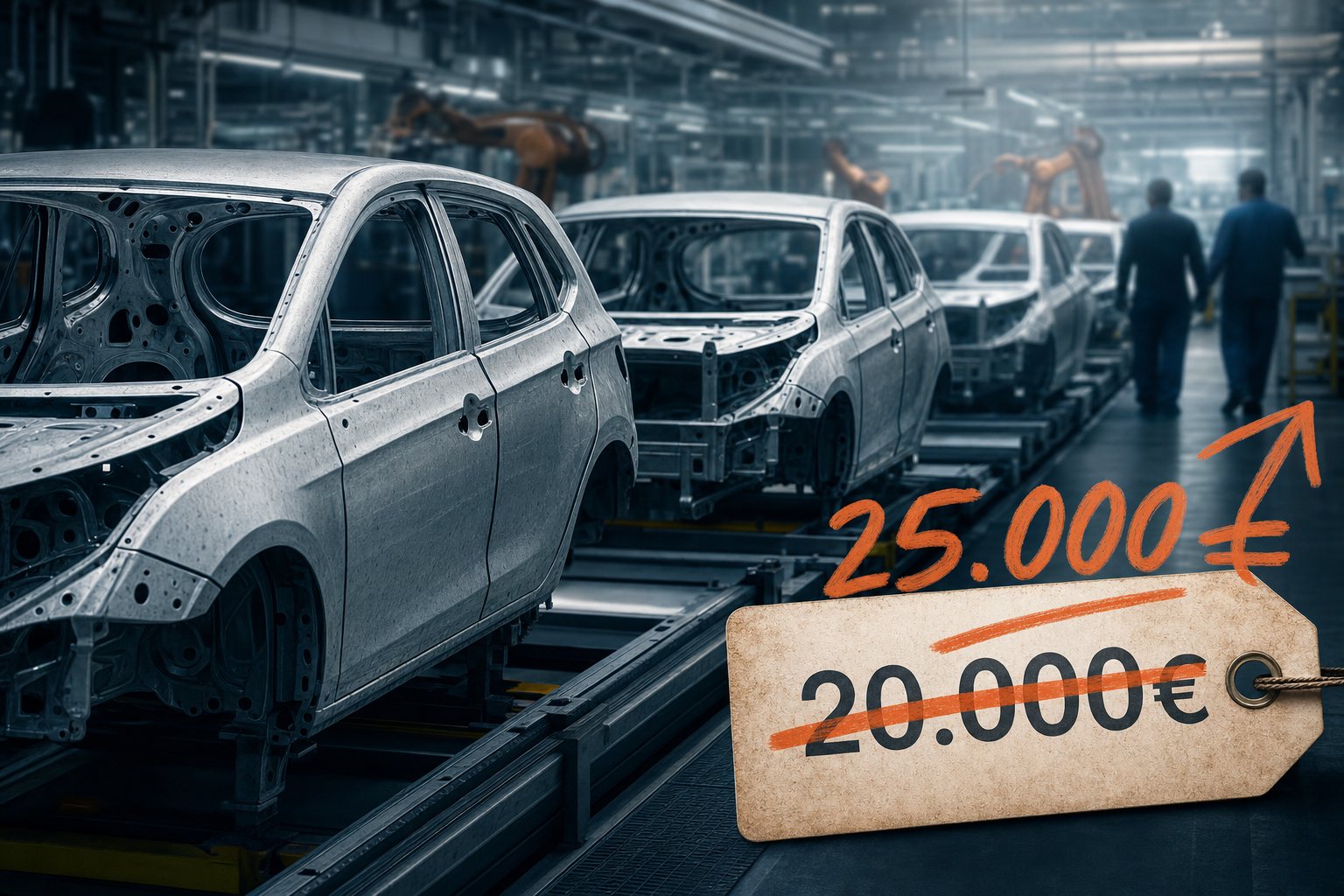
Escape to Bulgaria: The only way out for affordable cars? Why Germany has abandoned the idea of cheap new cars – Image: Xpert.Digital
140,000 jobs at risk? What Toyota is currently doing much better than VW
No VW under €20,000: Why German new cars are becoming unaffordable
How VW plans to save the affordable small car
Anyone looking for a new car for under €20,000 today will find nothing among German manufacturers. High energy costs, strict safety regulations, and often cumbersome corporate structures have effectively eradicated the affordable entry-level car from domestic production. While international competitors like Dacia, Citroën, and emerging Chinese brands effortlessly fill this gap, a look at more efficient rivals like Toyota reveals the profound structural problems of German automakers like Volkswagen. But is the affordable new car truly a thing of the past? A detailed analysis of the current market situation will reveal whether a shift in production to low-tax European countries like Bulgaria or the electric microcar "ID. EVERY1," announced for 2027, can still turn things around—or whether Germany has finally given up on affordable new cars altogether.
When thrift becomes a foreign word
Anyone looking for a brand-new car in Germany for less than €20,000 today is out of luck, and those who also insist on a car bearing the emblem from Wolfsburg, Ingolstadt, or Rüsselsheim are completely out of luck. A recent analysis by the ADAC (German Automobile Club) from August 2026 shows that there are only 16 new car models from established brands on the German market whose list price falls below this psychologically important threshold. By comparison, in 2021 there were 35 models, more than twice as many. Among the remaining 16 vehicles, there isn't a single one from a German manufacturer, and remarkably, none from Japan either. By far the cheapest car is the Romanian Dacia Sandero TCe 100 Essential at €13,590, followed by the Citroën C3 Turbo 100 You at €16,290 and the Fiat Pandina 1.0 GSE Hybrid Pop at €16,490. For the first time this year, three fully electric models have appeared for under the €20,000 mark, including the Dacia Spring Electric 70 Essential for €16,900, the Chinese Leapmotor T03 for €18,900, and the Renault Twingo E-Tech Electric for €19,990. The cheapest German car of all, the VW Polo, costs €20,380 in its base version, just missing the mark, but still just missing it. The change is even more drastic when looking at the lower end of the price spectrum: five years ago, there were three vehicles available for around €10,000; today, not a single car is available in this price range. The entry point into the German new car market has thus shifted upwards by approximately €3,600.
The expensive legacy of German location costs
The reasons for this decline lie deep within the cost structure of Germany as a production location. High labor, personnel, and energy costs have made the production of mass-market models increasingly unattractive in Germany, as such fixed costs have a particularly strong impact on small cars with their already tight margins. The German Association of the Automotive Industry (VDA) regularly points to this structural disadvantage and simultaneously calls for political reforms, arguing that Germany is suffering an increasing price disadvantage in global competition, primarily due to high energy, labor, tax, and bureaucratic costs. The figures impressively underscore this complaint. In the second half of 2025, German industry paid around 22.64 cents per kilowatt-hour of electricity in the medium consumption class, the third highest figure in the entire European Union and about 23 percent above the EU average. For comparison: In Finland, industrial electricity cost only 7.48 cents, and in Sweden 9.70 cents, roughly a third of the German level, because both countries rely heavily on nuclear and hydropower without the burden of taxes and levies typical in Germany. More than half of the German electricity price now goes not towards energy production itself, but towards taxes, levies, and grid fees. German industrial companies pay the highest grid fees in all of Europe, almost twice the EU average. The discrepancy is even more drastic for natural gas. German industrial companies pay about five times what companies in the USA, Canada, or Mexico have to pay – a structural disadvantage that, according to studies, will be difficult to eliminate in the foreseeable future.
The invisible price of security and software
Regulation is the second major cost driver that significantly impacts the price of a small car. New vehicles today must be equipped as standard with a multitude of driver assistance and safety systems, ranging from emergency braking assistants and lane keeping systems to drowsiness detection, all of which incur development, electronics, and software costs. These requirements apply regardless of the vehicle's price and, relatively speaking, hit a small car costing €15,000 considerably harder than a luxury sedan costing €80,000, because the fixed development costs cannot be proportionally passed on to the sales price. Furthermore, this development work is largely carried out by engineers and software specialists at expensive German locations, meaning that the high labor and personnel costs are reflected in the price calculation a second time, this time not on the factory floor, but in the development center. From a business perspective, this creates an understandable, albeit inconvenient, incentive for automotive companies to concentrate on higher-margin and more expensive models. SUVs and mid-size sedans simply generate significantly higher profits than subcompact cars, whose profit margins are already reduced by safety and regulatory requirements. In a period of declining profits and multi-billion-dollar cost-cutting programs, manufacturers are consistently optimizing their portfolios for higher margins rather than increasing sales volume in the lowest price segment.
Toyota as an uncomfortable mirror for Wolfsburg
A look at the competition from Japan reveals that high location costs alone don't tell the whole story, as efficiency and personnel structure play at least as important a role. Current figures from 2025 show that Volkswagen employs around 628,893 people and sells approximately nine million vehicles, while Toyota, with only 383,853 employees—just over 60 percent of VW's workforce—sells 11.3 million vehicles—significantly more than its German rival. Converted to productivity per capita, Volkswagen produces roughly 13 to 14 vehicles per employee per year, while Toyota produces about 23 to 28 vehicles, more than double. This discrepancy cannot be explained solely by differing wage levels, but points to profound differences in production systems, standardization, and decision-making structures. The Toyota Production System has been considered a benchmark for lean, waste-free manufacturing for decades, while Volkswagen traditionally operates with a more complex brand architecture, greater vertical integration, and a more co-determined, politically intertwined corporate structure. In this structure, the state of Lower Saxony, as a shareholder, and the unions, through the supervisory board, exert considerable influence on strategic decisions such as plant closures or staff reductions. When a corporation employs nearly twice as many people per vehicle produced as its Japanese competitor, it's reasonable to assume that a significant portion of the cost burden is self-inflicted and cannot be explained solely by external location factors such as energy prices. Volkswagen itself has now announced plans to cut up to 140,000 jobs, a move that implicitly acknowledges the structural overcapacity in its workforce, even though a reduction to 530,000 employees would still leave Volkswagen significantly above Toyota's level of around 384,000.
Related to this:

Our EU and German expertise in business development, sales and marketing

Our EU and German expertise in business development, sales and marketing - Image: Xpert.Digital
Industry focus areas: B2B, digitalization (from AI to XR), mechanical engineering, logistics, renewable energies and industry
More information here:
A thematic hub offering insights and expertise:
- Knowledge platform covering global and regional economies, innovation and industry-specific trends
- A collection of analyses, insights, and background information from our key areas of focus
- A place for expertise and information on current developments in business and technology
- A hub for companies seeking information on markets, digitalization, and industry innovations
Bulgaria as a solution to the margin crisis for affordable vehicles?
Bulgaria as a tax-efficient manufacturing option
If a small car priced at €15,000 is truly economically viable, there is little alternative to relocating production to a low-cost country, and Bulgaria deserves particular attention. With a flat corporate tax rate of 10 percent, the country boasts the lowest corporate tax rate in the entire European Union, significantly below the German rate of approximately 29.8 percent, the French rate of 25 percent, or the Austrian rate of 24 percent. For car manufacturers with already slim margins in the small car segment, this difference is not a cosmetic detail, but a factor that directly impacts the bottom line across the entire value chain. Added to this are a flat personal income tax rate of 10 percent, a complete exemption from dividend tax for entrepreneurs, and increased depreciation rates of up to 50 percent for investments in new machinery and equipment, making investments in production capacity even more attractive from a tax perspective. As a full EU member since 2007, Bulgaria is not subject to any tariffs or import quotas within the single market, which significantly simplifies the transport of components and finished vehicles to and from the EU compared to manufacturing outside the EU. The automotive industry is no longer a theoretical option in Bulgaria, but a lived reality: companies like Kostal Automotive and Witte Automotive already produce electronic and mechatronic components for the automotive industry there, and around 80 percent of the automotive sensors installed in Europe now come from Bulgarian production. The state-owned company National Company Industrial Zones already operates modern industrial parks in eight cities, including the Trakia Economic Zone in Plovdiv, which has attracted investments of around €3 billion to date, including from Liebherr and Osram. For investors from outside the EU, Bulgaria's Investment Promotion Law also applies, offering tiered incentives depending on the investment amount and the number of jobs promised, with the automotive industry explicitly listed among the preferred target sectors. In Bulgaria, the period from site selection to production readiness is often less than twelve months, a speed rarely achieved in other Central or Eastern European countries. From a purely tax and cost perspective, Bulgaria is therefore one of the most compelling options within the EU for making a low-margin entry-level model economically viable without sacrificing the legal and logistical security of the European single market.
The shrinking of an entire market segment
Volkswagen regularly argues that its withdrawal from the sub-€20,000 price segment is not a development specific to Germany or VW, but rather reflects a pan-European market trend, pointing to the fact that the microcar segment in Europe more than halved between 2019 and 2025. While this statement is partially supported by available market data, it warrants a more nuanced analysis, as it only tells half the story. In fact, the microcar as a distinct vehicle class is declining across Europe, while the neighboring small car segment has actually gained market share overall. This is partly because many buyers now opt for a slightly larger model or a compact mini-SUV instead of a traditional microcar. The decline in the smallest vehicles is therefore less a pure demand issue than a supply shift, one that manufacturers themselves have helped to shape, as larger, better-equipped vehicles simply offer higher profit margins. When manufacturers simultaneously discontinue models in the lowest price segment and steer the remaining buyers toward higher-priced segments by, for example, gradually phasing out base versions with fewer features, then the argument of pure market development is only half the story. These manufacturers are actively contributing to the narrowing of the market, instead of merely reacting to an exogenous shift in demand. Furthermore, the claim that the disappearance of affordable vehicles is solely a market development and not a company-specific issue ignores the fact that Volkswagen itself had five of its own models under the €20,000 mark in its lineup just five years ago, and now has none – a decline that cannot be explained solely by shrinking overall demand, but is largely due to strategic portfolio decisions made by the company itself.
The return of the affordable Volkswagen as an electric car
Despite all the structural challenges, Volkswagen does not consider the €20,000 mark permanently unattainable and has announced a course correction for the coming year. From 2027, the production version of the electric ID. EVERY1, internally sometimes referred to as ID.1, is slated to launch in precisely this price range, with a targeted starting price of around €19,995 and a range of at least 250 kilometers. This model will be complemented by the slightly larger ID.2all, similar in size to the Polo, which is expected to launch a year earlier for around €25,000. It is noteworthy that Volkswagen is focusing on electromobility for this initiative, even though battery-electric vehicles, due to the expensive battery cells, have traditionally been more difficult to price below a certain threshold than comparable combustion engine models. Volkswagen's decision to pursue this path can be explained by falling battery costs and regulatory pressure. European fleet consumption targets and CO2 limits are forcing manufacturers to increase the proportion of electric vehicles in their portfolios, meaning an affordable electric model serves two strategic goals simultaneously. However, whether the targeted price of just under €20,000 will actually be sustainable at the 2027 market launch remains to be seen. Similar price promises for entry-level electric vehicles have been made by several manufacturers in the past and sometimes had to be revised upwards once actual production costs, battery prices, and material availability were factored into the final calculations. Until the ID. launch... For price-conscious German buyers, EVERYY1 therefore remains, for the time being, the only option to choose a foreign brand, be it from Romania, France, Italy or increasingly from China, as the example of the Leapmotor T03 shows, which as the first Chinese model is already listed in Germany below the 20,000 euro threshold.
What the elimination in the small segment really means
The disappearance of affordable German new cars is ultimately more than a mere footnote in automotive statistics; it is a symptom of the deeper competitiveness crisis facing Germany as a whole. When a country renowned for its automotive engineering prowess for decades can no longer offer a single domestic model for under €20,000, while Romanian, French, Italian, and now also Chinese manufacturers can do so with ease, it reveals structural weaknesses that cannot be explained solely by short-term economic cycles. The combination of high energy costs, above-average labor costs, a high level of regulation compared to other countries, and, in Volkswagen's case, an additionally oversized and politically difficult-to-reform personnel structure, results in a cost burden that makes particularly low-margin vehicle segments unprofitable in Germany. At the same time, the Toyota example shows that it is indeed possible to achieve competitive prices with leaner structures and greater efficiency, even without resorting to low-wage countries. This places the responsibility not only on external location factors but also on the German manufacturers' own management systems. For German economic policy, this means that reforms to energy prices, grid fees, and bureaucracy are necessary but insufficient on their own as long as the automotive companies themselves do not also address their internal efficiency deficits. For consumers, the current market situation simply means that affordable mobility from German production is, for the time being, a thing of the past, and anyone who wants to buy a new car with a focus on price will inevitably have to consider foreign brands – at least until the announced ID. EVERY1 in 2027 shows whether Volkswagen is truly willing and able to reverse this trend.
🎯🎯🎯 Data-driven B2B industry hub as a quasi-in-house solution

The quasi-in-house solution: How Xpert.Digital closes operational gaps in B2B marketing and sales – Smart Content-Driven Business - Image: Xpert.Digital
Xpert.Digital is a data-driven B2B industry hub led by Konrad Wolfenstein . The company acts as an external, quasi-in-house solution for industrial partners, closing operational gaps in marketing, content, and sales – without requiring additional resources on the client side.
More information here:
Your global marketing and business development partner
☑️ Our business language is English or German
☑️ NEW: Correspondence in your native language!

Konrad Wolfenstein
I and my team are happy to be available to you as your personal advisor.
You can contact me by filling out the contact form here [email protected]:or simply call me at +49 7348 4088 965. My email address is
I'm looking forward to our joint project.





