
10% off everything: The Bulgarian tax miracle that Germany can only dream of
Xpert Pre-Release

Available in 27 languages 📢
Prefer Xpert.Digital on GoogleⓘPublished on: May 24, 2026 / Updated on: May 25, 2026 – Author: Konrad Wolfenstein
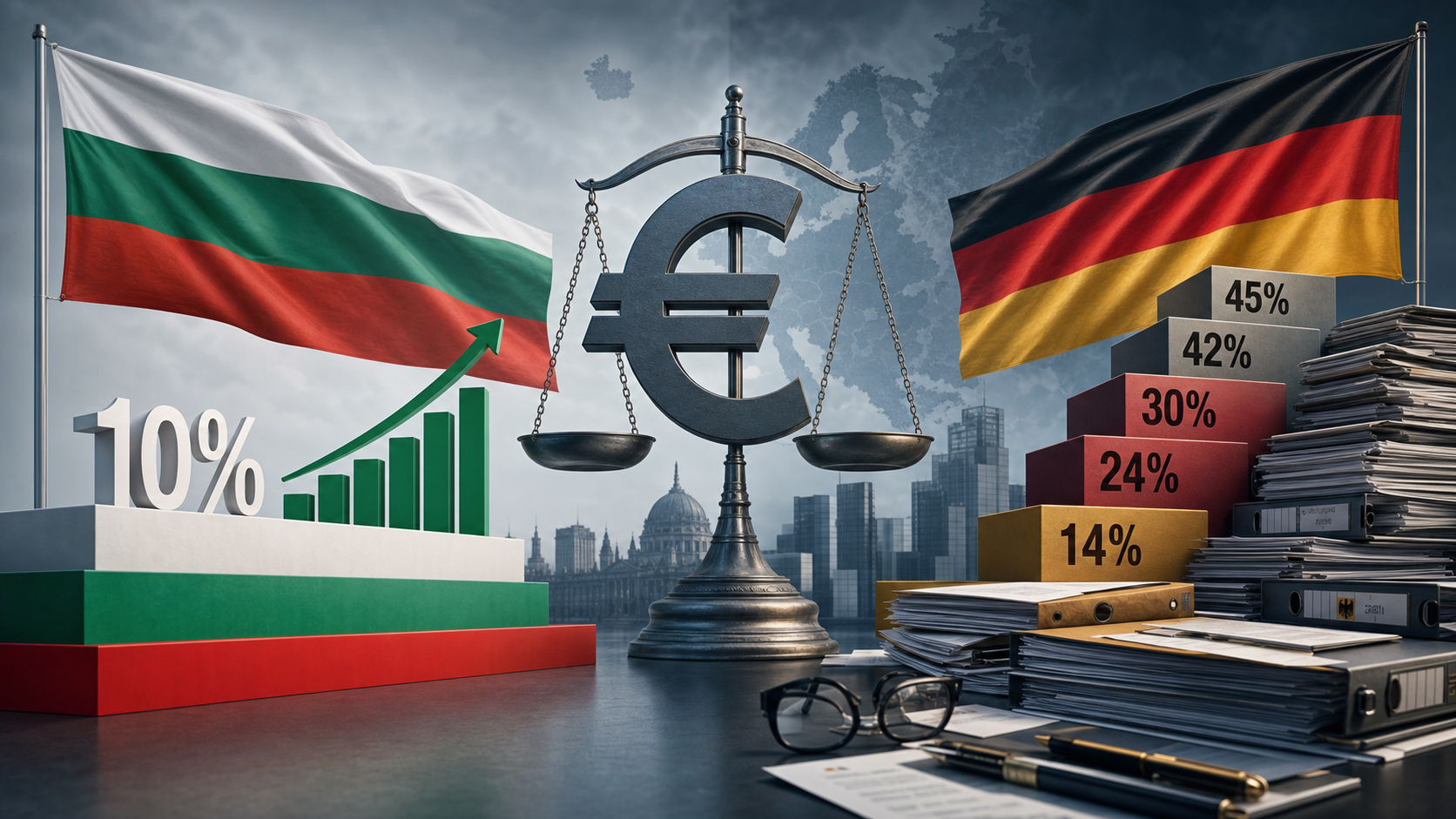
10% off everything: The Bulgarian tax miracle that Germany can only dream of – Image: Xpert.Digital
Radical thought experiment: What happens if Germany introduces a 10 percent tax?
Tax shock in comparison: Why the poorest EU country attracts German entrepreneurs
Billions are leaving the country: Is the Bulgarian "flat tax" the solution to our tax chaos?
Germany suffers from one of the most complex and expensive tax systems in the world. Billions in capital flow abroad every year, while small businesses, corporations, and citizens alike groan under an oppressive bureaucratic burden. A look at Eastern Europe, however, shows that there is a completely different way. Bulgaria, the poorest member state of the EU, has relied for over a decade on a radically simple "flat tax" of 10 percent on income and corporate profits – with astonishing success. The tax system is so simple that it not only attracts investors from all over the world but also once gave the International Monetary Fund a run for its money. But could this radical model simply be transferred to Europe's largest economy? A fascinating economic thought experiment reveals why a German tax rate of 10 percent would shatter our welfare state – and what fundamental lessons Berlin nevertheless urgently needs to learn from Sofia.
Flat tax instead of progressive taxation – What Germany could learn from Bulgaria (and what it couldn't)
The Bulgarian tax miracle: A system that provokes
Objectively speaking, Bulgaria is the poorest member of the European Union. Despite continuous progress, its per capita GDP remains significantly below the EU average, much of its infrastructure is in need of repair, and corruption and the emigration of skilled workers are persistent structural problems. And yet, this country has achieved something in terms of taxation that German entrepreneurs and economists have dreamed of for decades: it taxes corporate profits and income at a simple, flat rate of 10 percent – without complicated scales, without a plethora of exceptions, and without the bureaucratic obstacle course that German tax law imposes on its taxpayers.
Since 2008, corporate tax in Bulgaria has been exactly 10 percent – the second-lowest rate in the entire European Union, surpassed only by Hungary's corporate tax rate of 9 percent. In addition, there is a personal income tax, also at a flat rate of 10 percent, and a dividend tax of just 5 percent. There is simply no trade tax in Bulgaria. This model makes the country not only a low-tax location but also a prime example of tax simplicity.
The story of this reform is remarkable. At the end of July 2007, the Bulgarian government announced its intention to introduce a new income tax system, a flat tax of 10 percent, starting with the 2008 tax year. This new system was to replace the existing four-tier progressive tax system. The International Monetary Fund explicitly warned at the time of significant revenue losses. The Bulgarian government ignored this advice – and reality proved them right: instead of the expected budget deficits, tax revenues increased by up to 40 percent after the introduction of the new system, and 2007 saw a record in foreign direct investment, with capital inflows of almost 14 billion euros.
Germany's tax system: Tall, complex, and burdensome
To understand the scope of a hypothetical system change, one must first consider the German tax system in all its complexity. In 2024, Germany collected a total of approximately €947.7 billion in taxes before distribution between the federal government, states, and municipalities – an increase of 3.5 percent compared to the previous year. Income tax, at around €248.9 billion, was the second largest source of revenue after value-added tax (VAT), which generated €302.1 billion.
The taxation of corporations in Germany comprises a complex interplay of several types of taxes. A GmbH (limited liability company) initially pays corporate income tax of 15 percent on its annual taxable profit, plus a solidarity surcharge of 5.5 percent on the corporate income tax, resulting in an effective corporate income tax burden of approximately 15.825 percent. In addition, there is trade tax, which varies considerably depending on the municipality – in Munich the multiplier is 490 percent, in Berlin 410 percent, and in Leipzig 460 percent – leading to an effective trade tax rate of about 15 percent. The total effective tax burden from corporate income tax and trade tax thus usually lies between 23 and 30 percent.
If a shareholder then wishes to withdraw these taxed profits from the company, another layer of taxation comes into play: the capital gains tax of 25 percent, plus a solidarity surcharge and, if applicable, church tax. The total tax burden on profits from the company to the individual can thus exceed 40 percent. The Centre for European Economic Research (ZEW) clearly establishes in its studies that companies in Germany are not only subject to a high effective tax burden compared internationally, but also face significant disadvantages in the competition for highly qualified employees. To enable a highly qualified employee to earn a net income of €100,000 after taxes and social security contributions, a German company must spend almost €200,000 – in Switzerland, the figure is less than €130,000.
In Germany, individuals are subject to a progressive income tax system, starting at a minimum rate of 14 percent and reaching a top rate of 42 percent, which currently applies to taxable incomes of approximately €66,000 to €68,000. In addition, there is a so-called "wealth tax" of 45 percent for incomes above approximately €277,000, as well as a solidarity surcharge for some taxpayers. Corporate tax revenues amounted to approximately €39.8 billion in 2024, after reaching a record high of €46.3 billion in 2022.
Direct comparison of tax architectures
The contrast between the two tax systems can be precisely described along several dimensions. At the corporate tax level, Bulgaria's transparent 10 percent rate contrasts with a German system that burdens companies with three different types of taxes, generating total burdens between 23 and 30 percent. For income tax, Bulgaria uses a single rate for all income levels, while Germany employs a multi-tiered tax system that reaches up to 45 percent at the top rate. Bulgaria does not have a trade tax; in Germany, it is a significant source of municipal revenue, generating over €75 billion in 2023 alone.
A particularly significant difference concerns dividend taxation: In Bulgaria, profit distributions to shareholders are subject to a flat withholding tax of 5 percent. In Germany, the distribution is taxed at a flat withholding tax of 25 percent, which, combined with the corporate tax rate, creates an economic double taxation of over 40 percent. This difference is of considerable importance for entrepreneurial investment decisions, as it directly affects the return on invested equity.
Added to this is the issue of bureaucratic compliance. The Bulgarian tax system, due to its flat-rate structure, is considered significantly easier to manage, with less administrative burden for both companies and tax authorities. The German tax system, on the other hand, is notorious for its complexity – the numerous interrelationships between corporate tax, trade tax, solidarity surcharge, income tax, and capital gains tax often require specialized tax advice and generate considerable compliance costs.
The revenue argument: What losses would be realistic?
The central question in a hypothetical system change is that of the fiscal consequences. Would Germany actually suffer enormous revenue losses by adopting the Bulgarian tax model? An honest answer is more nuanced than one might initially assume.
In 2024, the most lucrative sources of German tax revenue were wage tax (€248.9 billion) and value-added tax (€302.1 billion). Corporate tax contributed approximately €39.8 billion. Assessed and non-assessed income tax together accounted for tens of billions more. By 2025, total tax revenue had already risen to around €989.8 billion. Among shared taxes, wage tax was the second largest source, at €262.7 billion.
If Germany were to lower income tax to a flat rate of 10 percent, the calculated losses would be immense. Currently, top earners pay 42 to 45 percent income tax, and wage tax accounts for over a quarter of all tax revenue. A rough simulation shows that even under the optimistic assumption that the tax base increases significantly due to changes in behavior—i.e., less tax avoidance, more incentives to work and invest—the short-term revenue losses would amount to several hundred billion euros annually, according to reliable model calculations. The ifo Institute and the German Economic Institute regularly estimate, in corresponding flat-tax simulations, that losses in income tax revenue alone in the range of 100 to 200 billion euros or more would be possible if the rate were abruptly reduced to 10 percent.
However, the Bulgarian model is not simply a tax cut that can be applied in isolation to the German context. Bulgaria's fiscal model before 2008 was different: the country had far lower government spending ratios, a smaller social welfare system, and lower public expenditures than Germany. Bulgaria spends considerably less on social benefits relative to its GDP than Germany, whose welfare state is among the most extensive in the world. A flat 10 percent tax would fundamentally clash with the financing logic of the welfare state in Germany.
Furthermore, the economic structure differs fundamentally: Bulgaria's economic output is many times smaller in absolute terms than Germany's. The significant percentage increase in Bulgarian tax revenues after 2008 was largely due to the formalization effect – that is, the decline of the shadow economy and improved tax compliance resulting from a low and simple tax rate perceived as fair. This effect is considerably smaller in a highly formalized tax state like Germany because, while the shadow economy exists, it is structurally on a different scale.
Dynamic effects: What static calculations overlook
A purely static approach – that is, the naive multiplication of existing tax bases by lower tax rates – systematically underestimates the dynamic feedback effects that a change in the tax system would trigger. That is the real lesson of the Bulgarian experiment.
When Bulgaria lowered its corporate and income taxes to 10 percent in both 2007 and 2008, two factors converged to fuel the growth spurt: tax simplification and EU accession, which simultaneously attracted foreign investors. These two effects overlapped, making it difficult to separate the purely tax-related impact from the institutional strengthening brought about by EU membership. However, one thing is clear: the IMF's forecasts of revenue shortfalls did not materialize – tax revenues increased, investments flowed into the country, and employment rose.
Similar dynamic effects could be expected for Germany, albeit with a different emphasis. First, a drastic reduction in the corporate tax burden would curb capital flight. The current trend is alarming: In the last five years alone, Germany's net foreign assets have increased by almost €1 trillion – capital that leaves the country annually at an average rate of €200 billion, financing investments in the USA, Asia, and Switzerland instead. This is not a random development, but rather the structural consequence of a location with high taxes, high labor costs, and increasing regulatory density.
Secondly, simplifying the tax system would significantly reduce compliance costs. The bureaucratic burden of German tax law represents a considerable competitive disadvantage for companies – especially small and medium-sized enterprises (SMEs). The complexity of the interactions between different types of taxes necessitates costly tax consulting services, which are unnecessary in countries with simple flat-tax systems. This indirect welfare gain is difficult to quantify but is significant in the real economy.
Thirdly, stronger investment incentives are likely to broaden the tax base in the medium term. If corporate profits are taxed at a lower rate, it becomes more worthwhile to retain and reinvest profits within the company rather than shifting them or parking them in tax avoidance structures. The ifo Institute has calculated that Germany loses around €5.7 billion in tax revenue annually due to profit shifting by large corporations. An internationally competitive tax rate would significantly reduce this incentive for shifting profits.
Our EU and German expertise in business development, sales and marketing

Our EU and German expertise in business development, sales and marketing - Image: Xpert.Digital
Industry focus areas: B2B, digitalization (from AI to XR), mechanical engineering, logistics, renewable energies and industry
More information here:
A thematic hub offering insights and expertise:
- Knowledge platform covering global and regional economies, innovation and industry-specific trends
- A collection of analyses, insights, and background information from our key areas of focus
- A place for expertise and information on current developments in business and technology
- A hub for companies seeking information on markets, digitalization, and industry innovations
Location competition and taxes: Can Germany attract investment with lower rates?
Distributive justice: The uncomfortable core problem
The most compelling argument against a German flat tax is not fiscal, but rather socio-political: the question of tax fairness. Germany's progressive tax system is based on the principle of ability to pay – those who earn more should contribute a larger share of their income to the state. This principle is constitutionally enshrined in the mandate of taxation according to economic capacity and enjoys broad public acceptance.
A flat tax of 10 percent would radically reverse this distribution model. For an employee with a gross annual income of €30,000, a 10 percent income tax would represent massive relief compared to the current tax rate, which, depending on deductions, effectively ranges from 15 to 20 percent. For a top earner with an annual income of €300,000, the same reform would mean a halving of their tax burden or more. The percentage tax relief gains are concentrated, in absolute terms, among the upper income brackets – this is the arithmetic logic of reducing progressive taxation.
Microsimulation studies for Germany consistently show that a drastic reduction towards a flat tax rate would significantly increase net income inequality unless substantial compensation is provided for low-income groups. The Leibniz Institute for Economic Research and the DIW have demonstrated in several analyses that flat tax proposals in Germany, without accompanying measures, would imply a substantial redistribution of wealth from the bottom to the top.
Bulgaria assessed this conflict of objectives differently due to its social and economic circumstances. In an economy with a large shadow economy, low trust in state institutions, and fiscal simplification primarily focused on tax compliance and formalization, a flat tax can be a fairer means of broadening the tax base than a nominally progressive system that effectively only captures a small formal sector. In Germany, with its highly formalized economy and broad tax base, this argument is considerably less compelling.
Welfare state and the tax authorities: The financing question
Any discussion about a radical tax cut must take the financing aspect seriously. In 2024, Germany had total government spending of €2.132 trillion and a budget deficit of approximately €119 billion. While tax revenues rose to a record high, spending grew even faster. In this context, a massive decline in revenue that is not offset by growth effects would be immediately detrimental to the budget.
The German welfare state – with its expenditures on pensions, healthcare, long-term care, education, infrastructure, and social security – depends on tax revenues of the current magnitude. Even the political debate surrounding minor relief measures, such as compensating for bracket creep, is regularly countered by the government with references to the budget situation. A flat tax, like the one practiced in Bulgaria, would lead to an unsustainable model without a radical overhaul of the welfare state.
In addition, there is the issue of social security contributions, which in Germany are strictly separated from taxes. Employees and employers pay substantial contributions to pension, health, long-term care, and unemployment insurance. While these social security contributions also exist in Bulgaria, they are at a significantly lower level and have a different institutional structure. If Germany were to simply lower tax rates without adjusting the social security system, the overall burden of labor would remain high for many segments of the population.
Elements with reform potential: What Germany could adopt
Even though a complete adoption of the Bulgarian tax system would not be structurally feasible for Germany, the model contains several elements that could serve as impetus for a long-overdue tax reform.
Firstly, the argument for simplification could be taken seriously. A significant reduction in tax exemptions, allowances, and deductions would lower compliance costs and actually increase tax fairness – because complex tax systems systematically favor those who can afford highly qualified tax advice. A simplified tax code doesn't have to be a flat tax system, but it can learn from Bulgaria's clarity.
Secondly, a reform of the corporate tax system, specifically regarding trade tax, would be politically justifiable. Economists consider trade tax economically inefficient because it fluctuates depending on location, ties companies to fixed location decisions, and increases the complexity of the system through its additions and deductions. Abolishing or fundamentally reforming trade tax with compensation for municipalities would be a sensible structural measure. In fact, the current federal government is planning a gradual reduction of corporate tax starting in 2028, in five steps of one percentage point per year.
Thirdly, the Bulgarian model demonstrates that a low dividend tax rate can retain capital domestically. The current flat tax of 25 percent on dividends makes Germany unattractive compared to other European countries for investors and entrepreneurs who rely on distributions. A targeted reduction to a competitive 15 percent or less would counteract the capital export driver without destabilizing the overall system.
Fourth, the Bulgarian mechanism for reducing the shadow economy deserves attention. The argument that a tax rate perceived as fair and low encourages tax compliance has empirical substance – not only in Bulgaria, but also in the historical development of other flat-tax countries such as Estonia and Romania. Germany, while not having a comparably large informal economy, would nevertheless benefit from greater tax compliance among the self-employed and small businesses if tax obligations were easier to fulfill and rates less prohibitive.
European tax competition: The structural dilemma
The analysis would be incomplete without considering the broader European context. Tax competition within the EU has intensified considerably since its eastward expansion. Average corporate tax rates in the older EU member states fell from just over 38 percent to just under 29 percent between 1997 and 2007, while in the newer member states they dropped from 32 percent to an average of 19 percent. This downward pressure has been exacerbated by the single market, because there is no exchange rate risk in the Eurozone and corporate profits can be shifted relatively easily from one country to another.
Germany has traditionally responded to this competition by emphasizing its locational advantages: legal certainty, excellent infrastructure, a skilled workforce, and market access. However, these advantages are eroding, while the tax burden remains a structural obstacle. The vbw-Bayern study on tax-related location quality in the EU concludes that Germany also ranks second-worst in terms of effective tax burden. This is not merely an academic issue, but a real-world economic signal that impacts investment decisions.
At the same time, coordination initiatives at the EU level stand in the way of radical tax cuts. The introduction of a global minimum tax of 15 percent for multinational corporations, championed by the OECD and the EU, does put a stop to tax competition, but it does not change the leeway that individual EU countries still have in taxing small and medium-sized enterprises and individuals. Countries like Bulgaria, Hungary, and Ireland consistently make use of this leeway – thereby attracting investments that are lacking elsewhere.
The failure of the flat tax elsewhere: Lessons from the retreat
A more nuanced analysis must also consider that the flat tax is by no means an unstoppable success story. Of the eight European countries that still use a uniform tax rate today, seven others have abandoned the model over the years. Serbia switched from a flat tax of 14 percent to three rates, Slovakia reverted from 19 percent to a two-tier system, the Czech Republic introduced a second tax rate, and similar developments occurred in Latvia and Lithuania. The common reason for the return to progressive taxation was almost always the same: financial pressures and the political realization that a single low rate, coupled with rising government spending, restricts the fiscal base too much.
This finding is relevant to the analysis of Germany. Even countries with significantly lower government spending ratios than Germany were forced to abandon the flat tax because a single low rate is insufficient in the long run for a modern state with social infrastructure. Bulgaria is one of the few countries that have retained the model so far – but Bulgaria also has one of the lowest government spending ratios, the lowest social spending, and the lowest national debt in the EU. In comparison, Germany has a government spending ratio of over 45 percent of GDP and a welfare state whose financing requirements are essentially met by the tax and social security system.
A provocative thought experiment with clear boundaries
The Bulgarian tax model is not a direct role model for Germany, but it serves as an illuminating mirror. It shows that tax simplification is possible, that low rates can stimulate investment and growth, and that the apparent conflict between tax cuts and revenue can be mitigated through behavioral changes. However, it also shows that these mechanisms are contingent on economic, institutional, and societal conditions that differ fundamentally between Sofia and Berlin.
If Germany were to adopt Bulgaria's 10 percent flat tax tomorrow, the revenue losses would be real and substantial – corporate and income taxes alone would have to be estimated at several hundred billion euros in shortfall, even taking dynamic growth effects into account. The German welfare state, the public investment budget, and municipal financing could not be sustained without far-reaching structural reforms. An immediate, complete adoption of the Bulgarian model would be fiscally irresponsible.
What Germany can learn from Bulgaria, however, are the principles, not the figures: radically simplifying tax law, making the corporate tax burden and dividends internationally competitive, strengthening investment incentives, and thus counteracting capital flight. The current German government has taken a first step in the right direction with the announced gradual reduction of the corporate tax rate starting in 2028 – but the pace and the courage for structural reform fall far short of what would be necessary to put Germany back among the top European investment locations. Tiny Bulgaria, the poorest member of the EU, has shown more determination on this issue than Europe's largest economy.





