
Mega Logistics Park CIDCO: An attack on China's supply chains – What the new 374-hectare megapark in Mumbai means for global trade
Xpert Pre-Release

Available in 27 languages 📢
Prefer Xpert.Digital on GoogleⓘPublished on: September 7, 2026 / Updated on: September 7, 2026 – Author: Konrad Wolfenstein
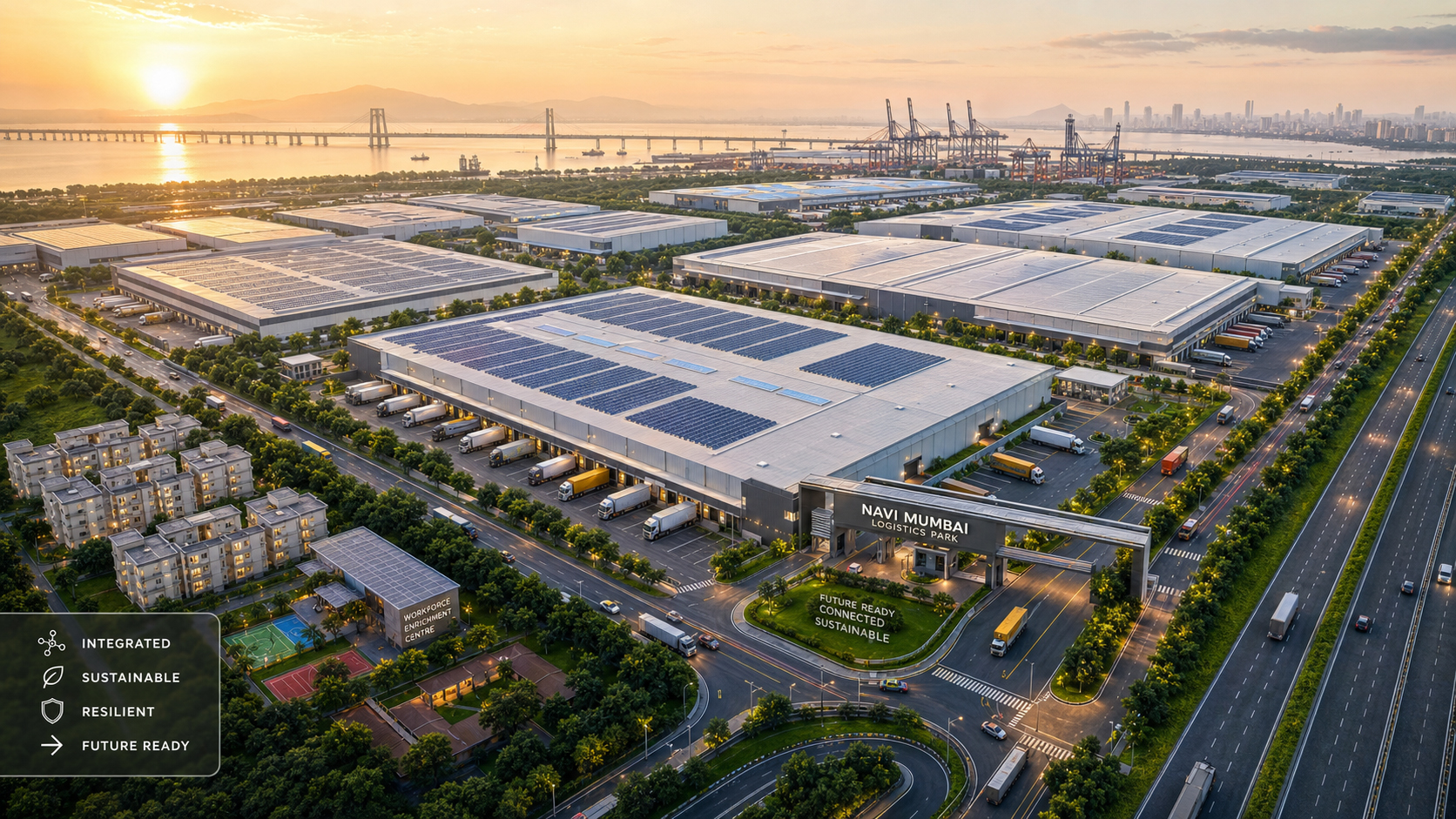
Mega Logistics Park CIDCO: An Attack on China's Supply Chains – What the new 374-hectare megapark in Mumbai means for global trade – Creative image for Thea, with AI: Xpert.Digital
India's new mega-project: Will the country win the bet against its own infrastructure chaos?
Global trade is shifting: How a mammoth Indian project aims to revolutionize international logistics
More than just warehouses: India's gigantic logistics master plan on the outskirts of Mumbai
India, as an emerging manufacturing hub, is increasingly coming into focus for the global economy. But anyone wanting to profit from the global "China plus one" trend must solve a deeply rooted problem: the country's chronically overburdened and expensive logistics infrastructure. This is precisely where a gigantic mega-project is now coming in. On the outskirts of Mumbai, the state-owned development corporation CIDCO is planning a 374-hectare mega-logistics park. Located in close proximity to India's fastest-growing container port and a new international airport, it aims to create nothing less than the most modern logistics ecosystem on the subcontinent. But is India truly ready to shed the bureaucratic shackles of the past and implement such a mammoth project? The planned CIDCO mega-park in Navi Mumbai will thus become the ultimate test case for the country's economic ambitions.
India's new logistics axis: The CIDCO megapark in Navi Mumbai
Is India betting against its own infrastructure past with 374 hectares of fallow land?
India has a logistics problem as old as its industrial policy itself: goods traditionally take longer to get from the port to the shelf than elsewhere, and the costs of storage, transport, and handling consume a disproportionate share of the added value. Against this backdrop, the announcement by the state-owned development corporation CIDCO to build an Integrated Logistics Park in Navi Mumbai on an area of approximately 924 acres, or about 374 hectares, is more than just an ordinary real estate announcement. It is a strategic test case for whether the Indian state of Maharashtra is capable of moving from the mere announcements of past decades to a phase of concrete, investment-ready implementation.
The City and Industrial Development Corporation of Maharashtra, or CIDCO for short, is not a new player in urban development. Since the 1970s, it has transformed Navi Mumbai from relatively undeveloped marshland into one of Asia's fastest-growing planned cities, consistently acting as a state-run land developer, acquiring land, providing basic infrastructure, and then transferring it to private investors or end users. With its current project, the corporation is consistently continuing this proven model, but shifting its focus significantly from purely residential and commercial construction to a highly specialized logistics infrastructure designed to meet the evolving demands of global trade.
The location is geographically advantageous. The reserved area lies near the village of Chirle in the so-called Pushpak Node, and thus in the immediate vicinity of three of Maharashtra's most significant transport projects: the existing Jawaharlal Nehru Port container terminal, the new Navi Mumbai International Airport (currently under construction or in its start-up phase), and the already opened Mumbai Trans Harbour Link, India's longest sea bridge connecting the two shores of Mumbai Bay. This cluster of infrastructure is complemented by a planned multi-modal corridor and a connection to a dedicated freight corridor. Anyone considering location decisions in the logistics sector will hardly find a comparable concentration of heavy transport infrastructure in such a small area.
Between announcement and tender
Why the first 72 hectares are more important than the remaining 300
What's remarkable about the current project phase is that CIDCO isn't marketing an entire area in the abstract, but has actually begun operational implementation. For the first phase, designated as Land Parcel L1 in the documents, twelve individual plots of land, totaling approximately 179 acres or 72 hectares, have been put out to tender. Interested investors, developers, and logistics companies can apply for these plots through a competitive bidding process, known as an Expression of Interest. Vijay Singhal, Vice Chairman and Managing Director of CIDCO, is responsible for implementing a master plan that divides the entire site into seven distinct logistics zones, thus creating a functional mix of traditional warehousing, container freight stations, inland container depots, and light industrial units.
This differentiation into zones is not a bureaucratic gimmick, but follows a clear economic logic. Container Freight Stations handle the interim storage and customs clearance of containers outside the actual port area, thus relieving the notoriously congested area directly at the quayside. Inland Container Depots allow exporters and importers to complete customs formalities inland, reducing waiting times at the port itself. Finally, light industrial units make it possible to carry out simple processing and packaging steps directly at the logistics location, instead of unnecessarily transporting goods across the country for such intermediate steps. Combining these three functional areas under a common master plan promises synergies that individual, isolated warehouse projects cannot offer.
CIDCO has also prioritized scale in its internal development. The primary road network within the park will be built with widths of 45 and 30 meters, far exceeding what is typical in many older Indian industrial areas, where narrow and often congested access roads regularly slow down heavy goods vehicles. Before the actual allocation of land, CIDCO will also undertake the complete basic development, including road construction, water supply, sewage disposal, and a functioning rainwater drainage system. Only after the selection process is complete will individual Memoranda of Understanding be signed with the successful bidders regarding land acquisition and payment terms.
This approach distinguishes the project from many private logistics developments, where investors must bear the development risk themselves, and delays in permits, groundwater issues, or connectivity problems can postpone entire projects by years. By having a government agency undertake this preliminary work, the risk for private investors is significantly reduced, which in turn should increase the project's attractiveness to international investors, who traditionally operate cautiously in India when it comes to unclear land and permitting situations.
The harbor at your back
What the record numbers at Jawaharlal Nehru Port have to do with the new logistics park
To properly assess the economic significance of the project, it's worth looking at the immediate neighbor of the planned logistics park, Jawaharlal Nehru Port, often known by its older name, Nhava Sheva. This port is no longer just India's largest container port, but has recently become one of the fastest-growing container ports in the world. In the 2025/26 fiscal year, the port recorded a new annual record with over 8.17 million standard-sized containers (TEUs), significantly exceeding the previous year's figure of approximately 7.3 million TEUs, representing growth of nearly twelve percent. Total cargo throughput also reached a historic high of over 102 million tons.
This dynamic has accelerated even further in the current fiscal year. Between April and July 2026, container throughput grew by over fourteen percent compared to the same period of the previous year, while global analyses even ranked the port as the fastest-growing container port worldwide in the first half of 2026, propelling it from 28th to 21st place in the global rankings. A key driver of this development is geopolitical shifts in global trade, which have directed additional transshipment cargo—that is, transshipment traffic between different sea routes—to Nhava Sheva, complemented by structurally increasing export volumes from Indian industry.
A port growing this rapidly inevitably reaches its spatial limits. The port's own container storage capacity is around 176,000 TEUs, of which between 90,000 and 100,000 TEUs are already occupied under normal conditions. During periods of increased demand, such as those temporarily experienced due to geopolitical tensions in the Middle East, occupancy even climbed to around 67 percent of total capacity. This is precisely where the logic of the new logistics park comes into play: if the port itself has hardly any room left to temporarily store additional containers, this function must be shifted to upstream facilities in the hinterland. Container freight stations and inland depots in the planned park could therefore directly contribute to relieving the pressure on a port whose theoretical annual capacity of just over 10.4 million TEUs is likely to be reached within a few years, given current growth rates.
Your intralogistics experts

Consulting, planning and implementation of complete solutions for high-bay warehouses and automated storage systems - Image: Xpert.Digital
More information here:
Integrated Logistics Park Navi Mumbai: How social infrastructure becomes a location advantage
More than warehouses
How a plot of land can become a social ecosystem
A recurring theme in CIDCO's communication surrounding the project is the concept of a future-proof ecosystem. This encompasses more than simply a collection of warehouses and transshipment areas. The aim is to integrate essential infrastructure, social facilities, communal spaces, and utility networks directly into the planning, ensuring that workers, truck drivers, and employees at the site find not just a workplace, but a functioning environment. In the wider Navi Mumbai area, where CIDCO has previously developed themed districts such as Educity for educational institutions, Medicity for healthcare, and Sportscity for sports infrastructure, the logistics park fits into a larger framework of holistic urban planning.
This approach marks a clear departure from older Indian industrial zones, which were often developed as purely functional areas lacking social infrastructure and where employees frequently faced long commutes from distant residential areas. Modern logistics real estate development, increasingly becoming the international standard, deliberately integrates operational space with housing, local amenities, educational and recreational facilities to enhance the location's attractiveness for both skilled workers and management. For international logistics companies seeking to establish a presence in India, this aspect is likely to be a significant factor in their site selection, as the availability of qualified personnel remains one of the biggest operational challenges in many Indian economic zones.
At the regulatory level, the project relies on two key policy frameworks: the MIDC Pass-through Policy, which defines industry-specific standards for industrial and logistics developments, and the Maharashtra Logistics Policy, which serves as the state's basis for promoting logistics infrastructure. Under this policy, Integrated Logistics Parks benefit from significant building code concessions. Statewide, these parks are granted either a land use factor of one or the otherwise permissible base value, whichever is higher. Developers can also obtain up to 200 percent additional buildable area above the base value, sometimes for a premium. Furthermore, a higher floor area ratio of up to 75 percent is permitted, provided that setback and fire safety regulations are met. These building code concessions significantly reduce land costs per storage or handling unit, thereby directly improving the profitability of investment decisions for private operators.
Risks between announcement and reality
Why land reform projects in India traditionally fail in implementation
For all the ambition, it would be irresponsible to ignore the structural risks that have historically accompanied large-scale projects of this kind in India. Numerous government-announced industrial and logistics corridors of the past two decades have experienced significant delays in their implementation, whether due to delays in the actual transfer of land, resistance from affected village communities, financing bottlenecks for selected developers, or sluggish approval processes at lower administrative levels. While the fact that CIDCO is undertaking the initial development itself reduces the direct investment risk for private bidders, it by no means completely shifts the implementation risk. Instead, it initially concentrates it on the government agency itself, whose own development speed thus becomes a critical success factor.
A second risk factor lies in the parallel development of several major projects in the same region. The new Navi Mumbai international airport, the Mumbai Trans Harbour Link, and various connecting roads are all at different stages of construction, and delays in any one of these projects could directly impact the profitability of the logistics park, as its locational advantage depends significantly on the completion of these neighboring projects. For example, if the new airport's full operational capacity is reached later than planned, this would also delay the air freight-related synergy effects for the logistics park.
Thirdly, it remains to be seen how strong the actual investor interest in the advertised plots will be. Competitive tendering processes appear transparent and market-based on paper, but their actual effectiveness depends heavily on the number of serious bidders. Should only a small group of established developers apply, this could shift the conditions to the detriment of the public sector, whereas broader international interest would tend to lead to more competitive prices and faster development. Initial indications of the true extent of international interest are not expected to emerge until after the current tender period for the first phase has concluded.
Fourth, the social dimension should not be underestimated. Land acquisition projects of this scale almost always affect existing agricultural use, informal settlement structures, or traditional land rights in the affected villages. Although there are no direct reports of conflicts with the local population in this case, experience from comparable projects in Maharashtra and other states shows that unresolved compensation issues or insufficient communication with affected communities can lead to significant delays, even when the fundamental logic behind the location is compelling.
The greater economic logic
Why India is focusing on logistics infrastructure right now
The timing of the project is by no means coincidental, coinciding with a period in which India is attempting to capitalize on global shifts in supply chains. For several years now, numerous multinational companies have been consciously diversifying their production and procurement structures away from a one-sided dependence on China, a trend often summarized under the term "China plus one." With its large population, growing industrial base, and comparatively low labor costs, India is considered one of the most obvious beneficiaries of this shift, provided the country's chronic infrastructure deficiencies can be addressed.
The logistics sector, in particular, has been considered the Achilles' heel of the Indian economy for years. While manufacturing capacities in sectors such as electronics, textiles, and pharmaceuticals have grown competitively, transport and storage costs have remained above average by international standards, significantly offsetting any labor cost advantages. The federal government in New Delhi has addressed this problem with national programs such as the PM Gati Shakti Initiative and the National Logistics Policy, which aim to better integrate road, rail, sea, and air transport and reduce overall logistics costs as a share of GDP. The Navi Mumbai logistics park can be seen as a regional implementation of precisely this overarching national objective, adapted to the specific geographical conditions of the greater Mumbai area.
For the state of Maharashtra itself, traditionally one of India's strongest economic regions but facing increasing competition for investment from states like Gujarat, Tamil Nadu, and Karnataka, the project also sends a clear signal regarding its economic position. Investors choosing between several Indian states often consider, among other things, where the administrations are actually capable of delivering results—that is, providing land, building infrastructure, and processing permits quickly. If CIDCO succeeds in awarding and developing the first phase of the project within a reasonable timeframe, this would not only provide immediate economic benefits but also serve as a signal of confidence for further investment decisions in the region.
Integrated Logistics Park Navi Mumbai: Location opportunity or political test case?
Between location advantage and implementation pressure
In summary, the planned Integrated Logistics Park in Navi Mumbai rests on a solid geographical and infrastructural foundation, significantly enhanced by its proximity to the growing Jawaharlal Nehru Port, the new airport, and key transport links such as the Mumbai Trans Harbour Link. The concrete tendering process for the first phase, with its clearly defined area, well-conceived zoning concept, and pre-funded public infrastructure development, sets this project apart from many previous Indian projects that have often failed due to precisely these details.
At the same time, the real proof of its feasibility remains to be provided. Whether enough reputable investors can be found for the twelve plots of land in the first phase, whether the development proceeds within the planned timeframe, and whether the parallel projects in the vicinity are completed on schedule will ultimately determine whether this ambitious announcement actually becomes the future-proof logistics hub that CIDCO envisions. For observers of Indian industrial and location policy, the project thus remains a test case of supra-regional importance, the progress of which warrants close monitoring over the next two to three years.
Your global marketing and business development partner
☑️ Our business language is English or German
☑️ NEW: Correspondence in your native language!

Konrad Wolfenstein
I and my team are happy to be available to you as your personal advisor.
You can contact me by filling out the contact form here [email protected]:or simply call me at +49 7348 4088 965. My email address is
I'm looking forward to our joint project.










