
The next price shock is looming: What China's naval blockade means for German consumers – sea routes as a new weapon?
Xpert Pre-Release

Available in 27 languages 📢
Prefer Xpert.Digital on GoogleⓘPublished on: April 16, 2026 / Updated on: April 16, 2026 – Author: Konrad Wolfenstein
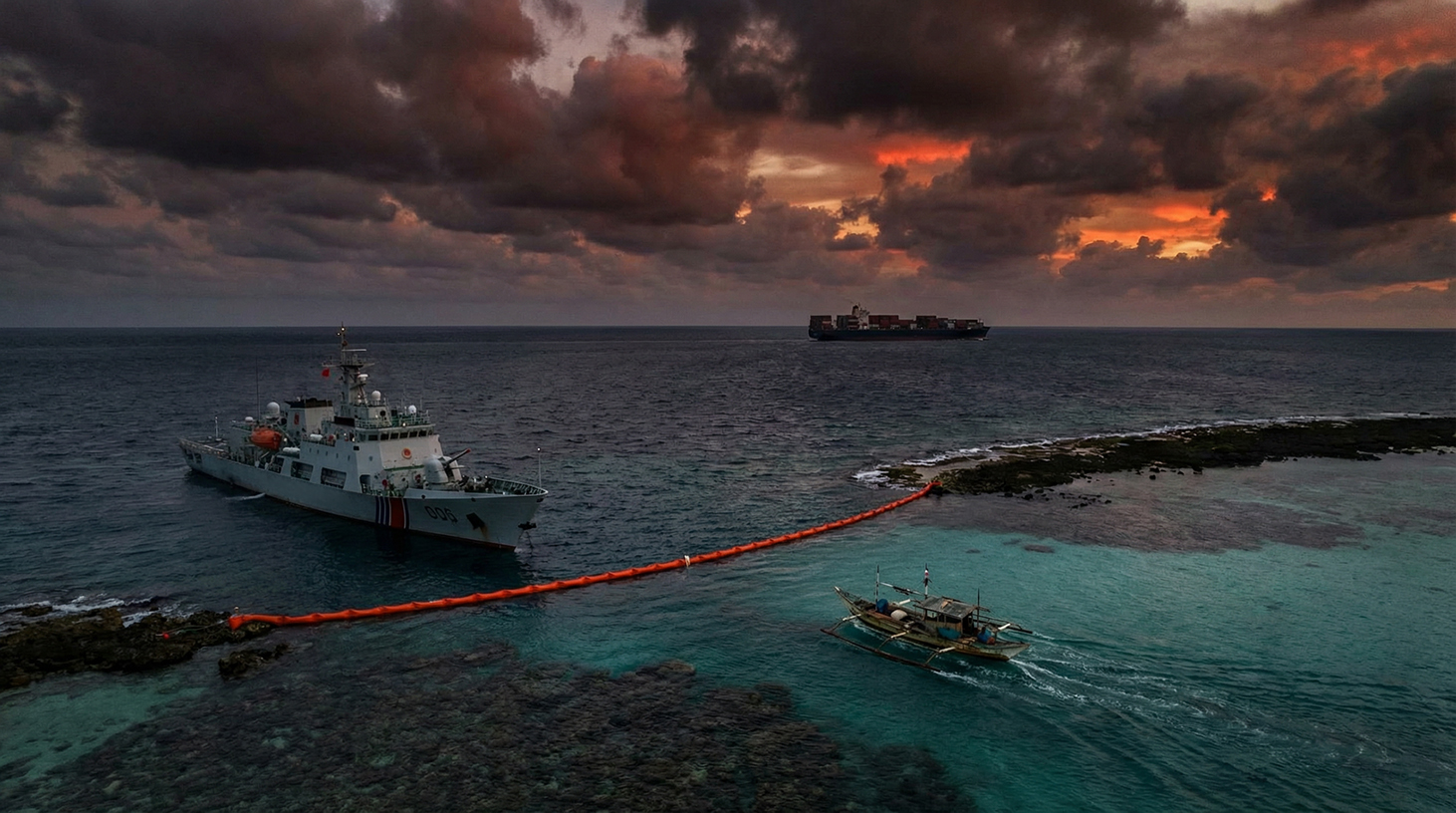
The next price shock is looming: What China's naval blockade means for German consumers – sea routes as a new weapon? – Image: Xpert.Digital
Worse than Hormuz? Why China's reef blockade threatens global trade
Secret maneuver in the South China Sea: How China is driving up our prices
Satellite images reveal: China's dangerous great power strategy at Scarborough Reef
While the world watches with bated breath as the military escalation and the looming blockade of the Strait of Hormuz unfolds, thousands of nautical miles away a geopolitical maneuver is taking place that could have an even more devastating impact on the global economy. In the South China Sea, China is using physical barriers and a fleet of fishing and coast guard vessels to create a noose around Scarborough Shoal. It is a dangerous stress test: Will maritime blockades become the new normal in great power politics? For export nations like Germany and the rest of Europe, this development is extremely perilous. When sea lanes become weapons and international law erodes, not only do exploding freight costs and disrupted supply chains threaten – the entire rules-based order of global trade is at stake. Why a tiny coral atoll is becoming the epicenter of a new global economic conflict, and why European consumers will ultimately foot the bill.
Two crises, one pattern: The simultaneous escalation on the world's oceans
Global shipping faces an unprecedented situation in April 2026: two strategically important straits and maritime areas are simultaneously affected by blockades or seriously threatened. In the Strait of Hormuz, through which about one-fifth of the world's crude oil exports flow, Iran initially restricted shipping and imposed transit fees in the wake of its military conflict with the US. Subsequently, US President Donald Trump announced a complete blockade of the strait by the US Navy, and international insurance companies canceled their war risk coverage for ships in the region. IEA chief Fatih Birol has already warned of a "Black April" and predicted that the Hormuz crisis would surpass all historical oil shocks.
Simultaneously, some 3,700 nautical miles away, China is conducting its own maneuver in the South China Sea, one that could have far-reaching long-term consequences. Satellite images exclusively published by Reuters on April 14 and 15, 2026, show Chinese fishing boats, a coast guard or navy vessel, and a 352-meter-long floating barrier that has been blocking the only major access to Scarborough Shoal since April 10 and 11. The simultaneity of these two developments is no coincidence—it marks a new level of instrumentalization of sea lanes as geopolitical leverage.
The Scarborough Reef: Small atoll, big stage
Scarborough Shoal, known as Huangyan Dao in Chinese and Panatag Shoal in Filipino, is a triangular coral atoll with a lagoon of approximately 3,524 hectares. Named after a British ship that ran aground there almost three centuries ago, it lies 220 kilometers west of the Philippine island of Luzon – and thus clearly within the Philippines' exclusive economic zone under international maritime law. Nevertheless, China claims the reef as part of its territory, citing historical claims and the infamous nine-dash line, which Beijing uses to claim roughly 90 percent of the entire South China Sea.
The Permanent Court of Arbitration in The Hague ruled in 2016 that China's blockade of the reef violated international law, as it is a traditional fishing ground for several countries, including China, the Philippines, and Vietnam. Beijing pointedly ignored this ruling. China had effectively taken control of the reef in 2012 and has since systematically displaced Filipino fishermen. In 2025, China authorized the establishment of a national marine protected area at Scarborough Shoal—a move Philippine security officials described as "a clear pretext for an occupation." The barriers and vessels now in place represent the most concrete physical barrier China has erected in these disputed waters to date.
China's strategy of presenting facts on the ground
The current escalation follows a Chinese pattern known for years, which analysts call "gray zone warfare." Beijing relies on a gradual expansion of its control below the threshold of open military conflict: coast guard vessels operating disguised as civilian vehicles, artificial islands in the South China Sea being developed into military bases, and now physical barriers at strategic access points. Each individual step, taken on its own, appears calculatedly too small to provoke a military response—but taken together, these measures fundamentally alter the status quo.
Scarborough Shoal holds more than just symbolic value for China. Strategically located in the middle of the South China Sea, in close proximity to key shipping lanes, it offers—once fully controlled—significant opportunities for projecting power toward the Philippine archipelago and beyond. The reef's location allows for monitoring and potentially hindering US and Philippine naval operations. A US destroyer, the USS Higgins, was, according to the Chinese military, "driven away" from the reef in August 2025—Washington, however, described it as a routine operation to uphold freedom of navigation.
The economic context: Why the South China Sea matters
The real reason why the developments at Scarborough Shoal extend far beyond a regional territorial dispute lies in the sheer economic importance of the South China Sea. According to UNCTAD, a third of all global maritime trade passes through it. A US expert group led by Bonnie Glaser of the CSIS calculated that in 2016 alone, goods worth US$3.37 trillion were transported through the South China Sea – representing 21 percent of global trade at that time. More recent estimates put the figure at over US$3 trillion annually.
Energy transport is particularly critical. Around 40 percent of all globally traded petroleum products are shipped annually through the South China Sea. For the major Northeast Asian powers, the dependence is even more pronounced: Over 64 percent of China's own maritime trade passes through these waters, as do almost 42 percent of Japan's foreign trade and around 30 percent of India's. Researchers at Duke University estimate that goods worth US$7.4 trillion are shipped annually between the South and East China Seas alone. By comparison, the Strait of Hormuz, whose current blockade is shaking world markets, is significantly less exposed in terms of the total volume of global trade – it is primarily critical for oil transport, while the South China Sea serves as a general trading hub for almost all classes of goods.
Hub for Security and Defense - Advice and Information

Hub for Security and Defense - Image: Xpert.Digital
The Security and Defence Hub offers expert advice and up-to-date information to effectively support companies and organizations in strengthening their role in European security and defence policy. Working closely with the SME Connect Defence Working Group, it particularly promotes small and medium-sized enterprises (SMEs) that wish to further develop their innovative capacity and competitiveness in the defence sector. As a central point of contact, the Hub thus creates a crucial bridge between SMEs and European defence strategy.
Related to this:
When shipping risks prove costly for German industry
A bone of contention for seven nations: An overview of the conflict system
The South China Sea is not a bilateral conflict between China and the Philippines. A total of seven littoral states – China, Taiwan, the Philippines, Vietnam, Malaysia, Brunei, and Indonesia – claim parts of the sea. The conflicts overlap in at least nine different zones and involve fishing rights, mineral resources, and strategic shipping lanes. The seabed of the South China Sea is estimated to contain 30 billion barrels of oil and 7,500 cubic kilometers of natural gas – resources that have fueled the sovereignty dispute with significant economic implications.
China is involved in virtually every one of these conflicts and has alienated all other coastal states through its aggressive enforcement of its nine-dash line. While confrontations between China and the Philippines are currently the most intense—with incidents such as ramming Philippine supply vessels and using water cannons against Philippine fishermen—tensions also regularly simmer with Vietnam, Malaysia, and Indonesia. The International Court of Justice in The Hague declared China's extensive claims illegal under international law in 2016—which has not prevented Beijing from continuing to enforce these claims in practice.
The price shock mechanism: How maritime uncertainty is affecting Europe
Even if a complete physical blockade of the South China Sea seems militarily and politically unrealistic, the developments at Scarborough Shoal are already having measurable economic consequences – via the classic channel of risk premiums. Insurance companies and shipping lines react to geopolitical uncertainties before they translate into concrete physical disruptions. The pattern is already familiar from the current Hormuz crisis: War risk insurance premiums for ships in the Strait of Hormuz jumped from 0.25 percent to 1 percent of the ship's hull value, and VLCC tanker charter rates quadrupled to as much as US$770,000 per day. International insurance consortia canceled existing war risk coverage and demanded expensive new contracts.
A comparable effect in the South China Sea would have a far greater impact on global consumer prices, given the volume of trade handled there. Rising insurance premiums and charter rates flow directly into freight costs, which in turn are passed on to end consumers – for electronics products from Asia as well as for raw materials, textiles, machinery, and intermediate goods. For German industry, which is heavily integrated into global supply chains and maintains significant trade relations with China, Japan, South Korea, and the ASEAN countries, persistent uncertainty in the South China Sea would be a direct cost driver. The research context of the ifo Institute underscores that German exports to China amount to €86 billion – a considerable share of which travels via the maritime route through the South China Sea.
The strategic dimension: A precedent with global consequences
What is happening at Scarborough Shoal is more than a local fishing dispute. It is a deliberate test: Can a major power exert physical control over internationally used waters without effective intervention from the international community? Should China succeed with this strategy, a precedent would be set that calls into question the entire framework of international maritime law. The logic would be simple: Whoever creates physical facts on the ground without having to fear serious consequences can systematically expand this instrument.
While the US has conducted freedom of navigation operations in the South China Sea, the simultaneous escalation in the Persian Gulf limits its capacity for a decisive engagement on both fronts. European naval presence in the region is marginal. Japan, Australia, and the Philippines attempt to demonstrate their presence through joint exercises, but lack the military firepower to curb Chinese ambitions on their own. The Europeans' geopolitical and military room for maneuver is, in effect, zero.
Germany and Europe: Taxpayers without a voice
For Germany and Europe, the situation is particularly difficult because the economic damage is real, yet political influence is extremely limited. Europe depends on the free flow of goods through the South China Sea – whether for imports from Asia or for its own exports to the growing markets of the ASEAN region. At the same time, Europe lacks both the military capabilities and the political will to act as a stabilizing force in this region. For European economies, dependence on a functioning, rules-based international order is not an abstract demand, but a fundamental economic prerequisite.
The structural dilemma is profound: The instrumentalization of sea lanes by major powers—whether Iran, the US, or China—disproportionately affects open economies like Germany. Trading nations that rely on stable and predictable transport routes have the most to lose when these routes become bargaining chips in geopolitical rivalries. Rising freight costs, higher insurance premiums, and potential supply chain disruptions are costs that ultimately accrue to consumers and businesses—not to the major powers that create the tensions. The simultaneous crises in the Strait of Hormuz and the South China Sea reveal just how vulnerable the global trading system is to targeted geopolitical disruption.
When rules no longer apply
Developments at Scarborough Shoal and in the Strait of Hormuz reveal a dangerous trend: Maritime law and the international rules that have enabled global trade since the end of World War II are increasingly being treated as optional by major powers. China is ignoring the ruling of the Permanent Court of Arbitration, Russia has destabilized Black Sea trade, and now the US government is also pursuing a unilateral policy of blockade. The multilateral system of freedom of the seas, which forms the basis of modern global trade, is under more pressure than at any time since the Cold War.
This poses a systemic threat to the global economy. A world in which sea lanes are permanently used as an instrument of power politics is a world with structurally higher transport costs, unpredictable supply chains, and increasing deglobalization. The short-term effects on insurance premiums and freight costs are merely the visible tip of a much deeper problem: the erosion of the rules-based order upon which export-oriented economies like Germany and the entire EU are existentially dependent. Without a coordinated European response—political, diplomatic, and, in the long term, military—Europeans will be presented with the economic bill in every new crisis without having sat at the negotiating table.
Consulting - Planning - Implementation

Markus Becker
I would be happy to serve as your personal advisor.
Head of Business Development
Chairman SME Connect Defense Working Group
Consulting - Planning - Implementation
Konrad Wolfenstein
I would be happy to serve as your personal advisor.
contact me at wolfenstein ∂ xpert.digital
Just call me on +49 7348 4088 965 .





