
Saudi Arabia | How a kingdom becomes a logistics superpower: When straits fail, the desert comes into its own
Xpert Pre-Release

Available in 27 languages 📢
Prefer Xpert.Digital on GoogleⓘPublished on: May 11, 2026 / Updated on: May 11, 2026 – Author: Konrad Wolfenstein
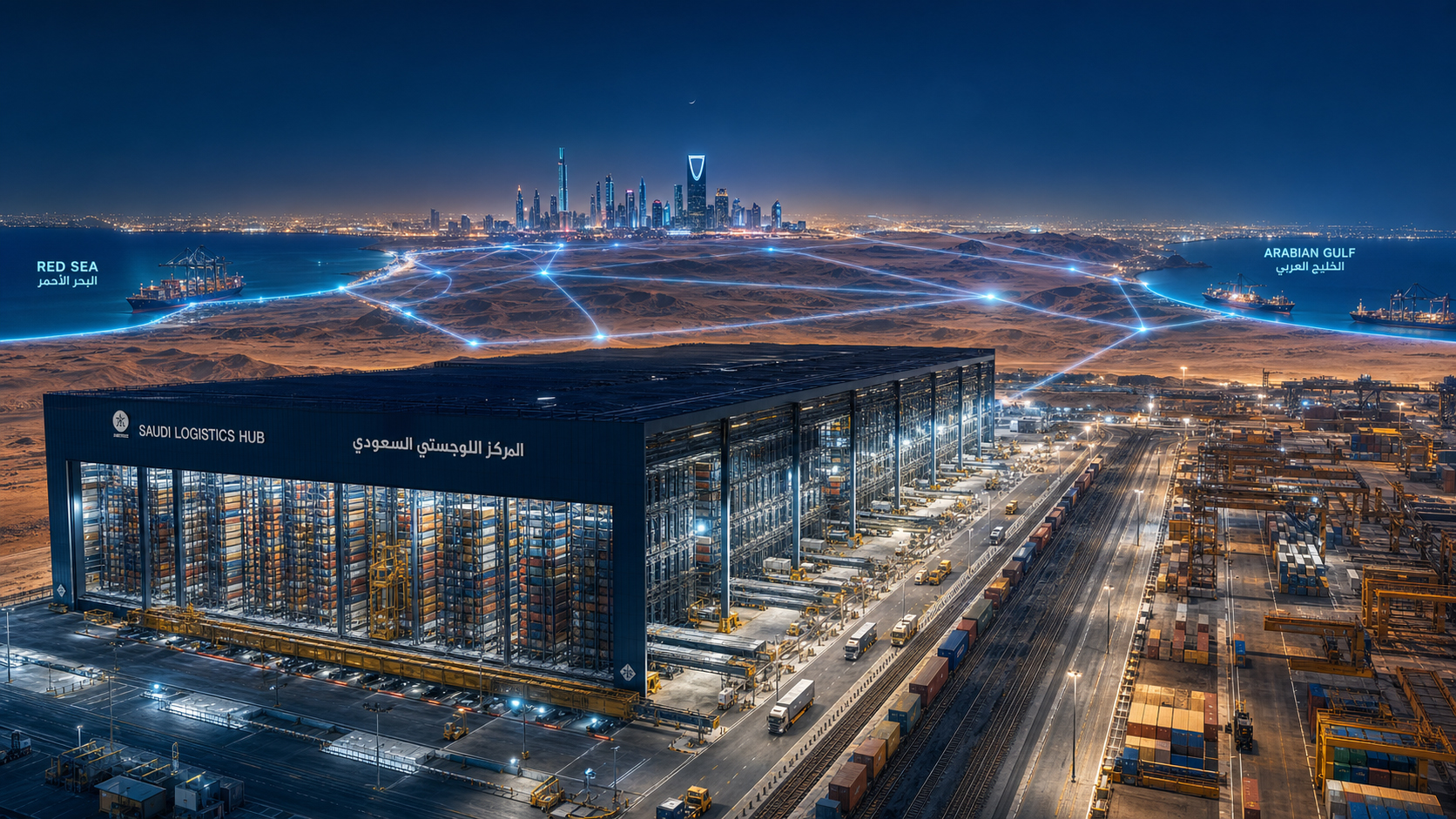
Saudi Arabia | How a kingdom becomes a logistics superpower: When straits fail, the desert comes into its own – Image: Xpert.Digital
1,300 kilometers through the sand: Why shipping companies now prefer to use trucks and trains instead of ships
Mega-project IMEC: This gigantic logistics network in Saudi Arabia is changing global trade
Robot ports and high-tech trains: The gigantic master plan for Saudi Arabia's logistics miracle
Global shipping is mired in an unprecedented, ongoing crisis. Houthi attacks in the Red Sea, persistent tensions in the Strait of Hormuz, and blocked bottlenecks like the Suez Canal are forcing the global economy to radically rethink its strategies. Amidst this geopolitical upheaval, a country previously associated primarily with oil is moving into the spotlight: Saudi Arabia. Through an unprecedented effort and billions in investment, the kingdom is transforming its deserts into the new lifeline of international trade. What began in 2026 as a logistical stopgap for major shipping companies like MSC is evolving, through mega-infrastructure projects and fully automated high-bay container warehouses, into a permanent and highly profitable alternative to the risky sea route. Discover how Saudi Arabia, with visionary projects like the IMEC corridor and European high-tech solutions, is rising to become an indispensable logistics superpower – and why the world's ocean bottlenecks could soon lose their significance.
Related to this:

Geopolitical tipping point: Why Saudi Arabia is suddenly irreplaceable as the nerve center of the new world trade order
The Strait of Hormuz has long been considered one of the most sensitive bottlenecks in global shipping, but it was only the cumulative impact of several simultaneous crises that gave the Kingdom of Saudi Arabia a central strategic role in world trade that seemed almost unimaginable just a few years ago. Since the beginning of the 2020s, a series of maritime disruptions has forced almost all major shipping companies to fundamentally rethink their established routes: Houthi attacks in the Red Sea, ongoing tensions surrounding the Strait of Hormuz, US and Israeli military operations against Iran, and the blockage of the Suez Canal in March 2021 have created a climate of permanent route uncertainty that is structurally transforming the logistics industry.
From March 2026, the situation deteriorated dramatically: Maersk, Hapag-Lloyd, and CMA CGM suspended transit through the Strait of Hormuz and extended their routes around the Cape of Good Hope. MSC, the world's largest container shipping company, had already issued so-called "End of Voyage" declarations prior to this point, whereby cargo destined for the Gulf was unloaded at the nearest safe ports and onward transport was organized separately. However, on May 2, 2026, MSC institutionalized this reactive measure into a planned network structure, thus transforming a defensive measure into an offensive logistics strategy.
In this geopolitically turbulent environment, Saudi Arabia plays a dual role: it is both the centerpiece of the MSC land corridor solution and the indispensable landmass upon which the visionary IMEC corridor (India-Middle East-Europe Economic Corridor) is built. Both concepts share the understanding that a future-proof trade architecture between India, the Middle East, and Europe is simply not feasible without a fully functional, intermodal Saudi Arabia.
A new line structure is emerging: The anatomy of the MSC land corridor – More than a makeshift solution
MSC's "Europe – Red Sea – Middle East Express," announced on May 2, 2026, is technically a multimodal circular service combining sea, land, and feeder shipping. The inaugural sailing departed Antwerp on May 10, 2026, with a rotation including Gdansk, Klaipeda, Bremerhaven, Antwerp, Valencia, Barcelona, Gioia Tauro, Abu Kir, and then via the Suez Canal to the Red Sea. The service utilizes vessels with a capacity of 14,000 to 16,000 TEU – significantly smaller than the megaships typically operating on the Far East route, but sufficiently sized to handle trans-European-Arabian trade economically.
The technical heart of the service is the land bridge across Saudi Arabia. Containers are unloaded at the Red Sea ports of King Abdullah Port in Rabigh and the Islamic Port of Jeddah, transferred to trucks, and transported via a roughly 1,300-kilometer route through Riyadh to the east coast port of Dammam (King Abdulaziz Port). From Dammam, feeder ships with significantly less capacity handle the onward distribution to the Persian Gulf – to Jebel Ali and Abu Dhabi in the United Arab Emirates, as well as to Bahrain, Kuwait, and Iraq.
Why the route via Riyadh is economically justifiable
At first glance, a 1,300-kilometer truck route appears costly and ecologically questionable. However, the economic calculation is more nuanced: The alternative route around the Cape of Good Hope extends travel time between Northern Europe and the Persian Gulf by an average of 10 to 14 days and significantly increases fuel consumption and charter costs. While the overland route through Saudi Arabia does generate direct transshipment and transport costs, it significantly reduces the overall transit time compared to the Cape route and allows for the maintenance of service reliability and frequency.
Furthermore, Saudi Arabia has invested heavily in its road infrastructure in recent years. The Jeddah–Riyadh–Dammam route is one of the best-developed and paved connections on the Arabian Peninsula, allowing semi-trailer trucks with container trailers to travel in three to four days. In the context of the current crisis, where many shipping companies are incurring over $100,000 in additional costs per day due to the detour around Cape Town, the truck overland segment represents an economically competitive option.
IMEC: The strategic long-term vision behind the makeshift solution
From the G20 declaration to the construction site
The India-Middle East-Europe Economic Corridor (IMEC) was officially launched at the G20 summit in September 2023 under the Indian presidency and is supported by the EU, Germany, France, Italy, the UAE, Saudi Arabia, India, and the USA. At its core, IMEC consists of two interconnected axes: an eastern corridor connecting India to the Arabian Peninsula and a northern corridor running from the Gulf to Europe. The total length of the corridor is approximately 6,400 kilometers.
The core of the IMEC concept is not a single infrastructure project, but an integrated, multimodal network of rail lines, ports, highways, data lines, power transmission corridors, and hydrogen pipelines. The first concrete steps toward its realization were taken in April 2025, when construction officially began on key infrastructure components such as new rail lines, ports, and highways. Research shows that IMEC could reduce transit times between India and Europe by more than 50 percent – a time saving that even exceeds initial projections.
Saudi Arabia as an indispensable anchor
Without Saudi Arabia, there is no IMEC. This statement sounds banal, but it carries considerable geopolitical implications. The Kingdom is geographically, economically, and politically at the heart of the planning: The IMEC route necessarily passes through Saudi territory to bridge the land-based section from the UAE to Jordan and Israel. At the same time, Saudi Arabia is by far the largest investor in regional infrastructure, with announced total investments in technology and infrastructure of US$267 billion.
However, the geopolitical situation in 2026 is complex: Saudi Arabia has signaled that while it recognizes the economic benefits of the IMEC project, it will not engage in direct cooperation with Israel on megaprojects until a lasting solution to the Israeli-Palestinian conflict is found. This stance slows down the expansion of IMEC in its most complete, Israel-inclusive configuration, but accelerates Saudi investment in those parts of the infrastructure that run within the Kingdom or towards the Gulf States.
The detailed concept: Intermodal transport system with container high-bay warehouse
System architecture of a future-proof corridor hub
The key insight from the MSC land corridor solution and the IMEC concept is this: A sustainably efficient, multimodal trade route through Saudi Arabia requires more than just truck convoys on asphalt. It needs a physical infrastructure that guarantees efficient, fast, and reliable transfers between modes of transport at the central transshipment points – the ports of Jeddah and King Abdullah Port in the west, and King Abdulaziz Port in Dammam in the east. At the heart of this infrastructure is a new generation of automated, intermodal logistics centers based on high-bay storage (HBS) container warehouses.
Such a center consists of several interdependent modules that work together as a seamless system:
Module 1: Seaside input interface
At the quay, incoming containers are fed into the HBS system via an Automated Stacking Crane (ASC) or reach stacker. Each container receives a digital identity (RFID tag or QR code) upon storage and is assigned a fixed shelf location. The system automatically determines the storage location based on the delivery destination, priority, and onward transport method.
Module 2: The Container High-Bay Warehouse
At its core is the fully automated HBS (High-Speed Binding System), where containers are stacked on top of each other in individually assigned racking compartments, up to 11 to 16 levels high. Unlike conventional container yards, where reshuffling – the unproductive rearranging of containers to access the right one – accounts for up to 60 percent of all crane movements, the HBS allows direct, individual access to each container without any restacking maneuvers. This drastically reduces handling times for trucks and trains, making turnaround times predictable and reliable. Systems like BOXBAY (a joint venture between DP World and the German SMS group) achieve an area capacity of over 5,400 TEU per hectare – three times that of conventional solutions.
Module 3: Landside Output Interfaces
The HBS is directly connected to three transfer interfaces: a truck handling facility with automated provision of containers at the respective parking space, a rail connection for direct transfer to container wagons, and a pipeline interface for refrigerated containers (reefer), which ensures an uninterrupted cold chain during handling.
Module 4: Digital Control Level
The entire system is controlled by a Terminal Operating System (TOS) that synchronizes ship schedules, train arrivals, truck slots, and port capacities in real time. Predictive analytics identify bottlenecks before they occur, and AI-powered routing algorithms optimize loading sequences based on destination port and priority. The digital layer enables seamless integration with the IMEC corridor's data exchange, including digital customs clearance and real-time tracking.
Location strategy: Where the hubs need to be built
On the western side of Saudi Arabia, King Abdullah Port in Rabigh and the Islamic Port of Jeddah provide the natural anchor points of the intermodal system. The Islamic Port of Jeddah, which is slated for expansion from 2.5 to 20 million TEU of annual throughput by 2030, is the largest single investment project in the Saudi port sector, with a project volume of nearly US$7 billion. At this port, an HBS-supported transshipment center is not only sensible but, given the planned eightfold increase in capacity, virtually essential, as conventional expansion is hardly feasible due to topographical and financial constraints.
On the eastern side, King Abdulaziz Port in Dammam (KAPD) forms the counterpart. The groundbreaking ceremony in November 2025 for the Dammam Integrated Logistics Zone, located directly adjacent to KAPD, with an area of one million square meters and an investment volume of up to US$346 million, marks the first step towards an integrated eastern hub architecture. The facility will be connected to KAPD, the SGP Intermodal (Riyadh Dry Port Ecosystem), and road and rail links, and is expected to reach an annual capacity of up to 300,000 TEU.
A third strategic hub would be an inland dry port near Riyadh. This would serve not only as a buffer against potential capacity bottlenecks at the coastal ports, but also as a distribution center for the Saudi domestic market and as a transshipment point for the planned Saudi Landbridge railway.
The Saudi Landbridge: From truck land bridge to rail connection
The currently used truck-land bridge is functional, but not the final stage of the concept. The strategic perspective clearly points to rail. The Saudi Landbridge project – a rail corridor connecting the Red Sea ports with Dammam on the Gulf – is the key infrastructure project of the coming decade. With an investment of US$7 billion and a planned total length of more than 1,500 kilometers, including a 900-kilometer new line between Jeddah and Riyadh, the route is intended to transport containers from Jeddah to Dammam in under ten hours – compared to three to four days by truck. Construction is scheduled to begin in 2026, with commissioning planned for 2030.
With container trains operating at speeds of around 120 kilometers per hour for freight transport and seven new logistics centers along the corridor, the Saudi Landbridge will drastically reduce the cost per TEU on the land segment, thus sustainably improving the competitiveness of the entire trade route compared to the sea route around the Cape of Good Hope. Only the rail link will elevate the Saudi land corridor from a tactical stopgap measure to a strategic infrastructure asset of global importance.
LTW Intralogistics: The ideal system provider for the Saudi corridor
Among the available providers of automated container high-bay warehouse systems, LTW Intralogistics, headquartered in Wolfurt, Austria, occupies a prominent position – for reasons that are particularly crucial for the requirements of the Saudi Intermodal Corridor. Founded in 1981, LTW has always been a wholly owned subsidiary of Doppelmayr Holding SE, the world's leading ropeway manufacturer. This affiliation is not merely a side note, but rather the key to a decisive competitive advantage: All LTW storage and retrieval machines and conveyor technology components are manufactured to ropeway standards – a level of quality mandated by international law for public passenger transport and thus among the strictest production standards in the world.
This manufacturing standard translates specifically into: maximum material strength, extremely tight manufacturing tolerances up to a height of 45 meters, exceptional robustness against continuous operation, and a lifetime guarantee for mechanical components that is unusual for the intralogistics industry. In an environment like the Saudi Arabian ports, where salty air, extreme heat, and 24/7 operation are the norm, this industrial resilience is the critical differentiator against competitors.
The technical specifications of LTW systems are precisely tailored to the requirements of the Saudi corridor: The storage and retrieval machines are designed for payloads from 50 kilograms to over 8 tons – and up to 18 tons for heavy-duty versions used in container applications. The certified operating temperature range extends from -30 degrees Celsius to +60 degrees Celsius, meaning that the systems can operate fully and without any loss of performance even in the extreme summer conditions of Saudi Arabia, where temperatures can reach up to 50 degrees Celsius. This thermal certification clearly distinguishes LTW from systems designed for temperate climates, which often necessitate technical compromises during the Arabian summer.
For the corridor's core intermodal function – the simultaneous transshipment between ship or feeder vessel, rail, and truck – LTW offers the EcoSlider system, a patented horizontal handling technology built on the stacker cranes. This system enables the direct transfer of containers between trains and racks without additional handling equipment. Within a width of just 12 meters, up to 100 swap bodies (13.60 meters) can be stored per 100 meters of length – a space efficiency ideal for the limited port areas in Jeddah and Dammam. The loading track is integrated directly into the high-bay warehouse, allowing trains to be loaded and unloaded without shunting.
LTW has already proven the practicality of its container high-bay warehouse systems in a real-world reference project: The first LTW container warehouse was developed and implemented for armasuisse, the Swiss Federal Office for Defence Procurement. The 20-meter-high storage and retrieval machine, with a payload of 18 tons, stores containers, swap bodies, and roll-off containers. A special gate system even allows maintenance work to be carried out directly at the storage location without having to remove the container. Another reference project is the fully automated high-bay warehouse at the Jungfrau Railway station at 3,454 meters above sea level – proof of the technology's functionality under extreme environmental conditions.
The decisive advantage over competitors like BOXBAY (a joint venture of DP World and SMS group) lies in its comprehensive systems expertise: LTW not only develops, manufactures, and installs the mechanical components (storage and retrieval systems, conveyor technology), but also, as a general contractor and full-service provider, supplies all the control and warehouse management software from a single source. This depth of software expertise – achieved through the 2017 integration of a Vienna-based software company – eliminates the interface problems common in port logistics between mechanical systems and Terminal Operating Systems (TOS) from different providers. For an intermodal corridor that must coordinate ship arrivals, train schedules, and truck slots in real time, this integrated software solution represents a significant operational advantage.
Ultimately, overall plant availability is the decisive KPI for a corridor of this strategic importance. Depending on the agreed maintenance contract, LTW guarantees availability of up to 99 percent and ensures this through redundant drive systems, a 24/7 hotline, and remote maintenance access. In contrast to BOXBAY, which was developed as a joint venture of a port operator (DP World) primarily for its own port installations, LTW positions itself as a manufacturer-independent, globally operating system integrator with over 1,000 completed projects in more than 36 countries. This profile is particularly attractive for Saudi Arabia, which prefers a neutral technology partner not tied to a specific shipping company or port group.
Under Saudi Arabia's intense solar radiation, solar-equipped HBS roofs, combined with LTW all-electric storage and retrieval systems, can not only cover the warehouse's entire electricity demand but, ideally, enable energy-positive operation. The all-electric drives completely eliminate diesel emissions within the enclosed warehouse area and reduce noise levels to those of an urban environment.
Your container high-bay warehouse and container terminal experts

Container high-bay warehouses and container terminals: The logistical interplay – expert advice and solutions - Creative image: Xpert.Digital
This innovative technology promises to fundamentally change container logistics. Instead of stacking containers horizontally as before, they will be stored vertically in multi-story steel racking structures. This not only allows for a drastic increase in storage capacity within the same area, but also revolutionizes all processes at the container terminal.
More information here:
Opportunities and risks of the Saudi corridor: Geopolitics, capital and the future of transit
Economic Depth Dimensions: What Saudi Arabia Earns from this Role
The logistics sector as a growth engine
Saudi Arabia's freight and logistics market is estimated to be worth approximately US$25 billion in 2024 and is projected to grow to around US$33 billion by 2029, representing an average annual growth rate of 5.4 percent. These figures already reflect the investment drive of Vision 2030, which aims to increase the share of the transport and logistics sector in Saudi GDP from its current 6 percent to 10 percent and boost annual revenues from the sector to US$12 billion. The total framework for planned investments in technology and infrastructure amounts to US$267 billion.
Container throughput is projected to increase from approximately 10 million TEU currently to 40 million TEU by 2030. This represents a fourfold increase within just a few years and requires an investment volume of over US$12 billion in port projects currently in the planning or construction phase. The expansion of the Islamic Port of Jeddah alone represents a project volume of almost US$7 billion. With the goal of ranking among the world's top ten logistics hubs by 2030, Saudi Arabia has unequivocally stated its ambition.
The strategic rent effect of geography
The economic logic behind Saudi Arabia's logistics ambitions extends beyond mere infrastructure investments. Saudi Arabia occupies a geographically unique position: the country has simultaneous access to the Red Sea (approximately 1,800 kilometers of coastline) and the Persian Gulf (approximately 560 kilometers of coastline), placing it directly on the trade axis between the Indian subcontinent, the Middle East, and Europe. Roughly 13 percent of total global trade already flows through Saudi Arabia's region. This geographical monopoly means that any disruption in the straits surrounding the Arabian Peninsula automatically increases the value of land routes through Saudi Arabia.
Economists refer to this as a strategic rent effect: Saudi Arabia generates revenue not despite, but precisely because of its unique geographical position during times of crisis. The more the straits become unreliable, the more valuable the Saudi transit corridor becomes. This effect is not fleeting. Once established, logistics infrastructure creates network effects and lock-in relationships that persist beyond the current crisis.
Competition and complementarity: MSC Land Corridor and IMEC
The MSC Land Corridor and IMEC are not competing concepts, but rather different stages of development for the same strategic corridor. The MSC Land Corridor is the short-term operational solution: it utilizes existing road infrastructure, ports, and a flexible multimodal freight model to bridge the maritime crisis of 2025/2026. IMEC is the long-term institutional vision: a legally binding, government-backed infrastructure corridor with a rail system, digital connectivity, and energy transport infrastructure.
During the transition phase, the operational use of the MSC corridor strengthens the political and economic justification for IMEC's investments. Every MSC container shipment passing through the Saudi corridor demonstrates its functionality and creates stakeholder interest, encouraging further development towards a rail connection. At the same time, IMEC's vision increases the Saudi government's willingness to improve the framework for private logistics players such as MSC, Medlog, and other shipping companies and freight forwarders.
Related to this:

Risks and structural limitations of the concept
Geopolitical dependency problems
The strength of the Saudi corridor is simultaneously its structural weakness: it concentrates critical trade infrastructure in a single country with its own unique geopolitical dynamics. Saudi Arabia itself is not without its tensions. Saudi-Israeli relations are at a low point after the Gaza War, the Saudi-Iranian rivalry remains structurally virulent, and domestic decision-making structures under MBS (Mohammed bin Salman) are centralized and potentially volatile. A shift in Riyadh's political course—such as a rapprochement with Tehran or a falling out with Washington—could jeopardize transit agreements and undermine the reliability of the trade route.
In addition, there is the IMEC-specific blockage: As long as the Palestinian question remains unresolved, Saudi Arabia refuses to integrate Israel into the IMEC rail network, thus blocking the entire corridor from India to Europe via Saudi Arabia and Israel. The current MSC land corridor solution circumvents this problem by excluding Israel from the route and instead entering the area via Aqaba (Jordan).
Capacity and time slot adherence
The current truck-based land bridge scales poorly. With increasing volume, not only does the number of vehicles rise, but so do the coordination effort, the risk of congestion on the roads within the Arab world, and the likelihood of delivery delays. The heterogeneity of driver's license regulations, toll rules, and safety requirements in a truck-dominated transport model creates friction that potentially multiplies with increasing volume. Only rail provides the necessary scalability: A single container train has the capacity of several dozen truck units and, with a functioning timetable, can offer drastically higher capacity with significantly better punctuality.
Technological and financial feasibility
The development of fully automated HBS systems in Saudi ports requires substantial initial investment. BOXBAY's HBS system at London Gateway, built for just under €100 million, comprises 16 levels for empty containers. Significantly higher investment volumes are required for a fully integrated HBS for loaded containers in Jeddah or Dammam. However, the Saudi government and private operators like Saudi Global Ports (SGP) possess the capital resources for these investments, as demonstrated by the US$346 million investment in the Dammam Integrated Logistics Zone. The public-private partnership (PPP) model used at the Dammam Logistics Zone, which provides for a 30-year concession, could serve as a blueprint for further HBS projects.
Competition from China and the Belt and Road Initiative
Two visions for the same corridor
IMEC was explicitly conceived as a strategic counterweight to China's Belt and Road Initiative (BRI), and this juxtaposition significantly shapes the project's political dynamics. In recent years, China has invested heavily in port infrastructure in the region—in the port of Haifa in Israel, in Gwadar in Pakistan, and indirectly through COSCO at various hubs in the Red Sea. A successful IMEC corridor would counteract this Chinese infrastructure strategy in the region by offering Western-oriented countries an alternative, geopolitically more reliable trade architecture.
Saudi Arabia is navigating this competition pragmatically: Riyadh maintains strong economic ties with China, the US, and Europe. Its strategy is not to commit to one side, but to build its own strategic importance by positioning the Kingdom as an indispensable hub for all geopolitical actors. A successful transit corridor capable of channeling both IMEC-oriented and BRI-related trade flows will maximize Saudi added value and geopolitical freedom of action.
Vision 2030 as an institutional driver
More than marketing: Structural transformation
Saudi Arabia's Vision 2030 is not merely a collection of ambitious targets, but the institutional framework that provides the Kingdom's logistics initiative with political legitimacy and budgetary resources. The National Transport and Logistics Strategy (NTLS), adopted in 2021, sets concrete, measurable goals: Saudi Arabia's ranking among the top 10 in the Logistics Performance Index (up from 55th place in 2018), the increase of air freight capacity from 0.8 to 4.5 million tons, and the quadrupling of container throughput to 40 million TEU by 2030.
Progress has been made, particularly on the regulatory side: the reduction of container customs clearance times and the digitalization of supply chain processes are measurable early indicators of the corridor's operational quality. Without these efficiency gains, even the best port capacities are of little use if containers are stuck in customs procedures for days.
The program also includes the construction of 37 new logistics centers by 2030, the expansion of seaports and airports, and tax breaks for selected companies in the logistics sector. This combination of infrastructure investment and regulatory reform is unprecedented in the region in its consistency and intensity, giving Saudi Arabia an institutional advantage over potential competitors such as Turkey or Egypt.
Intermodal detailed concept: Process architecture of the overall system
The three functional levels
A complete intermodal transport center based on container high-bay warehouses operates on three interconnected functional levels:
The physical level encompasses the port infrastructure (quayside, cranes, rail connection, truck access), the HBS core module with stacker cranes and conveyor technology, and the connection to external transport modes (road, rail, feeder). At this level, space efficiency is the critical bottleneck: In a large port like Jeddah, which is slated to grow from 2.5 to 20 million TEU, an eightfold horizontal expansion is logistically and urbanistically unfeasible. HBS systems, which can store three to four times the volume on the same footprint, are the only realistic solution.
The digital layer connects the Terminal Operating System (TOS) with national customs and clearance systems, shipping companies' (such as MSC) booking systems, and shippers' tracking systems. For IMEC, digital interoperability is an equally important area of focus alongside physical infrastructure: The agenda includes smart port platforms, data interoperability, cybersecurity, alternative fuels, and low-emission technologies. Without harmonized digital standards between the participating countries—Saudi Arabia, the UAE, Jordan, India, and the EU member states—a friction zone arises at every border crossing, negating any time savings.
Finally, the institutional level governs the corridor's governance structure: customs agreements, transit Memoranda of Understanding (MoUs), liability regulations for transit cargo, insurance standards, and dispute resolution mechanisms. This level is the least visible but the most difficult to establish. Experience with international transport corridors shows that technical and physical infrastructure is typically completed more quickly than the institutional framework that governs its ongoing operation.
Phase model of implementation
A realistic implementation strategy for the intermodal Saudi corridor is divided into three phases:
In the first phase (2026–2028), the existing truck land bridge will be optimized through operational improvements: dedicated truck lanes on the Jeddah–Riyadh–Dammam route, digital fleet management systems, accelerated customs clearance at the transshipment ports, and the installation of modular HBS pilot systems at one location each on the west and east coasts.
In the second phase (2028–2031), the transition to rail will take place with the commissioning of the Saudi Landbridge. HBS systems will be fully scaled and integrated with the rail network. The inland dry port infrastructure in Riyadh will become fully operational. Digital integration with IMEC partner countries, particularly India and the UAE, will be accelerated.
In the third phase (2031 and beyond), the corridor will operate as an integral part of the global trade infrastructure. Depending on geopolitical developments – particularly the status of Israeli-Arab relations and the Strait of Hormuz – the IMEC corridor may be extended towards Israel and Greece, transforming it from a regional to a genuine intercontinental supply network.
Saudi Arabia as an unavoidable logistics axis
Saudi Arabia, through a combination of favorable geography, massive infrastructure investments, and a political leadership that views diversification as a matter of national interest, has maneuvered itself into a position where the international logistics industry ultimately has no alternative but to cooperate closely. The MSC Land Corridor is the immediate, pragmatic response to the 2025/2026 crisis – but it lays the groundwork for a far more fundamental reshaping of global trade geography.
The detailed intermodal concept with container high-bay warehouses is not a luxury, but a technical necessity: only the vertical density and fully automated direct accessibility of HBS systems can achieve the throughput required by a corridor of this importance without exceeding the available port space. BOXBAY, AMOVA, and Konecranes-Pesmel are the technological enablers, and Saudi Arabia's vested interest in a successful logistics sector ensures the necessary financing.
The real challenge lies not in the technology, but in institutionalization: A reliable corridor requires political stability, transparent legal systems for transit transport, and a Saudi Arabian state that does not jeopardize its strategic value as a transit country through short-term geopolitical maneuvers. Whether Saudi Arabia can maintain this balance—as an ally of the West, as an accepted partner of China, and as a regional power without the stigma of being a pariah state—is the crucial unknown of the next decade.
However, one thing is certain: the global trade architecture, structured for decades by the unimpeded passage through Suez and Hormuz, has been permanently shaken. Saudi Arabia is the logical hinge of the new order. And the kingdom is investing in this role with a determination that leaves no doubt about its long-term ambition.
Consulting - Planning - Implementation

Konrad Wolfenstein
I would be happy to serve as your personal advisor.
me at wolfenstein∂xpert.digital contact
Just call me on +49 7348 4088 965 .
Our global industry and economic expertise in business development, sales and marketing

Our global industry and economic expertise in business development, sales and marketing - Image: Xpert.Digital
Industry focus areas: B2B, digitalization (from AI to XR), mechanical engineering, logistics, renewable energies and industry
More information here:
A thematic hub offering insights and expertise:
- Knowledge platform covering global and regional economies, innovation and industry-specific trends
- A collection of analyses, insights, and background information from our key areas of focus
- A place for expertise and information on current developments in business and technology
- A hub for companies seeking information on markets, digitalization, and industry innovations
Your container high-bay warehouse and container terminal experts

Container terminal systems for road, rail and sea transport in the dual-use logistics concept of heavy-lift logistics - Creative image: Xpert.Digital
In a world marked by geopolitical upheavals, fragile supply chains, and a new awareness of the vulnerability of critical infrastructure, the concept of national security is undergoing a fundamental reassessment. A state's ability to guarantee its economic prosperity, the provision of essential goods and services to its population, and its military capability increasingly depends on the resilience of its logistical networks. In this context, the concept of "dual-use" is evolving from a niche category of export control to a broader strategic doctrine. This shift is not merely a technical adjustment but a necessary response to the "paradigm shift" that demands a profound integration of civilian and military capabilities.
Related to this:










