

Published on: January 24, 2026 / Updated on: January 24, 2026 – Author: Konrad Wolfenstein
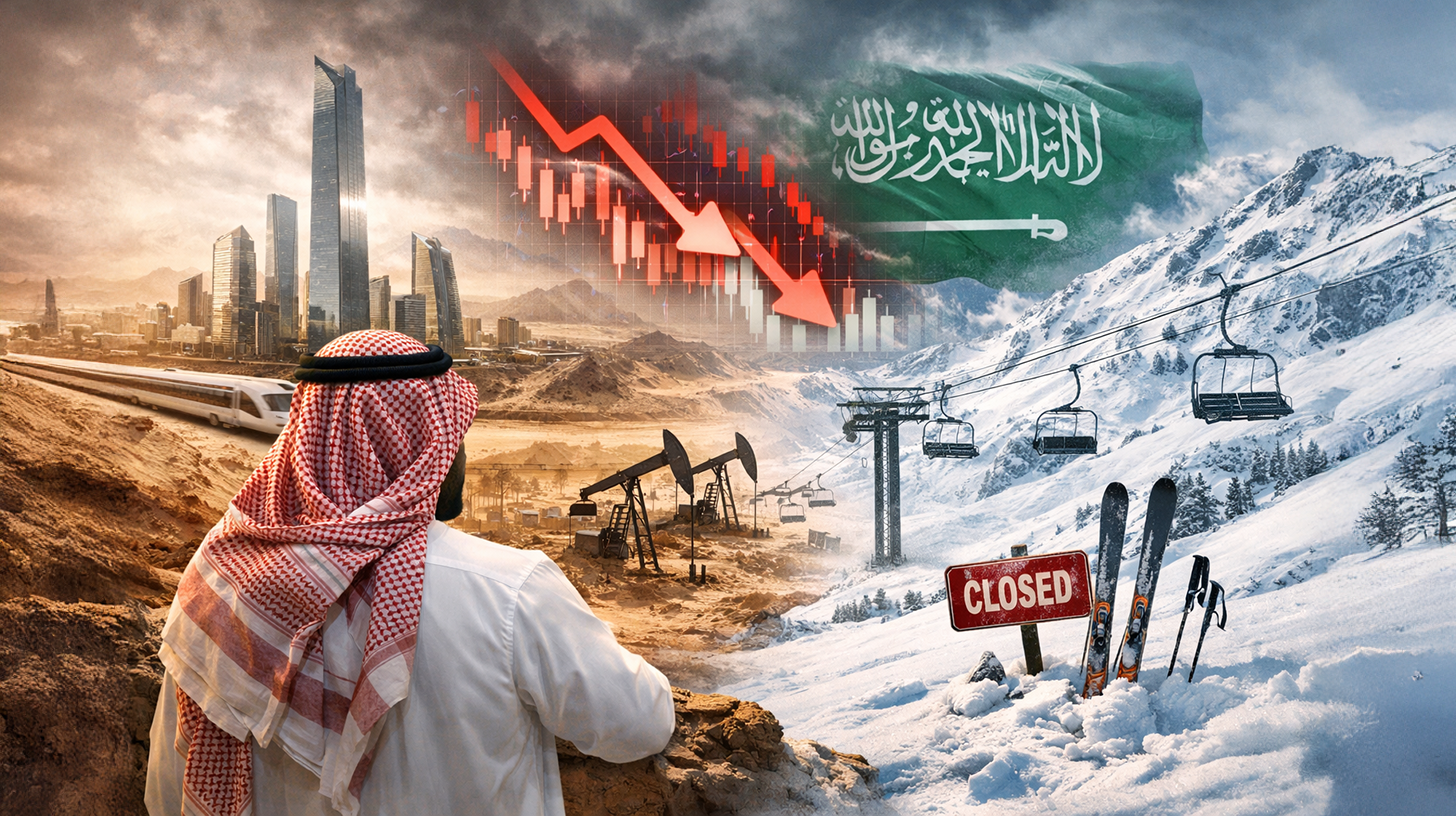
Saudi Arabia postpones the 2029 Asian Winter Games: Analysis of the systemic crisis behind the decision – Creative image: Xpert.Digital
Why Saudi Arabia's winter fairytale is now truly bursting
Oil billions are not enough: The brutal financial truth behind the Saudi withdrawal
The postponement of the 2029 Asian Winter Games by Saudi Arabia is not an isolated sports-political maneuver, but rather the logical consequence of a systemic crisis that calls into question the kingdom's entire transformation strategy. The decision, officially declared a "strategic delay," is symptomatic of profound financial and structural disillusionment, which culminated in the spectacular failure of "The Line." Analysis reveals a pattern of fatal megalomania, unrealistic cost calculations, and a collapse of international credibility that even the kingdom's oil billions cannot withstand.
The 2029 Asian Winter Games had been officially awarded to Trojena as part of the NEOM project in Saudi Arabia.
Where exactly should they take place?
- The venue was Trojena, a planned mountain and winter sports resort within the NEOM region in northwestern Saudi Arabia.
- Trojena is located about 50 km from the coast, at an altitude of around 1,500–2,600 m; the winter sports competitions were to take place there on artificial snow.
How safe was the venue?
- The award was made by the Olympic Council of Asia (OCA) on October 4, 2022 in Phnom Penh; Saudi Arabia would thus have been the host of the Asian Winter Games for the first time.
- However, there were concerns about the construction progress of Trojena; since the resort would probably not be completed in time, the OCA also considered alternatives such as a possible location in South Korea or China.
Financial reality: The limits of oil financing
Budget crises and oil price arbitrage
Saudi Arabia is in a precarious financial situation that exposes the fundamental discrepancy between ambition and economic reality. The kingdom needs an oil price of at least $96 per barrel to balance its budget. In fact, the effective break-even point is above $100 when megaproject expenditures are factored in. However, the reality of the oil market confronts Riyadh with prices that have not reached this threshold for years.
The budget deficit has worsened dramatically. In the first half of 2025, Saudi Arabia recorded a deficit of 93 billion Saudi riyals (US$24.8 billion), more than three times the previous year's deficit. Oil revenues fell by 24 percent during the same period, while spending on megaprojects continued to rise. This development illustrates an unsustainable financial spiral that is forcing the Kingdom to radically rethink its priorities.
The PIF under pressure: From vision to currency crisis
The Public Investment Fund (PIF), the financing instrument for the transformation plans, is coming under increasing pressure. Its cash reserves reached their lowest level in years in 2023, while the fund had to drastically reduce its profits – by 60 percent to just $6.9 billion in 2024. The PIF valuation of the megaprojects was written down by $8 billion, officially documenting exploding costs and delays.
The share of gigaprojects in the PIF portfolio fell from 8 percent (241 billion riyals) in 2023 to 6 percent (211 billion riyals) in 2024 – a decline of over 12 percent. These figures demonstrate that even Saudi Arabia's vast oil reserves are insufficient to plug the enormous financial holes created by these megaprojects.
The failure of "The Line" and "NEOM": Symbols of a systemic failure
"The Line": From 170 kilometers of vision to 2.4 kilometers of reality
"The Line" was conceived as the crown jewel of Saudi Arabia's transformation strategy – a 170-kilometer-long futuristic linear city in the desert, intended to revolutionize urban life. The reality is a spectacular debacle: instead of the planned metropolis for 1.5 million inhabitants, only 2.4 kilometers will be completed by 2030 – a reduction of over 98 percent. The target population has been slashed to less than 300,000 people.
Suitable for:

“NEOM”: The cost explosion: From 500 billion to 8.8 trillion dollars
The original cost estimate of $500 billion for the entire NEOM project proved to be completely unrealistic. An internal report obtained by the Wall Street Journal put the actual total cost at an astronomical $8.8 trillion. This sum is more than 25 times the annual Saudi Arabian state budget. Construction time would increase from the originally planned 25 years to over 60 years, with completion not expected until 2080.
The figure pair “from 500 billion to 8.8 trillion dollars” refers to new, unofficial cost forecasts – it is not an officially confirmed budget, but an internal estimate that has been picked up by the media.
What is "true" about the statement:
- The original, officially communicated framework for NEOM was around 500 billion US dollars, primarily through the Public Investment Fund (PIF).
- According to an internal audit, which was reported on by the Wall Street Journal and numerous media outlets, the long-term total cost forecast has now been raised to as much as $8.8 trillion.
- This 8.8 trillion refers to an “end-state” scenario up to about 2080, not to expenditures up to 2030 or 2040.
What needs to be limited:
- The 8.8 trillion is an internal projection from an audit, not an officially confirmed government line or a figure communicated by NEOM itself as a new official budget; NEOM representatives have criticized the interpretation of these figures as "misinterpreted".
- Other estimates in the public debate are significantly lower, some as high as "1.5 trillion US dollars" for NEOM as a whole; the 8.8 trillion is therefore more of a worst-case or maximum scenario from an internal audit report.
- According to the audit, part of this sum would be financed over many decades, partly by private investors, and not exclusively through the Saudi state budget.
The factually correct statement is: "The NEOM project was originally estimated at $500 billion; a later internal audit is said to have projected the potential total costs in the long term to as much as $8.8 trillion."
Management errors and systematic disinformation
In addition to macroeconomic problems, serious management errors contributed to the project's failure. According to reports in the Wall Street Journal, there was systematic manipulation of financial reporting. Executives allegedly included unrealistic assumptions in business plans to conceal cost overruns. A project manager who openly criticized these cost estimates was dismissed. The original architect of "The Line," Thom Mayne, wanted to inform the Crown Prince about the true costs but was prevented from doing so by NEOM's leadership.
These “mutual deceptions” meant that Crown Prince Mohammed bin Salman was kept in the dark for a long time about the true costs and problems of his prestige project. This culture of misinformation is symptomatic of autocratic systems in which critical voices are suppressed and unpleasant truths are concealed.
The postponement of the Asian Winter Games: a consequence of the systemic crisis
Trojena: The unrealizable desert skiing
The 2029 Asian Winter Games were supposed to take place in Trojena, a planned ski resort in the mountains of NEOM. The project included ski slopes on the roofs of luxury hotels, a 3-kilometer-long artificial freshwater lake, and a state-of-the-art hospitality and entertainment complex ("The Vault") blasted into the mountain. The reality: Construction is significantly behind schedule, and the project would not be completed in time without a substantial budget increase.
The technical challenges are enormous: 2.7 million cubic meters of water would have to be pumped through a 1-meter-diameter pipe at full capacity for at least two years to create the artificial lake. Construction on the main desalination plant in Sharma hasn't even begun, making it extremely unlikely that the 2029 deadline will be met.
The formal decision: From postponement to a stoppage
On January 23, 2026, the Olympic Committee of Asia (OCA) and the Saudi Arabian Olympic Committee issued a joint statement confirming the postponement of the Games to a later, unspecified date. Officially, the decision is justified as a "strategic delay" to "develop a winter sports culture." The reality: This is an admission of failure.
As early as August 2025, the OCA approached South Korea and China as potential replacement hosts. South Korea confirmed that the OCA had formally inquired about taking over. The fact that Saudi Arabia now intends to hold "a series of independent winter sports events in the coming years" instead of hosting the Games suggests that the Games have not only been postponed but effectively canceled.


