
German precision meets Chinese speed: Why industrial negotiations fail even though both sides want to win together
Xpert Pre-Release

Available in 27 languages 📢
Prefer Xpert.Digital on GoogleⓘPublished on: August 15, 2026 / Updated on: August 15, 2026 – Author: Konrad Wolfenstein
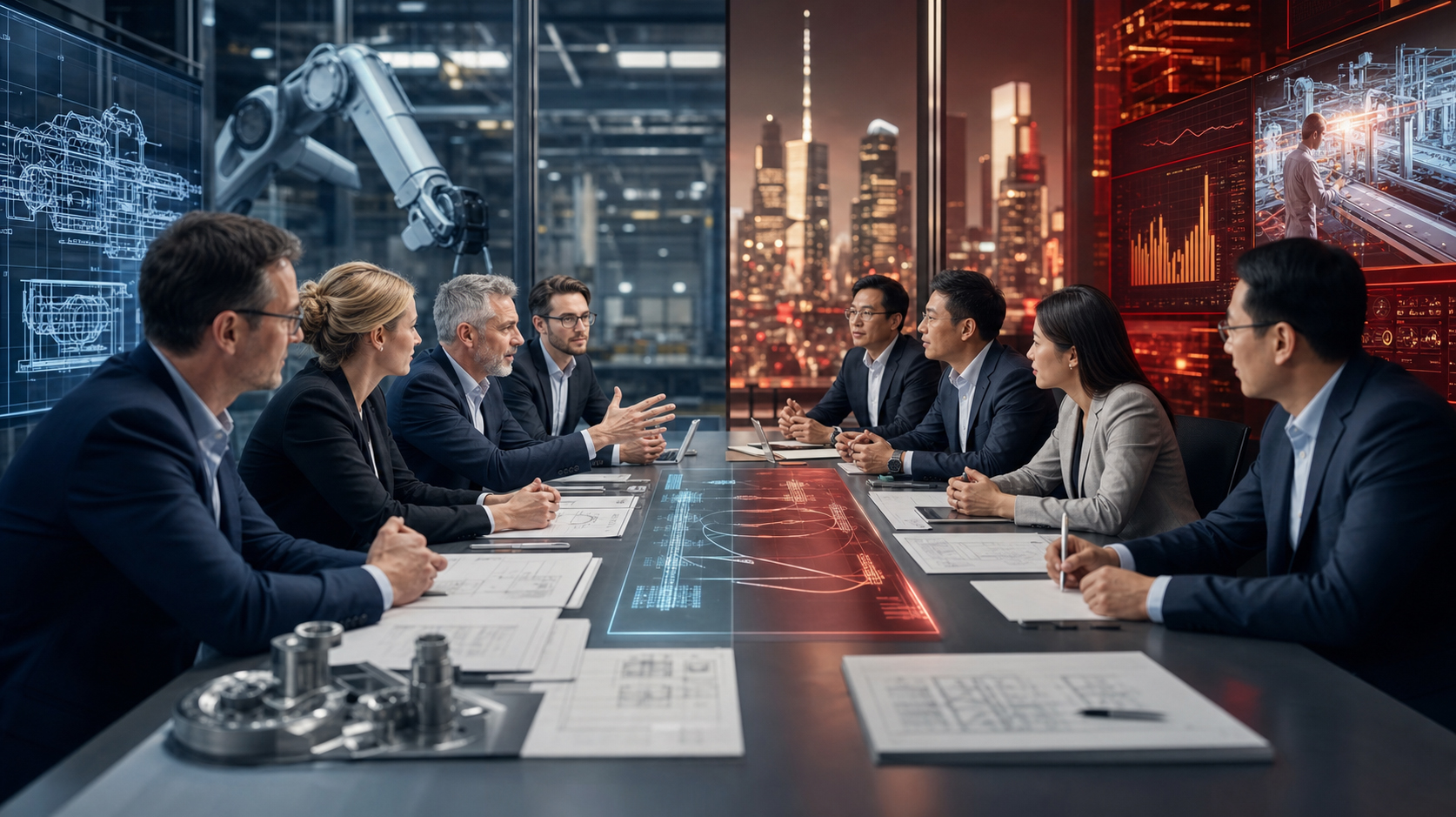
German precision meets Chinese speed: Why industrial negotiations fail even though both sides want to win together – Image: Xpert.Digital
Too slow, too inflexible? How German precision is becoming a real competitive advantage in China
Negotiating in China: The most dangerous mistake German managers are making today
The Chinese market has radically changed its rules of the game. Where once the "Made in Germany" label and superior engineering almost automatically opened doors, German industrial companies now face a significantly tougher environment. Confident, technologically advanced local competitors and a relentless pace of market change characterize the new landscape. When German planning certainty clashes with Chinese agility in this tense environment, worlds often collide – and misunderstandings at the negotiating table are practically inevitable.
But those who dismiss these points of friction merely as cultural hurdles miss the true core of the problem and forfeit valuable market share. It's no longer just about intercultural politeness, but about hard-nosed economic negotiation logic. The following article delves into why classic German strategies – such as the persistent emphasis on the calculated "best price" or lengthy bidding processes – are increasingly ineffective in China. Learn how to strategically adapt your own working methods so that German thoroughness becomes a measurable commercial competitive advantage, rather than a costly sales disadvantage.
Related to this:
"That's our best price": Why this sentence often means the end of negotiations in China
Cooperation between German and Chinese industrial companies remains highly relevant economically, but is becoming more demanding. China continues to be a key trading and production partner for Germany, while German companies simultaneously face increased competitive pressure, local Chinese competition, growing imports, and declining export opportunities. Therefore, market success is no longer solely determined by the technical quality of a product, but rather by the ability to professionally combine different decision-making and negotiation logics.
In recent years, many negotiations between German and Chinese industrial companies have shown a recurring pattern: Both sides approach the collaboration with genuine interest, possess highly competent teams, and often see real economic benefits. Nevertheless, delays, disappointments, price disputes, or a gradual erosion of trust arise. The reason is rarely the language barrier. Far more often, differing expectations regarding speed, information quality, pricing, decision-making processes, risk, and relationship management clash.
The problem often begins when one side views its own working methods as a neutral standard. German companies often interpret thorough preparation, technical documentation, precise cost calculations, and robust processes as signs of professionalism. Chinese counterparts, on the other hand, may perceive these same elements as slow, inflexible, or overly focused on internal safeguards. Conversely, a quick inquiry, a short-term price comparison, or repeated renegotiation on the German side can create the impression that the potential customer isn't taking the technical expertise seriously or is simply trying to put pressure on the supplier.
Both interpretations fall short. They are neither an expression of a lack of seriousness nor necessarily indicative of a fundamental cultural incompatibility. They stem from differing economic experiences. Germany is strongly characterized by long-term planning, standardized processes, engineering quality, product liability, documentation requirements, and an industry where errors often result in high consequential costs. China, on the other hand, is more strongly characterized by high market velocity, intense comparability, rapid supply cycles, regional competition, and a high capacity to make decisions with incomplete information.
Those who treat these differences as cultural stereotypes are doomed to failure. Those who understand them as economic logic can turn them into a significant competitive advantage.
Related to this:

The economic context changes the positions in the discussion
German-Chinese industrial relations today take place in a significantly tougher environment than ten or fifteen years ago. German companies in China no longer encounter only price-oriented local manufacturers, but also technologically advanced competitors in mechanical engineering, automation, electromobility, battery technology, robotics, photovoltaics, software, and industrial digitalization. At the same time, the Chinese market remains strategically relevant for many German companies due to its size, its industrial ecosystem, and its dynamic innovation.
Economic ties remain strong. China has remained Germany's most important trading partner in terms of imports, while at the same time the trade balance is increasingly shifting to the detriment of German manufacturers. German exports to China have recently come under pressure, while Chinese deliveries to Germany have gained considerable importance. This exacerbates the situation, particularly in sectors where German companies have long benefited from technological, quality, and brand advantages.
At the same time, German companies continue to invest in China. According to available data, direct investments rose to around seven billion euros in 2025, representing a significant increase compared to the previous year. This development reveals an important strategic reality: many companies are not reducing their dependence through a complete withdrawal, but rather through greater localization. They are producing closer to the market, expanding local research and development, developing regional supply chains, and adapting products to Chinese customer requirements.
This leads to an uncomfortable realization: For German industrial companies, the Chinese market is no longer primarily an export destination for technologically superior products. It is increasingly a competitive arena where speed, adaptability, service, local presence, and cost structure are becoming just as crucial as traditional engineering quality.
Negotiations reflect this new reality. A Chinese buyer or CEO no longer negotiates with just one German supplier. They often compare several international and local options simultaneously. Negotiations thus become a process of market exploration: Who can react quickly, answer technical questions clearly, reduce risks, demonstrate delivery capability, signal price flexibility, and provide local support if necessary?
This situation can be frustrating for German suppliers. They invest time in technical clarification, proposal development, and feasibility analyses, while the customer is simultaneously speaking with several competitors. But this is precisely where it's decided whether German thoroughness translates into a commercial advantage or a costly sales disadvantage.
Proposal preparation: Thoroughness without tact costs orders
A typical scenario begins with an inquiry for a complex machine, an automation solution, a production line, or an engineering project. The German company initially wants to review specifications, clarify technical requirements, define interfaces, assess risks, compare production capacities, and obtain internal approvals. After two weeks, a meticulously prepared proposal is available, possibly including technical specifications, a project plan, a warranty concept, and payment terms.
On the Chinese side, the reaction may be sobering: other providers have already delivered initial guidance within just a few days. The question then is not necessarily whether the German offer is technically superior. It is: why did it take so long to establish a solid basis for discussion?
From a German perspective, the answer is logical. A complex proposal without sufficient analysis can be professionally unsound. Those who prematurely quote prices may later have to demand additional payments, explain technical limitations, or assume risks that would have been foreseeable with thorough preparation. The German side thus follows the logic of planning certainty: understand first, then decide.
However, the Chinese side may follow a different economic logic. They first want to identify the available solutions, price ranges, delivery times, and technological options. The initial offer is not always the final decision-making tool; it often serves as an orientation. Only after comparing several approaches is a decision made regarding which partners warrant further technical clarification.
The difference is crucial. The German supplier often treats the offer as the result of a preliminary review. The Chinese customer initially sees it as an entry ticket to the next round of negotiations.
The consequence should not be that German companies submit imprecise or reckless bids. Rather, the correct response is that bidding processes must be structured in multiple stages. A fast, transparent, and clearly defined initial offer can provide guidance without sacrificing technical diligence.
An effective model consists of three levels. The first level delivers an indicative solution outline within a few days, including a price range, delivery timeframe, assumptions, and open questions. The second level follows technical clarification and contains a detailed configuration with clearly defined performance limits. The third level leads to a binding offer that clearly addresses risks, interfaces, acceptance procedures, service, and change processes.
The crucial factor is the linguistic and commercial context. A German supplier shouldn't simply state that an assessment takes time. They should explain the economic benefits this assessment generates. For example, they can openly demonstrate that an early feasibility study avoids later modifications, delivery delays, quality issues, and unplanned additional costs. Speed remains important, but it must be linked to a comprehensible risk assessment.
The strongest position arises when a company sends two signals simultaneously: We react quickly, and we know exactly which questions need to be answered before a binding commitment.
The best price is not a number, but a negotiation narrative
A second area of conflict arises with pricing. German sales teams often work with meticulously calculated offers. Materials, engineering, assembly, project management, warranty, service, risk premiums, and internal target margins all contribute to a price that, from a German perspective, is already largely optimized. When this price is described as the best price, it is intended to create clarity: there is hardly any room for negotiation, the calculation is sound, and a further discount would jeopardize the company's economic viability.
In many Chinese negotiation situations, however, this same phrase is not understood as a final limit. It can be interpreted as the starting point for the actual price negotiation. If, after an announced best price, a discount of 10, 15, or more percent is requested, this does not necessarily mean that the customer is treating the supplier disrespectfully. It can be an expression of an established comparison and negotiation process.
The core of the misunderstanding lies in the meaning of price. For German companies, price is often the result of internal calculations. For Chinese companies, it can be a stronger signal about their relative negotiating position, the value of the business relationship, the expected quantity, the strategic importance of the project, and the supplier's willingness to commit to a long-term partnership.
Those who react to a claim for an inheritance with insults or demonstrative rigidity often forfeit opportunities. Conversely, those who give in uncontrollably damage their position just as much. The right approach lies not between toughness and leniency, but in a structured pricing strategy.
First, a supplier shouldn't just communicate a total price. They should highlight the value drivers. For a production plant, these could include higher availability, lower energy consumption, faster cycle times, lower scrap rates, better data integration, reduced maintenance, or a longer service life. Without this explanation, the price remains an isolated number. With it, it becomes a key economic decision.
This requires clearly defined negotiation packages. A price reduction should almost never be granted without something in return. It can be tied to a higher production volume, faster payment, a framework agreement, a reference release, regional exclusivity, a tailored service package, less customization, or a clearly defined delivery schedule. This provides the customer with a tangible benefit, while the supplier protects their economic rationale.
An example illustrates the effect. Instead of simply rejecting a request for a 15 percent price reduction, a German supplier can explain that the current price reflects the agreed-upon specifications, the desired delivery time, and the service coverage. If the customer wants to achieve a different economic target, three alternative approaches are possible: adjusting the project scope, changing the payment terms, or entering into a long-term volume agreement. This transforms a confrontational price debate into a collaborative optimization effort.
The key point is this: price negotiations should not be seen as an attack on one's professionalism. They are a normal part of initiating business. Professionalism is demonstrated by consciously shaping the scope for negotiation, not by denying its existence.
From hours to results: Making invisible value creation visible
Engineering services, feasibility studies, consulting, project planning, and technical services are particularly prone to conflict. A German engineering team can spend several weeks working on a comprehensive study: analyzing production data, evaluating material flows, creating plant layouts, identifying risks, planning interfaces, and performing cost-benefit analyses. The result might be a 200-page report of high technical quality.
However, if this service is billed by the hour, a trust gap quickly arises. The client sees a large invoice and a detailed time record. They may question whether every billed hour was truly necessary, whether the team worked efficiently, and whether the scope was artificially inflated. This skepticism is particularly likely if the benefits of the analysis are not immediately translated into economic benefits.
The problem isn't with time tracking itself. Especially in complex projects, it's essential for transparency, project control, and resource planning. The problem lies in selling the hour as a product. For the client, an hour isn't a service, but an input. They're not buying the presence of engineers. They're buying less risk, better decisions, faster implementation, and lower follow-up costs.
If a report merely explains what was analyzed but doesn't clearly demonstrate which costs, delays, or incorrect decisions will be avoided as a result, its value remains abstract. A Chinese decision-maker might then understandably ask why the service is so expensive. This isn't a rejection of quality; it's a request for an economic justification.
German companies should therefore align their service models more closely with results. This doesn't mean necessarily paying for every service based on success. It means making the value contribution visible. A feasibility study, for example, can demonstrate which investment risks it reduces, which capacity reserves it identifies, which scrap costs are avoided, how commissioning time is shortened, or how many months of delay are prevented through early interface clarification.
When a study demonstrates that a potential production error could later result in millions of euros in remodeling costs, the perception of an engineering fee changes fundamentally. If a planning project shortens a factory's start-up phase by eight weeks, this can lead to significant effects on revenue, liquidity, and market share. The price of the consulting service is then no longer compared solely to person-days, but rather to the consequences of a less favorable decision.
Hybrid compensation models are a sensible approach. A clearly defined base fee covers the technical analysis. Additional milestones are tied to verifiable results, such as the approval of a layout, the successful acceptance of a digital twin, the reduction of a defined risk, or the achievement of an agreed-upon planning maturity. In suitable cases, part of the compensation can be linked to a future contract award or a credit note upon order placement.
This model lowers the barrier to entry for the customer and signals confidence in the company's performance. At the same time, it must be clearly structured contractually. Otherwise, the provider bears the entire upfront cost, while the customer switches to a competitor with the developed solution. Therefore, clear rules regarding intellectual property, exploitation rights, confidentiality, and the potential crediting of the preliminary study towards a subsequent contract are crucial.
🎯🎯🎯 Sino-Cooperation

Sino-Cooperation is a platform based in China and Germany
Sino-Cooperation is a platform based in China and Germany that promotes exchange and cooperation between German and Chinese companies, especially through events, digital formats and an online cooperation exchange for market entry and partnerships.
More information here:
German-Chinese industrial partnerships: How thoroughness meets flexibility
Planning security and market adaptation are not opposites
Beyond cultural stereotypes: This is how German-Chinese business projects work today
German thoroughness and Chinese flexibility are often described as cultural opposites. This categorization isn't entirely wrong, but it's too simplistic. It underestimates the fact that both behaviors can be economically rational.
German thoroughness often stems from the experience that technical errors are costly. Anyone who incorrectly dimensions a production line, overlooks a safety requirement, fails to secure an interface, or makes a delivery commitment without sound planning risks significant consequential costs. The German industrial environment therefore rewards planning, adherence to standards, documentation, and meticulous approvals. These strengths are by no means outdated. In safety-critical, capital-intensive, or highly automated projects, they remain indispensable.
In contrast, Chinese flexibility often stems from the experience that markets change rapidly. Customer demands can be adjusted at short notice, local competitors introduce new variants, price levels shift, funding conditions change, or supply chains need to be reorganized. In such an environment, the ability to quickly test, adjust, and pragmatically revise decisions can represent a significant competitive advantage.
The real problem arises not from either of these logics, but from their unreflective application. A German company can eliminate itself from the equation through endless coordination. A Chinese buyer can damage trust and reliability with a supplier through constant renegotiation. Successful collaborations, therefore, combine commitment on key issues with flexibility in areas that are subject to change.
This can be implemented concretely within a project structure. Technical safety requirements, quality criteria, payment terms, intellectual property, acceptance procedures, and key delivery dates should be precisely defined early on. Product variants, local procurement, phased delivery volumes, service packages, training formats, or optional extensions, on the other hand, can be designed modularly and adaptably.
The art lies in distinguishing between non-negotiable core parameters and deliberately open areas for flexibility. Those who try to cover everything become slow. Those who leave everything open become unreliable. Good negotiations create a system in which both sides know what is fixed, what is negotiable, and how changes will be decided.
Related to this:

Decision-making processes: Whoever sits at the table doesn't always make the decisions
Another common mistake is equating the negotiating team with the actual decision-making body. In German companies, responsibilities are often formally organized. Sales, engineering, purchasing, management, and the legal department all have defined roles. A negotiating team can therefore often clearly explain who grants which approvals and when a contract is ready for a decision.
In Chinese companies, decision-making processes can vary significantly depending on ownership structure, region, company size, industry, and personal relationships. A local buyer may have considerable operational influence but still not make the final decision on strategic projects. A technical director may formulate very detailed requirements, while the economic impetus comes from the CEO, owner, state shareholder, financial partner, or another internal network.
The consequence is that technical clarity alone does not guarantee completion. A project can be largely agreed upon from a technical perspective and still stall because the economic priority, internal political support, or personal trust base is not yet sufficiently developed.
German companies should not interpret this as an opportunity to circumvent formal processes or to manipulate hierarchies with spectacular gestures. Far more important is professional stakeholder management. It should be clarified early on who influences the technical specifications, who negotiates the price, who assesses risks, who grants financial approval, who is operationally responsible after the contract is signed, and who can effectively mediate in the event of a conflict.
Shared decision-making maps are helpful in this regard. They are not a vote of no confidence, but rather a project tool. When both sides transparently define which milestones require which decision-makers, the likelihood of later surprises decreases. At the same time, it becomes clear which information is relevant for different roles. The technical director needs details on performance, integration, and reliability. The finance director needs costs, capital commitment, amortization, and payment structure. The CEO is often interested in strategic impact, market position, scalability, and reputational risk.
A compelling proposal must therefore not only be technically correct. It must also be translatable for multiple decision-making levels.
Trust is not only created through contracts
German companies often rely on robust institutions: contracts, certificates, references, standards, technical specifications, insurance, legal departments, and documented processes. These instruments are important, especially for complex capital goods and international projects. They reduce room for interpretation and create a basis for conflict resolution.
In China, this formal level remains relevant. At the same time, the quality of personal relationships can have greater practical significance for the speed, problem-solving, and resilience of a collaboration. This applies not only to traditional concepts like guanxi, but also to very concrete business realities: Does a partner react quickly in a crisis? Do they take responsibility? Are they accessible? Do they understand local constraints? Do they demonstrate long-term interest or only short-term sales intent?
Trust is not built through frequent invitations or superficial politeness. It arises from repeated reliability. This includes prompt feedback, a consistent point of contact, transparent problem-solving, visible management attention, and a willingness to take personal responsibility, even for difficult issues.
A German provider may be technically superior and still lose out if, after signing the contract, they can only be reached via standardized ticketing processes. A Chinese customer might then, at the next opportunity, choose a provider that is technically similar but offers faster and more personalized service.
Conversely, a good personal relationship should not lead to the neglect of contracts, quality controls, or intellectual property rights. Personal trust and formal safeguards are not alternatives. The most sustainable collaborations combine both. They have a robust contractual foundation and, at the same time, effective relationships between those responsible.
The new reality: Cooperation under competitive pressure
The days when German companies primarily appeared in China as indispensable technology providers are over in many sectors. Chinese companies have caught up technologically and are globally competitive or leaders in certain areas, such as electromobility, batteries, photovoltaics, digitally integrated manufacturing, and parts of robotics. This increases the pressure on German suppliers to define their added value more precisely.
Competition isn't won with blanket statements about German quality. Quality alone is too abstract. Customers expect concrete answers: What are the total cost savings? How quickly is the system available? What local service capacities exist? How quickly can spare parts be delivered? Which interfaces can be integrated into existing systems? How is data sovereignty protected? What adaptations are possible for Chinese production realities?
The crucial shift is that technology is increasingly evaluated in conjunction with the business model, implementation speed, and customer integration. A technically superior solution can lose out if it is offered too slowly, explained in an overly complicated way, configured too inflexibly, or delivered without local support. A less expensive solution can win out if it is implemented faster, offers acceptable performance, and generates less operational friction.
German companies should therefore not try to copy Chinese negotiation styles. They should reorganize their own strengths. These include, firstly, modular product and service architectures; secondly, faster internal approvals; thirdly, local technical and commercial expertise; fourthly, clear value propositions; and fifthly, professional change management.
Companies that are particularly successful are those that don't sell their technology as an isolated product, but rather as a verifiable economic advantage. Instead of simply stating that a machine operates more precisely, the supplier should demonstrate how scrap costs are reduced, cycle times are increased, energy is saved, maintenance intervals are altered, and when the investment will pay for itself. Instead of referring to a long company history, they should show how this experience reduces the specific project risk factor.
Shared rules of the game replace cultural misunderstandings
The best German-Chinese industrial collaborations do not follow the notion that one side must completely adapt to the other. They develop a shared way of working. This begins before the contract is signed and continues in project management, escalation, quality control, supply chain, and service.
Such a collaborative approach requires clear rules. This includes a binding response time for inquiries. If a customer expects initial guidance within three days, the provider should either deliver the information or explain what information is missing and when a reliable response will be possible. In fast-paced markets, silence is often interpreted as a lack of interest or competence.
Equally important is a consistent approach to proposals. Both parties should understand whether a document represents a non-binding budget estimate, a technical concept, a basis for commercial negotiations, or a binding offer. This distinction prevents later conflicts regarding price, performance, and delivery time.
Price negotiations require a defined system. Which parameters can be changed? Which discounts are tied to which counter-benefits? Which services are optional? What happens in the event of changes in quantities, fluctuations in raw material prices, exchange rate risks, or delays on the customer's side? The more transparent these rules are, the less each individual renegotiation will be perceived as a personal conflict.
Project management should also be bilingual and visual. Complex technical topics are often better communicated through schedules, process diagrams, layouts, digital twins, responsibility matrices, and clearly defined milestones than through long email chains. Especially in interdisciplinary teams, a visual project logic reduces misunderstandings and accelerates decision-making.
Another key to success is a functioning escalation mechanism. When a problem arises, it must be clear who makes the decision and within what timeframe. German companies sometimes tend to address open questions internally first. Chinese partners, on the other hand, often expect a quick, visible response. This doesn't mean making hasty commitments. It means taking responsibility quickly, defining the clarification process, and agreeing on the next binding step.
The strategic consequences for German companies
The central challenge for German industrial companies is not to become less thorough. It is to make their thoroughness marketable. Planning reliability, technical depth, quality management, and robust documentation remain valuable differentiators. However, they only translate into an advantage if customers understand the economic benefits they derive from them.
Anyone who needs two weeks for a technical review must demonstrate within a few days what they are reviewing, why it is important, and what benefits the customer will gain. Anyone who cannot offer a further discount must offer a credible alternative that still allows the customer to make economic progress. Anyone who charges for engineering hours must clearly demonstrate the value of the avoided risks and the accelerated decision-making process.
The statement "This is our best price" is insufficient. Likewise, the statement "We need more time for quality" is inadequate. Both statements may be true, but without an economic explanation, they are ineffective. The customer must understand why a higher price, a longer review process, or a more meticulous project structure is more advantageous for them than a faster or cheaper alternative.
The real key to future success, therefore, lies in combining German industrial reliability with proximity to the Chinese market. German companies should adapt more quickly, offer more modular solutions, quantify business benefits more consistently, and operate more locally. Chinese partners, in turn, benefit from viewing technical depth, clear performance limits, and stable quality processes not as obstacles, but as safeguards for long-term project success.
It's not about who is right. The German logic of preparation and the Chinese logic of adaptation are each rational under certain conditions. What matters is whether both sides recognize that their approaches minimize different risks. One side offers greater protection against technical and contractual errors. The other offers greater protection against market losses, delays, and missed opportunities.
Those who accept this perspective are no longer negotiating over mentalities. They are developing a robust business model. This is precisely the difference between a strenuous one-off transaction and an economically viable industrial partnership.
🎯🎯🎯 Data-driven B2B industry hub as a quasi-in-house solution

The quasi-in-house solution: How Xpert.Digital closes operational gaps in B2B marketing and sales – Smart Content-Driven Business - Image: Xpert.Digital
Xpert.Digital is a data-driven B2B industry hub led by Konrad Wolfenstein . The company acts as an external, quasi-in-house solution for industrial partners, closing operational gaps in marketing, content, and sales – without requiring additional resources on the client side.
More information here:
Your global marketing and business development partner
☑️ Our business language is English or German
☑️ NEW: Correspondence in your native language!

Konrad Wolfenstein
I and my team are happy to be available to you as your personal advisor.
You can contact me by filling out the contact form here [email protected]:or simply call me at +49 7348 4088 965. My email address is
I'm looking forward to our joint project.





