
Precision metal processing in China: Quality instead of price wars – How German machines are supposed to save China's SMEs
Xpert Pre-Release

Available in 27 languages 📢
Prefer Xpert.Digital on GoogleⓘPublished on: July 18, 2026 / Updated on: July 18, 2026 – Author: Konrad Wolfenstein
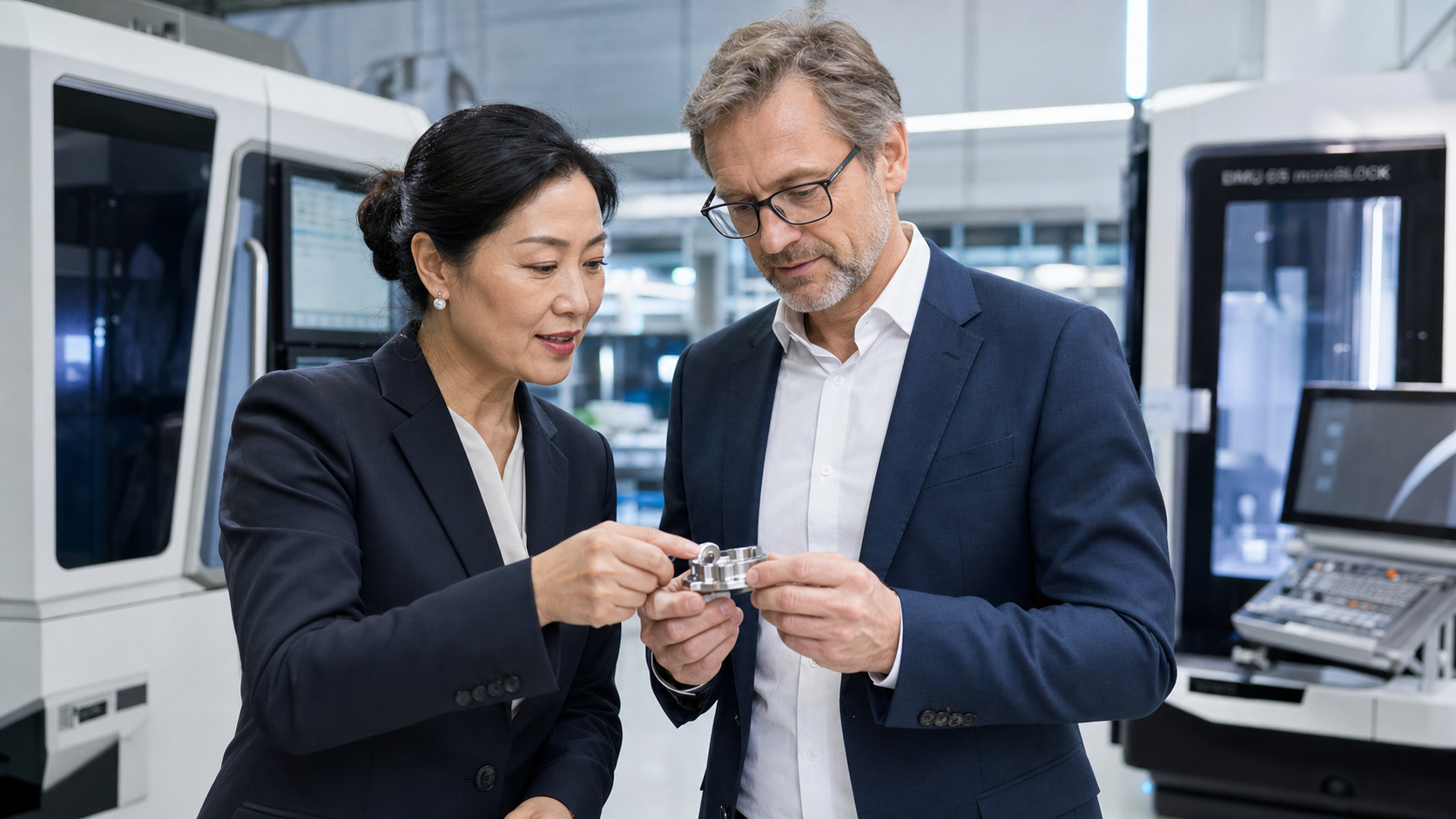
Precision metal processing in China: Quality instead of price wars – How German machines are supposed to save China's SMEs – Creative image: Xpert.Digital
Why Chinese manufacturers are suddenly paying ten times as much for German machines
The way out of the cheap trap: How China's industry is secretly upgrading
For decades, "Made in China" primarily stood for one business model: unbeatable low prices and mass-produced standard goods. But a closer look at the factories of Chinese precision metal processing currently reveals a quiet yet massive transformation. Although the macroeconomic situation in the People's Republic is cooling, technology-driven medium-sized companies are suddenly investing heavily in expensive German machine tools. They often pay ten times as much for them compared to domestic equipment – not out of prestige, but based on sound economic calculations. The ruthless price war at the lower end of the market has become a dead end, driving margins to rock bottom. Those who want to survive today must abandon the low-cost trap and focus on uncompromising quality, durability, and maximum process reliability. A business trip to five different manufacturers shows that the apparent contradiction between the economic crisis and the investment boom is, in reality, a profound structural change that is giving the market a completely new dynamic – and offering lucrative prospects for German mechanical engineering in its niche markets.
When price wars become a dead end
China's precision metal processing: The silent leap in quality
A business trip to Chinese precision metal processing companies reveals a phenomenon that contradicts the prevailing narrative about China's economic slowdown. The group visited manufacturers of saw blades for meat and foam processing, razor blade producers, and medical technology companies. The findings, documented by Yu Yijun, founder of the industry platform Sino-Cooperation, which boasts hundreds of thousands of followers in China and serves as an early warning system for German-Chinese economic relations, appear paradoxical at first glance: While the overall economic situation in the People's Republic is noticeably cooling, medium-sized manufacturing companies continue to invest in German machinery, even though it often costs more than ten times as much as domestic equipment.
This behavior cannot be explained by short-term optimism, but rather by a structural shift in the self-perception of Chinese industrial companies. They have recognized that pure price competition, which for decades sustained the growth model of China's manufacturing industry, has reached its limits. Those who still compete solely on price today find themselves in a downward spiral of shrinking margins, interchangeable products, and increasing competitive pressure from even cheaper suppliers. The answer for many technologically ambitious companies is therefore: to purchase high-quality foreign manufacturing technology in order to escape this price trap.
A look inside the factory halls: Five industries, one pattern
The companies visited cover a broad spectrum of industrial niches that, at first glance, have little in common. Saw blade manufacturers for meat and foam processing, razor blade producers, and medical technology companies serve completely different end markets. And yet, in all five cases, the same pattern emerges: The companies are at a crossroads in their development, where organic growth through pure cost leadership is no longer viable.
This mechanism can be particularly clearly illustrated using the example of saw blades for meat processing. In China, prices for such saw blades currently range from 1.5 to 13 renminbi per meter, which corresponds to approximately €0.20 to €1.69. This enormous price range already points to a deeply segmented market where quality and price are closely linked. The reason for the low prices at the lower end lies not in a lack of entrepreneurial will, but in structural quality limitations resulting from a combination of raw material quality, manufacturing processes, and technological know-how.
Why cheap raw materials become expensive
The quality of a saw blade depends significantly on the purity and alloy composition of the steel used, as well as the precision of the hardening and grinding processes. Chinese manufacturers lacking sophisticated processing facilities are forced to work with raw materials and processes that inevitably lead to larger tolerances, shorter service life, and less consistent cutting quality. The result is a product that can only differentiate itself on the market through price, because its technical characteristics cannot compete with premium products.
Foreign competitors like the US tool manufacturer Starrett demonstrate that another approach is possible. Because the quality of their saw blades is consistently high and their service life and cutting performance remain constant, customers are willing to pay significantly more. For companies in the meat and food processing industries, where downtime due to blade changes or quality losses during cutting have immediate cost consequences, this investment in reliability pays off very quickly. The premium supplier is therefore not just selling a product, but a guarantee of process reliability, and this guarantee comes at a price the market is willing to pay.
The learning process of Chinese industry
This is precisely the connection that many Chinese entrepreneurs have now internalized. The perpetual price war, in which one supplier undercuts the other without improving the underlying quality, leads to a dead end in the long run. Margins shrink, investments in research and development become unattractive, and the company remains trapped in a low-price segment from which there are hardly any ways to move up. This realization is not new, but it has become significantly more pronounced in recent years in many sectors of China's light industry and metal processing.
For many companies, the only way out of this trap lies in the systematic improvement of quality through better raw materials and more advanced manufacturing processes. Those who are able to technically upgrade their products can break out of the mass-market price segment and penetrate higher-value, higher-margin market segments. This logic explains why, precisely during a period of economic uncertainty, investments in expensive foreign machinery are not reduced but deliberately continued.
German mechanical engineering quality as a strategic asset
German machine tools enjoy an international reputation for combining technical precision with long service life and high process stability. For Chinese manufacturers aiming to transition from mass-produced goods to high-quality products, such machines are not simply production tools, but strategic capital that determines achievable product quality for years to come. The purchase price, often more than ten times that of comparable domestic equipment, is not seen as a mere cost burden, but as an investment in future market position.
This perspective also explains why German mechanical engineering companies continue to make intensive efforts to reach the Chinese market despite an overall more challenging business environment in China. The German Machine Tool Builders' Association (VDMA) identifies China as the second-largest export market and the most important foreign production location for the German machine tool industry, even though deliveries from Germany have recently declined, while at the same time more and more production is taking place directly in China. At the China International Machine Tool Show 2026 in Shanghai, around 140 German companies presented their products and services, demonstrating that the Chinese market remains of central importance for German precision engineering despite all the shifts in the market.
The macroeconomic counter-narrative
The described trend toward quality improvement in specific niche areas of metal processing stands in interesting contrast to the general development of the machine tool industry in China. Globally, China overtook Germany for the first time in 2025 as the world's largest exporter of machine tools, now holding a global market share of approximately 21.6 percent compared to 16.7 percent for Germany. Chinese machine tool production reached a new record high of around €30 billion in 2025, while German production, at approximately €9.4 billion, barely exceeded the levels of the pandemic years of 2020 and 2021.
These figures demonstrate that China itself has become a serious supplier of machine tools and is no longer merely a market for foreign technology. The crucial point, however, lies in the quality segment: While Chinese machine manufacturers have made enormous progress in the broader and mid-price segments, the top-tier quality and precision segment, particularly for heavy-duty applications in medical technology or precision tools such as saw blades, remains the domain of German and other Western suppliers. It is precisely in this segment that the companies visited by Sino-Cooperation operate.
🎯🎯🎯 Sino-Cooperation

Sino-Cooperation is a platform based in China and Germany
Sino-Cooperation is a platform based in China and Germany that promotes exchange and cooperation between German and Chinese companies, especially through events, digital formats and an online cooperation exchange for market entry and partnerships.
More information here:
Geopolitics meets mechanical engineering: Why German exports in the high-precision segment remain stable
A divided market instead of a unified narrative
The seemingly contradictory signals – an overall weakening Chinese machine tool market coupled with robust investments by individual companies in cutting-edge German technology – resolve themselves when the market is analyzed according to quality segments. In the mass market for standard machines and simple tools, China has long since assumed cost leadership and is further consolidating this position. However, in the high-precision segment, characterized by tight tolerances, high material quality, and process reliability, the technological gap with leading Western suppliers remains significant.
For companies in this premium segment, this results in a clear strategic logic. They do not compete with low-cost manufacturers for the same customer base, but rather target higher-margin customers who value reliability, durability, and process safety, for example in the food industry, medical technology, or in specialized industrial applications. The following overview illustrates the different market logics:
| segment | Price level | competitive factor | Typical customer group |
|---|---|---|---|
| Mass market standard tools | low, strong price pressure | Cost, availability | Price-sensitive processors, export goods |
| Mid-range quality segment | medium, increasing differentiation | Process stability, service | growing medium-sized businesses |
| High-precision segment | high, premium surcharge | Reliability, service life, process reliability | Medical technology, food industry, special applications |
The economic calculation behind the investment decision
From a business perspective, the investment decisions of the companies visited can be understood as a classic case of capital allocation under uncertainty. A machine that is ten times more expensive than its domestic equivalent must generate correspondingly higher contribution margins over its useful life in order to pay for itself. This is only possible if the company is actually able to translate the higher product quality into higher sales prices and more stable customer relationships.
This is precisely where the true entrepreneurial courage of the visited companies lies. They rely not only on the technical superiority of the machine itself, but on their own ability to elevate the entire production system—from raw material procurement and process control to quality assurance—to a higher level. The machine is a necessary, but not sufficient, condition for success. Without appropriately trained personnel, consistent quality management, and a sales strategy that can effectively communicate and monetize the higher product quality in the market, the investment remains ineffective.
Two options, no third
The observation that many companies are at a point in their development cycle where only two options remain deserves special attention. Either they invest in cutting-edge equipment and continuously optimize their quality, or they will be driven out of the market in the medium term. This binary situation is typical for industries in a phase of market maturity and consolidation, where the number of competitors decreases and market share concentrates in the hands of a few technologically superior suppliers.
This consolidation dynamic can be observed in many mature industrial sectors, from automotive supply to electronics manufacturing. For Chinese precision metal processing, this means that the coming years are likely to see a significant market shakeout. Smaller companies lacking access to capital for technology investments or the organizational maturity to implement new quality standards will increasingly be forced out of the market, while technologically advanced companies will expand their market position.
Geopolitical framework conditions as an amplifier
This business logic intersects with a geopolitical and trade policy environment that further reinforces the importance of quality and technological independence. The Chinese government has explicitly classified machine tools as a critical core technology in its new five-year plan, indicating increased state support for investments in future technologies. At the same time, despite declining direct exports, Germany remains an important trading partner: in 2025, with a foreign trade volume of €251.8 billion, China was once again Germany's most important trading partner, ahead of the United States.
The structure of this trade is noteworthy. In 2025, machinery and equipment accounted for a significant share of both German exports to China and Chinese imports from Germany, with the import value of machinery from a German perspective reaching €13.9 billion, an increase of 11.6 percent year-on-year. These figures confirm the pattern observed in the field: even as overall trade shifts and China catches up technologically in many areas, demand for German machinery remains robust to growing in certain highly specialized segments.
Structural change instead of weak growth
The paradoxical observation described at the beginning – a willingness to invest despite macroeconomic weakness – can ultimately be interpreted as an expression of a profound structural transformation within Chinese industry. The era in which Chinese manufacturers could gain global market share solely through low labor costs and aggressive pricing is drawing to a close in many segments of metal processing. The next growth impetus must come from higher value creation per unit of product, and this cannot be achieved without technological upgrades.
This development presents a mixed outlook for the German mechanical engineering industry. On the one hand, Germany's share of global machine tool exports is declining, and increasing amounts of German production are shifting directly to China, where the share of Chinese sites in the total production of German machine tool manufacturers abroad has risen from 27 to 32 percent. On the other hand, demand for genuine German cutting-edge technology remains strong in those segments where Chinese competitors have not yet closed the quality gap, and it is precisely there that the highest-margin business opportunities arise.
Outlook for the coming years
The observations from the five visited companies can be interpreted as a microcosm of a larger trend that is likely to continue in many sub-segments of the Chinese manufacturing industry in the coming years. The focus on quality rather than price is expected to prevail in other sectors of metal and precision manufacturing, particularly where end customers are willing to pay a premium for greater reliability and longer service life.
For foreign, and especially German, mechanical engineering companies, this necessitates the continuous sharpening of their positioning in the Chinese market. Those who continue to focus on premium quality, technical consulting expertise, and long-term customer relationships are likely to find viable business models in China, even in a generally weaker macroeconomic environment. This analysis thus exemplifies how aggregated economic data often masks highly differentiated, sometimes even contradictory, developments at the company level, an understanding of which remains essential for strategic decisions in international trade.
🎯🎯🎯 Data-driven B2B industry hub as a quasi-in-house solution

The quasi-in-house solution: How Xpert.Digital closes operational gaps in B2B marketing and sales – Smart Content-Driven Business - Image: Xpert.Digital
Xpert.Digital is a data-driven B2B industry hub led by Konrad Wolfenstein . The company acts as an external, quasi-in-house solution for industrial partners, closing operational gaps in marketing, content, and sales – without requiring additional resources on the client side.
More information here:
Your global marketing and business development partner
☑️ Our business language is English or German
☑️ NEW: Correspondence in your native language!

Konrad Wolfenstein
I and my team are happy to be available to you as your personal advisor.
You can contact me by filling out the contact form here [email protected]:or simply call me at +49 7348 4088 965. My email address is
I'm looking forward to our joint project.





