
Vision 2030 – From oil state to economic powerhouse: Saudi Arabia's transformation between ambition and fiscal reality
Xpert Pre-Release

Available in 27 languages 📢
Prefer Xpert.Digital on GoogleⓘPublished on: June 6, 2026 / Updated on: June 6, 2026 – Author: Konrad Wolfenstein
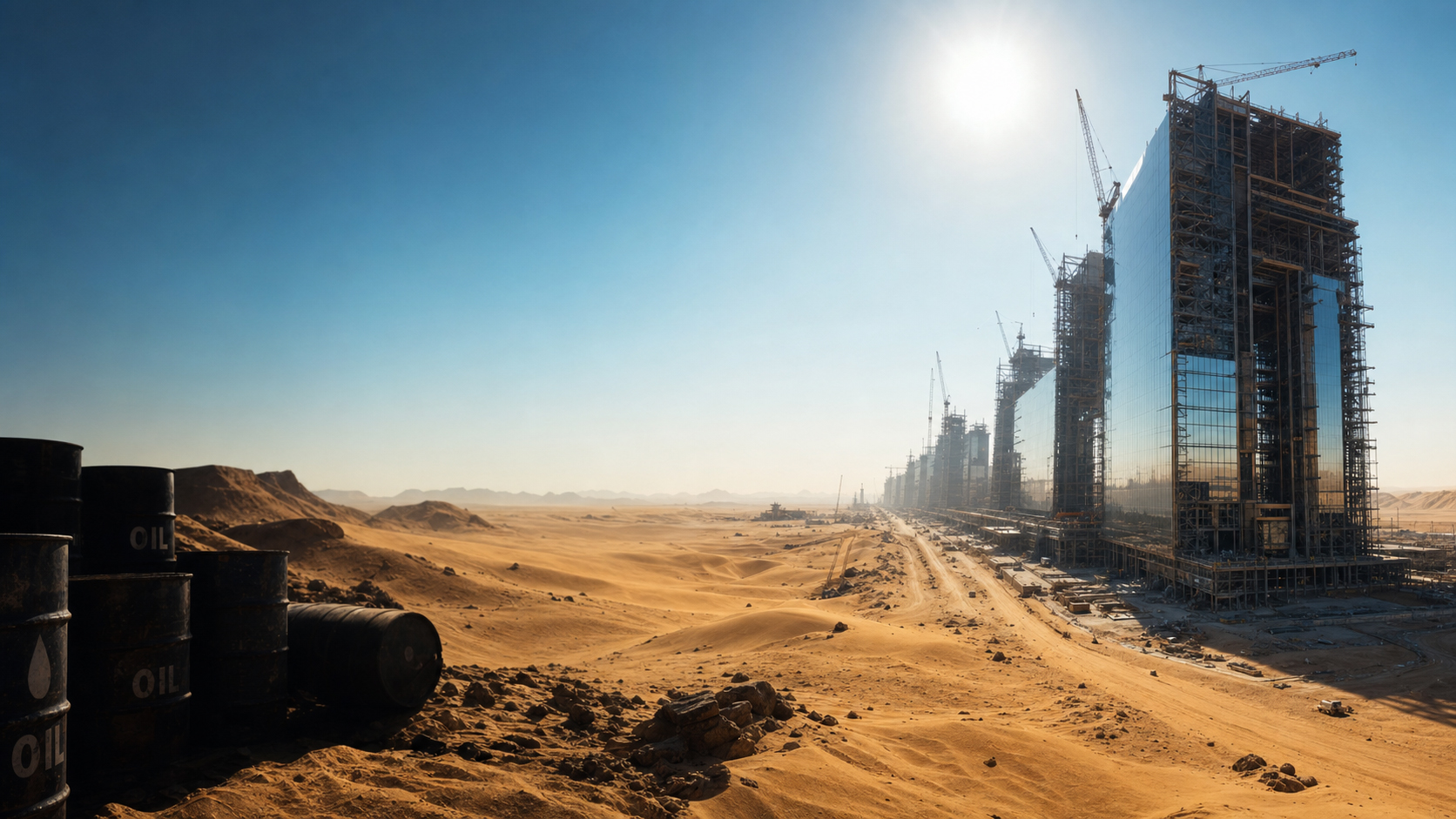
Vision 2030 – From oil state to economic powerhouse: Saudi Arabia's transformation between aspiration and fiscal reality – Creative image: Xpert.Digital
The invisible transformation: What really works – and what fails – in Saudi Arabia's Vision 2030
Gigantic debts instead of record-breaking construction projects: Why the Saudi Crown Prince is now wielding the red pen
Neom, The Line & Co. in crisis: The true extent of Saudi Arabia's financial awakening
From day one, Saudi Arabia's "Vision 2030" was considered the world's most ambitious transformation program—a gigantic master plan by Crown Prince Mohammed bin Salman to free the desert kingdom from its dependence on oil and lead it into a highly modern future. But four years before the major deadline, fiscal reality is catching up with the ambitious dreams. Prestigious megaprojects like the futuristic linear city "The Line" and monumental architectural icons are being massively scaled back, postponed, or even canceled altogether. Declining oil revenues, exploding costs, and a lack of foreign capital are forcing the powerful sovereign wealth fund, PIF, to implement a harsh austerity program. But anyone who prematurely dismisses Vision 2030 as a spectacular failure is taking the easy way out. Far removed from the glittering renderings and shattered utopias, a profound economic and social revolution is underway that has already irrevocably changed the country. A comprehensive analysis of the fine line between megalomaniacal ambition, autocratic self-presentation, and hard-nosed realpolitik.
Related to this:

When $500 billion isn't enough: The disillusionment of the great transformation
When Crown Prince Mohammed bin Salman, widely known as MBS, unveiled the Vision 2030 reform program in April 2016, the message was clear and radical: Saudi Arabia was to break free from its dependence on crude oil, build a diversified economy, and establish itself as a global hub for tourism, technology, sports, and entertainment. What followed was a flurry of spectacular announcements, far exceeding anything the Gulf region had ever seen in their audacity. The Public Investment Fund (PIF) became the vehicle for these ambitions—with nearly one trillion dollars in assets under management, it was intended to finance and drive the kingdom's transformation.
The program was deliberately launched during a period of economic hardship: A dramatic oil price collapse in 2015 had shaken Saudi public finances and ruthlessly exposed the structural vulnerability of a rentier state. Vision 2030 was therefore not the luxurious fantasy of an infinitely wealthy regime, but an economic necessity – a long overdue attempt to make the kingdom fit for the future. Measured against its own self-imposed standards, the program has made more progress in many key social and economic dimensions than international critics often acknowledge. However, measured against its most spectacular and media-savvy promises, a profound credibility problem is revealed.
The sovereign wealth fund as an engine: Structure and capital flow of the PIF
The institutional heart of Vision 2030 is the Public Investment Fund (PIF), which under MBS was transformed from a comparatively small, passive sovereign wealth fund into one of the world's largest and most active sovereign wealth funds. By the end of 2024, the PIF managed assets of approximately $913 billion, representing a 19 percent increase over the previous year. The fund is not financed solely by oil revenues: among the most significant capital inflows was the transfer of an additional 8 percent stake in Saudi Aramco, which simultaneously ties the PIF more closely to the oil sector – precisely the dependency that Vision 2030 was originally intended to overcome.
The fund's strategic focus has recently shifted significantly inward. International investments fell from 20 percent to 17 percent of the total portfolio, while the share of domestic investments climbed to around 80 percent. Recent portfolio expansions also indicate the direction the fund is heading: the AI mega-fund HUMAIN, the high-tech manufacturing company ALAT, and the commercial spaceflight company Neo Space were all founded in 2024 – bets on future industries intended to position Saudi Arabia not just as a supplier of raw materials, but as a technology nation. However, this very reorientation toward the domestic economy also reflects a fiscal constraint: the fund increasingly needs to allocate its capital to domestic investments.
Neom and The Line: The Fall of a Symbol
No project embodies the Vision 2030 so iconicly – and no project so drastically represents the gap between announcement and reality – as Neom and its most famous sub-project, The Line. Announced in 2017, this mega-development in northwestern Saudi Arabia, estimated at around $500 billion, covers an area of 26,500 square kilometers and includes several sub-projects: the linear city of The Line, the mountainous region of Trojena, the coastal resort of Sindalah, and the futuristic industrial port of Oxagon.
The Line was intended to become a global symbol of a new urban planning concept: 170 kilometers long, 500 meters high, 200 meters wide, nestled between two mirrored facades, free of cars and roads, with a completely underground transportation system, planned for up to 9 million inhabitants. An interim phase with 1.5 million residents was envisioned for 2030. What has become of this vision paints a sobering picture of technical, logistical, and fiscal reality: Bloomberg, citing informed sources, reported that by 2030 only 2.4 kilometers of the structure are likely to be completed, and the population will remain below 300,000. PIF Governor Yasir Al-Rumayyan publicly admitted that The Line is only one component of the overall Neom project and by no means needs to be completed by 2030.
In the PIF's 2024 annual report, the book value of the five gigaprojects was written down by approximately $8 billion to 211 billion riyals ($56.2 billion), a decline of over 12 percent compared to the previous year. This write-down is not a mere accounting detail: it signals that even the fund no longer considers the original project valuations sustainable. At the same time, budgets for Neom were drastically cut internally, including a single $5 billion contract, and Neom's long-serving CEO was dismissed at the end of 2024 due to unspecified performance issues.
Related to this:

Other projects under pressure: Trojena, The Cube and LIV Golf
Neom is not the only prestige project to come under fiscal pressure. The Trojena mountain resort, originally conceived as a desert ski complex and linked to the promise of hosting the 2029 Asian Winter Games, has been significantly scaled back—the Winter Games will now be held in Kazakhstan, not Saudi Arabia. The Cube, a monumental building project in Riyadh with an estimated $50 billion budget, has been abandoned altogether, according to the BBC. These decisions follow a pattern: projects that do not generate a clearly identifiable return on investment within a relevant timeframe are postponed or canceled.
The case of LIV Golf, the Saudi-funded alternative to the PGA Tour in professional golf, deserves particular attention. With approximately $5 billion invested to date, the tournament series aimed to generate global attention and solidify Saudi Arabia's image as a modern sporting nation. However, neither the hoped-for commercial success nor the desired boost to reputation materialized to the expected extent. LIV Golf thus exemplifies a pattern that also characterizes other projects within the Vision 2030 ecosystem: investments with a primarily narrative function that fail to deliver economic returns.
The fiscal screw: oil prices, deficits and growing debt
Saudi Arabia's structural dilemma is as old as the kingdom itself, and Vision 2030 has not solved it, but rather exacerbated it: the state budget remains highly dependent on the price of oil. In the first quarter of 2025, oil revenues plummeted by 17.65 percent compared to the same period of the previous year, amounting to only 149.81 billion riyals. Oil still accounted for 56 percent of total revenues – a slightly improved, but nonetheless alarming level of dependency.
The IMF (International Monetary Fund) calculated a fiscal break-even oil price of around $91 per barrel for Saudi Arabia, with some more recent estimates even suggesting $96. Given that oil prices frequently fluctuated between $70 and $75 in 2025, this represents a significant gap. The total deficit for 2025 was around 276 billion riyals, well above the originally planned target of 245 billion riyals. In the fourth quarter of 2025 alone, the quarterly deficit reached 94.9 billion riyals ($25.3 billion), the highest level since 2020. To finance this shortfall, the Kingdom is increasingly resorting to debt issuance: Public debt rose to 1.52 trillion riyals by the end of 2025, compared to 1.22 trillion riyals at the end of 2024.
These figures are not inherently dramatic from an economic perspective, as Saudi Arabia still has a moderate debt-to-GDP ratio compared internationally. The crucial question is different: How long can a regime that derives its political legitimacy largely from economic promises and state generosity maintain a policy of fiscal austerity without jeopardizing social stability?
The PIF under pressure to cut costs: reductions between 20 and 60 percent
In the spring of 2025, the true severity of the situation became apparent. The PIF ordered a minimum 20 percent spending cut for more than 100 of its portfolio companies; in some cases, budgets were slashed by as much as 60 percent. Layoffs followed. The directive affected over 50 development companies and signaled a fundamental shift in strategy: away from growth at any cost and toward a viability assessment of each individual project.
What is remarkable is the way this change of course is being communicated. Saudi Arabia is not portraying the adjustment as a retreat or failure, but rather as a prioritization and professionalization. Finance Minister Al-Jadaan publicly admitted that anyone who believes Neom will be built and profitable within five years is mistaken. Such statements are remarkably candid for a regime that adheres to authoritarian narrative control. They are also calculated: the aim is to signal to foreign investors that rational decision-making processes now take precedence over ego-driven projects. Whether this message is credible depends on the further development of the project.
The pattern of history: Before Vision 2030, after Vision 2030..
In a BBC analysis, economist Ellen R. Wald pointed to a recurring pattern in Saudi economic policy: first come grand announcements, then a significant downsizing. Indeed, Saudi Arabia had already announced economic cities under King Abdullah—such as the King Abdullah Economic City—which began similarly and fell far short of their goals. The parallel is striking and suggests structural causes that extend beyond individual political decisions.
A key element of this pattern is the information problem inherent in authoritarian decision-making structures: when advisors and bureaucrats tend to provide feedback that management wants to hear, systematically inflated expectations and underestimated risks arise. In a system where the absence of internal criticism is structurally encouraged, the corrective mechanism that democratic systems—at least theoretically—provide through opposition and a free press is lacking. The result is project calculations that clash with reality, not because the engineers or economists are incompetent, but because their findings have been filtered before reaching decision-makers.
🎯🎯🎯 Data-driven B2B industry hub as a quasi-in-house solution

The quasi-in-house solution: How Xpert.Digital closes operational gaps in B2B marketing and sales – Smart Content-Driven Business - Image: Xpert.Digital
Xpert.Digital is a data-driven B2B industry hub led by Konrad Wolfenstein . The company acts as an external, quasi-in-house solution for industrial partners, closing operational gaps in marketing, content, and sales – without requiring additional resources on the client side.
More information here:
Why investors hesitate: Trust, oil prices and the future of capital-intensive projects
What Vision 2030 has actually achieved: The invisible transformation
It would be analytically incomplete to view Vision 2030 solely through the lens of failed or scaled-back megaprojects. The program has made remarkable progress in key social and economic indicators, progress that is often underrepresented in international reporting.
The employment figures are the strongest argument: Saudi Arabia's unemployment rate has been reduced from 11.6 percent to 7 percent – the 2030 target was reached four years ahead of schedule. Female labor force participation rose from 17 percent to 36 percent, significantly exceeding the target of 30 percent. The proportion of women in leadership positions climbed from 1.3 percent to 4.8 percent, approaching the 5 percent target. These figures describe a profound societal transformation that goes far beyond mere statistical manipulation.
On the macroeconomic side, the share of non-oil-related economic activity exceeded 52 percent of total economic output for the first time. More than 600 international companies have relocated their regional headquarters to Riyadh. Total investment in Saudi Arabia has almost doubled since the Visions initiative began. These indicators show that economic diversification is indeed progressing – albeit more slowly than promoted and with a different mix than originally planned.
Related to this:
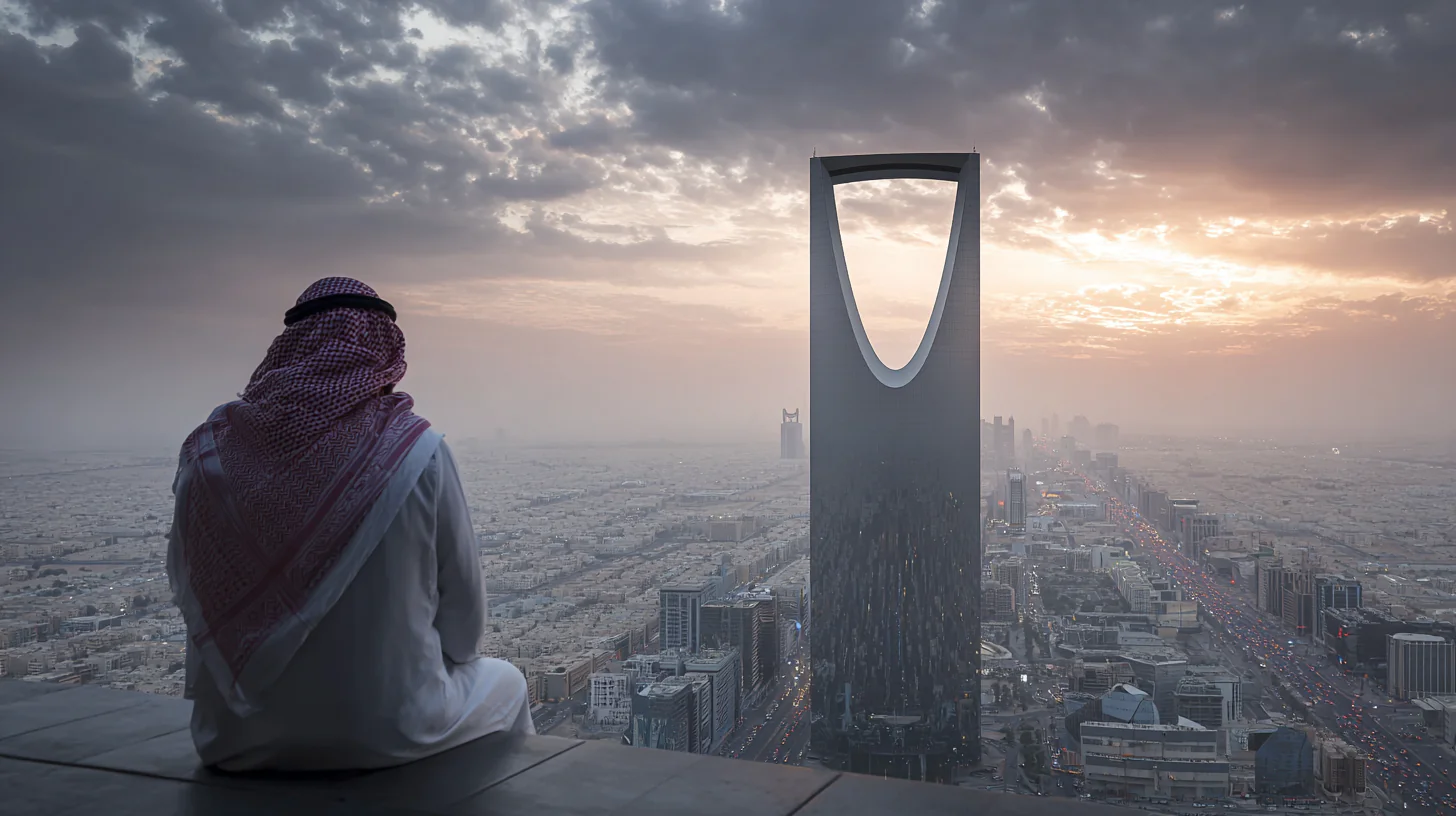
The investment climate: Trust between FDI goals and reputational risk
One of the central goals of Vision 2030 is to increase foreign direct investment (FDI) to 5.7 percent of GDP by 2030. Achieving this goal depends not only on infrastructure projects, but also significantly on the confidence of international investors in legal certainty, political stability, and the safety of capital and people.
It is precisely here that MBS itself has taken on substantial debt. The 2018 murder of journalist Jamal Khashoggi shocked the international business community and led to a massive exodus of prominent business leaders from the Future Investment Initiative Forum. The internment of dozens of wealthy businessmen and princes at the Ritz-Carlton in Riyadh under the guise of an anti-corruption campaign in 2017 sent a disturbing signal about the security of private property rights. The capital that subsequently flowed into Saudi Arabia was often short-term in nature—so-called hot money, which remains liquid and quickly flows out again.
PIF Governor Al-Rumayyan reported a 24 percent increase in foreign direct investment for 2024, reaching $31.7 billion. While this initially sounds like a success, it falls far short of the levels needed to finance megaprojects without relying on ongoing government debt. Furthermore, write-downs in the billions, project cutbacks, and leadership changes at key development corporations raise the question of which investor would commit long-term capital in an environment that is generating strategic reversals of this magnitude.
The structural problem: A young population is waiting for jobs
Behind all the multi-billion-dollar projects and visions of the future lies a fundamental demographic problem that Vision 2030 must address: Saudi Arabia has an extremely young population, whose economic integration represents the kingdom's real challenge for the future. Around 70 percent of the population is under 35 years old. By 2030, an estimated 920,000 additional jobs will be needed. Despite massive investments, the quality of the education system remains a critical bottleneck.
A 2025 Pearson report estimated the economic losses due to inefficiencies in the transition from education to employment at 62 billion riyals ($16.5 billion) annually for Saudi citizens alone; including losses for expatriates, this figure rises to 196 billion riyals ($52 billion), equivalent to roughly 4.2 percent of GDP. On average, university graduates take nearly 40 weeks to find their first job. Automation also threatens 23 percent of Saudi jobs. These figures underscore that creating sufficient quantities of jobs of a suitable quality remains the most fundamental structural promise of Vision 2030—and also the most difficult to achieve.
Prioritization instead of failure: What Saudi Arabia continues to build
Beyond the cancellations and cutbacks, there are projects that are being continued and expanded – and these provide a revealing picture of the Kingdom's true priorities. First and foremost is the preparation for the 2034 FIFA World Cup: Awarding the tournament to Saudi Arabia is not only a sporting coup, but also a strategic focal point for infrastructure development and international image. The World Cup necessitates investments in stadiums, transportation, and hotel capacity with a clear completion date – this is structurally more reliable than an open-ended promise for the future.
The historic Diriyah urban development project, the ancestral seat of the Al Saud dynasty in northwest Riyadh, with a total investment volume of $63.2 billion, remains a key undertaking. The Qiddiya theme park southwest of Riyadh aims to establish the capital as an entertainment destination and primarily targets a young domestic consumer base. AlUla, the ancient oasis region with rock carvings and Nabataean remains, is developing into a serious cultural tourism destination, already generating initial international booking figures. These projects share the characteristic of operating closer to realistic economic viability than the futuristic urban utopias.
The geopolitical dimension: OPEC+, oil price strategy and the austerity paradox
Saudi Arabia faces a strategic paradox that cannot be resolved by any domestic reform agenda: As the de facto leader of OPEC+, the kingdom bears the brunt of the production cuts intended to support oil prices – and simultaneously pays the highest price when these cuts reduce its own revenues. The convergence of lower prices and reduced production caused oil revenues to plummet by around 20 percent in 2025 compared to the previous year.
The decision to gradually ease OPEC+ restrictions starting in spring 2025 must be seen in this context: The Kingdom is trying to maintain a balance between production volume and price that does not jeopardize its own budget targets or cartel cohesion. However, the break-even price of $91 to $96 per barrel remains the crucial benchmark. As long as the global market price is significantly lower, Saudi Arabia is structurally dependent on debt or spending cuts – a situation that puts Vision 2030 under constant strain, without the Kingdom being able to fully control price formation.
The IMF's finding: Robustness with question marks
The International Monetary Fund's (IMF) assessment of Saudi Arabia's economic development is nuanced. The 2025 "Article IV Concluding Statement" attests to Saudi Arabia's strong economic resilience to shocks, with growing non-oil activities, subdued inflation, and record-low unemployment. The 2024 "Staff Report" described the ongoing transformation as progressing well but cautioned that non-oil growth momentum must be sustained and economic diversification pursued consistently.
This moderately positive assessment stands in tension with fiscal realities: rising deficits, growing public debt, and the need for an oil price substantially above market levels to achieve budget neutrality. The IMF sees structural progress, which is indeed present – but the question is whether this progress can be achieved at the pace of promises when the fiscal foundation is faltering.
Between strategy and self-promotion: What Vision 2030 really is
It would be an oversimplification to dismiss Vision 2030 as either a complete success or a resounding failure. The program is a multifaceted political construct intended to fulfill three functions simultaneously: First, it is a genuine economic reform framework with measurable targets in employment, diversification, and governance. Second, it is a legitimizing instrument for MBS, who bases his rule primarily on promises of economic performance and societal liberalization. And third, it is a soft power tool designed to reshape Saudi Arabia's image on the global stage.
These three functions are not always compatible. Where economic rationality argues for cuts, the need for legitimacy resists admitting failure. Where soft power ambitions demand spectacular investments, fiscal discipline dictates restraint. And where social openness would require genuine political liberalization, the autocratic system clings to repressive instruments. These internal contradictions can be masked by rhetoric about prioritization, but not eliminated.
The final phase and the legacy of 2030
In 2026, Vision 2030 is set to enter its third and final delivery phase – a phase officially described as the implementation phase, meaning the time when announced measures are to be completed. Four years before the target year, the situation is complex: some key targets, such as employment rates, have been met or exceeded. The non-oil-related share of the economy has surpassed the 50 percent mark. Tourism is developing. Social life in Riyadh and Jeddah has noticeably changed.
At the same time, The Line, the city that would house 1.5 million people, will not exist by 2030. The Cube project no longer exists. Trojena will not host the Winter Games. LIV Golf has not achieved its anticipated status. Foreign direct investment remains below target. The budget deficit is growing. The price of oil remains the dominant determinant of government capacity.
What remains is an interim result that is more than nothing, but less than promised. Saudi Arabia is abandoning—to put it aptly—not its vision, but the idea that every multi-billion-dollar promise must actually be built. This is not failure. It is realpolitik. And it is perhaps the most important lesson the Kingdom has learned in the ten years since the announcement of Vision 2030: that transformation takes time, capital alone does not resolve complexity, and that the substance of a country cannot be redefined through architectural renderings.
Consulting - Planning - Implementation

Konrad Wolfenstein
I would be happy to serve as your personal advisor.
You can contact me at wolfenstein∂xpert.digital or
Just call me on +49 7348 4088 965 .
Your container high-bay warehouse and container terminal experts

Container terminal systems for road, rail and sea transport in the dual-use logistics concept of heavy-lift logistics - Creative image: Xpert.Digital
In a world marked by geopolitical upheavals, fragile supply chains, and a new awareness of the vulnerability of critical infrastructure, the concept of national security is undergoing a fundamental reassessment. A state's ability to guarantee its economic prosperity, the provision of essential goods and services to its population, and its military capability increasingly depends on the resilience of its logistical networks. In this context, the concept of "dual-use" is evolving from a niche category of export control to a broader strategic doctrine. This shift is not merely a technical adjustment but a necessary response to the "paradigm shift" that demands a profound integration of civilian and military capabilities.
Related to this:










