
IMEC vs. Silk Road: The invisible mega-war for the world's most important trade route
Xpert Pre-Release

Available in 27 languages 📢
Prefer Xpert.Digital on GoogleⓘPublished on: May 17, 2026 / Updated on: May 17, 2026 – Author: Konrad Wolfenstein
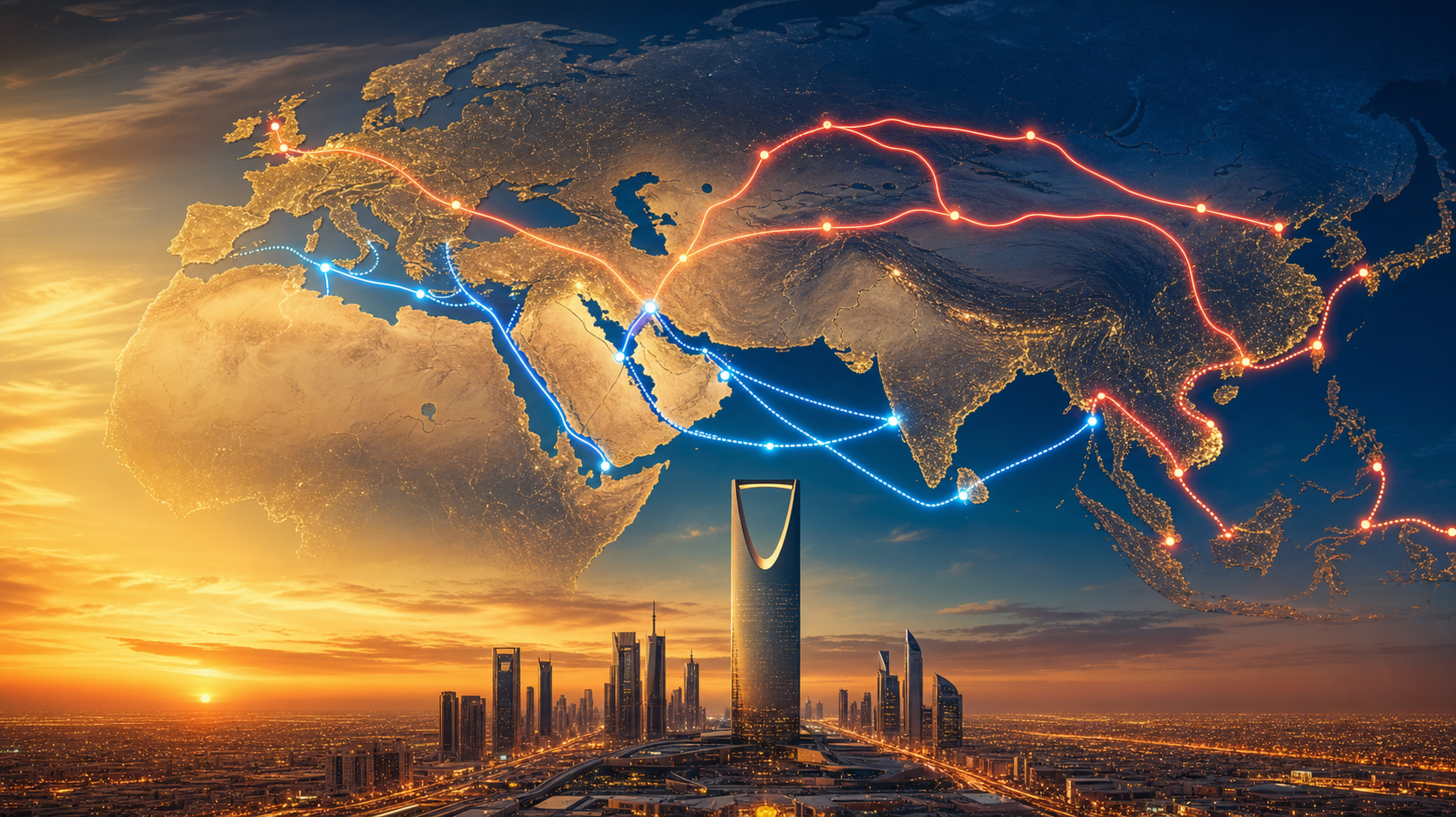
IMEC vs. Silk Road: The invisible mega-war for the world's most important trade route – Image: Xpert.Digital
Trillion-dollar poker in the desert: How Saudi Arabia is ruthlessly playing the US and China against each other
A brilliant move by the Crown Prince: Why the new world order will be decided in Saudi Arabia
Europe's answer to China: Why the 600 billion project in the Middle East hangs by a thread
The global trade architecture is being redrawn before our very eyes – and the epicenter of this historic upheaval lies not in Washington, Brussels, or Beijing, but on the Arabian Peninsula. With immense financial resources, two gigantic infrastructure visions are currently vying for economic and geopolitical dominance: China's established, trillion-dollar Belt and Road Initiative (BRI) is clashing with its ambitious Western-Indian counterpart, the India-Middle East-Europe Economic Corridor (IMEC). At the very heart of this competition is Saudi Arabia. Instead of subordinating itself to either of the two power blocs, the kingdom under Crown Prince Mohammed bin Salman is executing a strategic masterstroke. Riyadh is consistently exploiting the rivalry between the superpowers, allowing itself to be courted by both sides and profiting on a massive scale – be it through new mega-ports, rail networks, or digital infrastructure. This comprehensive analysis reveals why the future multipolar world order will be decided in the desert, what role wars and crises play in this, and why soon no global trade corridor will bypass Saudi Arabia.
Related to this:

IMEC vs. BRI: How Saudi investments are shifting global trade competition
The kingdom as a hub: Why no trade corridor works without Riyadh
The new world order of trade infrastructure will not be decided in Washington, Brussels, or Beijing—but on the Arabian Peninsula. In the spring of 2026, Saudi Arabia stands at the intersection of two rival infrastructure visions that will not only move goods but also reshape power relations. On the one hand, there is China's Belt and Road Initiative (BRI), which, since its launch in 2013, has cumulatively invested the equivalent of more than US$1.3 trillion in infrastructure projects worldwide. On the other hand, there is the India-Middle East-Europe Economic Corridor (IMEC), which was signed at the G20 summit in New Delhi in September 2023 by the US, the EU, India, Saudi Arabia, the UAE, France, Germany, and Italy as a counter-proposal to the BRI. The fact that Riyadh is a signatory to both initiatives speaks volumes about the Kingdom's foreign policy strategy.
Related to this:

Two corridors, one arena: Architecture and ambition compared
The IMEC is conceptually structured around three pillars: a transport axis integrating rail and sea infrastructure, an energy axis with cross-border energy and electricity infrastructure, and a digital axis with new fiber optic cables and digital connectivity between continents. Ideally, the corridor will transport approximately 46 trains daily, carrying 1.5 million standard containers (TEU) annually—with the potential to expand to 3 million TEU. The promised time savings compared to the Suez Canal route: up to 40 percent. This positions the IMEC not merely as a transport route, but as a multimodal infrastructure platform that links physical logistics, digital sovereignty, and energy security.
The Belt and Road Initiative (BRI), on the other hand, is the more established, but also considerably more complex, instrument. In 2025, the Chinese Silk Road reached its highest level to date: In the first half of 2025 alone, contracts worth US$124 billion were signed—more than the total volume for 2024. For the entire year of 2025, this resulted in a historic record of US$213.5 billion in BRI engagement, comprising US$128.4 billion in construction contracts and US$85.2 billion in direct investment. The Middle East positioned itself as the second-highest region worldwide in terms of construction volume, with a total of US$39.4 billion. These figures demonstrate that, despite all the criticism and political turmoil, the BRI has not reduced its activity, but rather expanded it massively.
Riyadh between the blocs: The kingdom's dual strategy
To understand Saudi Arabia's behavior in the IMEC-BRI competition, one must grasp the concept of strategic hedging. Under Crown Prince Mohammed bin Salman (MBS), the Kingdom has developed a foreign policy that pursues transactional realism rather than mono-alliances. Specifically, this means that Saudi Arabia is both a BRI signatory and an IMEC partner; a member of the G20 and in the process of joining the expanded BRICS group; the closest security partner of the US and simultaneously a major consumer of Chinese technology and infrastructure services. Riyadh does not align itself with any bloc—it allows itself to be courted by all of them.
The figures behind this strategy are impressive. In 2023, Chinese investors accounted for 58 percent of all new investments in Saudi Arabia—a total of US$16.8 billion. At the same time, in January 2026, Saudi Aramco shipped approximately 49.5 million barrels of crude oil to China—equivalent to about 1.6 million barrels per day and the highest monthly volume since October 2025. The People's Republic is thus not only China's largest foreign policy investment partner in the Middle East, but also Riyadh's indispensable customer for the country's most important export commodity. This mutual dependence is the structural reason why Saudi Arabia will not submit to any clear geopolitical alignment.
At the same time, the Kingdom is deepening its ties with the West. The signing of IMEC, cooperation with the US defense apparatus, and active support for the EU-India Free Trade Agreement—signed in January 2026, which significantly strengthens the institutional framework for IMEC—demonstrate Riyadh's desire to be economically anchored in both worlds. For the Kingdom, IMEC is not an anti-Chinese act, but an opportunity for diversification—just as the BRI is seen not as an anti-Western agenda, but as an infrastructure driver for Vision 2030.
The IMEC construction start and its limitations: Progress in the shadow of war
In April 2025, construction officially began on key IMEC infrastructure components such as railway lines, ports, and highways—a historic milestone for the project. The eastern corridor between India and the UAE is showing the most significant progress: a de facto virtual trade corridor with real-time customs digitization is emerging between the ports of Mundra, Jawaharlal Nehru Port, and Jebel Ali. The bilateral Intergovernmental Framework Agreement (IGFA) between India and the UAE, in effect since 2024, provides institutional stability to this segment.
But the northern corridor—the heart of the project—is stalled. The planned rail link from the UAE through Saudi Arabia, Jordan, and finally to the Israeli port of Haifa is the crucial diplomatic bottleneck. The Gaza war has frozen Israeli-Arab normalization, which, under the Abraham Accords, was a prerequisite for the project. Without Saudi-Israeli normalization—which has become politically imminent—the western segment of the IMEC cannot be realized. Added to this are the Houthi attacks in the Red Sea, the instability in Lebanon, Syria, and Yemen, and the Iran-Iraq conflict following the Israeli military operation "Rising Lion" against Iran's nuclear infrastructure, which destabilized the entire Gulf region in the spring of 2025.
The strategic response to this blockage is noteworthy: The European actors participating in the 2026 Munich Security Conference confirmed a “sustainable and strategic” interest in IMEC, but shifted the focus from immediate implementation to modular implementation. This means that instead of waiting for a major breakthrough across the entire corridor, priority will be given to those segments that are already politically and logistically functional. A pragmatic, if somewhat sobering, rethink.
Vision 2030 meets infrastructure imperative: Saudi Arabia's logistical transformation
Regardless of which corridor ultimately prevails, Saudi Arabia is investing in its own logistics infrastructure at an unprecedented level. Under Vision 2030, over US$100 billion is being invested in modernizing and digitizing the Kingdom's supply chains. The logistics sector, which already accounts for 6 percent of GDP, is projected to grow to 10 percent by 2030. With a projected market value of US$38.8 billion by 2026 and a compound annual growth rate (CAGR) of 5.85 percent, Saudi logistics is among the most dynamic sectors in the entire economy.
Emblematic of this transformation is Oxagon—a $20 billion industrial container port, part of the NEOM project on the Red Sea, scheduled to open in 2026 with a 900-meter-long automated container terminal. The entire facility is designed to establish a capacity of 1.5 million TEU at the crossroads of European-Asian shipping routes—modest compared to Jebel Ali's 14 million TEU, but strategically positioned as a gateway to the NEOM corridor. This infrastructure is complemented by the Riyadh Integrated Logistics Zone, an AI-powered freight ecosystem zone with direct access to air freight corridors, and the expansion of King Abdulaziz Port in Jeddah.
The National Industrial Development and Logistics Strategy (NIDLP) aims to triple the Kingdom's industrial GDP and double industrial exports to 557 billion riyals by 2030. In the first half of 2025 alone, 1.3 million square meters of new warehouse space were built in Saudi Arabia—an indicator that the logistics transformation is taking place not just on paper, but in concrete form.
China continues building: BRI records in the Middle East
While the IMEC grapples with geopolitical turmoil, China is simply doubling its activity in the region. According to the MBN China Tracker, Saudi Arabia is the target country with the most and most diversified Chinese BRI projects in the entire MENA region—with commitments in manufacturing, renewable energy, oil and gas, real estate, and transport infrastructure. In the first half of 2025, the Kingdom secured $7.2 billion in Chinese construction contracts, ahead of the UAE with $7 billion.
Particularly noteworthy is the shift in the composition of Chinese BRI investments in Saudi Arabia. While the BRI globally experienced a regression to large-scale fossil-based projects in 2025—oil and gas alone accounted for US$30 billion in the first half of the year—the picture in Saudi Arabia is more nuanced. Saudi Arabia has been identified by the Griffith Asia Institute as the leading market for Chinese renewable energy investment in the Middle East, with Chinese green energy construction contracts exceeding US$5 billion in 2025. Chinese companies such as Sinopec and Longi Green Energy are leading investments in renewable energy and technology sectors.
This strategic focus is no coincidence: it corresponds exactly to what Saudi Arabia needs within the framework of its Vision 2030—namely, technology transfer and the development of domestic industrial capacity in sectors beyond oil. China delivers what Riyadh demands, and does so with contracts that are negotiated more quickly and with fewer political constraints than Western alternatives.
Your container high-bay warehouse and container terminal experts

Container high-bay warehouses and container terminals: The logistical interplay – expert advice and solutions - Creative image: Xpert.Digital
This innovative technology promises to fundamentally change container logistics. Instead of stacking containers horizontally as before, they will be stored vertically in multi-story steel racking structures. This not only allows for a drastic increase in storage capacity within the same area, but also revolutionizes all processes at the container terminal.
More information here:
Debt trap or misunderstanding? A new perspective on China's BRI
The debt trap debate: Between narrative and reality
No issue dominates Western discourse on the BRI as persistently as the accusation of debt-trap diplomacy. The term originated in 2017 in relation to the Sri Lanka Hambantota Port Agreement, in which Beijing received a 99-year right to use the port in exchange for outstanding debts, and has since been applied to almost every BRI treaty. However, more recent findings paint a considerably more complex picture. Chatham House, in an in-depth analysis, found that the evidence for a systematic Chinese debt-trap strategy is limited: economic factors—not geopolitical calculations—are the primary driver of BRI projects; and in the most frequently cited cases, Sri Lanka and Malaysia, local political elites and vested interests have significantly shaped the debt dynamics.
At the same time, it would be naive to ignore the systemic risks of the BRI. A report by the Lowy Institute shows that 75 developing countries are struggling with significant debt crises; this year alone, repayments of US$35 billion to China are due, US$22 billion of which come from the poorest countries. An AidData study examined 13,427 BRI projects in 165 countries and found that over 40 countries have debt exposure to Beijing exceeding 10 percent of their GDP, and 35 percent of the projects have faced problems such as corruption scandals, labor rights violations, environmental damage, or public opposition. The Council on Foreign Relations concludes that the real weakness of the BRI is not a malignant plan, but rather poor risk management and a lack of coherence between Chinese state-owned enterprises, private companies, and local governments.
For Saudi Arabia and the wealthier Gulf states, the debt trap debate is largely academic. As net capital exporters and holders of enormous sovereign wealth funds, they have a fundamentally different starting point than an indebted emerging market in sub-Saharan Africa. Riyadh negotiates with Beijing not as a supplicant, but as an equal economic player.
IMEC as a geopolitical instrument: The USA, the EU and the question of counterweight
For Washington and Brussels, the public message is clear: IMEC is intended to counter China's BRI with a global connectivity proposal. The G7 summit pledged $600 billion for global infrastructure financing as a counter-program to the BRI; IMEC is a core element of this strategy. The project was explicitly announced before the third BRI conference in China—the timing was no coincidence.
But the Arab participants—especially Saudi Arabia and the UAE—view IMEC differently: not as an anti-Chinese act, but as another instrument in their multipolar diversification strategy. The Gulf states are positioning themselves in the new world order as partners of all major powers simultaneously, which led the European Council on Foreign Relations to characterize Saudi Arabia's foreign policy as "opportunistic activism." This assessment sounds critical, but it is factually accurate: Riyadh is exploiting the competition among the major powers to achieve maximum economic and security returns.
The EU-India Free Trade Agreement, signed on January 27, 2026, represents the most significant institutional boost to date for the IMEC. The agreement brings 1.4 billion Indians and 450 million Europeans into a system that eliminates more than 90 percent of tariffs; EU companies alone are expected to save around €4 billion annually. For the IMEC, this means that the trade flows intended to sustain the corridor economically now have a contractual foundation. According to the IMEC analysis portal MENAUnleashed, the agreement completes a chain of bilateral agreements along the IMEC route—from the India-UAE CEPA and the Intergovernmental Framework Agreements to the EU-India FTA.
Digital Silk Road versus digital IMEC: The underestimated battlefield
Besides ports and railways, the digital axis is the most strategically important and least discussed element of competition. Under the banner of the “Digital Silk Road,” China has systematically invested in submarine cables, 5G infrastructure, surveillance technology, and data centers throughout the Belt and Road Initiative (BRI) zone—with significant implications for data sovereignty, telecommunications standards, and intelligence vulnerabilities. In the Middle East, China now operates significant telecommunications infrastructure, including projects in Saudi Arabia’s Khalifa Economic Zones in the UAE.
IMEC responded with the EU-Africa-India Digital Corridor, presented at the Global Gateway Forum in Brussels in October 2025. At its heart is the Blue Raman Submarine Cable System—an 11,700-kilometer underwater cable that links Europe, East Africa, the Middle East, and India with ultra-high-speed data connections and is positioned within the IMEC framework as a “trusted, secure, and high-performance data link.” The subtext is unmistakable: IMEC is intended not only to transport goods but also to provide an alternative to the Chinese-dominated digital infrastructure. For Saudi Arabia, which on the one hand is investing heavily in 5G and AI infrastructure with Chinese providers and on the other hand maintains deep digital partnerships with US tech companies, hedging is once again the dominant strategy.
In parallel, according to Atlantic Council analyses, the IMEC corridor plans deeper grid integration as well as new terrestrial and submarine fiber optic cables to connect emerging data centers in the Middle East with Europe and India. However, the economic viability of a trans-Saudi gas network or green hydrogen pipelines along the IMEC remains uncertain—feasibility studies and political will are still lacking.
Geopolitical risks and structural vulnerabilities
The medium- to long-term realization of the IMEC hinges on a key geopolitical condition largely beyond the control of the signatories: the stabilization of the Middle East. Without an Israeli-Arab settlement that revives the normalization of relations under the Abraham Accords, the northern segment of the corridor—from the Red Sea through Saudi Arabia, Jordan, and Israel to the Mediterranean—is effectively unworkable. The Iran-Iraq conflict has pushed this prospect even further into the distance. Even if a ceasefire is achieved in Gaza, the question remains whether Saudi Arabia, under domestic pressure from an Arab population that perceived the Gaza offensive as a massacre, can justify formal normalization with Israel.
Added to this are infrastructural vulnerabilities: IMEC plans for submarine cables and digital networks expose these security risks through sabotage, as demonstrated by the 2024 attacks on submarine cables in the Baltic Sea. The Houthi attacks on shipping in the Red Sea not only drove up insurance premiums for the entire region but also raised fundamental questions about security guarantees for infrastructure projects in this geography. Yemen and Saudi Arabia share an 1,800-kilometer border—a latent security risk for any logistics infrastructure crossing Saudi territory.
On the BRI side, there are other, but equally serious, structural problems. Countries like Pakistan, Ethiopia, Zambia, and Ecuador have been involved in debt restructuring negotiations due to BRI debt. The message to potential partners is that while the BRI promises rapid construction capacity, it often results in inadequate risk assessment, insufficient transparency standards, and complex refinancing negotiations. China has responded to this criticism—Xi Jinping himself has called on Chinese investors to improve risk management—but adapting the model is slow.
Saudi Arabia's self-interest: Who really benefits?
Behind the geopolitical narratives lies a simple economic logic: Saudi Arabia benefits significantly from both initiatives. As the physical hub of the IMEC, the Kingdom receives infrastructure investments that serve its own Vision 2030 goals—particularly the development of a diversified, logistics-based economy. As the most important BRI partner in the region, it receives Chinese construction capacity, technology transfer, and investments in renewable energy at competitive rates.
Based on pure infrastructure data, Saudi Arabia has the broadest BRI portfolio of any country in the entire MENA region—projects spanning manufacturing, energy, real estate, and transportation. At the same time, the Kingdom is a key IMEC transit state, leveraging its geographic location to gain structural bargaining power with both blocs. Saudi Arabia's logistics strategy through 2030 aims to position the Kingdom among the world's three most strategically important logistics markets—a goal that would be virtually impossible to achieve without active participation in both corridor systems.
The gamble Riyadh is therefore taking is this: the more indispensable Saudi Arabia becomes as a transit state and investment location for both sides, the more geopolitical capital the kingdom accumulates—and the less it has to choose sides. It is a strategy that will only work if the kingdom neither creates nor can resolve the instabilities that stand in the way of its plans—the Gaza war, Houthi attacks, the Iran conflict—on its own.
Long-term power shift: Who will win the infrastructure competition?
An honest assessment must acknowledge the asymmetry between the two initiatives. The BRI is a proven, financially sophisticated system with 150 signatory states and a cumulative commitment of over US$1.3 trillion. Despite all its problems, it has built ports, railways, power plants, and fiber optic cables. IMEC, despite all the political will, remains primarily a memorandum of understanding, still lacking a detailed financing plan or binding implementation mechanism. The criticism that IMEC is more of a geopolitical symbol than a viable infrastructure project is valid, at least for the northern segment.
And yet, it would be premature to write off IMEC as a failure. First, the EU-India FTA of January 2026 gave the project the institutional weight it previously lacked. Second, the escalation of geopolitical tensions—the Iran conflict, Houthi attacks, and Suez Canal uncertainties—creates precisely the pressure that makes alternatives to existing shipping infrastructure attractive. Third, the EU and the US are pursuing a long-term strategy in which IMEC is just one element of a larger “Global Gateway” or the Partnership for Global Infrastructure Investment—a systemic alternative, not an isolated measure.
For global trade competition, this means two things in the medium term: Firstly, the BRI will not easily relinquish its dominant influence in parts of Africa, Central Asia, and Southeast Asia—the investments already made are too deep, the diplomatic ties too strong. Secondly, if the Israeli-Arab bottleneck is politically eased in the coming years, the IMEC offers a genuine alternative for trade flows between India, the Middle East, and Europe that favor Western or democratically oriented companies. However, the scenario of a complete lifting of the blockade presupposes a Middle East peace agreement, the timing of which can only be speculated upon at best.
The structural logic of rivalry
IMEC and BRI are not simply two infrastructure projects—they are competing concepts of a global order. The BRI entrenches economic dependencies bilaterally, top-down, and under strong Chinese auspices; IMEC seeks to shape connectivity multilaterally, based on norms, and in line with market principles. Both models have strengths and blind spots. The BRI delivers faster but is less transparent; IMEC negotiates more slowly but with greater institutional resilience.
In this constellation, Saudi Arabia possesses the paradoxical strength of indecisiveness: it benefits from both sides without having to commit itself. As long as the geopolitical fault lines persist—and there is much to suggest they will in the current global situation—the Kingdom remains the indispensable, calculatingly neutral hub in a system of competing corridors. Ultimately, what will be decided in the competition between IMEC and the BRI is which version of globalization prevails: a Chinese-led infrastructure world or a pluralistically grounded connectivity order with the Middle East at its geographical heart. Both versions lead through Riyadh.
Consulting - Planning - Implementation

Konrad Wolfenstein
I would be happy to serve as your personal advisor.
me at wolfenstein∂xpert.digital contact
Just call me on +49 7348 4088 965 .
Our global industry and economic expertise in business development, sales and marketing

Our global industry and economic expertise in business development, sales and marketing - Image: Xpert.Digital
Industry focus areas: B2B, digitalization (from AI to XR), mechanical engineering, logistics, renewable energies and industry
More information here:
A thematic hub offering insights and expertise:
- Knowledge platform covering global and regional economies, innovation and industry-specific trends
- A collection of analyses, insights, and background information from our key areas of focus
- A place for expertise and information on current developments in business and technology
- A hub for companies seeking information on markets, digitalization, and industry innovations
Your container high-bay warehouse and container terminal experts

Container terminal systems for road, rail and sea transport in the dual-use logistics concept of heavy-lift logistics - Creative image: Xpert.Digital
In a world marked by geopolitical upheavals, fragile supply chains, and a new awareness of the vulnerability of critical infrastructure, the concept of national security is undergoing a fundamental reassessment. A state's ability to guarantee its economic prosperity, the provision of essential goods and services to its population, and its military capability increasingly depends on the resilience of its logistical networks. In this context, the concept of "dual-use" is evolving from a niche category of export control to a broader strategic doctrine. This shift is not merely a technical adjustment but a necessary response to the "paradigm shift" that demands a profound integration of civilian and military capabilities.
Related to this:










