
Greenland: China's sharp warning to the USA – Is the dispute over the "Polar Silk Road" escalating?
Xpert Pre-Release

Available in 27 languages 📢
Prefer Xpert.Digital on GoogleⓘPublished on: January 13, 2026 / Updated on: January 13, 2026 – Author: Konrad Wolfenstein
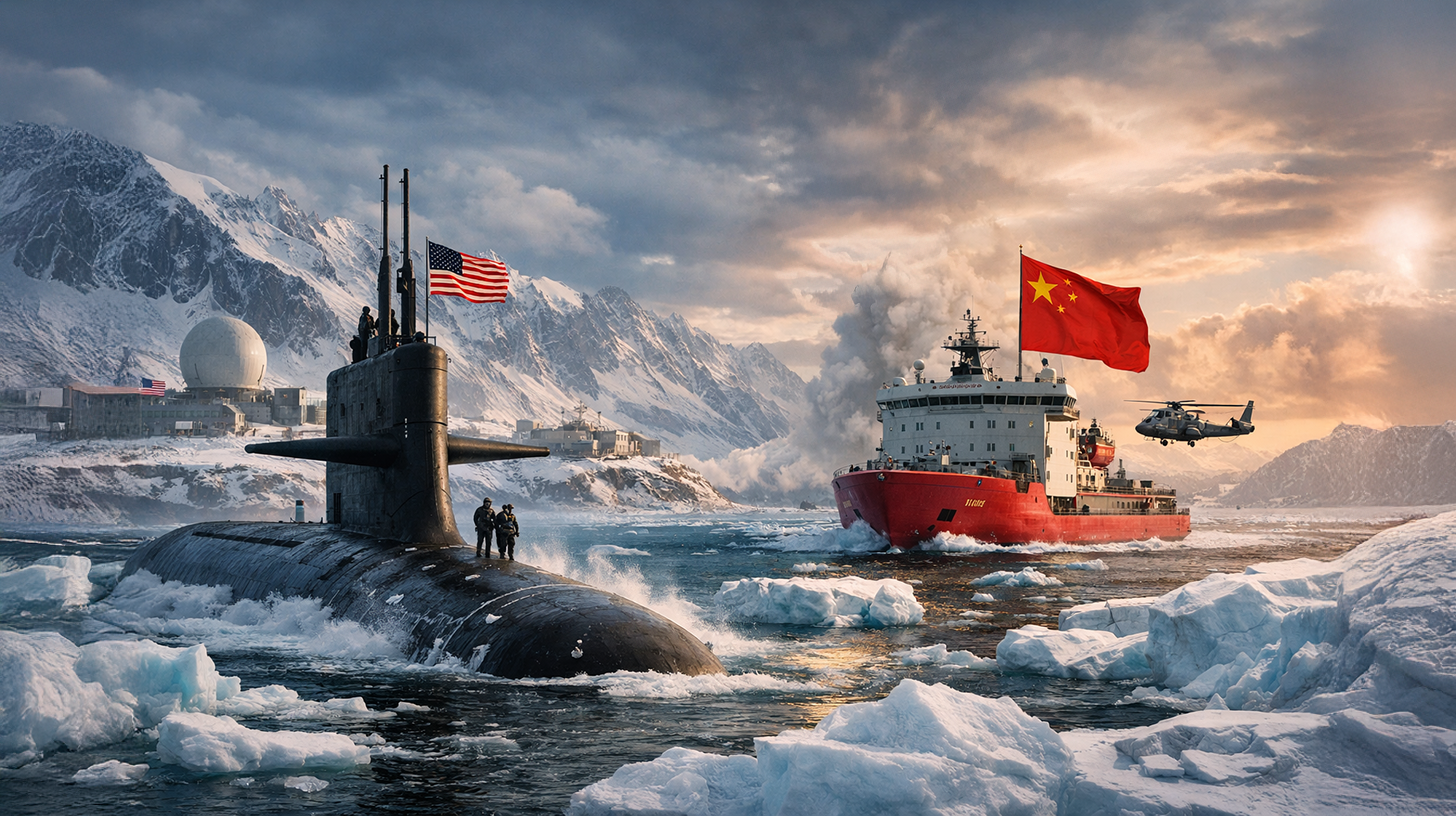
Greenland: China's sharp warning to the US – Is the dispute over the "Polar Silk Road" escalating? – Image: Xpert.Digital
Icy power struggle in 2026: USA and China on a collision course off Greenland
Battle over rare earth elements and faster container ship sea route to Europe?
Washington's billion-dollar bet against Beijing's dominance – Why Greenland is now becoming the world's most dangerous flashpoint.
The Arctic between confrontation and cooperation: For Greenland, this means a time of extreme uncertainty. The island nation finds itself caught in a pincer movement between Washington's imperial ambitions, its historical ties to Copenhagen, and the economic allure of Beijing.
At the beginning of 2026, the Arctic has transformed from a zone of peaceful scientific cooperation into an arena of bitter geopolitical rivalry. At the heart of this global power struggle is Greenland, whose melting ice is not only opening up new sea routes but also attracting the attention of world powers as a treasure trove of critical raw materials. While the second Trump administration declares the island a national security priority and massively increases pressure on the Kingdom of Denmark, resistance is forming on the other side: Beijing is issuing dire warnings against the instrumentalization of the region and defending its ambitions along the "Polar Silk Road." This article examines the dramatic escalation of the situation, analyzes the strategic importance of rare earth deposits for the technological independence of the West, and shows how Greenland is fighting for its own future in the crossfire between Washington's expansionist plans and the Sino-Russian alliance.
Washington's imperial reach and the end of Danish sovereignty as the price for securing the Western Hemisphere?
The geopolitical architecture of the Arctic underwent a fundamental transformation at the beginning of 2026, shifting from a regime of historical cooperation to an arena of intense great power rivalry. Recent developments surrounding Greenland demonstrate that the world's largest island is no longer merely a peripheral issue in international politics, but has become a central linchpin of the United States' global security architecture under the second Trump administration. Washington's announcement that it would designate Greenland as a national security priority, not ruling out military options to secure the territory, has triggered a diplomatic shockwave that extends far beyond the Kingdom of Denmark, notably drawing the attention of the People's Republic of China.
In a remarkable diplomatic intervention, the Chinese Foreign Ministry warned the United States in January 2026 against using other nations as a pretext for its own geopolitical ambitions. Spokeswoman Mao Ning emphasized that Beijing's activities in the Arctic were strictly in accordance with international law and aimed at peace, stability, and sustainable development. This reaction from China is a direct response to American rhetoric justifying an acquisition of Greenland by claiming the need to prevent a perceived loss of control to China and Russia. Economic analysis of this dynamic reveals a complex web of resource hunger, the pursuit of technological autonomy in the rare earth sector, and the securing of new maritime trade routes made accessible by the melting of Arctic ice.
The instrumentalization of the Arctic and the end of diplomatic restraint
The American argument that Greenland must be acquired to block Chinese and Russian influence is rejected by Beijing as a baseless pretext. From a Chinese perspective, the US is merely using the alleged threat from external actors to expand its own sphere of influence in line with a modernized Monroe Doctrine. Indeed, China formalized its interests in the region as early as 2018, when it declared itself a near-Arctic state. This declaration laid the foundation for the integration of the Arctic into the global Belt and Road Initiative through the concept of the Polar Silk Road.
However, economic reality shows that Chinese investment in Greenland has so far fallen far short of media and political perception. Historically, projects such as airport expansion or the takeover of an abandoned naval base have been blocked by Danish and American interventions. Nevertheless, strategic concern remains high in Washington, as China, with its dominance in rare earth processing, could be a potential partner for the Greenlandic government if Western capital fails to materialize. China aims to claim a legitimate role in Arctic governance through scientific research, infrastructure investments, and the acquisition of raw material resources, which the US views as a direct attack on its security interests.
Infrastructural hegemony and the rise of the polar Silk Road
The Polar Silk Road is far more than a rhetorical project for Beijing; it is a strategic necessity for diversifying its trade routes. In 2025, the successful transit of the Northern Sea Route by Chinese container ships marked a turning point in global logistics. The voyage of the Istanbul Bridge, a Panamax container ship that completed the route from China to the UK in just 20 days in October 2025, demonstrated the enormous time savings compared to the traditional route through the Suez Canal.
This route is approximately 7,000 kilometers shorter than the southern passage, which not only reduces transit time by almost 40 percent but also significantly lowers fuel costs. At a time when conventional sea routes are threatened by geopolitical instability, such as in the Red Sea, the Arctic offers China a stable escape route that is largely beyond the control of the US Navy, as long as cooperation with Russia continues.
| Key figure for transport routes | Northern Sea Route (NSR) | Suez Canal route | Difference / Advantage |
|---|---|---|---|
| Distance (Shanghai to Hamburg) | approximately 14,000 km | approximately 21,000 km | -7,000 km |
| Transit time (average) | 18 – 25 days | 35 – 50 days | up to 50% faster |
| Fuel savings | approximately 20% – 40% | Underlying value | significant cost reduction |
| Navigation | seasonal (summer/autumn) | year-round | NSR limited to ice-free conditions |
| Geopolitical risk | Russian EEZ regulation | Piracy / Conflicts (Malacca/Suez) | NSR as an alternative |
The expansion of Chinese activities in the Arctic includes the construction of new icebreakers. Construction began in 2025 on a fourth icebreaker, potentially nuclear-powered, further increasing Beijing's operational capability in extreme latitudes. These vessels are officially designed for research but are dual-use capable and can be deployed for reconnaissance as well as supporting commercial shipping.
The resource war for the strategic independence of the West
A key driver for the American approach is securing access to critical minerals essential for modern defense technology and the green transformation. Greenland possesses some of the world's most significant untapped reserves of rare earth elements (REEs). In a world where China controls roughly 90 percent of global processing of these metals and increasingly uses this dominance as a political tool, Washington views Greenland as the key to strategic autonomy.
The Tanbreez project in southern Greenland is a particular focus of American efforts. With an estimated 28.2 million tons of rare earth oxides, it is considered one of the world's largest deposits, with heavy rare earth elements accounting for over 27 percent. In June 2025, the US Export-Import Bank signaled interest in a $120 million loan for this project to ensure that the resources remain within Western supply chains and are not tied up in Chinese offtake agreements.
| Global reserves of rare earth elements (2025) | Amount in million tons | Global share |
|---|---|---|
| People's Republic of China | 44,0 | approximately 48% |
| Brazil | 21,0 | approximately 23% |
| Vietnam | 3,5 | approximately 4% |
| Russian Federation | 3,8 | approximately 4% |
| Greenland (estimate) | 1.5 (according to USGS) | approximately 1.6% |
| United States | 1,9 | approximately 2% |
Note: Greenland's resource potential is estimated to be significantly higher in some reports once exploration progresses into deeper ice layers.
The economic hurdle for mining in Greenland remains the lack of infrastructure and the extremely harsh climate. Experts point out that opening a single mine in this region requires billions of dollars in investment and planning horizons of 10 to 20 years. Nevertheless, the Trump administration justifies the high costs with the argument of national security. The fear is that without direct American control over Greenland's resources, the risk of technological blackmail by Beijing will persist.
Our global industry and economic expertise in business development, sales and marketing

Our global industry and business expertise in business development, sales and marketing - Image: Xpert.Digital
Industry focus: B2B, digitalization (from AI to XR), mechanical engineering, logistics, renewable energies and industry
More about it here:
A topic hub with insights and expertise:
- Knowledge platform on the global and regional economy, innovation and industry-specific trends
- Collection of analyses, impulses and background information from our focus areas
- A place for expertise and information on current developments in business and technology
- Topic hub for companies that want to learn about markets, digitalization and industry innovations
Torn between the superpowers: Greenland's risky game for its own independence
The erosion of the transatlantic alliance and the Danish dilemma
The US actions toward Greenland have led to an unprecedented crisis within NATO. Danish Prime Minister Mette Frederiksen has repeatedly warned that an American takeover of Greenland would mean the end of the alliance. In Copenhagen, American policy is increasingly perceived as hostile. In December 2025, the Danish Defence Intelligence Service (DDIS) published a report classifying the US, for the first time, as a threat to national sovereignty.
This assessment is based on reports of American influence operations aimed at radicalizing the Greenlandic independence movement and sowing discord between Nuuk and Copenhagen. The US is employing a hybrid warfare strategy that combines disinformation and economic pressure to force Denmark to relinquish its Arctic territories. A key element is the bloc subsidy that Denmark pays to Greenland annually. At approximately $511 million, Copenhagen finances about 20 percent of Greenland's GDP. Washington has indicated it will either take over this subsidy or replace it with massive investments in mining to economically remove Greenland from the Danish sphere of influence.
| Economic indicators Greenland (2025) | Value (estimated) |
|---|---|
| Gross Domestic Product (GDP) | approximately USD 3.24 billion |
| Annual Danish block grant | approximately USD 511 million |
| Share of the block grant in the budget | > 50% |
| Main export commodity | Fishing (shrimp, cod) |
| Investment rate as a percentage of GDP | 36% (record value 2023) |
| Population | approximately 57,000 |
The reaction of Denmark's European allies to this development has been one of concern. Leaders from France, Germany, the United Kingdom, and other EU member states issued joint statements supporting Denmark's territorial integrity and emphasizing that Greenland belongs solely to its people. There is concern that a violent or forced annexation of Greenland could set a precedent for other powers, undermining international norms on state sovereignty worldwide.
The Pituffik space base as the nuclear nerve center of the Arctic
A crucial factor in American interest is the military significance of the Pituffik space base, formerly Thule Air Base. As the northernmost installation of the US Department of Defense, it houses the upgraded Ultra-Emergency Warning and Reconnaissance Radar (UEWR), which is essential for detecting and tracking intercontinental ballistic missiles (ICBMs) over the North Pole. The base is an integral part of the Space-Delta 4 early warning system and enables the US to maintain continuous surveillance of northern air and space approaches.
With the melting of the ice and the opening of new shipping lanes, Pituffik's role has expanded. It now also serves as a platform for monitoring the maritime movements of Russian and Chinese ships in the Arctic. As part of the Polar Maintenance Initiative, the US has begun a massive expansion of the base's infrastructure to prepare it for a permanently increased troop presence and modern weapons systems, including hypersonic missile interceptors.
The legal basis for the US presence is the 1951 defense agreement, which preserves Denmark's sovereignty but grants the US extensive usage rights. Trump, however, argues that this agreement, in its current form, is insufficient to counter the growing threats from China and Russia. Military planners consider the pursuit of full sovereignty over the base and surrounding territory necessary to guarantee unimpeded operational freedom without consulting Copenhagen.
Greenlandic identity between self-determination and global pragmatism
The political climate in Greenland itself is divided. The parliamentary elections of March 2025 resulted in a victory for the Demokraatit party under Jens-Frederik Nielsen, which pursues a pragmatic and gradual path to independence from Denmark. Nielsen firmly rejects annexation by the USA and emphasizes that Greenland wants to be neither Danish nor American, but independent. He is counting on strengthening the Greenlandic economy through the expansion of mining and tourism to such an extent that independence becomes fiscally viable.
On the other side is the Naleraq party, which demands a faster separation from Denmark and uses American attention as leverage to force better terms in negotiations with Copenhagen. A small segment of the population even sees a close alliance with the US as an opportunity for a higher standard of living and modern infrastructure, which Denmark cannot offer due to its own economic limitations.
However, Greenland's economic reality in 2025 was fraught with challenges. A decline in shrimp stocks and the discontinuation of major infrastructure projects led to stagnant GDP growth of just 0.2 percent. This increased the pressure on the government in Nuuk to develop new sources of revenue. In this context, mining became a key promise for the future. The Tanbreez project alone, it was estimated, could significantly reduce dependence on the Danish block subsidy through export taxes and job creation.
The strategic Moscow-Beijing axis and Arctic naval supremacy
China's warning against the US instrumentalization of Greenland must be seen in the context of its close cooperation with Russia. In October 2025, Beijing and Moscow signed an agreement for the joint development and commercialization of the Northern Sea Route. Russia considers this route the transport artery of the 21st century and relies on Chinese capital to build the necessary infrastructure along its Siberian coast.
China, in turn, benefits from Russian icebreakers to safely navigate its ships through Arctic waters. This cooperation also extends to the energy sector. Beijing has become the main buyer of Russian Arctic crude oil, receiving almost two million tons in 2024. The development of the Yamal Peninsula and the planned Power of Siberia 2 gas pipeline are further pillars of this energy alliance, which aims to circumvent Western sanctions and ensure China's energy security.
The US views this rapprochement with suspicion. Joint Chinese-Russian naval patrols near the Aleutian Islands and in the Bering Sea are seen as a direct attack on American dominance in the North Pacific. The deployment of Chinese research vessels to the Arctic, where they collect data on ice movement for months at a time, is interpreted by US intelligence agencies as preparation for a permanent military presence by Beijing in the region.
The economic burden of a potential annexation
A US acquisition of Greenland would entail enormous financial obligations. In addition to assuming Denmark's annual subsidy of over half a billion dollars, the US would have to invest massively in civilian infrastructure to maintain a level of living standards for Greenlanders that prevents social unrest. The costs of expanding the military presence and securing the extensive coastlines are estimated at tens of billions of dollars.
Critics in the US, particularly Democrats, warn that such an expansion would further increase national debt without delivering any immediate economic return. They accuse Trump of viewing Greenland merely as a trophy to immortalize his name on a vast island, rather than pursuing a sound foreign policy. In contrast, proponents argue that the long-term gains from mining and control of global trade routes would far outweigh the initial investment.
| Projection of annexation costs (annually) | Amount (estimated) |
|---|---|
| Compensation for the Danish block subsidy | USD 511 million |
| Infrastructure development (roads, ports, energy) | 1.5 – 2.5 billion USD |
| Military build-up and maintenance | 3.0 – 5.0 billion USD |
| Social spending and healthcare | 400 – 600 million USD |
| Total cost estimate per year | USD 5.41 – 8.61 billion |
The labyrinth of international law and the future of Arctic governance
Legally speaking, a unilateral annexation of Greenland by the US without the consent of Denmark and the Greenlandic people is a clear violation of international law. The right to self-determination of peoples, enshrined in the UN Charter, would require the Greenlanders to decide on their future status in a referendum. Denmark, in turn, has made it clear that Greenland is not for sale and that any change in sovereignty can only occur through a democratic process within the Kingdom.
Another area of conflict is the extension of continental shelf claims under the United Nations Convention on the Law of the Sea. Russia, Denmark (via Greenland), and Canada all claim parts of the Lomonosov Ridge, which stretches across the North Pole. The United States has not yet ratified the convention, which weakens its position in these negotiations. However, by annexing Greenland, the US could inherit the Danish claims and thus massively expand its access to the Arctic seabed and its resources.
China's admonition that the Arctic affects the interests of the entire global community aims to prevent the exclusivity of the Arctic states. Beijing advocates for multilateral Arctic governance, in which non-Arctic states also have a say, particularly regarding freedom of navigation and scientific research. This position stands in stark contrast to the American strategy of viewing the Arctic primarily as a security zone for the defense of the North American continent.
The Arctic between confrontation and cooperation
The analysis of events up to January 2026 makes it clear that Greenland has become the epicenter of a new Cold War. China's warning to Trump is symptomatic of a profound shift in global power relations. While the US attempts to consolidate its waning hegemony through territorial expansion and securing critical resources, China and Russia are exploiting climate change to establish alternative power centers in the Arctic.
For Greenland, this means a time of extreme uncertainty. The island nation finds itself caught in a pincer movement between Washington's imperial ambitions, its historical ties to Copenhagen, and Beijing's economic allure. The coming years will show whether Greenland can continue on its path to independence without being swept away in the maelstrom of great power competition. Greenland's fate will determine not only the future of the Danish kingdom but also whether the Arctic remains a space governed by international law or becomes a lawless zone where only the might of the strongest prevails.
The economic potential is enormous, but the risks of military escalation or a lasting rift within the Western alliance are equally real. In this highly dangerous game over rare earth elements, shipping lanes, and strategic dominance, Greenland is the prize all sides are fighting for with increasing ferocity. The warning from Beijing is merely a harbinger of the coming conflicts that could permanently alter the face of the world map in the 21st century.
Your global marketing and business development partner
☑️ Our business language is English or German
☑️ NEW: Correspondence in your national language!

Konrad Wolfenstein
I would be happy to serve you and my team as a personal advisor.
You can contact me by filling out the contact form or simply call me on +49 7348 4088 965 (Munich) . My email address is: wolfenstein ∂ xpert.digital
I'm looking forward to our joint project.
☑️ SME support in strategy, consulting, planning and implementation
☑️ Creation or realignment of the digital strategy and digitalization
☑️ Expansion and optimization of international sales processes
☑️ Global & Digital B2B trading platforms
☑️ Pioneer Business Development / Marketing / PR / Trade Fairs
🎯🎯🎯 Benefit from Xpert.Digital's extensive, five-fold expertise in a comprehensive service package | BD, R&D, XR, PR & Digital Visibility Optimization

Benefit from Xpert.Digital's extensive, fivefold expertise in a comprehensive service package | R&D, XR, PR & Digital Visibility Optimization - Image: Xpert.Digital
Xpert.Digital has in-depth knowledge of various industries. This allows us to develop tailor-made strategies that are tailored precisely to the requirements and challenges of your specific market segment. By continually analyzing market trends and following industry developments, we can act with foresight and offer innovative solutions. Through the combination of experience and knowledge, we generate added value and give our customers a decisive competitive advantage.
More about it here:










