
Billions from Brussels, but a veto for Moscow: Bulgaria's dangerous tightrope walk
Xpert Pre-Release

Available in 27 languages 📢
Prefer Xpert.Digital on GoogleⓘPublished on: June 20, 2026 / Updated on: June 20, 2026 – Author: Konrad Wolfenstein
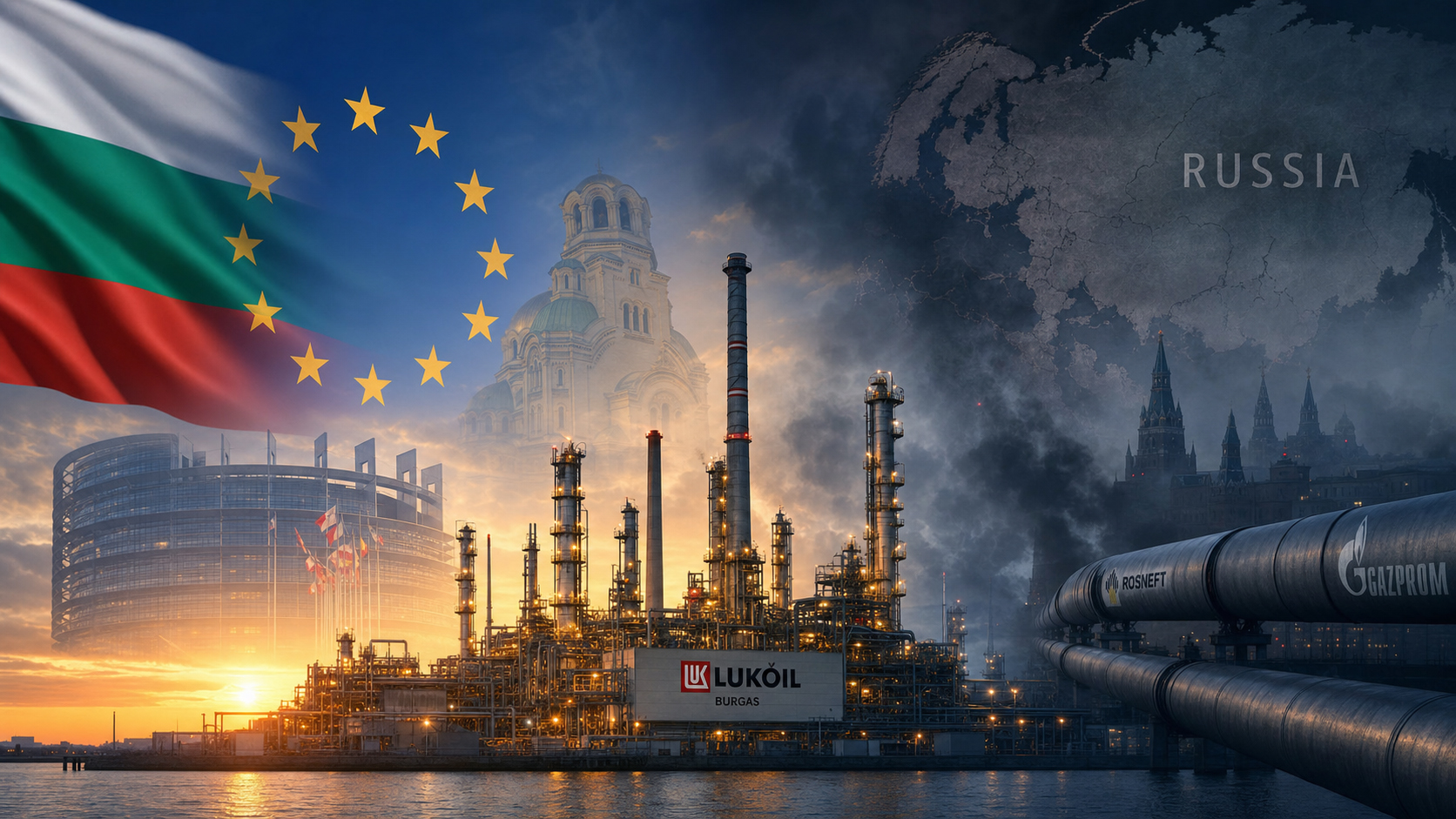
Billions from Brussels, but a veto for Moscow: Bulgaria's dangerous tightrope walk – Image: Xpert.Digital
Despite sanctions blockade: Why EU billions are now flowing to Bulgaria
The Lukoil Dilemma: How a single company dictates Bulgaria's EU policy
Euro accession and Russian oil: The truth about Bulgaria's economic miracle
In the summer of 2026, Bulgaria finds itself at the center of a geopolitical and economic balancing act that poses complex challenges for the European Union. On the one hand, after a long struggle, billions from the EU recovery fund are finally flowing into Sofia, following the country's implementation of important, albeit still incomplete, reforms. On the other hand, the new government under Prime Minister Rumen Radev is causing headaches in Brussels: it is deliberately blocking key EU sanctions against Russia, particularly in the sensitive energy sector. What might at first glance appear to be a blatant political contradiction, or even a show of loyalty to Moscow, reveals itself upon closer inspection as a stark economic survival instinct. Trapped in decades of dependence on the Russian oil giant Lukoil and burdened by profound structural challenges, Bulgaria is fighting for its national energy security and stability in the year of its historic accession to the euro. The following article sheds light on the complex background of a country that proves even states with significant economic catching-up needs know how to use their leverage in Europe extremely effectively.
Bulgaria in a state of tension — EU funds, energy dependence and the dilemma of sanctions policy
Between Brussels' billions in funding and Moscow's power: Why Sofia has no easy way out
In the summer of 2026, Bulgaria faces a situation rarely experienced so acutely in its modern history: On the one hand, billions of euros from the EU recovery fund are flowing into Sofia; on the other, the new government under Prime Minister Rumen Radev is blocking key sanctions proposals against Russia. This is not a contradiction—rather, it is an expression of a deeply rooted structural dependency that limits political room for maneuver and dominates economic calculations. Anyone who views this dynamic solely through the lens of political loyalties misunderstands the economic reality in which the EU member state with the greatest need for economic recovery finds itself.
Billions from Brussels: The fourth RRP payment and its significance
On June 19, 2026, the European Commission issued a positive preliminary assessment of Bulgaria's fourth payment request under the National Recovery and Resilience Plan (RRP). Bulgaria will receive nearly €1 billion from this tranche, with the funds expected to be credited to the state's accounts by the end of July 2026. An additional €150 million in previously withheld funds was also released. Of the 26 milestones and objectives in this fourth tranche, 23 were assessed as having been met; three outstanding measures, primarily related to anti-corruption legislation, must be completed by August 31, 2026.
This payment is part of a series of disbursements that have characterized the relationship between Sofia and Brussels over the past two years. The first payment, amounting to €1.37 billion, was received by Bulgaria in December 2022. The second tranche, totaling €438.6 million, was received in November 2025—following a three-year hiatus due to political instability, stalled reforms, and repeatedly renegotiated milestones. The third payment of €1.47 billion followed shortly thereafter after a positive assessment, in which 48 out of 50 milestones were deemed fulfilled. The total framework of Bulgaria's RRP amounts to between €6.17 and €6.27 billion in grants from the NextGenerationEU program.
The timing is revealing: at the end of 2024, the European Commission suspended a disbursement of €653 million because Bulgaria had failed to meet its commitments in the areas of energy, anti-corruption, and public procurement. At that time, the country received only a third of its total allocation, while the EU average was 37 percent. The fact that Bulgaria is now receiving several tranches in rapid succession in the spring and summer of 2026 is the result of intensive reform efforts by the previous government and successful renegotiation of individual milestones—especially in the justice sector.
The question of conditionality: reforms as a condition, not as a backdrop
EU payments to Bulgaria are not an expression of political favor or diplomatic compensation for any foreign policy stance. They follow a strictly conditional mechanism: funds are only released once concrete, predefined milestones in areas such as judicial reform, combating corruption, energy supply, public procurement, and digitalization have been demonstrably met.
Nevertheless, the political narrative of the new Radev government, which interprets these payments as an expression of EU confidence in its Russia policy, is factually untenable. The EU Commission approves payments based on reforms, not on geopolitical pledges of loyalty. In fact, Bulgaria had significant ground to make up in several key reform areas: No progress, or no further progress, was observed in 2025 on four out of six EU recommendations concerning the rule of law. The 2026 Liberties Rule of Law Report even classifies Bulgaria as an active "dismantler" of the rule of law—along with Croatia, Hungary, Italy, and Slovakia. The fight against corruption shows structural weaknesses, the number of convictions for corruption at the highest levels remains low, and in Transparency International's Corruption Perceptions Index, Bulgaria shares 76th place with China, Moldova, and the Solomon Islands.
This background information significantly puts the triumphant rhetoric into perspective. The fact that the EU is still paying does not signify endorsement of Sofia's overall political course—it means that certain reform milestones have been administratively ticked off, even if the overall picture remains worrying. The outstanding anti-corruption reform from the fourth tranche, which is due by August 2026, demonstrates that Brussels reserves the right to withhold a portion of the funds until actual implementation has been demonstrated.
The Lukoil Complex: When National Energy Sovereignty Becomes a Hostage
Bulgaria's core structural problem in the context of sanctions is its energy dependence on a single player—the Russian Lukoil Group and its Bulgarian subsidiary, Lukoil Neftochim Burgas. The facility on the Black Sea coast is the largest oil refinery on the entire Balkan Peninsula, processing approximately 190,000 barrels of crude oil daily. It supplies more than two-thirds of Bulgaria's fuel needs and provides kerosene to all five of the country's international airports. In 2024, Lukoil Neftochim Burgas generated revenues of around €4.7 billion, making it not only Bulgaria's largest employer but also its largest taxpayer.
These figures explain why any serious discussion about sanctions against Lukoil or its majority shareholder Vagit Alekperov is immediately perceived as an existential threat in Sofia. When the US imposed sanctions on Lukoil and Rosneft in November 2025, Bulgaria was suddenly confronted with the scenario of an acute fuel crisis. International banks threatened to cease their cooperation with the sanctioned company, which could have led to supply shortages. The Bulgarian government had to request exemptions from Washington, which ultimately allowed the refinery to continue operating until April 2026.
The situation was further complicated by an arbitration claim filed by Lukoil's Swiss-registered subsidiary, Litasco, against Bulgaria. The background: Following the transfer of the management of Lukoil's Bulgarian subsidiaries to a special state administrator as part of the implementation of US sanctions, Litasco initiated formal arbitration proceedings in February 2026, arguing that the measures constituted unlawful expropriation without compensation. The compensation sought amounts to $3 billion. At the EU summit in June 2026, Prime Minister Radev explicitly referred to this ongoing arbitration claim when he declared that Bulgaria would not allow sanctions against Alekperov—this would be "an own goal." The economic logic is undeniable: By agreeing to sanctions, a country reinforces its own arbitration claim and simultaneously jeopardizes its national energy supply, acting against fundamental national interests.
Lukoil itself has been trying to sell the refinery for years. As early as 2023 and 2024, there were reports of a potential sale to a Qatari-British consortium, and Lukoil claimed to have invested over $3.4 billion in the facility over more than 20 years. However, a Bulgarian think tank estimates that Lukoil has generated around $3 billion in excess profits from its Bulgarian operations over the years—a figure that casts the investment rhetoric in a different light. Nevertheless, the refinery remains the backbone of Bulgaria's energy supply, and a rapid divestiture without significant transitional risks is not realistic.
Patriarch Kirill and the Orthodox heritage: Religion as a geopolitical instrument
Bulgaria's blockade of EU sanctions against Russian Orthodox Patriarch Kirill touches upon a different dimension of the issue—and is considerably more complex in its political logic than it initially appears. At the EU summit, Radev declared, "The time of the Crusades is over," emphasizing that his concern was not with Kirill personally, but with the principle of keeping politics and religion separate. Bulgarian Foreign Minister Velislava Petrova described the planned sanctions against the Patriarch as "symbolic measures" that would have no real economic impact but could prove counterproductive by fueling anti-European narratives.
The argument has a certain domestic political plausibility: around 70 percent of the Bulgarian population belongs to the Bulgarian Orthodox Church, which is historically closely linked to the Russian Orthodox Church. The accusation that Europe is interfering in religious affairs would indeed resonate in a country with such a high density of believers. At the same time, this is a policy area in which Radev's government can gain domestic political capital without incurring immediate economic costs—because, as Petrova admits, sanctions against Kirill have no direct economic impact.
Critics in Bulgaria see things differently. Former Finance Minister Asen Vasilev, chairman of the pro-European Change Party, pointed out that Kirill is anything but a purely religious leader and that his support for the Russian war of aggression is well-documented. Sanctions against him are not only justified but necessary as a signal of moral resolve. Until Radev came to power, Bulgaria was not the only obstacle: the previous Hungarian government under Orbán had blocked sanctions against Kirill since 2022. Only the new Hungarian government under Péter Magyar signaled its willingness to agree—whereupon Bulgaria assumed the role of veto player.
This episode demonstrates how an EU member state, one of the most economically challenged in the Union, can exert political influence far beyond its actual size through targeted obstruction in consensus-building processes. This is not a peculiarity of Bulgaria—it is the structural weakness of the EU's unanimity principle on sanctions issues.
The new Radev government: Taking power with a geopolitical agenda
Rumen Radev, former president and chairman of the Progressive Bulgaria party, assumed the office of prime minister on May 8, 2026, following his victory in the parliamentary elections of April 19, 2026. Parliament approved his single-party cabinet by a vote of 124 to 70. Radev cited the adoption of a state budget for 2026, combating inflation, judicial reform, and accessing EU recovery funds as his government's priorities.
Radev's simultaneous announcement that he would "defend" Bulgarian interests in the EU and NATO while also improving relations with Russia reflects a dual foreign policy strategy. It hints at the ambiguity that has characterized Bulgaria's foreign policy for decades: formal Western integration coupled with a strong cultural, religious, and economic pull towards Russia. This ambiguity reflects not only clientelism but also real societal divisions that can be mobilized in elections.
The new government took office without a valid state budget for 2026—the year that marks Bulgaria's historic entry into the eurozone. Financial experts pointed to a worrying deficit of 1.4 percent in the first four months of the year, as well as rising public sector spending. The introduction of the euro on January 1, 2026, which made Bulgaria the 21st member of the eurozone, had already sparked discussions about potential inflationary effects. The European Central Bank estimated the additional boost to inflation at between 0.2 and 0.4 percentage points—a sensitive issue in a country already struggling with rampant inflation.
Our EU and German expertise in business development, sales and marketing

Our EU and German expertise in business development, sales and marketing - Image: Xpert.Digital
Industry focus areas: B2B, digitalization (from AI to XR), mechanical engineering, logistics, renewable energies and industry
More information here:
A thematic hub offering insights and expertise:
- Knowledge platform covering global and regional economies, innovation and industry-specific trends
- A collection of analyses, insights, and background information from our key areas of focus
- A place for expertise and information on current developments in business and technology
- A hub for companies seeking information on markets, digitalization, and industry innovations
Lukoil and the refinery dilemma: How Bulgaria can break its energy dependency
Economic assessment: Growth despite instability
Viewed in isolation from the political turmoil, Bulgaria's overall economic situation is remarkably robust. In the first three quarters of 2025, GDP growth was among the highest in the EU: 3.5 percent in the first quarter, 3.4 percent in the second, and 3.2 percent in the third. For the entire year of 2025, the European Commission forecasts growth of 3.0 to 3.1 percent, the sixth highest in the Union. The European Bank for Reconstruction and Development (EBRD) expects growth of 2.7 percent for 2026 and 2.6 percent for 2027. Bulgaria thus remains one of the more dynamic economies on the eastern edge of the EU, even though the absolute income gap compared to the EU average is still considerable.
Economic growth is driven by a combination of rising private consumption, wage growth, foreign investment, and—increasingly—the influx of EU recovery funds. Eurozone membership is considered a long-term anchor of stability: the previous currency board mechanism had structurally disadvantaged Bulgaria's creditworthiness, as international rating agencies negatively assessed foreign debt denominated in a foreign currency. With the elimination of this deduction and direct integration into the ECB, the country's refinancing situation should improve, strengthening the confidence of foreign investors.
At the same time, significant structural risks exist. Energy supply remains heavily dependent on the Lukoil refinery. Despite Bulgaria's strong export performance in the electricity sector—the country ranks eleventh in the EU for net electricity exports—diversification of the energy mix has made little progress in the area of liquid fuels. Labor markets suffer from a chronic shortage of skilled workers and emigration, contributing to increased vulnerability to inflation. The public administration is structurally oversized, with systemic inefficiencies and an automatic salary adjustment mechanism that restricts budgetary flexibility.
Sanctions policy as a balancing of interests: No betrayal, but also no free pass
It would be an oversimplification to interpret Bulgaria's blockade of sanctions as simply pro-Russian sentiment. The reality is more complex. Bulgaria did not block the extension of existing EU sanctions packages against Russia. Sofia did not prevent the 21st sanctions package altogether, but only specific measures: the sanctions against Patriarch Kirill and those directly affecting the Bulgarian energy sector. The Bulgarian Foreign Minister clearly articulated the position: Bulgaria supports sanctions that create real economic pressure on Russia, but rejects measures that harm Bulgaria itself without influencing the war.
This logic of weighing options is quite understandable for a small country with a vulnerable energy infrastructure. The problem lies in the fact that it can easily be portrayed in the public eye as complicity with Moscow—and that it causes real damage to European unity, regardless of its economic justification in any given case. Every veto by a member state on sanctions weakens the EU's negotiating position vis-à-vis Russia and sends a signal that extends beyond the specific issue at hand.
Furthermore, the distinction between "economically sensible" and "symbolic" is not always as clear-cut as Sofia portrays it. Sanctions against Patriarch Kirill may be insignificant for Bulgaria personally—but for Ukraine, whose cultural heritage Russian troops are systematically destroying under Kirill's Segen , they have a different meaning. The moral dimension of sanctions policy cannot be entirely reduced to a cost-benefit analysis.
The refinery dilemma: Between decoupling and maintaining dependency
The structural question underlying the current sanctions debate is that of Bulgaria's medium-term energy strategy. The state's special administrator of Lukoil's operations, Rumen Spetsov, called on the Bulgarian state in May 2026 to repurchase the Neftochim Burgas refinery, describing the current situation as a historic opportunity. Indeed, Bulgaria has been discussing a potential change of ownership for the refinery for years—either through a sale to a Western consortium (there have been reports of interest from Qatar and the UK) or through a state takeover.
Competition proceedings against Lukoil Neftochim Burgas and Lukoil Bulgaria were initiated in the summer of 2025 following evidence suggesting that fuel imports and wholesale trade in the country had been deliberately obstructed. These proceedings indicate that the dominant market position of the Lukoil unit poses not only a strategic but also a competition law problem. A monopolist that simultaneously controls the supply and price structure of a national market is problematic from an antitrust perspective—regardless of its nationality.
The real economic policy challenge, therefore, does not primarily lie in the question of whether or not to sanction Alekperov. It lies in whether and how Bulgaria can overcome its structural dependence on a single Russian refinery within a realistic timeframe. Approaches exist: utilizing alternative crude oil sources from Kazakhstan and Arab countries, which are already processed at the plant; diversifying the supply route via the Black Sea; and, last but not least, accelerating the energy transition to reduce the long-term demand for liquid fuels. All of this requires time, investment, and political will—resources that have always been scarce in a country with decades of political instability and six parliamentary elections in a short period.
Geopolitical implications for the EU: The structural problem of unanimity
Bulgaria's behavior at the EU summit in June 2026 is not an isolated incident, but part of a pattern that seriously limits the EU's foreign policy capabilities. The unanimity principle for sanctions decisions allows each of the 27 member states to effectively block a decision or delay it until its own conditions are met. Hungary, under Viktor Orbán, systematically used this instrument to maximize bilateral concessions. Now that Budapest has become more cooperative under the new government, Sofia is assuming a similar role.
This presents a dilemma for the European Commission: it cannot use the same instruments against member states that block sanctions for understandable economic reasons as it does against countries that do so out of pure political loyalty to Moscow. At the same time, it cannot indefinitely tolerate the EU's collective leverage being undermined by individual national veto interests. Reforming the voting procedure in foreign and security policy towards qualified majority voting has been under discussion for years—but is being blocked by precisely those member states that value their veto power.
The release of EU funds to Bulgaria despite the sanctions blockade demonstrates that Brussels strategically separates the conditional nature of reconstruction funds (linked to reform achievements) from foreign policy (where Bulgaria acts as a sovereign entity). This is legally sound and politically understandable—but it does not resolve the fundamental problem that a member state can receive EU funds while simultaneously blocking EU foreign policy. This tension is inherent in the European treaties and can only be resolved through treaty amendments.
Euro accession as an anchor and incentive
Amidst this geopolitical turmoil, Bulgaria's accession to the euro on January 1, 2026, remains perhaps the country's most important economic event since joining the EU in 2007. The abolition of the lev and integration into the eurozone will provide Bulgaria with lower long-term transaction costs in intra-European trade, a more stable currency foundation for foreign direct investment, and improved creditworthiness. ECB President Christine Lagarde described the introduction of the euro as a measure that "strengthens Bulgaria's economic foundations, increases its resilience to global shocks, and gives more weight to its voice in the eurozone.".
In the short term, the introduction of the euro caused uncertainty among some members of the population, who feared price increases. However, the ECB estimated the additional inflationary impulse at a moderate 0.2 to 0.4 percentage points, since the lev had already been pegged to the Deutsche Mark and later to the euro via a currency board since 1997—thus largely neutralizing exchange rate effects. The real benefit of joining the euro lies in the signal it sends: A country that suffered from hyperinflation and banking system collapse as recently as the 1990s has made it into the eurozone. This is a watershed moment with psychological, symbolic, and economic significance.
However—and this is the crucial caveat—a strong monetary regime is of little use without fiscal discipline. Bulgaria joined the Eurozone in 2026 without a valid annual budget, with a rising deficit and a bloated public sector. The Eurozone's Stability and Growth Pact sets clear limits—members with deficits exceeding 3 percent of GDP face increased European pressure. The new Radev government has identified the budget problem as its "number one priority," but has yet to present any structural reforms beyond short-term spending appeals.
Structural constraints, no easy answers
Bulgaria's economic and political situation in the summer of 2026 cannot be grasped through simple narratives. It is neither a country rewarded by Brussels with billions for loyalty, nor one that acts as Moscow's Trojan horse within the EU through sanctions and blockades. It is a country suffering from deep structural dependencies that have grown over decades of industrial decisions, and navigating the tension between European integration and Russian energy power—with limited domestic political resources and under the pressure of a chronically unstable political system.
EU funds are flowing because reforms have taken place—incomplete, delayed, and under European pressure, but real nonetheless. The blockade of sanctions against Kirill and Alekperov is economically justifiable, even if it incurs political and moral costs and damages European unity. Eurozone accession is a milestone that promises long-term stability gains but requires short-term fiscal discipline, which Bulgaria finds structurally difficult. And the Lukoil issue remains the core, unresolved problem—an energy-related Gordian knot whose solution is not possible through the refusal of sanctions, but only through an active diversification policy.
For external observers—especially German and European companies and investors—Bulgaria's development provides a textbook example of applied interest politics: Even the EU's lowest-income state is not a passive actor, but a calculating state that uses its limited resources with remarkable efficiency. This deserves respect—and critical attention in equal measure.
🎯🎯🎯 Data-driven B2B industry hub as a quasi-in-house solution

The quasi-in-house solution: How Xpert.Digital closes operational gaps in B2B marketing and sales – Smart Content-Driven Business - Image: Xpert.Digital
Xpert.Digital is a data-driven B2B industry hub led by Konrad Wolfenstein . The company acts as an external, quasi-in-house solution for industrial partners, closing operational gaps in marketing, content, and sales – without requiring additional resources on the client side.
More information here:
Your global marketing and business development partner
☑️ Our business language is English or German
☑️ NEW: Correspondence in your native language!

Konrad Wolfenstein
I and my team are happy to be available to you as your personal advisor.
You can contact me by filling out the contact form here [email protected]:or simply call me at +49 7348 4088 965. My email address is
I'm looking forward to our joint project.





