
SPIEF 2026 Economic Forum: Calculated pragmatism or dangerous breach of the dam? Germany's risky bet on the Russian market
Xpert Pre-Release

Available in 27 languages 📢
Prefer Xpert.Digital on GoogleⓘPublished on: June 2, 2026 / Updated on: June 2, 2026 – Author: Konrad Wolfenstein
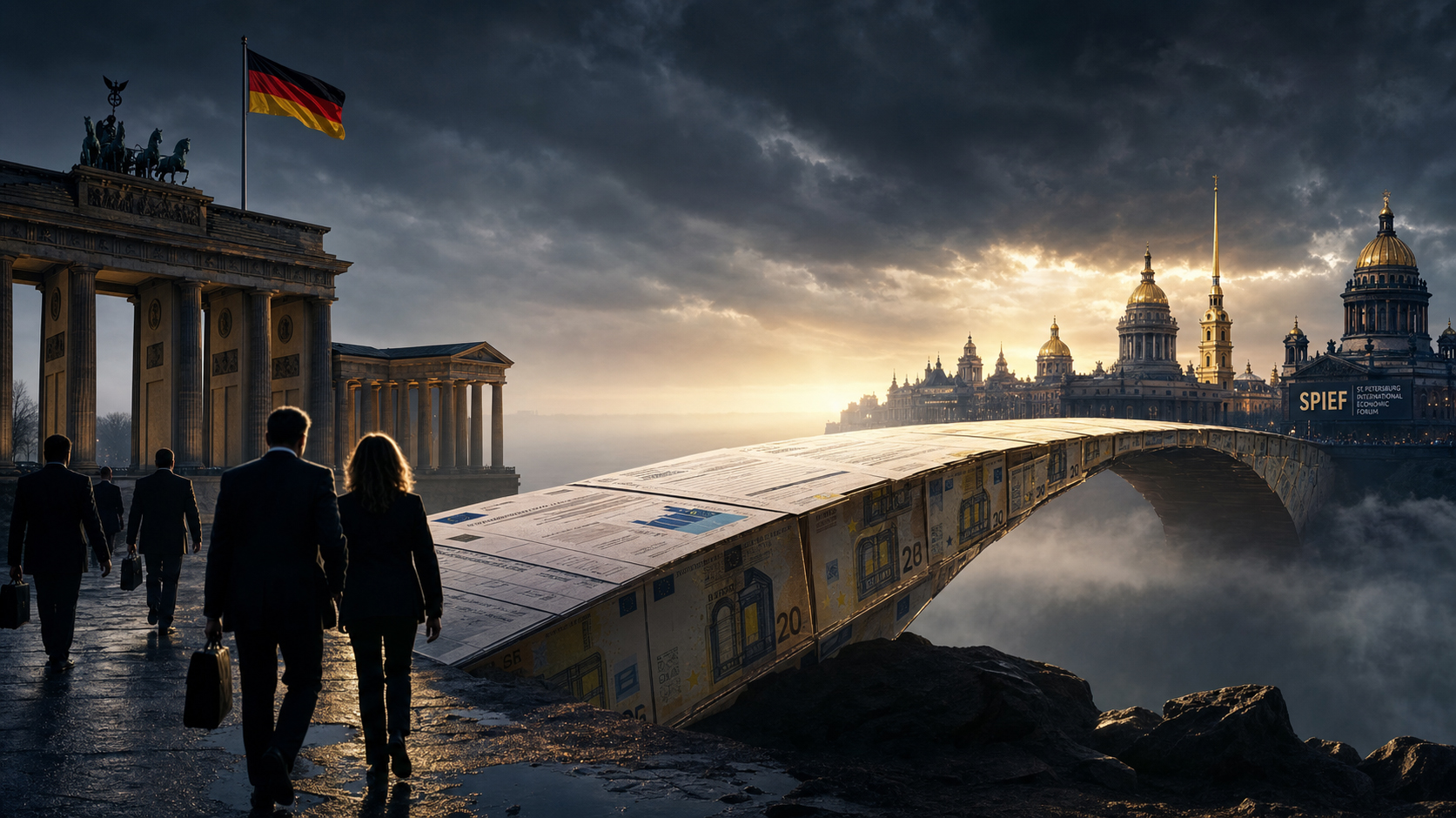
SPIEF 2026 Economic Forum: Calculated pragmatism or dangerous breach of the dam? Germany's risky bet on the Russian market – Image: Xpert.Digital
100 billion euros at stake: The risky Russian comeback of the German economy
Despite war and sanctions: Why German companies are suddenly returning to St. Petersburg
China takes over: Is Germany now losing the Russian market for good?
In June 2026, a segment of the German economy took a step that went far beyond typical business calculations: For the first time since the start of Russia's war of aggression against Ukraine, official German business representatives participated in the St. Petersburg International Economic Forum (SPIEF). For some, it was a necessary and pragmatic act of damage control, intended to protect German assets worth over €100 billion from Moscow's ultimate seizure and to prevent surrendering the market to Chinese competitors without a fight. For others, it was a dangerous breach of trust, a moral bankruptcy, and a disastrous political signal in times of unprecedented global crises. While some 1,600 German companies continued to generate billions in revenue in the Russian domestic market and secretly hoped for a swift end to the diplomatic chill, these efforts stood in stark contrast to the reality of European sanctions and the irreversible severing of ties with Russian gas. A ruthless analysis of the highly explosive tension between economic survival instinct, geopolitics, and the question of how much morality German foreign trade can afford.
German companies are returning to St. Petersburg
When German entrepreneurs officially participate in the St. Petersburg International Economic Forum (SPIEF) in June 2026 for the first time since the Russian attack on Ukraine, it will be more than just a footnote in the international business calendar. It will be a deliberate statement, a silent declaration about how a segment of the German economy assesses the situation – and what its priorities are. From June 3 to 6, 2026, dairy producer Stefan Dürr with his EkoNiva Group and long-time Globus manager Thomas Bruch, among others, will participate in a specially arranged business dialogue. The forum is being hosted by Vladimir Putin himself, the instigator of a war that has plunged Europe into its most serious security crisis in decades.
The German-Russian Chamber of Commerce (AHK) articulates the motivation for this return with disarming candor: The aim is to "maintain the economic bridge to Russia" and protect German assets – not least with a view to a possible ceasefire. It's about money, a lot of money. More than €100 billion of German assets are said to be tied up in Russia – in the form of factories, retail chains, frozen accounts, and companies under Russian foreign administration. This is a sum that necessitates consolidation, even if the political context seems to override any rational calculation.
Last year, US and French delegations participated in a business dialogue at SPIEF. Germany is now following this pattern – with the unspoken logic that it would be strategically unwise to completely cede the Russian market to others while maintaining a distance. Whether this move is wise or self-destructive cannot be answered categorically. It warrants careful economic analysis.
Europe's largest trading partner – and how it fell: The historic collapse of an economic relationship
To understand the extent of the rupture, it is worth looking at the recent past. Until the start of Russia's war of aggression, Germany was Russia's largest European trading partner. In 2021, the last full year of peace, bilateral trade amounted to €59.8 billion – an increase of 34 percent compared to the first year of the pandemic, 2020. Imports from Russia, consisting primarily of oil and natural gas, accounted for the lion's share at €33.1 billion. Energy formed the foundation of this economic relationship – and simultaneously proved to be its greatest structural weakness.
The historical peak of German-Russian trade relations was even earlier, in 2012, when bilateral trade volume reached a record high of around 80 billion euros. At that time, Germany alone imported goods worth approximately 42.8 billion euros from Russia, primarily energy products. This interconnectedness was the result of a decades-long, deliberately shaped Ostpolitik (Eastern Policy) that relied on change through trade – a concept that, in retrospect, has not only failed but has become a geopolitical trap for Germany.
Following the start of the war of aggression in February 2022, this trade relationship collapsed with breathtaking speed. German imports from Russia fell by 94.6 percent by 2024, to a value of just €1.8 billion. Exports to Russia plummeted by 71.6 percent over the same period, reaching €7.6 billion. This caused Russia to slip to 59th place among Germany's most important suppliers – down from 12th in 2021. What was once a mainstay of German foreign trade is now an economic footnote.
Between the impact of sanctions and wishful thinking: What the AHK survey really reveals
The German-Russian Chamber of Commerce conducted a business climate survey among its 750 members, yielding revealing, and in some cases contradictory, results. Of the 265 companies that participated in the survey, 75 percent stated they were satisfied with the development of their business in Russia – despite the massive losses in the millions caused by the sanctions regime. This result is surprising at first glance, but can be explained by a selection effect: The companies still active in Russia are those that have either found a niche, successfully adapted to the pressure of the sanctions, or have strategic reasons that override short-term profitability considerations.
The assessment of the sanctions' impact is also revealing: Two-thirds of the surveyed companies are convinced that Western sanctions are severely or very severely impacting the Russian economy. At the same time, just over a third state that the measures are harming Germany at least as much as Russia, and more than half see a nearly symmetrical impact on both sides. These assessments are not only relevant from an economic policy perspective—they reflect a deep ambivalence that characterizes the public debate on sanctions policy in Germany.
Particularly noteworthy is the survey of opinions on energy: When asked whether Germany should resume importing gas and oil from Russia, 65 percent of the companies surveyed answered "yes, the sooner the better." A further 31 percent favored a resumption, but only after a ceasefire in Ukraine. In other words, almost all of the companies surveyed desire a return to energy cooperation with Russia – at a time when the EU has decided to completely ban Russian gas by the end of 2027. This discrepancy between economic wishful thinking and European legal reality is no coincidence, but rather an expression of a fundamental divergence of interests.
20 billion in revenue, ten billion in trade: Two figures that explain a lot
Trade volume between Germany and Russia fell below ten billion euros in 2025. At the same time, the approximately 1,600 German companies still operating in Russia generate sales of around 20 billion euros. This seemingly paradoxical situation – low bilaterally registered trade volume despite substantial local sales – is explained by the structure of the remaining German companies in Russia. They predominantly produce locally, purchase locally, and sell locally. They are no longer trading partners in the traditional sense, but rather market participants within the Russian domestic market.
This distinction is crucial: the decline in trade volume measures the flow of goods across the border, not economic activity within the country itself. Companies like EkoNiva, which specialize in Russian agriculture and dairy production, or retail chains like Globus, are deeply embedded in the Russian economic system. Their withdrawal would entail significant financial losses—and this threat deters many from leaving the market permanently. At the same time, no economic advantage justifies moral complicity with a regime waging a war in violation of international law. This tension cannot be resolved—it must be endured.
In 2011, these companies' revenues were four times higher. That's a decline to 25 percent of their previous level – despite their continued presence and all optimization efforts. What the remaining German firms are doing is, at best, damage control. At worst, it's subsidizing the Russian budget through economic activity that generates tax revenue, jobs, and stability – in a country that uses these resources for its war.
Sanctions: An instrument with side effects on both sides
Whether sanctions are effective is one of the most intensely debated questions in international economic policy. In the Russian case, the answer is nuanced: In the short term, the Russian economy has proven more resilient than many Western forecasts had predicted. GDP still grew robustly in 2024 because defense spending artificially stimulated the economy. In the medium term, however, structural cracks are becoming apparent: The International Monetary Fund forecasts growth of only 0.9 percent for 2025, and the Kremlin itself has revised its growth expectation downwards to 0.4 percent.
Russian military spending has nearly tripled since 2021, rising from $65 billion to approximately $190 billion in 2025 – from 3.6 to 7.5 percent of GDP. This arms boom distorts the picture: behind the growth figures lies an exhausted economy with structural imbalances, galloping inflation, and an exorbitant key interest rate of 14.5 percent. The Russian central bank itself had warned of an "overheated" economy with exhausted production capacities and a labor shortage. In the first quarter of 2026, the Russian economy contracted for the first time since early 2023.
For Germany, the consequences of the sanctions were also substantial, albeit asymmetrical: The energy price shocks of 2022 and 2023, triggered by the abrupt cessation of Russian gas supplies, severely impacted German industry. Meanwhile, the EU decided to phase out all gas imports from Russia by the end of 2027 – a phase-out plan that structurally undermines the expectations of those German companies that had hoped for a swift return to the energy partnership. This decision is irrevocably enshrined in European law and formally and permanently closes the path back to Nord Stream.
China's silent takeover: How Beijing is filling the Western gap
Perhaps the most compelling economic objection to continued Western abstention from the Russian market is the Chinese argument. Matthias Schepp, Chairman of the German-Russian Chamber of Commerce (AHK), summed it up perfectly: In the first quarter of 2026 alone, Chinese entrepreneurs founded 1,400 new companies in Russia. The strategic conclusion he draws from this – that the West should not "permanently cede Russia, its large market, and its raw materials to Asia" – is not without economic logic.
Since 2022, China has systematically filled the gaps left by Western companies. In the automotive market, the share of Chinese brands rose from six percent (2021) to over 20 percent of new registrations as early as 2022, with a continuing upward trend. Of the 60 car brands that once operated in Russia, only 14 remain – eleven of them Chinese. In the smartphone market, Chinese manufacturers achieved a market share of 70 percent after the withdrawal of Apple and Samsung. Huawei operates 30 to 40 percent of Russia's mobile phone base stations. At SPIEF 2026, the US delegation, with more than 300 representatives, is the largest American delegation ever to participate in this forum – a signal that goes beyond mere trade intentions.
The strategic shift is real: Under the pressure of Western sanctions, Russia is developing into an economic vassal market of China. While Beijing negotiates favorable raw material supply contracts, acquires market share in technology, and finances infrastructure projects, the West is losing influence and market position. Whether a return of Western companies—a highly problematic political prospect—could reverse this process is questionable. China's entrenchment is already too deep, and Russia's economic dependence on Beijing has become too structural.
Our EU and German expertise in business development, sales and marketing

Our EU and German expertise in business development, sales and marketing - Image: Xpert.Digital
Industry focus areas: B2B, digitalization (from AI to XR), mechanical engineering, logistics, renewable energies and industry
More information here:
A thematic hub offering insights and expertise:
- Knowledge platform covering global and regional economies, innovation and industry-specific trends
- A collection of analyses, insights, and background information from our key areas of focus
- A place for expertise and information on current developments in business and technology
- A hub for companies seeking information on markets, digitalization, and industry innovations
SPIEF and sanctions: How German participation puts European unity to the test
100 billion at stake: The wealth question as an economic policy dilemma
The figure that has the greatest emotional impact in German economic policy discussions is that of the German assets at risk in Russia: over €100 billion tied up in factories, retail chains, energy holdings, frozen accounts, and companies under Russian receivership. This figure comes from the German-Russian Chamber of Commerce (AHK) and has not been independently verified, but it reflects a real dimension of risk that must be taken seriously.
The scope of this category is heterogeneous: some are direct investments in tangible assets – factories, buildings, machinery – that cannot be physically moved out of Russia. Others are liquid assets held in Russian blocked or escrow accounts, to which foreign companies have only limited access after selling their Russian businesses. Still others are stakes in companies that Moscow has placed under state administration – a measure that effectively amounts to expropriation without formally carrying it out.
The political dilemma is structural: the more decisively the EU uses Russian central bank assets for Ukraine, the greater the risk of Russian countermeasures against German private property in Russia. Chancellor Merz has advocated for the use of frozen Russian assets, which increases the pressure on German companies operating in Russia. The German-Russian Chamber of Commerce (AHK) explicitly warns of this domino effect. Anyone still holding assets in Russia is in a hostage situation – and the return to the SPIEF (State Agency for International Financial Equalization) can also be interpreted as an attempt to strengthen this negotiating position.
Between Moscow and Brussels: The sanctions architecture and its limits
The Western sanctions architecture against Russia has reached a new dimension with the EU's 20th sanctions package. For the first time, not only direct transactions with Russia were included, but also exports from the EU to third countries if there is suspicion of sanctions circumvention. The rules for combating circumvention via third countries – such as Central Asia or Turkey – have been tightened. Banks and companies outside the EU that participate in sanctions circumvention can also be directly sanctioned.
Nevertheless, the data show that the sanctions regime is riddled with loopholes and is partially circumvented through substitution, diversion, and gray market transactions. German exports to Russia still amounted to almost ten billion euros in 2025 – a significant portion of which consisted of goods classified as humanitarian aid or exempt from sanctions. These include pharmaceuticals, medical technology, and other explicitly exempt product categories. At the same time, the data is incomplete: goods routed through third countries do not appear statistically as German exports, but are de facto part of an ongoing economic interdependence.
The legal situation for German companies participating in SPIEF is sound, as long as they do not meet with sanctioned individuals, conduct prohibited transactions, or negotiate goods subject to the sanctions regime. Mere participation in a forum—even one hosted by Putin—is not prohibited under current EU law. However, what makes participation a politically sensitive undertaking is the signal it sends: at a time when European unity vis-à-vis Russia is considered a strategic asset, the official return of German business representatives sends an ambiguous message to Moscow, Kyiv, and their European partners alike.
Energy as the Achilles' heel: The illusion of a quick return
The desire for a swift resumption of Russian gas and oil deliveries, as expressed in the AHK survey, ignores the legal and infrastructural realities. Since Russia halted gas deliveries via pipelines in 2022, Germany has rapidly developed alternative sources of supply and built up an LNG infrastructure. Meanwhile, the EU has decided to ban all gas imports from Russia by the end of 2027 at the latest – with prohibitions on new contracts that have been in effect since spring 2026.
This decision is not merely a matter of political will, but binding European law. Even if a ceasefire in Ukraine were to alter the political climate, an immediate return to Russian energy supplies would be legally impossible and hardly feasible from an infrastructural standpoint, given that the Nord Stream pipelines are permanently out of service. The desire, expressed by 65 percent of the surveyed companies, for a return to Russian gas "the sooner the better" is therefore, under the given circumstances, an unrealistic expectation. It reveals less a strategic analysis than a desire for a return to cheap input prices – a competitive advantage that is irrevocably a thing of the past.
For German industry, this represents a structural challenge: the energy transition must now be undertaken in two ways – away from fossil fuels in general and away from Russian dependence in particular. The costs of this transformation process are real and significantly impact the international competitiveness of energy-intensive industries. But the alternative – strategic dependence on a regime that uses energy supplies as a geopolitical weapon – has already once led Germany into a dangerous vulnerability from which it only escaped through considerable economic hardship.
The political backdrop of SPIEF: Where business and propaganda intertwine
In addition to the economic discussions, SPIEF 2026 is also hosting an event entitled "Culture as a Bridge Builder in Times of Crisis." According to the organizers, the German participants include conductor Justus Frantz, publisher Holger Friedrich of the Berliner Zeitung, filmmaker and journalist Hubert Seipel, and Jörg Urban, chairman of the AfD in Saxony and member of the state parliament. The participation of AfD representatives and a publisher who has repeatedly attracted attention for his pro-Kremlin reporting lends the German presence at SPIEF a political slant that extends beyond purely business interests.
Under Putin, the SPIEF has become an instrument of strategic communication. It serves not only to initiate economic relations but also to demonstrate that Russia remains internationally integrated despite sanctions and war, that Western business representatives are finding their way back to Moscow, and that the Kremlin's geopolitical isolation has its limits. Every official participation of Western companies—whether American, French, or German—is used accordingly in Russian state propaganda. This is not speculation but a pattern that has been clearly observable in recent years.
Economics and geopolitics are never entirely separable, but in situations of active military aggression, the line between economic pragmatism and political complicity is particularly thin. Companies that make this choice are not inherently wrong – but they bear a special burden of justification that must extend beyond asset protection and market access.
Perspectives after a ceasefire: Who really benefits?
The entire logic behind Germany's return to the SPIEF is based on the assumption that a ceasefire or peace agreement could be reached in the near future, and that Germany would then want to be in a strong position to benefit from Russia's reconstruction and the normalization of economic relations. This assumption warrants critical examination. Even if a ceasefire were to occur, it is unclear whether and under what conditions Western sanctions would be lifted, whether the energy embargo could be reversed, and whether Russia would actually become a reliable economic partner.
China's structural integration into the Russian economy will not simply dissolve with a ceasefire. In four years of sanctions and a forced shift eastward, Russia has developed a new economic axis of gravity. Its dependence on Chinese technologies, investments, and markets is profound. A Western comeback in the Russian market would therefore not be a reversal of history, but rather competition under fundamentally altered circumstances.
Furthermore, the reconstruction of Ukraine – provided the West honors its pledges of support – offers a far more attractive and geopolitically less complicated economic engagement than a Russia that could remain under UN sanctions, ongoing EU restrictions, and geopolitical hostility. The question "Where will Germany invest after the war?" therefore arises not only in relation to Russia, but also to Ukraine – and there, a market beckons that is far more compatible with Western values, Western legal standards, and Western security needs.
Economic assessment: What a rational approach to Russia requires
An honest overall economic assessment of German-Russian economic relations must consider several dimensions simultaneously. First, the remaining 1,600 German companies in Russia, with a turnover of 20 billion euros, are not economically insignificant, but they represent a shrinking and risky position in a market that is structurally losing importance. Forgoing Russian energy has incurred considerable short-term costs for Germany, but in the long term, it has forced it to pursue resilient diversification, which is strategically valuable.
Secondly, sanctions are having an effect – but not immediately and not completely. By 2026, the Russian economy will be in a period of slowing growth, rising inflation, and structural overextension due to military spending. The IMF, the World Bank, the OECD, and the European Commission all project growth of around one percent for 2025 and 2026 – far from what Russia needs to increase its prosperity and maintain its international competitiveness. This is not a triumph of the sanctions regime, but an indication that it is taking a toll on long-term substance.
Thirdly: The decision to participate in SPIEF is understandable for the companies involved and within the framework of applicable law. However, it is not a contribution to European unity, a signal of solidarity with Ukraine, or an expression of a coherent long-term German foreign economic strategy. It is the result of individually rational decisions by actors who prioritize short-term asset protection over long-term geopolitical positioning. This tension is real – and it will continue to shape German-Russian economic relations for a long time to come, regardless of whether there is a ceasefire or not.
No easy answers, but clear priorities
Germany stands at an economic policy crossroads that offers no easy solutions. On one side of the equation: real financial losses from withdrawing from Russia, strategic advantages for China, at-risk assets, and a market that could be reopened in the long term. On the other side: the credibility of European sanctions policy, solidarity with a country under attack, Germany's reputation as a reliable ally, and the long-term realization that economic entanglement with authoritarian regimes creates strategic risks that outweigh their economic value.
The participation of German companies in SPIEF 2026 is, in this light, neither a scandal nor a given. It sends a difficult signal at a time when Germany would like to be both: economically pragmatic and geopolitically credible. These two ambitions cannot always be realized simultaneously – and the St. Petersburg International Economic Forum is a place where this tension becomes particularly evident. The approximately 1,600 German companies that remain in Russia do not deserve blanket condemnation. But they also do not deserve uncritical support – but rather a clear analysis of the conditions under which their involvement can be justified and the limits that must not be crossed.
🎯🎯🎯 Data-driven B2B industry hub as a quasi-in-house solution

The quasi-in-house solution: How Xpert.Digital closes operational gaps in B2B marketing and sales – Smart Content-Driven Business - Image: Xpert.Digital
Xpert.Digital is a data-driven B2B industry hub led by Konrad Wolfenstein . The company acts as an external, quasi-in-house solution for industrial partners, closing operational gaps in marketing, content, and sales – without requiring additional resources on the client side.
More information here:
Your global marketing and business development partner
☑️ Our business language is English or German
☑️ NEW: Correspondence in your native language!

Konrad Wolfenstein
I and my team are happy to be available to you as your personal advisor.
You can contact me by filling out the contact form here simply call me at +49 7348 4088 965. My email address is [email protected]:or
I'm looking forward to our joint project.










