
Russia | Putin's economic illusion is shattered: The true figures from the Kremlin
Xpert Pre-Release

Available in 27 languages 📢
Prefer Xpert.Digital on GoogleⓘPublished on: April 13, 2026 / Updated on: April 13, 2026 – Author: Konrad Wolfenstein
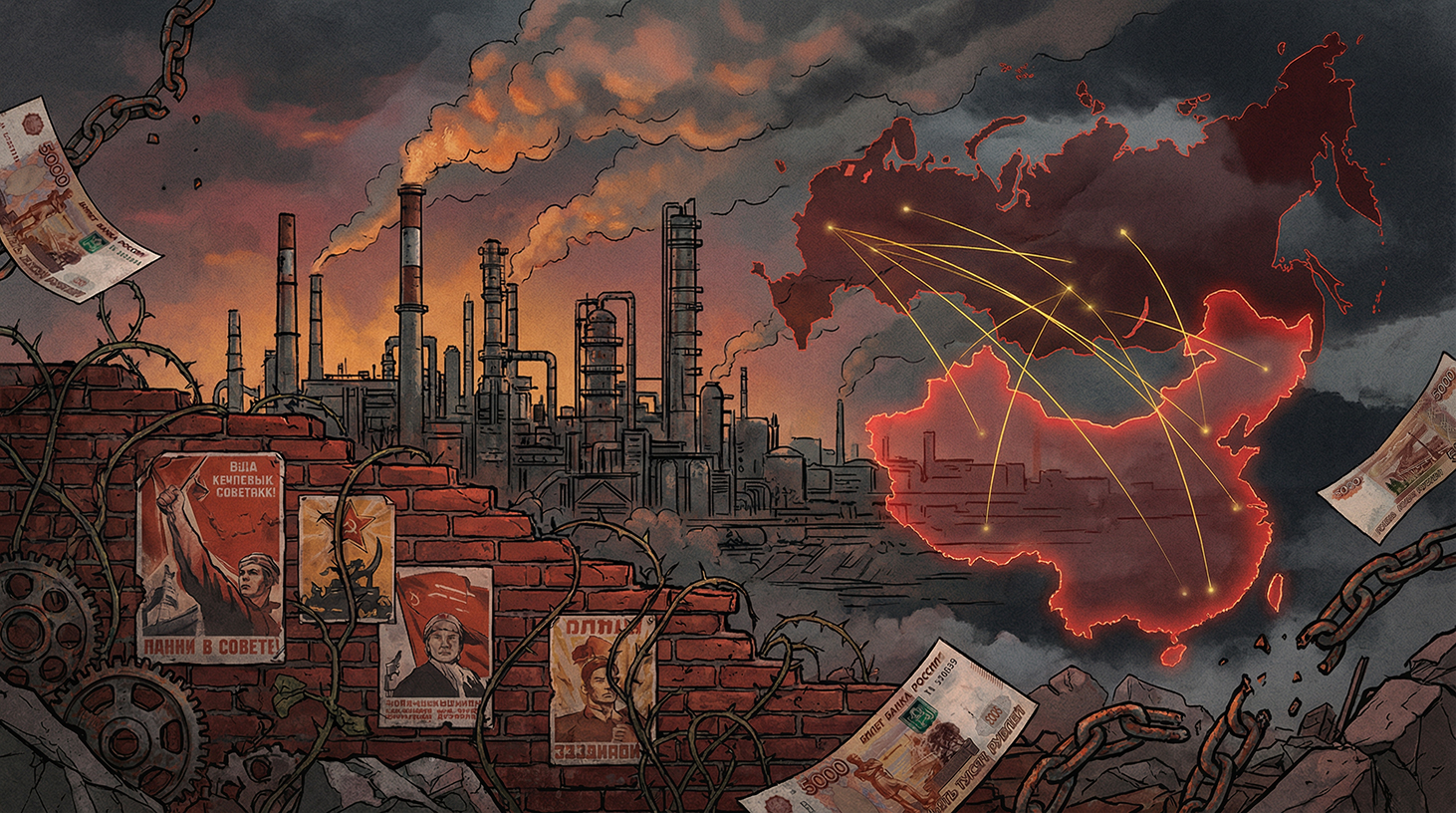
Russia | Putin's economic illusion is shattered: The true figures from the Kremlin – Image: Xpert.Digital
Crash in the fifth year of the war: Why Russia's economy is now running out of steam
Secret warnings to Putin: Is Russia facing summer collapse?
16 percent interest rates, empty coffers: The 5 real reasons for Russia's collapse and how China is reducing Russia to a mere resource colony
For a long time, the Russian economy seemed to defy the expectations of Western observers. Despite massive sanctions, the Kremlin presented growth rates that were celebrated as proof of Moscow's supposed resilience. But appearances are deceiving: the initial growth was merely a flash in the pan of a massively subsidized war economy that is now burning itself out. In the fifth year of the conflict, the tide is turning drastically. Galloping inflation, crushing interest rates of 16 percent, a glaring labor shortage, and massively declining revenues from the energy sector are driving the Russian economy into inevitable stagnation. At the same time, the supposed salvation provided by China is increasingly turning into a dangerous dependency that is reducing Russia to a mere resource colony. While Moscow desperately tries to conceal the decline, internal experts are already warning of a dramatic budget shortfall. A detailed analysis of the five structural stressors shows why time is running out for Putin's war machine and how the creeping economic decline is systematically eroding the Kremlin's long-term power base.
Putin's economy on the sidelines: How sanctions, interest rates and China are driving Russia into stagnation
From war boom to stagnation – the collapse of an economy in the fifth year of the war
In 2023 and 2024, Russia's economy seemed to defy Western observers. While NATO countries imposed one sanctions package after another, the Russian economy grew at rates of 3.6 percent in 2023 and 4.3 percent in 2024. The Kremlin used these figures for propaganda purposes as proof of the ineffectiveness of Western pressure measures. But this apparent resilience had a precisely identifiable cause: massively increased government spending, particularly on defense and military production. Federal spending rose by almost a quarter in 2024 to 40.2 trillion rubles (US$502.5 billion), up from 32.35 trillion rubles in 2023. This was not an expression of economic strength—it was the flash in the pan of a self-perpetuating war economy.
The years 2025 and 2026 demonstrate how short-lived this boom will be. The IMF lowered its growth forecast for Russia a total of three times within a year, now standing at 0.6 percent for 2025 and 0.8 percent for 2026. The Russian economy will grow four times slower than the global average (3.3 percent) and eight times slower than India (6.2 percent) in 2026. Among the world's largest economies, only Japan, with a projected growth of 0.6 to 0.7 percent, is weaker. This is the context that Moscow is trying to obscure.
The anatomy of stagnation: Five structural stress factors
Russia's economic slowdown is not a temporary phenomenon, but the result of a simultaneous interaction of several stress factors that reinforce each other.
First: High interest rates as a growth killer
The Russian central bank kept the key interest rate at an extremely high level to combat runaway inflation. Inflation in Russia reached 8.4 percent in 2024, is projected to rise to 9 percent in 2025, and only fall back to 5.2 percent in 2026. Interest rates of around 16 percent stifled private investment and consumption. Anyone investing in an environment with 16 percent interest rates on loans must have exceptionally high return expectations – in a war-torn, sanction-ridden market, this is the exception, not the rule.
Secondly: Declining tax revenue from the energy sector
Oil and gas revenues are the fiscal backbone of the Russian state. Revenues from oil and gas exports fell by 19 percent compared to the same period last year, representing a 27 percent decline compared to pre-war levels. Crude oil exports declined by about 6 percent, but revenues fell even more sharply – an indication of increasing discounts on sales. Russia is selling its oil at increasingly substantial discounts because of a lack of Western buyers and the fact that alternative customers like China and India are leveraging their bargaining power.
Thirdly: US sanctions against Rosneft and Lukoil
The situation worsened noticeably with the US sanctions against Russia's two largest oil companies, Rosneft and Lukoil, in October 2025. These measures were not aimed at peripheral sectors, but rather at the state's core revenue streams. The exclusion of insurance and shipping service providers, the threat of secondary sanctions against transactions in yuan and dirhams, and the extension to rupee transactions have placed targeted pressure on the Russian oil industry. Rosneft and Lukoil are dependent on state support, which further ties up budgetary resources.
Fourth: Labor shortage as a structural deficit
Hundreds of thousands of Russian men of working age are on the front lines or have emigrated. Paradoxically, the labor market is tight despite economic weakness: the unemployment rate in 2024 was 2.5 percent – a figure that under normal circumstances would indicate full employment, but here reflects a labor shortage. Rising wages in war-related industries, coupled with shortages in the civilian sector, are fueling inflation and distorting the economic structure.
Fifth: Increased tax burden without growth prospects
To limit the budget deficit, the Kremlin increased the value-added tax (VAT) from 20 to 22 percent on January 1, 2026. The government also plans to introduce new taxes on electronic products such as laptops, smartphones, and lighting. A rising tax burden in a stagnant economic environment is a recipe for further declines in private consumption.
Our global industry and economic expertise in business development, sales and marketing

Our global industry and economic expertise in business development, sales and marketing - Image: Xpert.Digital
Industry focus areas: B2B, digitalization (from AI to XR), mechanical engineering, logistics, renewable energies and industry
More information here:
A thematic hub offering insights and expertise:
- Knowledge platform covering global and regional economies, innovation and industry-specific trends
- A collection of analyses, insights, and background information from our key areas of focus
- A place for expertise and information on current developments in business and technology
- A hub for companies seeking information on markets, digitalization, and industry innovations
War financing 2026: Is there enough money to maintain Russia's offensive?
The Shadow Fleet and the impact of sanctions
A key element of Russia's sanctions circumvention strategy is the so-called shadow fleet – tankers that, operating under false flags or without transparent ownership, smuggle Russian oil past EU sanctions. EU efforts to combat this fleet are described by Russian insiders as one of the most serious threats to the Russian economy. Without the shadow fleet, Russia would receive even less for its oil, as buyers would insist on legal and cheaper alternatives.
Nevertheless, the debate about the effectiveness of the sanctions is complex. British analysts like Richard Connolly of the Royal United Services Institute emphasize that the sanctions have not yet been sufficient to fundamentally change Moscow's war strategy. As long as Russia can produce and sell oil—albeit at a discount—the economy will not remain a decisive factor in Putin's decisions. The more optimistic interpretation: The sanctions are having an effect, but it takes time, and the cumulative effects will become more noticeable in 2026 and 2027.
The China Factor: Lifeline or Golden Cage?
The most significant structural development in Russia's economy since 2022 is the complete reorientation of foreign trade towards China. The EU's share of Russian exports fell from nearly 50 percent before 2022 to just 8 percent. China now accounts for around 30 percent of Russian exports and 35 percent of imports. Eighty to ninety percent of the computer chips and electronics needed for Russia's defense industry are sourced via China and Hong Kong. Without this Chinese lifeline, Russia would have found itself in a significantly more difficult economic and military position.
But for Moscow, dependence on China is not a voluntary strategic decision, but a forced consequence of its geopolitical isolation. And it entails considerable risks. First, the trade relationship is fundamentally asymmetrical. In 2024, China's total foreign trade with Russia amounted to only around 4 percent – placing Russia eighth among China's trading partners, behind the EU, the US, South Korea, Hong Kong, Japan, Taiwan, and Vietnam. These imbalances give China considerable influence. Beijing buys Russian oil at discounts, but supplies consumer goods such as cars and electronics – yet invests hardly in factories in Russia.
2025 was the first year in five years in which China-Russia trade declined: Bilateral trade fell by 6.5 percent in yuan terms to 1.63 trillion yuan (US$234 billion). The decline is attributed to the slump in demand for Chinese cars in Russia and lower energy prices. This demonstrates that Russia is even dependent on China's willingness to trade with it.
What began as a partnership is evolving into a structural dependency, which some analysts compare to the situation of a resource colony. Russia supplies raw materials (oil, gas, metals), while China supplies finished goods and technology. Prices and quantities are increasingly dictated by China. Russia is becoming the junior partner: once, in the 2000s, Russia was the primary exporter of high-value goods to China – today, the relationship is completely reversed.
Budget scenarios and the question of war financing
The Russian state budget is under considerable pressure in 2026. Government spending is projected to reach 44.1 trillion rubles (US$551.3 billion), while energy revenues continue to decline. According to reports from Russian business circles, financial officials are urgently warning Putin of a crisis that could erupt as early as this summer: stagnant revenues coupled with high military spending are exacerbating the budget deficit, and there is no further fiscal leeway for tax increases. Russian oil revenues are expected to be around €87 billion in 2025, significantly below the original forecast of nearly €109 billion.
In the short term, Russia still has sufficient fiscal leeway to continue the war, according to Maria Snegovaya of the Center for Strategic and International Studies. In the long term—given the continuation of sanctions, low oil prices, and rising war costs—this leeway is shrinking. The key open question is: Can Russia sustain the economic costs of the war long enough to achieve its military objectives before economic exhaustion becomes politically destabilizing?
Controlled downturn or crisis?
The IMF projects 1 percent GDP growth for 2027 – a marginal increase that reflects not a recovery, but structural stagnation. Russia's own Ministry of Economic Development had forecast 1.3 percent for 2026 – a significant overestimate. The Russian central bank sees a growth range of 0.5 to 1.5 percent. All three forecasts are far below the global average and signal an economy caught between the costs of an unsustainable war and an inability to reprogram itself for structural, civilian growth. This is not a situation of collapse – but it is a creeping economic decline that is systematically eroding Russia's long-term power resources.
Your global marketing and business development partner
☑️ Our business language is English or German
☑️ NEW: Correspondence in your native language!

Konrad Wolfenstein
I and my team are happy to be available to you as your personal advisor.
You can contact me by filling out the contact form here or simply call me at +49 7348 4088 965. My email address is : [email protected]
I'm looking forward to our joint project.
☑️ SME support in strategy, consulting, planning and implementation
☑️ Creation or realignment of the digital strategy and digitization
☑️ Expansion and optimization of international sales processes
☑️ Global & Digital B2B trading platforms
☑️ Pioneer Business Development / Marketing / PR / Trade Fairs
🎯🎯🎯 Data-driven B2B industry hub as a quasi-in-house solution

The quasi-in-house solution: How Xpert.Digital closes operational gaps in B2B marketing and sales – Smart Content-Driven Business - Image: Xpert.Digital
Xpert.Digital is a data-driven B2B industry hub led by Konrad Wolfenstein . The company acts as an external, quasi-in-house solution for industrial partners, closing operational gaps in marketing, content, and sales – without requiring additional resources on the client side.
More information here:










