
The return of buffer stocks: Europe's supply chains after the crisis at the Red Sea and the Suez Canal
Xpert Pre-Release

Available in 27 languages 📢
Prefer Xpert.Digital on GoogleⓘPublished on: July 22, 2026 / Updated on: July 22, 2026 – Author: Konrad Wolfenstein
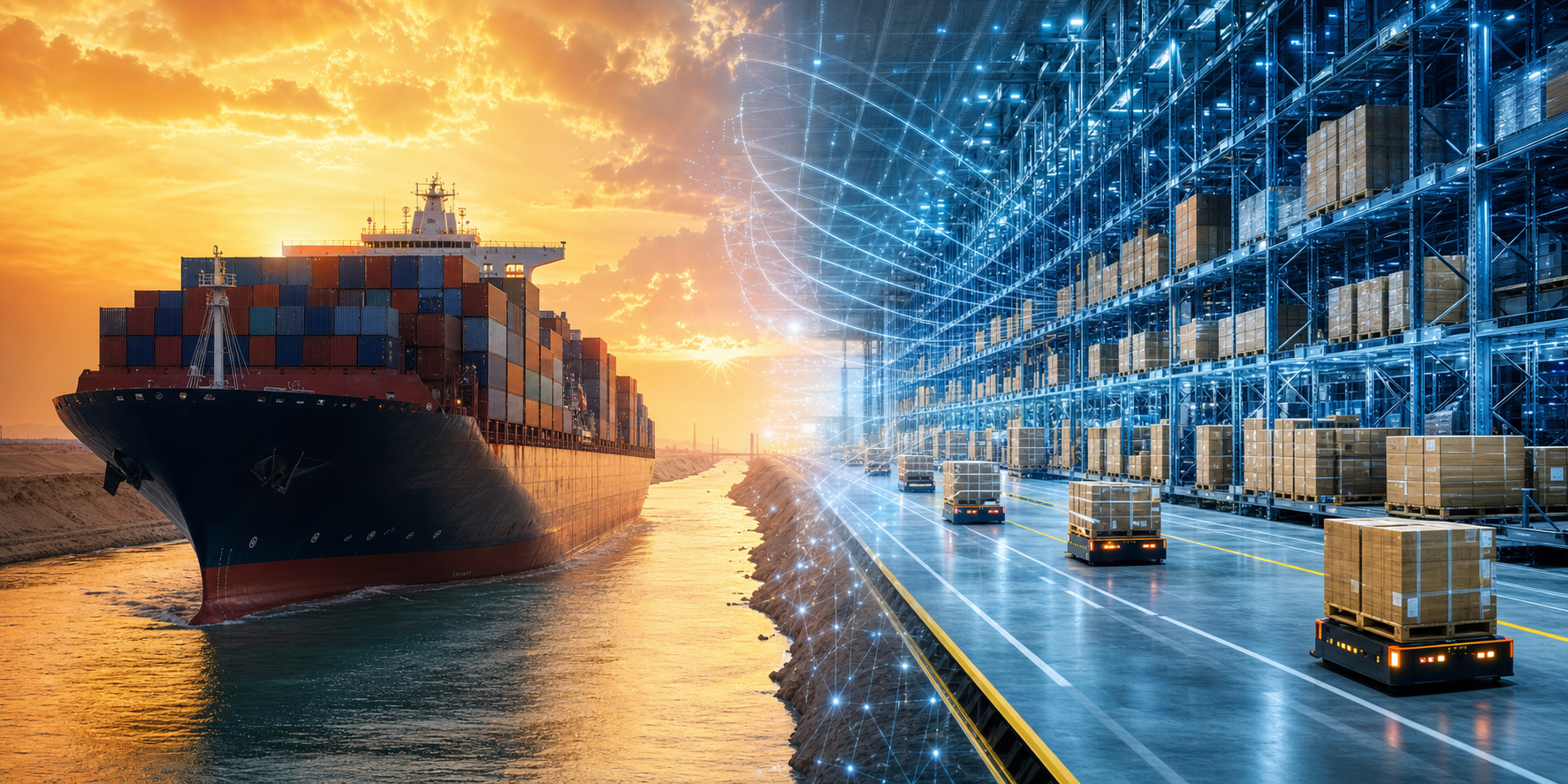
The return of buffer stocks: Europe's supply chains after the crisis on the Red Sea and the Suez Canal – Image: Xpert.Digital
When geopolitics wrecks the balance sheet: How German companies are preparing for the next supply chain shock
The Achilles heel of globalization: Why resilience is the new just-in-time
The attacks in the Red Sea have disrupted far more than just timetables – they mark the unmistakable end of a logistical era. For decades, the "just-in-time" principle was considered the inviolable standard in the global economy: minimal inventory, perfectly timed deliveries, and uncompromising optimization for maximum cost efficiency. But the ongoing geopolitical uncertainty surrounding the Suez Canal is now forcing industry and trade in Europe to drastically rethink their approach.
To protect themselves against unpredictable supply disruptions, tripled transport times, and exploding freight costs, buffer and safety stockpiles are making an expensive but necessary comeback. This has far-reaching consequences: megaports are reaching their capacity limits, automated high-bay warehouses are experiencing an unprecedented boom, and new regulatory hurdles are further reshaping supply routes. The key insight for companies is no longer how cheap a supply chain can be, but how much geopolitical stress it can withstand. This is an analysis of how the global procurement model is currently reinventing itself—and who the hidden winners of this development are.
End of the Just-in-Time Era? Why Europe's economy is now relying on huge buffer stocks
When geopolitics becomes an operating cost calculation
Since the end of 2023, one of the world's most important trade arteries has transformed into a strategic zone of uncertainty. Attacks by Houthi rebels on merchant ships in the Red Sea triggered a chain reaction whose consequences continue to shape the calculations of shipping companies, industrial firms, and logistics planners across Europe. What initially appeared to be a regional crisis on the fringes of the Middle East conflict has evolved into a structural stress test for the global procurement model, which has been optimized for decades for lean inventory, tight production cycles, and maximum capacity utilization. The central question facing companies in Germany and Europe today is no longer whether this disruption is temporary, but rather how robust their own supply chains need to be against precisely such recurring shocks.
The Suez Canal connects Asia and Europe via the shortest sea route and, before the crisis, accounted for roughly twelve to fifteen percent of global trade volume. When the major shipping lines MSC, Maersk, Hapag-Lloyd, CMA CGM, and Evergreen almost unanimously decided to reroute their fleets around the Cape of Good Hope instead, the distance between the Far East and Northern Europe increased by several thousand nautical miles. A ship that previously took ten days to travel from Singapore to the eastern Mediterranean now takes significantly longer by taking the detour via South Africa, in extreme cases almost three times the original journey time. This increase is not merely a technical footnote, but a direct intervention in the timeline of any production chain designed for just-in-time delivery.
From the Cape of Good Hope to the cost explosion: How detours affect the balance sheet
The most immediate and easily measurable consequence of the diversion is the dramatic increase in ocean freight rates. According to the freight booking platform Freightos, rates between Asia and Northern Europe doubled within a few weeks to over US$4,000 per container, while the route to the Mediterranean even climbed to over US$5,000. The Kiel Institute for the World Economy quantified the collapse in container volume transported through the Red Sea from around 500,000 to just about 200,000 containers per day, illustrating the enormous shift in capacity towards the longer African route. In addition to pure fuel costs, new surcharges such as the transit disruption surcharge introduced by Maersk and a high-season surcharge are further driving up the overall cost of a standard container from China to Northern Europe.
For an average container ship on the Far East route, the detour around Africa means additional costs of several hundred thousand US dollars per voyage, according to industry experts, for extra fuel alone. These sums add up to billions across a fleet and are passed on to the shipping industry through higher freight rates. It is noteworthy that experts like the director of the Kiel Research Center for Trade Policy emphasize that, despite these significant cost increases, no escalation comparable to the COVID-19 pandemic is to be expected, as freight rates remain far below the peak values of up to US$14,000 per container seen at that time. The economic burden is therefore real and noticeable, but not a systemic shock on the scale of 2021.
Clocked systems under pressure: Why shipping companies are cautiously returning
The developments in 2026 are interesting, demonstrating that the industry is by no means stuck in a static crisis mode, but rather continuously recalibrating. At the end of December 2025, a Maersk vessel, under heightened security measures, crossed the Bab el-Mandeb Strait and the Red Sea for the first time since the pandemic, a move seen as a cautious test run for a possible gradual return to the traditional route. At the same time, Maersk explicitly warns in its current market analyses that the simultaneous arrival of ships transiting the Suez Canal and those still being diverted around Africa could lead to a short-term surge in incoming goods at European ports. It is precisely this uncertainty regarding the timing and extent of a return to normalcy that is forcing many companies to fundamentally rethink their warehousing strategies, rather than waiting for a swift return to the status quo ante.
According to data from the analysis firm Drewry, the terminals in Rotterdam, Hamburg, and Algeciras are already operating at around 80 percent capacity, with some terminals in Antwerp even reaching almost 90 percent. This high baseline capacity means that the system buffers in key European ports were already thin before the actual crisis, and any additional disruption, whether caused by winter weather or a cluster of arriving ships, immediately translates into waiting times and congestion. In the winter of 2025/2026, large container ships already experienced delays of 24 to 48 hours in Rotterdam, while severe weather conditions temporarily slowed operations in Hamburg, Rotterdam, and Antwerp.
The comeback of safety stock: How companies are rethinking their warehouse logic
The central strategic response of European industry to this ongoing uncertainty is a return to higher safety stocks, a paradigm shift that directly contradicts the decades-long trend toward inventory minimization. Maersk points out that inventory-to-sales ratios in the eurozone are already higher than at the beginning of 2020, i.e., before the pandemic began. Companies that once prided themselves on minimal inventory and maximum capital turnover are now deliberately building up buffer stocks again to cushion production losses and delivery delays.
This transformation is anything but costly economically. Higher inventory levels mean tied-up capital, increased storage costs, and a heightened risk of depreciation for rapidly obsolete products, such as those in the electronics or fashion industries. The calculation companies must make today is a classic trade-off analysis between the opportunity cost of tied-up capital on the one hand and the risk of production downtime, lost sales, and reputational damage from empty shelves on the other. For many sectors, particularly the automotive and mechanical engineering industries, this assessment now clearly favors higher buffers, because the cost of a standstill on the production line far exceeds the additional storage costs.
Concrete, steel and software: Why automated high-bay warehouses are becoming the winners of the new warehouse logic
Companies that want to maintain larger inventories need more and more efficient storage capacity, and this is precisely where the real structural winner of this development comes in: automated high-bay warehouse systems, often referred to in industry jargon as AS/RS (Automated Storage and Retrieval Systems). These systems, which use stacker cranes to store and retrieve goods in densely stacked aisles, offer several crucial economic advantages over conventional, manually operated warehouses, advantages that are particularly significant in the current situation.
Firstly, high-bay warehouses enable drastically higher space utilization, as rack heights of twenty to forty meters can be achieved, while conventional warehouses are usually limited to six to ten meters. Given the scarcity and high cost of commercial space in European logistics corridors, particularly around the major North Sea ports, this space efficiency represents a direct cost advantage. Secondly, according to manufacturers, automated systems significantly reduce energy consumption compared to traditional warehouse operations, as unnecessary movements of personnel and vehicles are eliminated and the control software plans travel routes and storage and retrieval processes in an energy-optimized manner. Studies from the University of Stuttgart also show that the energy consumption of automated high-bay warehouses can be further optimized and reduced through intelligent peak load management methods, for example, by synchronizing storage and retrieval machines' movements with times of low electricity tariffs or high availability of renewable energy.
Retrofit instead of new construction: The pragmatic way to modernize existing storage capacity
A particularly economically relevant aspect is the possibility of modernizing existing high-bay warehouses instead of constructing entirely new facilities. Retrofit projects, in which the basic mechanical structure of a warehouse is retained but control technology, drives, and safety systems are upgraded, offer companies a middle ground between the high investment costs of a new building and the need to adapt their existing storage capacity to increased buffer stocks. A documented practical example demonstrates how optimizing the positioning system of storage and retrieval machines reduced mechanical stress while simultaneously increasing performance, and regenerative inverters enabled additional energy savings. These inverters convert the kinetic energy released when the storage and retrieval machines decelerate into electrical energy that can be fed into the company's power grid – a principle familiar from railway technology and increasingly prevalent in warehouse environments.
From a purely capital return perspective, this approach is the more economically rational path for many medium-sized companies. A retrofit not only reduces capital commitment compared to a completely new building, but also significantly shortens the amortization period, since the basic investment in the building, foundation, and racking structure has already been made, and only the technologically outdated components need to be replaced. At the same time, modernization increases the availability of the system, a factor that can hardly be underestimated given the current emphasis on delivery reliability. Unplanned downtime of a central high-bay warehouse can lead to significant consequential damage throughout the entire downstream supply chain, especially during periods of volatile incoming goods, such as those triggered by the Suez Crisis.
LTW Intralogistics Solutions

LTW Intralogistics – Engineers of Flow - Image: LTW Intralogistics GmbH
LTW offers its customers not individual components, but integrated complete solutions. Consulting, planning, mechanical and electrotechnical components, control and automation technology, as well as software and service – everything is networked and precisely coordinated.
In-house production of key components is particularly advantageous. This allows for optimal control of quality, supply chains, and interfaces.
LTW stands for reliability, transparency, and collaborative partnership. Loyalty and honesty are firmly anchored in the company's philosophy – a handshake still means something here.
Related to this:
Supply chains under stress: How Europe's ports are reacting to the next crisis
When ports become bottlenecks: The capacity question in Rotterdam, Hamburg and Antwerp
The high terminal utilization at major European ports is further exacerbating the need for efficient hinterland logistics and high-capacity buffer storage capacity in the immediate vicinity of the ports. If, as predicted by Maersk, ships arrive in concentrated waves because both the traditional Suez route and the Cape route are being used simultaneously, a temporary excess of demand for handling and storage capacity will arise, further compressing the already limited buffers. Shipping companies are already explicitly advising customers to expect longer container dwell times at the terminals and to organize pickups earlier, which in turn puts additional pressure on downstream distribution centers and their storage capacity.
This development favors locations with automated, rapidly scalable storage capacity near major seaports over competitors with conventional, labor-intensive warehousing. Automated systems can operate in multiple shifts without the labor law and personnel restrictions that apply to manually operated warehouses. This allows them to compensate for delays in receiving goods by increasing throughput rates during nighttime hours or weekends. In a market environment where availability is becoming the decisive competitive factor, the economic advantage is therefore systematically shifting in favor of capital-intensive but operationally more flexible warehousing concepts.
Real-world examples: How companies are managing the crisis in terms of communication and operations
Beyond the raw figures, it is worthwhile to look at the specific case studies, which make the dramatic nature of the situation tangible for the stakeholders involved. In January 2024, the shipping company Maersk had to recall four container ships already in the Red Sea, including the "Maersk Genoa" and the "Ebba Maersk," within a very short time and redirect them north via the Suez Canal before sending them on the long journey around Africa – a logistical feat that caused considerable additional costs and delays. Such episodes illustrate how short-term and volatile decision-making in the shipping industry has become during this period and how unreliable planning horizons are, even for weeks in advance.
Shipping companies' communication with their customers has also changed. Hapag-Lloyd, for example, has openly stated in public statements that the transit time on certain routes can almost triple due to the diversion, from approximately thirteen to over thirty days between Singapore and the Eastern Mediterranean. This transparency is also a communication strategy to prepare customers early for necessary adjustments to their own order and inventory planning and to manage expectations before delays lead to contractual penalties or reputational damage in their own supply chain. For companies that rely on content strategy and customer communication, this example demonstrates how important proactive, fact-based crisis communication is for maintaining customer trust in volatile markets.
From trade route to power struggle: The geo-economic dimension of the Red Sea crisis
The crisis in the Red Sea is not merely a logistical issue, but fundamentally a geo-economic one. The Houthi militia in Yemen is deliberately using its control of the Bab el-Mandeb Strait, a mere 27 kilometers wide, as a geopolitical tool in the context of the Middle East conflict, demonstrating how small, non-state actors can exert considerable influence on the global economy by controlling maritime bottlenecks. The UN Security Council explicitly condemned the attacks as a threat to freedom of navigation and global food supplies, underscoring the security implications beyond mere trade.
The international response, in the form of the US-led military alliance "Operation Prosperity Guardian," which included the UK, France, Italy, and the Netherlands, demonstrates that Western states now consider securing trade routes a core component of their security architecture. For Europe, which has traditionally relied heavily on freedom of navigation and open trade routes, this episode reveals a structural vulnerability: European businesses have limited capacity to militarily protect critical sea lanes and are instead dependent on the willingness of the US and its coalition partners. This dependency is likely to fuel discussions about a more independent European maritime security policy in the long term, even if concrete capabilities for this remain limited.
Regulatory responses: TEN-T, resilience and the remeasurement of European transport networks
In parallel with the acute crisis in the Red Sea, the European Union, with the revised Regulation 2024/1679 on the Trans-European Transport Network (TEN-T), has created a long-term regulatory framework explicitly aimed at greater resilience and redundancy in European transport infrastructure. The core network, encompassing Europe's main transport links and hubs, is scheduled for completion by 2030, the extended core network by 2040, and the comprehensive network, connecting all regions to the core network, by 2050. These staggered deadlines represent a deliberate political decision to ensure that particularly critical cross-border projects, such as missing rail links, are implemented significantly earlier than the comprehensive network.
In the context of the current supply chain crisis, it is noteworthy that the TEN-T Regulation explicitly focuses on the integration of the so-called European maritime space in order to link the maritime dimension more efficiently with other modes of transport such as rail and road, and to systematically expand short-sea shipping and port hinterland connections. This multimodal integration is a direct structural response to precisely those capacity bottlenecks that arise from the simultaneous use of the Suez and Cape routes in European ports. More efficient hinterland connections allow peak incoming goods to be diverted more quickly from overloaded port terminals to distribution centers and buffer warehouses located further inland. Furthermore, as part of the TEN-T reform, four European transport corridors were extended to include Ukraine and Moldova, while connections to Russia and Belarus were systematically downgraded – a clear indication that geo-economic realignment has now become an integral part of European infrastructure planning.
Customs duties, data law and the new regulatory architecture of the supply chain
In addition to the physical infrastructure, the regulatory framework for the movement of goods is also changing in ways that have direct consequences for warehousing. As of July 1, 2026, the European Union abolished the previous customs exemption for small consignments valued at up to €150 and instead introduced a flat fee of €3 per item type for small goods imported from third countries. This measure, primarily aimed at regulating the explosive growth of direct imports from Asian e-commerce platforms, is expected by industry observers such as Maersk to result in numerous e-commerce providers relocating their warehouses closer to European end consumers in order to circumvent the new fees through consolidation and local storage. This regulatory intervention thus acts as an additional driver for the expansion of local, automated warehousing capacity within Europe.
Another often underestimated regulatory area is European data law, which is becoming increasingly relevant for the digitalization and networking of supply chains. Automated high-bay warehouses and the underlying warehouse management systems generate enormous amounts of operational and transactional data. The exchange of this data between logistics partners, port operators, and shippers is framed by European data protection and data exchange regulations such as the Data Act. For companies that rely on real-time transparency regarding incoming goods and inventory levels in order to react flexibly to disruptions such as the Red Sea crisis, the legally compliant and efficient design of these data flows becomes an independent competitive factor that extends beyond the mere physical infrastructure.
Structural change instead of a state of emergency: What the crisis reveals about the future of supply chains
The developments surrounding the Red Sea and the Suez Canal should not be seen as an isolated emergency that will completely return to normal once the Houthi attacks have ended. Rather, they are part of a longer series of disruptions—from the COVID-19 pandemic and the blockade of the Suez Canal by the Ever Given in 2021 to trade conflicts and geopolitical tensions—that have collectively and significantly undermined business confidence in supply chains that are purely cost- and efficiency-optimized but lack resilience. The economic core of this realignment lies in a shift in the objective function from pure cost minimization to a balance between costs and resilience, with the latter increasingly being understood as an independent, monetarily quantifiable value.
For the European logistics and warehousing industry, this means that investments in automated, energy-efficient, and flexibly scalable storage capacity—whether through new construction or retrofit projects at existing high-bay warehouses—are not a passing fad, but a structural response to a permanently more volatile global situation. Companies that invest in such capacities early on not only secure short-term operational advantages in the form of higher availability and lower energy costs, but also position themselves strategically better for the next, and likely, disruption to a globally networked, but geopolitically increasingly fragmented trading system.
Consulting - Planning - Implementation

Konrad Wolfenstein
I would be happy to serve as your personal advisor.
You can contact me at wolfenstein∂xpert.digital or
Just call me on +49 7348 4088 965 .
Your intralogistics experts

Consulting, planning and implementation of complete solutions for high-bay warehouses and automated storage systems - Image: Xpert.Digital
More information here:










