

Rare earths – The new geopolitical battleground: Brazil senses its opportunity, while Americans and Japanese buy up the market
Xpert Pre-Release

Available in 27 languages 📢
Prefer Xpert.Digital on GoogleⓘPublished on: June 30, 2026 / Updated on: June 30, 2026 – Author: Konrad Wolfenstein
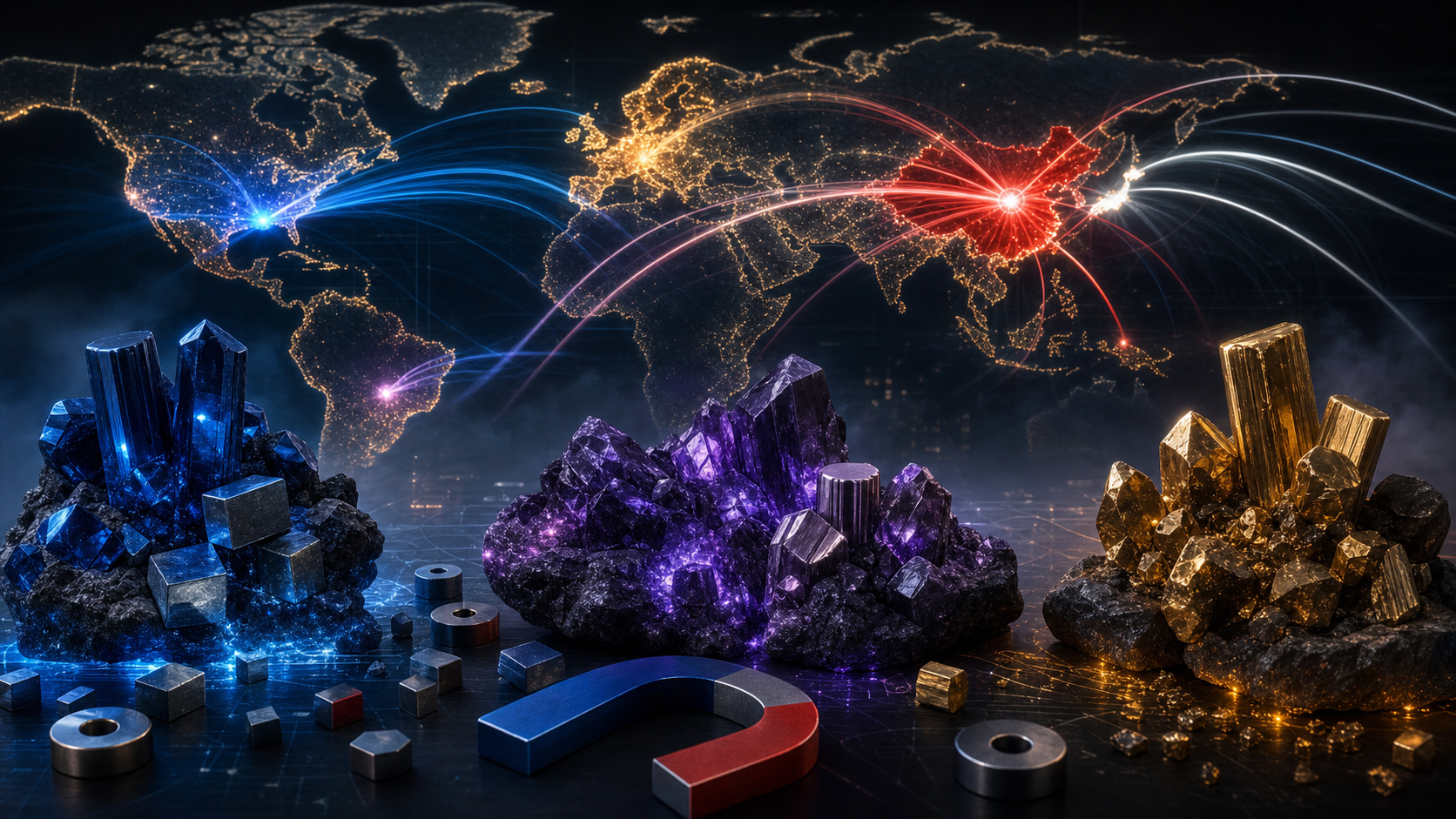
Rare earths – The new geopolitical battleground: Brazil senses its opportunity, while Americans and Japanese buy up the market – Image: Xpert.Digital
The sleeping giant awakens: How Brazil suddenly breaks China's dangerous raw materials monopoly
Panic buying on the global market: USA and Japan are buying up rare earths – Germany faces stagnation
Rare earth elements are the oil of the 21st century – and the battle for them has long since escalated. While the global economy urgently depends on these critical metals for the energy transition, electromobility, and modern armaments, China has transformed its enormous market power into a sharp geopolitical weapon. With drastic export restrictions in 2025 and 2026, Beijing caught the West off guard. The result is an unprecedented race for the remaining resources: While the US and Japan are using diplomatic pressure and multi-billion-dollar deals to buy up the market and secure exclusive rights to the emerging resource giant Brazil, Europe – and Germany in particular – risks being definitively left behind in the fight for technological sovereignty. This analysis sheds light on why the prices of critical elements such as neodymium and terbium are currently exploding, why new mines alone will not solve the problem, and how the global resource policy order is shifting dramatically before our very eyes.
Whoever controls the magnets controls the future
Rare earths have been a geopolitically charged issue for years – but the events of 2025 and 2026 fundamentally changed the situation. What was once considered an abstract debate about supply risks among experts has become an economic emergency: China is cutting off supplies, the West is buying up resources in a panic, and countries like Brazil are seizing their opportunity. Anyone who understands what is happening in this market also understands why electric cars are no longer rolling off the assembly line in Chicago, why a Berlin retailer hasn't received any deliveries for months, and why the US is investing half a billion dollars in a Brazilian mining company.
What rare earth elements actually are and why they are changing everything
The term "rare" is misleading in this context. The 17 chemical elements of the lanthanide group, as well as scandium and yttrium, are indeed present in the Earth's crust – but hardly ever in concentrations that allow for economically viable mining. What truly makes them rare is not their geological abundance, but their unique physical, magnetic, and chemical properties, which make them indispensable for a wide range of high-tech applications.
Neodymium, praseodymium, dysprosium, and terbium form the most strategically important subgroup: they are the core components of permanent magnets, the strongest magnets known. These neodymium-iron-boron magnets are found in the electric motors of electric vehicles, in the generators of wind turbines, in industrial robots, in drones, in fighter jet systems like the F-35, in missile defense systems, and in satellites. Without them, neither the energy transition nor modern defense technology would be conceivable. The entire electrification of the economy depends on this comparatively small group of metals.
This is the crux of the problem: Demand is rising exponentially because electromobility, renewable energies and armaments are booming simultaneously – and a frighteningly high proportion of the supply is in the hands of a single country.
China's market power – a monopoly achieved through decades of targeted strategy
China currently controls around 70 percent of the world's rare earth mining and nearly 90 percent of global refining. While only about 58 percent of the extraction of the necessary raw materials for permanent magnets, essential for electric cars, wind turbines, and robotics, is in Chinese hands, China accounts for 92 percent of the production of the corresponding end products. The European Union imports 98 percent of its rare earth magnets from China. According to Benchmark Mineral Intelligence, Chinese companies account for 99 percent of the world's rare earth processing.
This dominance is no accident, but the result of decades of strategic industrial policy. China has not only organized the most cost-effective extraction, but through massive state subsidies, lax environmental standards, and targeted technology investments, it has built a value chain from extraction to the final magnet that the West simply cannot replicate without investing considerable time and immense sums of money. Deng Xiaoping's famous statement – "The Middle East has its oil, China has its rare earths" – has proven to be the blueprint for one of the most effective raw materials strategies in history.
The situation is particularly critical with regard to heavy rare earth elements such as dysprosium and terbium. China holds a near-monopoly in this area, as these elements occur almost exclusively in so-called ion adsorption deposits in southern China, Vietnam, and – as is increasingly becoming apparent – Brazil. Light rare earth elements such as neodymium and praseodymium are more geographically distributed, but here too, the West lacks the necessary refining and separation capacities to operate independently.
Export embargo as a geopolitical weapon – China's escalation from April 2025
For a long time, China's export restrictions seemed largely theoretical. This changed abruptly in April 2025, when the Chinese Ministry of Commerce (MOFCOM) introduced export controls for seven rare earth elements for the first time: samarium, scandium, dysprosium, terbium, gadolinium, lutetium, and yttrium, as well as their alloys, mixtures, and permanent magnets. Companies wishing to import these materials from China were now required to apply for permits – with uncertain outcomes.
The measures were dramatically expanded in October 2025. On October 9, MOFCOM published six new notices extending the export control regime to include additional elements such as holmium, erbium, thulium, europium, and ytterbium. Even more significant was an extraterritorial clause: Products manufactured in third countries that contained Chinese rare earth elements or were produced using Chinese technology would be subject to Chinese licensing requirements upon re-export. The restrictions would apply as soon as products contained rare earth elements with a value of just 0.1 percent. A general export ban applied to products intended for military use.
The signal was clear: Beijing was using its raw material power as a strategic weapon in the trade conflict with Washington, but also as leverage against Europe. The Hamburg-based chemical trader MCC reported that since the restrictions were introduced, not a single gram of chemicals had been shipped from China because long-standing Chinese partners were no longer receiving permits. Production lines in the European automotive industry ground to a halt; Ford reduced SUV production in Chicago. US companies expected their stockpiles to be depleted within months.
China's partial withdrawal occurred under diplomatic pressure: As part of the US-China trade agreement of October 30, 2025, between Trump and Xi Jinping, a one-year suspension of October export controls was agreed upon, valid until November 10, 2026. However, these relaxations apply only very limitedly to EU companies – namely, only if they act as suppliers for US companies. For all other uses, the individual licensing requirement remains in place. This diplomatic respite has by no means eliminated the fundamental structural dependency.
The buying up of the world market – How the USA and Japan are exacerbating scarcity
This is precisely where the worrying observation of Berlin-based precious metals dealer Andreas Kroll comes in. His company, Noble Elements, has been active in the trade of heavy metals, precious metals, and rare earths for twelve years. The consequence of the Chinese export restrictions is not a uniform shortage, but rather a targeted concentration of purchasing power: American and Japanese companies, as well as state-coordinated procurement initiatives, are systematically buying up available stocks outside of China.
The US and Japan signed a formal agreement in October 2025 strengthening the joint exploration, processing, and supply of rare earth elements with the stated goal of ensuring the robustness and security of supply chains for essential minerals. Japan has decades of experience in resource diplomacy—it was subjected to a de facto export embargo by China in 2010 when a territorial dispute in the East China Sea escalated. Since then, Tokyo has continuously worked on alternatives and has been more aggressive than any other industrialized nation in sourcing from non-Chinese sources.
For medium-sized European companies like Noble Elements, this behavior has disastrous consequences: What is available on the global rare earth market outside of China is absorbed by significantly more lucrative, state-backed programs. Small and medium-sized enterprises (SMEs) are left behind. Kroll, whose company is aiming for annual sales of €100 million by 2026, therefore sees only one way out: the transformation from trader to producer. Projects in Australia, Brazil, and South Africa are intended to reduce dependence for his customers in the long term – but this path requires financing volumes in the billions, which only the financial industry can manage.
Price explosion as a market reaction – the data speaks for itself
The effects of export restrictions and Western purchasing behavior are directly reflected in prices. Since the beginning of 2025, prices for neodymium-praseodymium oxides (NdPr) have risen steadily, reaching a level of around $107,970 per ton in February 2026 – the highest level since the magnet boom of 2022. Compared to the end of 2025, when NdPr was trading at around 580,000 yuan per ton, this represents an increase of more than 29 percent in just two months.
The price increase was particularly drastic for heavy rare earth elements, which are needed for high-temperature applications and high-performance magnets. Terbium oxide reached around $4,028 per kilogram in mid-February 2026 – an increase of 103 percent since the beginning of the year. Dysprosium oxide traded at around $930 to $960 per kilogram, also an increase of around 105 percent compared to the start of the year. Yttrium, a key element for high-temperature superconductors and medical devices, rose from $260 per kilogram at the end of December 2025 to $425 in February 2026. Neodymium was trading at 992,500 yuan per ton at the end of June 2026, an annual increase of around 80 percent.
The China Rare Earth Price Index reached 288.7 on February 10, 2026 – a level last seen in early 2024 and significantly above the 2025 annual average. The NdPr market is projected to experience a supply deficit for the second consecutive year, with global demand expected to grow by 7.7 percent in 2026. Six consecutive price increases for rare earth concentrates since January 2026 underpin the structural upward trend. This price dynamic is not a short-term speculative phenomenon but rather reflects a fundamental imbalance between demand and available supply outside the Chinese system.
Germany and Europe in a pincer grip – A sober assessment
In 2024, Germany imported approximately 3,400 tons of rare earth elements from China – representing 65.5 percent of total German imports of this material group. The previous year, the figure was 69.1 percent, demonstrating that while diversification efforts exist, they are taking effect only slowly. The situation is particularly dire for certain elements: neodymium, praseodymium, and samarium, essential for permanent magnets in electric motors, were almost entirely imported from China in 2024.
In a European comparison, Germany fares particularly poorly. While the average import quota from China for the entire EU is around 46 percent, 65.5 percent of Germany's imports came from the People's Republic. The second most important country of origin was Austria with a share of 23.2 percent, followed by Estonia with 5.6 percent – both countries where Chinese raw materials are processed, thus obscuring the true origin statistically. The real dependence is therefore even greater than the raw figures suggest.
A study by the Supply Chain Intelligence Institute Austria (ASCII) has reached the alarming conclusion that the vulnerability of European supply chains has increased significantly since 2007 and that even minor geopolitical tensions or logistical bottlenecks could trigger production outages. For the German export sector, 77 of the 168 product categories examined that require rare earth elements are highly relevant – with an export volume that constituted a substantial portion of German industrial exports in 2023. ASCII Director Peter Klimek's conclusion is unequivocal: Without targeted investments in domestic processing capacities, strategic partnerships, and a diversification of sourcing, Germany risks losing its technological sovereignty in the long term.
🎯🎯🎯 Global Sourcing & Commodity Trading with integrated logistics

Raw materials, global procurement & trade - Image: Xpert.Digital
State-of-the-art cargo planes, optimized transport routes, and multimodal logistics chains are interchangeable—they can be bought, leased, or outsourced. What money can't buy are direct contacts with producers in Peruvian mines, reliable supply relationships in the CIS countries, and years of built-up trust in markets that are unfamiliar to outsiders. The decisive competitive advantage in global commodity trading lies not in transporting the good from A to B, but in knowing where the good comes from, who produces it, and how to gain access before others even know the market exists. Whoever owns the network sets the price. Everyone else pays it.
More information here:
Serra Verde & Co.: Why Brazil is becoming the key to combating China's monopoly
Europe's answer – Between legislative ambitions and realpolitik limits
The European Union has recognized the problem and created a regulatory framework with the Critical Raw Materials Act (CRMA), which sets ambitious targets for 2030: at least 10 percent of strategic raw materials should be extracted domestically, at least 40 percent processed, and at least 25 percent recycled. No single third country should supply more than 65 percent of any given strategic raw material category. These benchmarks directly target dependence on China.
In December 2025, the Commission presented the RESourceEU Action Plan, which supplements the CRMA with concrete financing and implementation mechanisms. A total of €3 billion is to be mobilized from EU programs such as InvestEU, the Innovation Fund, and Battery Booster by the end of 2026. A European Critical Raw Materials Centre will coordinate strategic procurement, market monitoring, and joint warehousing. New strategic partnerships—including one with Brazil—are intended to drive supply chain diversification.
However, skepticism regarding these plans is justified. The Association of German Chambers of Industry and Commerce (DIHK) explicitly warns against government intervention in procurement and storage as a last resort, since state-organized stockpiling during periods of scarcity could trigger further price spirals in the commodity markets. Scientists from the CSIS and other research institutes emphasize that diversification requires not only new mines, but also skilled labor, processing centers, reliable energy supplies, efficient infrastructure, and advanced separation technologies – a development that, according to optimistic estimates, would take ten to twenty years. Against this backdrop, the EU's 2030 targets appear extremely ambitious, even to the most sympathetic observer.
Brazil's Hour – The Sleeping Giant Awakens
!
While Europe debates, others are taking action. According to data from the US Geological Survey (USGS), Brazil possesses the world's second-largest rare earth reserves: approximately 21 million tons in REO equivalents, compared to 44 million tons in China. Crucially, the country has deposits in ion adsorption reservoirs that are particularly rich in heavy rare earth elements such as dysprosium and terbium – precisely those elements for which the Western world is most dependent on China and which are currently experiencing the most explosive price increases.
Despite this exceptional geological situation, Brazil accounted for less than one percent of global rare earth production for a long time. This changed fundamentally with the commissioning of the Pela Ema mine in the central Brazilian state of Goiás by the company Serra Verde in early 2024. The deposit is unique worldwide and represents the only significant source outside of Asia capable of producing substantial quantities of heavy rare earths such as dysprosium and terbium on an industrial scale. At least 5,000 tons of mixed rare earth oxides are expected to be extracted annually, with a projected increase to 6,500 tons by 2027.
The strategic importance of this development can hardly be overstated. Serra Verde is not just a mining project – it's a geopolitical pivot point. CEO Thras Moraitis has announced plans to shorten existing long-term supply contracts with Chinese customers; they are set to expire at the end of 2026. The reasoning is straightforward: originally, Chinese customers were chosen because there were no alternative processing capacities. This is now changing, as Western-made separation plants will be available in a few years.
$565 million as a political signal – The American grab for Serra Verde
In November 2025, the US government-owned Development Finance Corporation (DFC) invested $565 million in Serra Verde. The financing package was intended to refinance existing loans on better terms and further develop production facilities in Brazil. This was therefore not merely a commercial transaction, but a geopolitical move: the US was acquiring strategic access to the only significant deposits of heavy rare earth elements outside of Asia.
A US company has reportedly announced its intention to acquire Serra Verde completely for $28 billion, with the acquisition agreement stipulating that the US will receive 100 percent of production over the next 15 years – thus gaining direct access to the four key magnetic elements: neodymium, praseodymium, dysprosium, and terbium. This would be a historic step: the first complete access by a Western power to a functioning heavy rare earth production facility outside of China's sphere of influence.
For European consumers, such a scenario would be worrying. It would mean that the only significant alternative source of heavy rare earth elements outside of China would fall entirely under American control – and Europe would thus become dependent not only on China, but also on a new American dependency. The EU has therefore expressed interest in Brazil and is preparing new raw material partnerships, which are to be enshrined in the RESourceEU Action Plan.
For Brazil itself, the situation presents a historic opportunity, but also a balancing act. The government in Brasília does not want to link the development of rare earth resources to geopolitical alliances, but rather to maximizing domestic value creation. This means that Brazil not only wants to export raw materials, but also to enter the processing sector and strengthen its own industrial base. This sounds sensible, but carries the risk of being caught in the crossfire between the major powers, both of which are striving for the most exclusive possible access to Brazil's deposits.
The Atlantico Project and the speculative front line of exploration
In addition to the already producing Serra Verde group, the early exploration sector is also gaining attention. Companies like Atlantico Energy Metals Corp. (CSE: ATLA) are positioning themselves in the hope of anticipating the next Brazilian rare earth cycle. Its flagship Novo Cruzeiro project in the Eastern Brazilian Pegmatite Province of Minas Gerais comprises 15 contiguous exploration permits covering 24,387 hectares. Initial stream sediment results show enrichment of total rare earth oxides (TREO) with average values of approximately 421 ppm and a maximum of 1,422 ppm, as well as magnetic rare earth oxides (MREO) with an upper percentile value of 259.83 ppm.
It is important to put these early results into perspective: Stream sediment data provide target-generating clues, not mine-defining data. There is neither a confirmed mineral resource nor an economic feasibility study. The value of such early-stage projects lies in timing arbitrage: Those who invest in a structurally demanded commodity category before the broader market can achieve above-average returns – but also bear the full exploration risk. For strategic industrial investors seeking long-term supply chain security, such early-stage projects are less suitable than for speculative capital.
The structural limits of diversification – Why there is no quick fix
The entire debate surrounding the reduction of dependence on Chinese rare earths suffers from a fundamental misunderstanding: the primary goal is not to build mines, but to develop refining and separation capacities. The US possesses the only active rare earth mine outside of Asia on Western soil, Mountain Pass in California – but it exports the concentrate to China for processing because it lacks its own refining capacity. This is even more true for Europe.
China's lead in processing technology, particularly in solvent extraction for separating individual elements, is virtually impossible to overcome after decades of state-funded research. This requires not only immense investments but also highly skilled personnel, advanced chemical engineering, sufficient energy and water, and regulatory frameworks that provide investors with planning certainty. In Western countries with strict environmental regulations, all of this is significantly more expensive and time-consuming than in China.
Economist and China expert Jost Wübbeke of Sinolytics succinctly summarizes the fundamental problem: As soon as China's export controls are relaxed, prices and supply situations immediately ease – and with them, the economic incentive to build costly processing facilities outside of China disappears. Nothing is more devastating for a Western refinery operator than a price collapse caused by Chinese market flooding after investing billions in facilities. China's dominance is thus self-reinforcing: The mere threat of export restrictions is enough to disrupt investment cycles outside its own system.
Strategic conclusions – What is needed now
A sober analysis of the market situation in 2026 reveals clear strategic imperatives. First, the financing question is crucial: the billions needed for mines, refineries, and separation plants must be mobilized quickly and reliably. The state alone cannot manage this – the financial industry must step in with long-term oriented instruments. This is precisely what Kroll of Noble Elements also emphasizes as a key prerequisite for breaking China's market power.
Secondly, recycling capacities must be massively expanded. Permanent magnets from electric cars, wind turbines, and electronic waste contain significant quantities of rare earth elements, which are currently largely lost. A functioning circular economy for these elements would structurally and sustainably reduce import dependency – and is technologically much faster to implement than new mining projects.
Third, the example of Brazil shows that geographic diversification can work, but requires a coherent Western strategy. If the US secures exclusive access to the Serra Verde, it does little to help Europe. The EU needs its own partnerships, its own financing instruments, and a credible long-term purchase guarantee to make non-Chinese producers attractive alternatives. The RESourceEU Action Plan is a step in the right direction – but it comes late and its implementation speed is not yet keeping pace with geopolitical realities.
Fourthly, Germany needs its own raw materials diplomacy that extends beyond the EU level. The German government must leverage the American DFC investment in Brazil to establish its own presence and forge partnerships – not only for rare earths, but for the entire spectrum of critical minerals needed for the energy transition, digitalization, and defense capabilities. Chancellor Friedrich Merz's trip to China in February 2026 was a necessary signal, but it is insufficient as a response to a structural supply crisis.
Conclusion – A raw material that is renegotiating the world order
Rare earths are no longer a niche topic for mineralogists and mining engineers. They have become a central arena in the geopolitical realignment of the global economy. China's export weapon functions precisely because decades of Western passivity have created a structural dependency that cannot be resolved in the short term. The reactions from Washington and Tokyo—aggressive acquisitions, state investments in Brazil, bilateral supply agreements—are rational, but they exacerbate the situation for middle powers like Germany.
Brazil possesses the geographical prerequisites to become a serious counterweight to Chinese market power. Whether it does so depends not only on mining companies like Serra Verde, but also on political decisions regarding value chain integration, ownership structures, and strategic partnerships. The price explosions of 2025 and 2026 send an unmistakable market signal: the market values security of supply outside of China at a significant premium – and this premium will persist as long as the structural causes of this dependency remain.
Your contact for raw materials ⛏️ Global sourcing 🚢🌐 & trading 📦

Dmitry Kovalenko
I would be happy to serve as your personal advisor.
Dmitry Kovalenko
Tel: +49 7348 4088 961
Your contact for raw materials ⛏️ Global sourcing 🚢🌐 & trading 📦

Konrad Wolfenstein
I would be happy to serve as your personal advisor.
Konrad Wolfenstein
Email: [email protected]
Our global industry and economic expertise in business development, sales and marketing

Our global industry and economic expertise in business development, sales and marketing - Image: Xpert.Digital
Industry focus areas: B2B, digitalization (from AI to XR), mechanical engineering, logistics, renewable energies and industry
More information here:
A thematic hub offering insights and expertise:
- Knowledge platform covering global and regional economies, innovation and industry-specific trends
- A collection of analyses, insights, and background information from our key areas of focus
- A place for expertise and information on current developments in business and technology
- A hub for companies seeking information on markets, digitalization, and industry innovations





