
While Europe regulates, China is manufacturing the future – and its lead is growing daily
Xpert Pre-Release

Language selection 📢
Published on: March 21, 2026 / Updated on: March 21, 2026 – Author: Konrad Wolfenstein
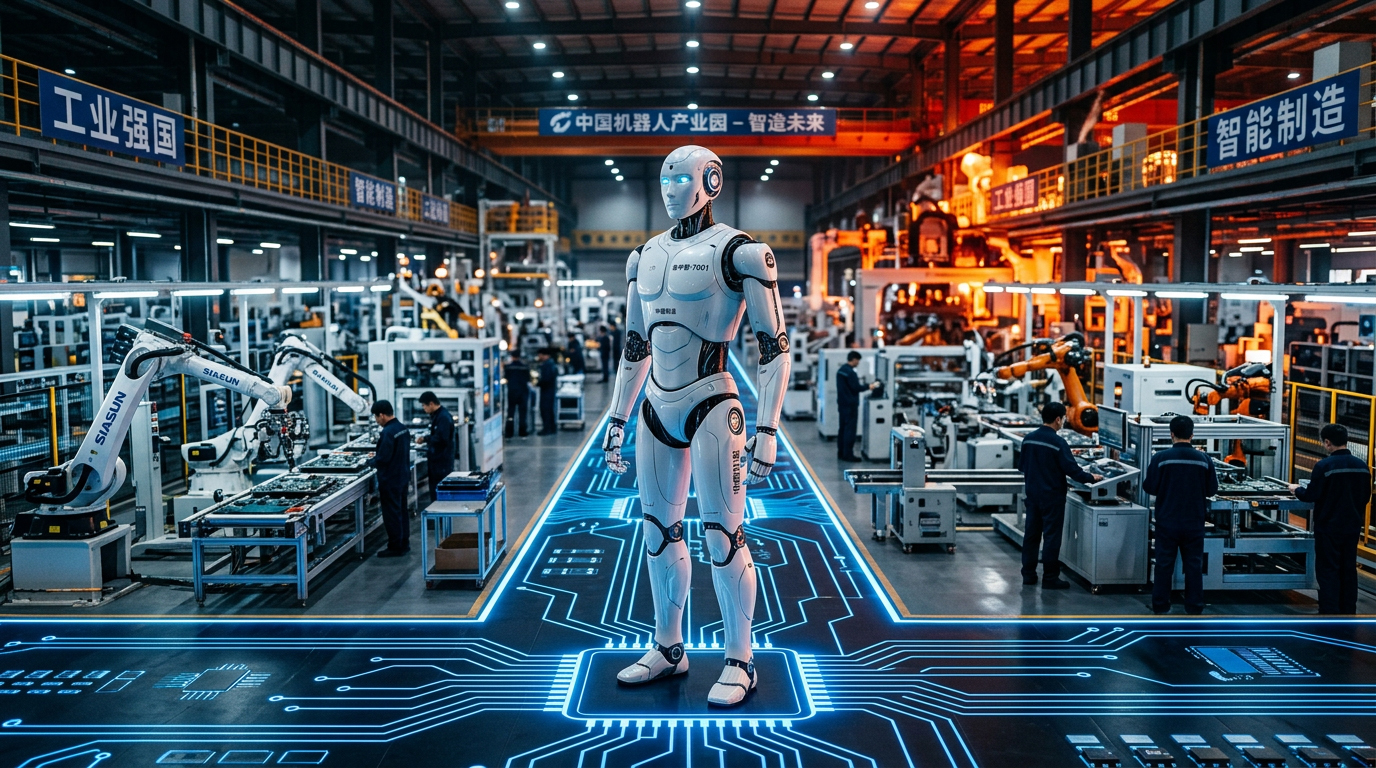
While Europe regulates, China is manufacturing the future – and its lead is growing daily – Image: Xpert.Digital
90% market share: How China is leaving the West behind in humanoid robots
Are Tesla and other companies powerless? Why China's robotics industry is uncatchable
The year 2025 marks a turning point in technological history: Humanoid robots have finally left the research labs and arrived in the harsh realities of industrial production. But anyone hoping for groundbreaking successes from Western tech giants will be disappointed. While the US is still refining prototypes and Europe is bogged down in complex regulatory debates, China has long since created irreversible facts. With a massive global market share of up to 90 percent, Chinese manufacturers now dominate mass production. This unprecedented triumph is no accident, but the result of extreme vertical integration: from absolute control over rare earth elements to the clever exploitation of synergies from the electric vehicle industry, all the way to massive state subsidies. China is not only building the machines of tomorrow, but is increasingly dictating prices and standards for a future trillion-dollar market. A look at the raw numbers reveals the stark reality: The race for the most important key technology of the 21st century seems to be already decided, even before it has really begun for the rest of the world.
Related to this:

Numbers that leave no room for misunderstanding
For the first time, humanoid robots were no longer just showcased as laboratory prototypes or trade fair attractions, but were produced and delivered in industrial quantities. The data emerging from this market breakthrough tells a story of geopolitical significance that extends far beyond robotics.
According to the technology analysis firm Omdia, between 13,000 and 14,500 humanoid robots were shipped worldwide in 2025. IDC estimates the figure is even higher, at around 18,000 units, representing a 508 percent increase compared to the previous year. The Chinese China Mobile Robot Industry Alliance (CMRA) puts global shipments at over 22,000 units, with Chinese manufacturers accounting for 80.7 percent. Regardless of which estimate one follows, the market shares speak for themselves: Chinese companies controlled between 80 and 90 percent of the entire global market for humanoid robots by 2025.
Leading this development is AgiBot from Shanghai, a company founded in early 2023 that rose to become the world's number one in just under three years. AgiBot shipped between 5,100 and 5,168 units in 2025, securing a global market share of approximately 39 percent. Closely following is Unitree Robotics from Hangzhou, which, according to its own figures, has shipped more than 5,500 fully humanoid robots – and thus potentially takes over the top spot. In third place is UBTECH Robotics from Shenzhen with around 1,000 units shipped.
The asymmetric duel: China against the rest of the world
The figures from the United States are downright sobering in the same market. Tesla, Figure AI, and Agility Robotics—all companies with substantial venture capital and media prestige—delivered only around 150 units each in 2025. The fact that these three pioneering American companies together don't even achieve a fraction of what AgiBot or Unitree alone accomplish highlights a fundamental difference in the stage of development: While the US is still primarily working on technological maturity and investment capacity, China is already in the industrial scaling phase.
The discrepancy is not merely a matter of differing corporate strategies. It reflects structural differences in the overall logic of the industrial ecosystem. In China, manufacturers like AgiBot, Unitree, and UBTECH specialized early on in different market segments: While AgiBot and UBTECH primarily target commercial and industrial applications, Unitree specifically utilizes the research, education, and consumer markets. This strategic differentiation enabled Chinese companies to simultaneously tap into various demand streams.
The price dynamics are also remarkable. While conventional Western robotic systems typically cost six-figure sums, Unitree offers a basic version of its humanoid robot, the R1 model, for $5,900. Even the established G1 model is available in its basic version for around $16,000. This radical price disruption follows a pattern familiar from the electronics industry: A country that controls the entire value chain can drive prices down so low that foreign competitors are forced out of the market before they can even scale up.
The industrial foundation: Why China is structurally ahead
China's leading position in humanoid robotics is no accident, but the result of decades of strategic industrial development. The country currently controls approximately 91 percent of the world's refined rare earth production and 94 percent of sintered rare earth magnets. Humanoid robots require up to 40 electric motors per unit, which rely on neodymium-iron-boron (NdFeB) magnets. Whoever controls the magnets essentially controls the entire value chain of robot production.
This raw material advantage is complemented by a dense network of suppliers, manufacturing processes, and technology partnerships. Chinese electronics manufacturers and mechanical engineering companies have built up expertise in precision mechanics, sensors, and actuators over decades, expertise that can now be directly transferred to robotics production. Over 60 percent of the holdings of the Global X China Electric Vehicle and Battery ETF are directly integrated into the supply chains of robot manufacturers. The analogy to the electric vehicle industry is not coincidental: In both cases, China is leveraging an existing industrial ecosystem to dominate new technology sectors.
In addition, there are massive government subsidies and targeted industrial policies. According to Reuters, the Chinese government invested over US$20 billion in subsidies in the robotics industry between late 2024 and early 2025 alone. In March 2025, the National Development and Reform Commission (NDRC) announced a state steering fund intended to channel US$137 billion into AI and robotics startups over the next 20 years. Cities like Shenzhen and Wuhan are attracting robot manufacturers with grants of up to five million yuan, as well as free office and production space. Furthermore, since 2023, Beijing has operated its own robotics fund, which provides individual companies with up to 30 million yuan for product development.
The EV effect: How the electric car industry is fueling the robotics boom
An often underestimated factor in China's robotics dominance is the strategic synergy between the electric vehicle industry and humanoid robotics. China's EV market has achieved a market penetration of over 50 percent and is considered a relatively mature market. The supply chains for battery technology, power electronics, sensor technology, and ADAS software that have emerged from this industry can be directly transferred to robotics manufacturing.
Major Chinese automakers have long recognized this synergy and are investing accordingly. BYD has invested in AgiBot, the GAC Group has developed its own humanoid robot, GoMate, and Changan Auto has announced investments of over 50 billion yuan in the robotics ecosystem. NIO is testing UBTECH robots in its manufacturing facilities and simultaneously developing its own robotics solutions. UBS analysts rate XPeng, BYD, and Li Auto as particularly well-positioned to benefit from the convergence of EV and robotics technologies.
This integration goes far beyond mere investment. Automotive factories offer the ideal testing ground for humanoid robots: structured environments, defined tasks, high repetitiveness, and at the same time sufficient complexity to generate training data for AI models. The more robots are deployed in Chinese EV factories, the more real-world data is generated for training movement and decision-making models – a self-reinforcing process of building expertise that structurally disadvantages Western competitors.
🎯🎯🎯 Data-driven B2B industry hub as a quasi-in-house solution

Xpert Smart Content-Driven Business Development Framework - Image: Xpert.Digital
Xpert.Digital is a data-driven B2B industry hub led by Konrad Wolfenstein . The company acts as an external, quasi-in-house solution for industrial partners, closing operational gaps in marketing, content, and sales – without requiring additional resources on the client side.
More information here:
China's robotics master plan: How Europe is missing out on the next industrial revolution
The government program: Industrial policy as a strategic weapon
China's technological lead in the field of humanoid robots is not a market-driven accident, but rather the result of consistently implemented industrial policy programs. As early as 2023, the Chinese Ministry of Industry and Information Technology (MIIT) outlined its strategic course in a nine-page document: mass production of humanoid robots by 2025 and technological leadership by 2027. This goal has largely been achieved.
In 2025, over 140 Chinese manufacturers released more than 330 different humanoid robot models. In February 2026, China adopted the first national standards system for humanoid robots and embodied AI, developed by over 120 institutions under the leadership of the MIIT Technology Committee. This system encompasses six areas: fundamentals and commonalities, brain-like and intelligent computing, limbs and components, overall systems, applications, and safety and ethics. China is thus simultaneously achieving industrial scaling and regulatory standardization—a combination previously reserved for technology leaders like the US in the semiconductor or software industries.
State-controlled companies also play a crucial role on the demand side. China Mobile, the state-owned telecommunications company, purchased $17 million worth of robots in 2025 from Unitree, AgiBot, and other national champions. This direct state procurement program creates early economies of scale and simultaneously sends a strong signal to private investors: The Chinese state believes in the technology and actively supports its development.
Related to this:

Europe's blind spot: Regulation instead of revolution
Europe's absence from global production statistics for humanoid robots is perhaps the most worrying element of this development. Not a single European company appears in the relevant market analyses as a significant producer or exporter of humanoid robots. While China introduced more than 330 new models in 2025, Europe is almost entirely absent from this narrative.
The Allianz Research report from 2025 clearly identifies the causes: Technological lags in sensor technology, microelectronics, and actuators limit Europe's scalability. Regulatory complexity due to differing national regulations hinders the cross-border collaboration necessary for leaps in innovation. The US invests seven times as much as Europe in venture capital for AI projects—a discrepancy that directly impacts innovation capacity. At the same time, while the EU's AI Act is an important regulatory milestone, its strict rules carry the risk of slowing innovation and discouraging investment, particularly for small and medium-sized enterprises (SMEs).
Europe certainly possesses genuine strengths: a strong scientific foundation in robotics research, an established precision engineering industry, and, with the AI Act, for the first time a clear legal framework for the use of high-risk AI systems. However, a gap exists between research excellence and industrial scaling that cannot be bridged without massive investment, coordinated industrial policy, and strategic exemptions from regulatory constraints. TNW's 2025 analysis suggests that Europe may be focusing on ethical design and legal clarity – but this approach will only take effect once other market participants have already produced billions of units.
Application areas: From research to society
The current distribution of applications for humanoid robots still reflects their early stage of development. According to IDC, the largest share of robots delivered in 2025 was allocated to entertainment and commercial performances, followed by research and education, data collection, exhibitions, and finally industrial manufacturing and warehouse logistics. However, the trajectory clearly points toward more productive applications.
The strategic importance lies in their broad range of medium- and long-term applications. Humanoid robots are being designed as industrial workers for repetitive and dangerous tasks, as logistics personnel in warehouses and distribution centers, as care assistants in an aging society, and, in the long term, as universal household helpers. RBC Capital Markets predicts that the household sector could account for a third of the total market volume by 2050, at around US$2.9 trillion. In Asian societies, particularly in Japan, South Korea, and China, where demographic change and labor shortages are especially pressing, humanoid robots are not considered science fiction, but a societal necessity.
The prediction that humanoid robots could replace up to 40 percent of labor-intensive jobs in agriculture, cleaning, and manufacturing by 2050 is both a promise and a warning. It promises enormous productivity gains for those economies that control the technology, and it warns those that, in the meantime, are only concerned with regulating it.
Market potential: The next trillion-dollar bet
Market forecasts for humanoid robots vary considerably depending on the research firm, but they all point in one consistent direction: exponential growth. Goldman Sachs has raised its market estimate for 2035 to $38 billion. Morgan Stanley projects a market volume of up to $357 billion by 2040 and estimates that over one billion humanoid robots could be in use by 2050. According to Morgan Stanley, the total addressable market, including supply chains and after-sales services, is expected to exceed $5 trillion by 2050.
RBC Capital Markets even anticipates a total market potential of nine trillion US dollars by 2050, with China likely to be the most important single market, accounting for over 60 percent. UBS forecasts a total addressable market of one trillion CNY in China alone by 2040. The market research firm Knowledge Sourcing Intelligence calculates a compound annual growth rate (CAGR) of 59.8 percent for the period from 2025 to 2030, which would increase the market from 1.8 billion US dollars to 18.9 billion US dollars in just five years. BCC Research, on the other hand, projects a CAGR of 42.8 percent for the same period. This range of estimates demonstrates how young and dynamic the market still is – but also makes it clear that no serious analyst questions its growth potential.
ABI Research anticipates a turning point between 2026 and 2027, when regulatory, security, and economic hurdles should be largely overcome. Entertainment applications using low-cost platforms like the Unitree G1 will dominate the early mass market before broader commercial penetration begins in the late 2020s.
Geopolitics of robotics: Whoever builds the machines writes the rules
China's dominance in humanoid robotics is not an isolated technological development—it is part of a broader geopolitical realignment of global value creation. Whoever controls the magnets controls the motors. Whoever controls the motors controls the robots. Whoever controls the robots increasingly controls the physical productivity of a globally interconnected economy. With its control over 91 percent of refined rare-earth production and 94 percent of sintered rare-earth magnets, China has created a vertical integration that is structurally difficult to break.
The US is not technologically insignificant: American companies retain strengths in AI software, basic research, and systems design. However, the risk described by leading analysts is real: The US could design the future of robotics while simultaneously having to import the machines because it lacks the manufacturing expertise and raw material base. This scenario is eerily reminiscent of the history of the solar industry, where American and European research leadership ultimately benefited Chinese manufacturers who took over the actual mass production.
China has learned from this history. In the field of humanoid robotics, the People's Republic is simultaneously implementing all steps of the value chain: raw material control, component manufacturing, system integration, software development, state-guaranteed demand, and now also normative standard-setting. The question for all other economies is no longer whether China will dominate this market—that is already the case. The question is whether and how other nations can prevent themselves from becoming mere consumers of a technology that will increasingly define their own economic and social infrastructure.
📈🔵 Ambidexterity or doom: The only management concept that still works in the triple crisis💡

When proven strategies fail: Organizational adaptability in the digital transformation of ambidexterity - Image: Xpert.Digital
We are currently experiencing a period of economic turmoil that differs fundamentally from previous recessions. A deceptive silence prevails in the boardrooms of European and international companies – broken only by the sound of failing strategies that were considered a guarantee of success just yesterday. This is not merely a cyclical downturn, but a profound structural break. The tools with which companies achieved growth for over two decades simply no longer work.
More information here:
Your global marketing and business development partner
☑️ Our business language is English or German
☑️ NEW: Correspondence in your native language!

Konrad Wolfenstein
I and my team are happy to be available to you as your personal advisor.
You can contact me by filling out the contact form here or simply call me at +49 7348 4088 965. My email address is: [email protected]
I'm looking forward to our joint project.









