
99% drop in one month: How China is cutting off the tap for German industry
Xpert Pre-Release

Available in 27 languages 📢
Prefer Xpert.Digital on GoogleⓘPublished on: May 29, 2026 / Updated on: May 29, 2026 – Author: Konrad Wolfenstein
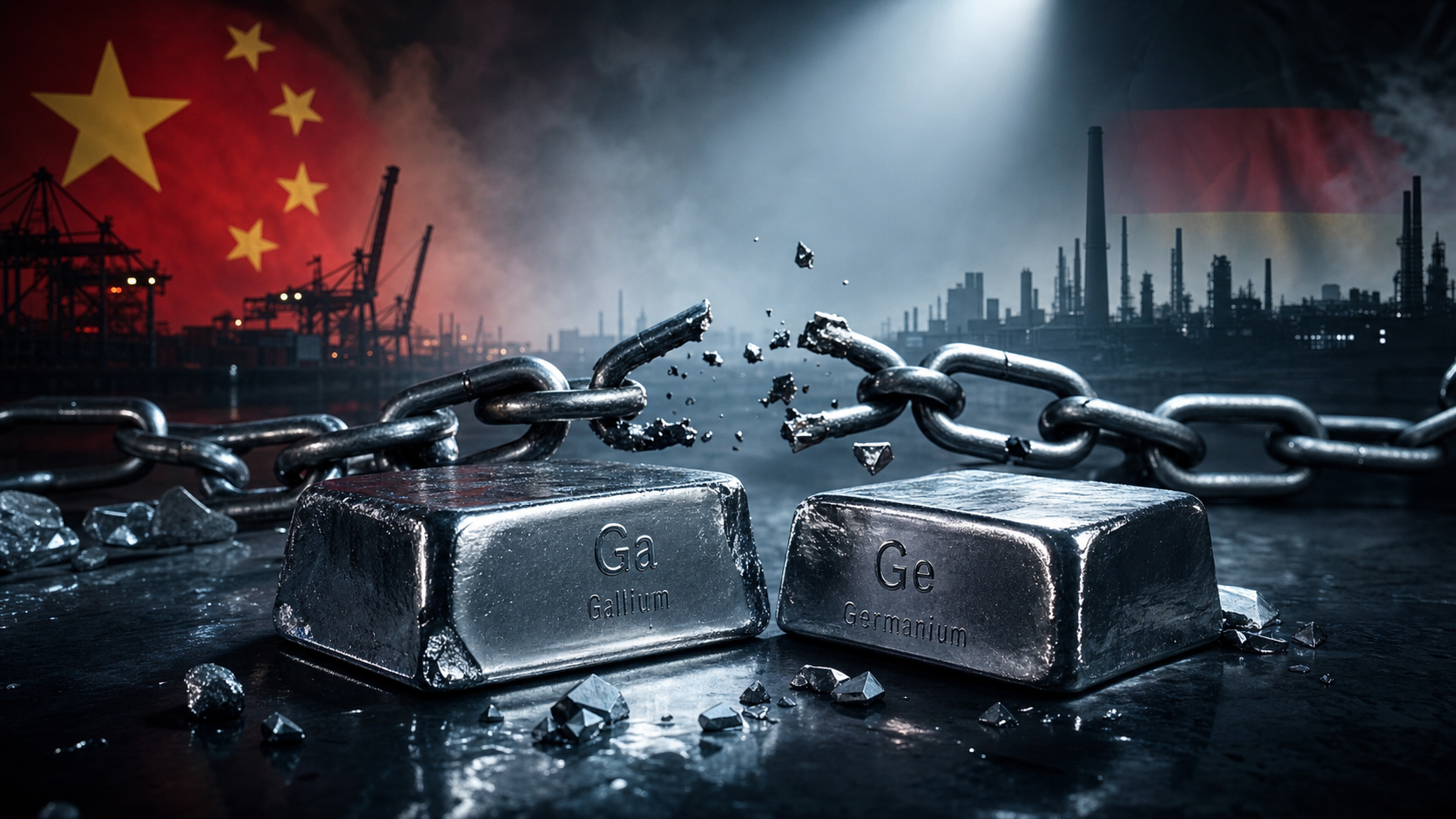
99% decline in one month: How China is cutting off the tap for German industry – Image: Xpert.Digital
Only 3 kilograms exported: China's covert raw material war escalates
Gallium & Germanium: Why two little-known metals could paralyze all of Germany
The export of just two seemingly insignificant metals determines the future of our key technologies – and China has just pulled the plug. Within a single month, Chinese exports of gallium and germanium plummeted; a coldly calculated move in the global arms and technology game. For Germany and Europe, this sudden halt in supplies reveals the full extent of a fatal triple dependency that goes far beyond previous crises. Without these metals, there are no 5G networks, no modern semiconductors, and no modern arms industry. While European policymakers desperately counter this with new laws and self-sufficiency targets, the domestic economy is already facing a raw materials checkmate. A look behind the scenes of an economic war that is no longer about supply and demand, but about the targeted use of resources as a geopolitical weapon.
Related to this:

The raw materials checkmate: China's fatal stranglehold on our key technologies
Worse than Russian gas: The next fatal dependency of the German economy
In April 2026, China exported a mere three kilograms of gallium worldwide. Three kilograms. In March of the same year, that figure had been 5,320 kilograms – a drop of more than 99 percent in a single month. By comparison, in April 2025, China had exported 4,777 kilograms of gallium. Anyone who thinks such figures are merely statistical fluctuations in global commodity trading underestimates what is happening here. This isn't about supply and demand. It's about power politics – and the deliberate instrumentalization of resource control as a geopolitical tool.
The situation is hardly better for germanium. Germany and Japan each received less than one kilogram in April – other destination countries were simply no longer registered in the Chinese customs data. Christian Hell, Senior Manager for Germanium and Minor Metals at the commodities trader Tradium, formulated the situation unusually directly in the company's market analysis: Entire supply chains are at risk, and if even Germany – which had previously been supplied relatively reliably – is left empty-handed, that sends a clear signal. Tradium left open the question of whether the April slump was due to a deliberate tightening of Chinese export policy or administrative delays in issuing export licenses. This ambiguity is part of the strategy: Beijing reserves the right to selectively control uncertainty.
Gallium, germanium and the blind spot of German industry
Both metals sound like laboratory equipment from chemistry class. In reality, they are industrial lifelines. Gallium is indispensable for integrated circuits in 5G networks, high-frequency chips in smartphones, radar systems, satellite technology, LEDs, and military electronics. Germanium, in turn, is a key component of fiber optic cables, infrared optics in night vision devices and thermal imaging cameras, as well as certain semiconductors and solar cells. Therefore, whoever controls the supply chains of these two elements effectively controls a significant portion of the fundamental technological infrastructure of modern economies.
And China controls it almost completely. According to the Federal Institute for Geosciences and Natural Resources, 83.6 percent of the world's primary gallium production comes from China – Germany, with just 4.2 percent, is the second-largest producer. For germanium, China's share of global primary production is estimated at over 60 percent; earlier estimates even suggested up to 80 percent. Commodities expert Alastair Neill of the Critical Minerals Institute put it succinctly: In the case of gallium, this is the greatest dominance of any single element on the planet. This concentration is not a natural phenomenon – it is the result of a decades-long, state-driven strategy.
China's strategic patience: Three decades of geopolitical decision-making
What is now perceived as a shock has a long history. As early as the 1980s, Deng Xiaoping recognized the strategic value of China's raw material reserves. His statement that the Middle East has oil, China has rare earths, is not a quote from a propaganda pamphlet – it is an economic policy program that has been consistently implemented ever since. Over the past 15 years, China has systematically secured mines, supply chains, refineries, ports, and access to raw materials worldwide, while Europe debated climate targets, regulatory frameworks, and subsidy structures.
The first overt use of this raw materials map occurred in July 2023, when China introduced export licensing requirements for gallium and germanium—a direct response to Western restrictions on semiconductor exports to Beijing. Exports subsequently plummeted to zero in August and September 2023. In December 2024, Beijing tightened controls again, prohibiting all exports of gallium, germanium, and antimony to the US. The next escalation followed in April 2025: export licenses were introduced for seven rare earth elements and the permanent magnets made from them, effectively cutting off Western arms manufacturers from supplies. The pattern is clear: China controls raw material supplies not like a market economy actor, but like a geopolitical chess player.
A wealthy man's trip to Beijing: Diplomacy between decency and dependence
Against this backdrop, German Federal Minister for Economic Affairs and Energy Katherina Reiche (CDU) traveled to Beijing at the end of May 2026 – accompanied by a business delegation including BASF CEO Markus Kamieth and Thyssenkrupp CEO Miguel Ángel López Borrego. During her meeting with China's Minister of Commerce Wang Wentao, she called for fair competition and emphasized that reciprocity was the guiding principle of the German government. Germany wanted to secure access to critical minerals and rare earth elements, because modern technologies would simply be inconceivable without these raw materials.
The symbolism of the trip speaks louder than the official pronouncements. While wealthy figures in Beijing were discussing transparent competition, data showed that China had reduced its exports of key raw materials to almost zero during precisely that period. Trade volume between Germany and China amounted to just over €250 billion last year – with Germany importing goods worth €170.6 billion, while German exports to China fell by 9.7 percent to €81.3 billion. The imbalance is structural – and China is using it as leverage.
🎯🎯🎯 Global Sourcing & Commodity Trading with integrated logistics

Raw materials, global procurement & trade - Image: Xpert.Digital
State-of-the-art cargo planes, optimized transport routes, and multimodal logistics chains are interchangeable—they can be bought, leased, or outsourced. What money can't buy are direct contacts with producers in Peruvian mines, reliable supply relationships in the CIS countries, and years of built-up trust in markets that are unfamiliar to outsiders. The decisive competitive advantage in global commodity trading lies not in transporting the good from A to B, but in knowing where the good comes from, who produces it, and how to gain access before others even know the market exists. Whoever owns the network sets the price. Everyone else pays it.
More information here:
Industrialized nation risk: How China, Russia and the USA are shackling Germany's economy
The triple dependency: An industrialized nation without a backbone
Germany's situation is so critical because it cannot be reduced to a single weakness. The country has simultaneously become dependent on: Russian energy – a mistake whose extent has been painfully apparent since February 2022 – Chinese raw materials for the entire industrial value chain, and American technology and security policy umbrella. Germany is almost 100 percent reliant on foreign imports for metal raw materials, and often there is no alternative to China. Such a constellation – triple foreign dependence in key strategic areas – is structurally dangerous for an export-oriented industrialized nation.
Jens Eskelund, President of the European Chamber of Commerce in China, warned of a paradoxical development in this context: instead of reducing dependence on China, companies' practices show that they are becoming even more dependent on China in procurement and production. Derisking – the reduction of one-sided dependencies – remains more wishful thinking than actual practice. The structural problem runs deeper: for decades, Europe outsourced raw material processing for cost reasons. There is a lack not only of mining opportunities, but above all of processing capacity. For example, over 90 percent of the world's processed lithium hydroxide from hard rock comes from China.
Related to this:

Europe's belated response: The Critical Raw Materials Act and its limits
The European Union has recognized the scale of the problem – albeit belatedly. The Critical Raw Materials Act (CRMA), which entered into force in May 2024, sets binding targets: By 2030, at least 10 percent of strategically important raw materials should be extracted domestically, 40 percent processed, and 25 percent recycled; furthermore, no more than 65 percent of any single strategic raw material should originate from a single third country. The EU has now concluded raw material partnership agreements with 14 countries and is planning to establish a strategic raw materials reserve, which will store rare earth elements, tungsten, and gallium.
These measures are necessary, but not sufficient. Raw materials experts assess the CRMA self-sufficiency targets as technically and ecologically unrealistic within the set timeframe. Europe's structural deficit is not primarily geological in nature—European deposits of critical raw materials certainly exist—but lies in a lack of processing capacity, insufficient government investment, and decades of deprioritizing industrial policy in favor of the service sector and regulation. The RESourceEU Action Plan, with its three billion euros for strategic projects, is a step in the right direction, but comes at least a decade too late.
What's at stake: Technological sovereignty in the age of resource warfare
The scope of the problem extends far beyond current supply bottlenecks. Whoever controls the raw materials will, in the long run, control the entire industrial, technological, and defense infrastructure of dependent economies. Semiconductors, 5G networks, fiber optic communications, satellite infrastructure, military night vision systems, AI hardware – all these key technologies require gallium, germanium, or other materials in which China holds a near-monopoly. China's share of the import value of rare earth elements in Germany alone rose from 18.6 percent in 2023 to 31.2 percent in 2025, while German companies spent around €24.2 million on rare earth elements from China in 2025. The dependency is growing – not shrinking.
The current escalation is not the end of the process, but rather an interim stage. China introduced further waves of export controls in April and October 2025, some of which were temporarily suspended following diplomatic talks between Xi Jinping and US President Trump – but only partially and only for a limited time. The fundamental licensing system for seven rare earth elements and permanent magnets remains in effect and explicitly aims to cut off Western arms manufacturers from supplies. Germany is therefore not facing a temporary bottleneck, but rather a structural geopolitical vulnerability for which it possesses neither the industrial policy instruments nor the necessary time to overcome.
The sobering conclusion is this: raw material security is not a matter of climate policy, not a matter for trade minister communiqués, and not a subject for PowerPoint presentations at industry conferences. It is a question of national and European security – and as such, it must be addressed with appropriate resources, priorities, and political will. That gallium and germanium, two metals virtually unknown just a few years ago, are forcing this debate is no irony of history. It is the inevitable result of decades of strategic blindness to the age-old principle of geopolitics: whoever controls the resources controls the power.
🎯🎯🎯 Data-driven B2B industry hub as a quasi-in-house solution

The quasi-in-house solution: How Xpert.Digital closes operational gaps in B2B marketing and sales – Smart Content-Driven Business - Image: Xpert.Digital
Xpert.Digital is a data-driven B2B industry hub led by Konrad Wolfenstein . The company acts as an external, quasi-in-house solution for industrial partners, closing operational gaps in marketing, content, and sales – without requiring additional resources on the client side.
More information here:
Your global marketing and business development partner
☑️ Our business language is English or German
☑️ NEW: Correspondence in your native language!

Konrad Wolfenstein
I and my team are happy to be available to you as your personal advisor.
You can contact me by filling out the contact form here simply call me at +49 7348 4088 965. My email address is [email protected]:or
I'm looking forward to our joint project.





