
Katherina Reiche's new energy agenda under scrutiny: The blind spot of current energy policy for small and medium-sized enterprises
Xpert Pre-Release

Available in 27 languages 📢
Prefer Xpert.Digital on GoogleⓘPublished on: May 19, 2026 / Updated on: May 19, 2026 – Author: Konrad Wolfenstein

Katherina Reiche's new energy agenda under scrutiny: The blind spot of current energy policy for small and medium-sized enterprises – Image: Xpert.Digital
Three-year timeframe for electricity prices: Why small and medium-sized enterprises (SMEs) are now threatened with an investment trap
Subsidies for large corporations, bureaucracy for small businesses: Is Germany losing its economic foundation?
The realignment of German energy policy under the leadership of Federal Minister for Economic Affairs and Energy Katherina Reiche is caught between industrial policy ambitions and the realities of small and medium-sized enterprises (SMEs). While political measures are often justified by the aim of creating planning certainty, strengthening international competitiveness, and reducing energy costs, the central question remains: who actually benefits from these conditions – the broadly diversified SME sector or primarily large, financially powerful corporations?.
For small and medium-sized enterprises (SMEs) in particular, not only are stable prices crucial, but also the ability to react flexibly to volatile energy markets and to manage costs dynamically. This is precisely where a potential structural imbalance becomes apparent: many energy policy instruments implicitly rely on economies of scale, regulatory capacity, and investment leeway that are more readily available to large corporations. SMEs, on the other hand, primarily need reliable, easily accessible, and quickly effective solutions.
Against this background, it is worthwhile to take a differentiated look at whether current energy policy actually contributes to greater planning certainty, cost control and international competitiveness for small and medium-sized enterprises – or whether it unintentionally further strengthens existing advantages of large industrial players.
Related to this:

Energy policy under Katherina Reiche: Who pays, who benefits?
Germany's small and medium-sized enterprises (SMEs) are considered the indispensable backbone of our economy – yet in the current energy policy landscape, they are in danger of being crushed. Under the leadership of the new Federal Minister for Economic Affairs, Katherina Reiche (CDU), far-reaching reforms, such as subsidized industrial electricity prices and new power plant strategies, have been initiated to lead the country out of recession. However, while political rhetoric praises SMEs, practice reveals a clear imbalance in favor of large, resource-rich corporations. High energy prices, a lack of planning certainty, and the growing influence of powerful lobbying structures are severely impacting the competitiveness of almost four million businesses. This comprehensive analysis examines who actually benefits from the new economic policy, which structural flaws are hindering SMEs, and what fundamental changes are needed to secure the most important foundation of the German economy, not just in rhetoric, but in reality.
The economic foundation that hardly anyone mentions by name
The German Mittelstand (SMEs) is not a sentimental concept. It is an empirically tangible economic powerhouse: More than 99 percent of all companies in Germany are small and medium-sized enterprises (SMEs). According to the latest data from the KfW SME Panel 2025, they will employ more than 33 million people for the first time, representing 71.6 percent of all employees subject to social security contributions. The total revenue of the 3.87 million small and medium-sized enterprises rose slightly to €5.2 trillion in 2024. These figures alone should carry sufficient political weight to ensure that SME-oriented economic policy is understood not as a mere footnote, but as a structural obligation.
In reality, however, the analysis of energy policy under Federal Minister of Economics Katherina Reiche (CDU), who has held office since May 6, 2025, reveals a contradictory picture: On a rhetorical level, small and medium-sized enterprises (SMEs) occupy a central position. At the level of concrete measures and their practical effects, however, significant structural imbalances become apparent. This analysis attempts to fairly weigh both aspects against each other – the actual reform progress initiated by Reiche and the systemic mechanisms that nevertheless put SMEs at a disadvantage.
Three years of recession as a starting point: The crisis as a political legacy
When Katherina Reiche took office, the economic situation was clearly critical. Germany was experiencing its third consecutive year of recession, and the Federation of German Industries (BDI) predicted a further GDP decline of 0.1 percent for 2025. In her first speech to the Bundestag, Reiche herself described the situation as the longest economic crisis in the history of the Federal Republic of Germany. The list of symptoms was long: rising insolvency figures, stalled foreign investment, a shortage of skilled workers, and structural inactivity in infrastructure.
At the heart of this crisis were energy costs. German industrial consumers paid up to five times more for natural gas than their American competitors, and according to the Brussels-based think tank Bruegel, industrial electricity tariffs in the EU were 158 percent higher than US levels in 2023. In 2024, electricity cost households in Germany an average of €39.50 per 100 kilowatt-hours – by far the highest figure in the entire EU. Even large industrial consumers, who receive significantly more favorable rates, paid an average of €155 per megawatt-hour, according to data from the ZEW Mannheim, while small consumers paid €272.
For small and medium-sized enterprises (SMEs), this structural price difference represents a permanent competitive disadvantage. While almost three-quarters of all SMEs have reduced their energy consumption through conscious behavior, 41 percent stated in surveys that they had already exhausted all available energy-saving measures. The energy policy situation Reiche entered into was therefore not a short-term market fluctuation, but rather the result of years of structural failures that disproportionately burdened SMEs.
What the rich announced: An overview of the reform agenda
Federal Minister of Economics Reiche's energy policy agenda is ambitiously formulated. In September 2025, she presented a ten-point program for realigning the energy transition, which places greater emphasis on security of supply and affordability compared to the previous focus on climate policy goals. She spoke of a "turning point in the energy transition" and made it clear that high energy prices were seriously jeopardizing the competitiveness of Germany as an industrial location.
The specific measures can be divided into several categories. Regarding electricity prices, the German government has permanently reduced the electricity tax for more than 600,000 manufacturing companies to the EU minimum rate, abolished the gas storage surcharge, and introduced a federal subsidy to reduce transmission network charges. These measures are intended to relieve households and businesses of approximately €10 billion per year, in addition to the existing relief of €17 billion from Germany's assumption of the EEG surcharge. In the area of taxation, the coalition agreement for 2025 includes an investment boost that will allow companies to immediately claim 30 percent of the acquisition costs of new machinery as a tax deduction. Starting in 2028, corporate tax is to be reduced by one percentage point in each of five annual steps.
Concrete steps have been taken to reduce bureaucracy: The national supply chain law is to be repealed, statistical reporting requirements are to be reduced through a moratorium, and depreciation rules are to be improved. Reiche explicitly emphasized that Germany must simplify, streamline, and eliminate red tape. In addition, plans are underway for up to 20 gigawatts of new gas-fired power plant capacity, which is intended to ensure a reliable baseload supply and be converted to hydrogen if renewable energies are insufficient.
The industrial electricity price: A program for everyone – or only for the big players?
Perhaps the most controversial single element of Reiche's energy policy is the industrial electricity price, which came into effect in January 2026 and was approved by the EU Commission under state aid rules on April 16, 2026. It stipulates that around 2,000 energy-intensive companies receive a state-subsidized electricity price based on the EU's CISAF state aid framework. The announced target price is approximately 5 cents per kilowatt-hour.
However, the practical implementation deviates considerably from this announcement. Subsidies cover a maximum of 50 percent of annual consumption, and the eligible price is capped by EU state aid rules. A ZEW expert noted that the EU framework CISAF simply does not permit a genuine industrial electricity price of 5 cents per kilowatt-hour for total consumption. Mandatory reinvestments in decarbonization further reduce the net effect for beneficiaries. According to industry experts, the result is a bureaucratic relief program with limited actual impact.
The crucial point is access. Only companies on the so-called EU carbon leakage list (Note: the original text, "short label list," has been corrected as an obvious typographical error) are eligible, meaning formally defined energy-intensive industries such as steel, chemicals, and paper. Medium-sized companies outside these categories receive no benefit, even though they suffer from the same high electricity prices. Peter Vest, former CEO of Yello Strom and co-founder of the electricity supplier STARQstrom, succinctly summarizes the core problem: The industrial electricity price exacerbates an existing problem because medium-sized businesses bear the brunt of the same volatile electricity prices but lack both the special political treatment and the lobbying power of large industrial corporations. A NORD/LB study from November 2025 shows that 83 percent of the medium-sized companies surveyed criticize energy policy for being primarily tailored to large corporations.
The ZEW Mannheim underscores this assessment with an empirical warning: If primarily large consumers are protected, the incentive for these companies to become more efficient decreases. In the long term, this can weaken the competitiveness of Germany as a whole, because young and medium-sized companies will find it more difficult to survive without government subsidies. The industrial electricity price thus does not act as a lever for a broad economic recovery, but rather as a selective support measure that cements the existing market power of large corporations.
Planning security: The central promise and its fulfillment
Planning certainty is the guiding principle most frequently invoked by wealthy individuals in their economic policy rhetoric. Indeed, the necessity is undeniable: According to a NORD/LB study, two-thirds of medium-sized companies state that they intend to invest specifically in predictable cost structures. Volatile energy prices complicate planning and calculations and create margin risks that SMEs, in particular, without their own energy department, can hardly manage systematically.
The problem lies not in the objective, but in the methodology and reliability of the political framework. A crucial weakness is the time limit on industrial electricity prices, which is currently set for the years 2026 to 2028. While three years of government-capped energy prices provide short-term security, they do not create a sustainable basis for long-term investment decisions in new production facilities, energy-efficient technologies, or site expansions. By comparison, in the US, some states guarantee new industries favorable energy tariffs for up to 20 years. The German approach, on the other hand, acts like an emergency brake, not a strategic foundation.
Added to this is structural regulatory uncertainty. In March 2026, more than 1,700 companies signed an appeal within a single day against the German government's energy policy, arguing that the proposed measures were losing sight of the goals and opportunities of the energy transition. The change of course in the energy transition announced by Reiche – away from expanding renewable energies and towards gas-fired power plants – is also creating investment uncertainty in the business sector, because it remains unclear which technologies will be eligible for subsidies and future-proof in the medium to long term. Small and medium-sized enterprises (SMEs) that have already invested in self-consumption photovoltaic systems or heat pumps are faced with the question of whether their investments will be devalued by future regulatory changes. This is the antithesis of planning certainty.
The investment propensity of German SMEs directly reflects this uncertainty: Only 39 percent of companies implemented investment projects in 2024 – a figure close to an all-time low. KfW Chief Economist Dirk Schumacher explicitly warned that it is essential for policymakers to always consider SMEs when reducing bureaucracy, facilitating investment, and cutting costs.
International competitiveness: A structural problem with systemic causes
The international competitiveness of German SMEs is not just a matter of energy prices, but a systemic problem that energy policy can either exacerbate or alleviate. In 2024, German industrial companies paid an average of €155 per megawatt-hour of electricity, while European industrial electricity tariffs were 158 percent higher than US levels. This structural disadvantage hits SMEs particularly hard because large corporations can negotiate more favorable market conditions through long-term power purchase agreements (PPAs), in-house energy procurement companies, and better credit ratings. SMEs do not have these structural options.
The Federation of German Industries (BDI) identified 20 levers for a more affordable energy transition and warned that without a course correction, Germany's value creation structure is at risk. A study by Frontier Economics, commissioned by the Association of German Chambers of Industry and Commerce (DIHK), calculated that the total costs of energy policy could rise to between €4.8 and €5.4 trillion between 2025 and 2049. For comparison, total private investment in Germany amounted to around €770 billion in 2024. To finance the energy transition, this investment would have to increase by 15 to 41 percent – a burden that, if distributed unequally, will fall primarily on small and medium-sized enterprises (SMEs) without special government support.
Reich's strategy of closing this competitive gap through gas-fired power plants and baseload power generation is not without economic logic. Supply interruptions and price volatility do indeed harm small and medium-sized enterprises (SMEs). However, the BDI analysis shows that a more cost-efficient energy transition through better coordination of renewables and demand could save more than €300 billion in investments by 2035 and reduce electricity costs by up to a fifth. This could structurally and sustainably strengthen competitiveness – whereas gas-based capacity expansion initially incurs investment costs in the billions without solving the fundamental price problem compared to global competitors.
Our EU and German expertise in business development, sales and marketing

Our EU and German expertise in business development, sales and marketing - Image: Xpert.Digital
Industry focus areas: B2B, digitalization (from AI to XR), mechanical engineering, logistics, renewable energies and industry
More information here:
A thematic hub offering insights and expertise:
- Knowledge platform covering global and regional economies, innovation and industry-specific trends
- A collection of analyses, insights, and background information from our key areas of focus
- A place for expertise and information on current developments in business and technology
- A hub for companies seeking information on markets, digitalization, and industry innovations
Industrial power is insufficient: This is how SMEs remain in the shadow of corporations – Why flexibility is vital for survival
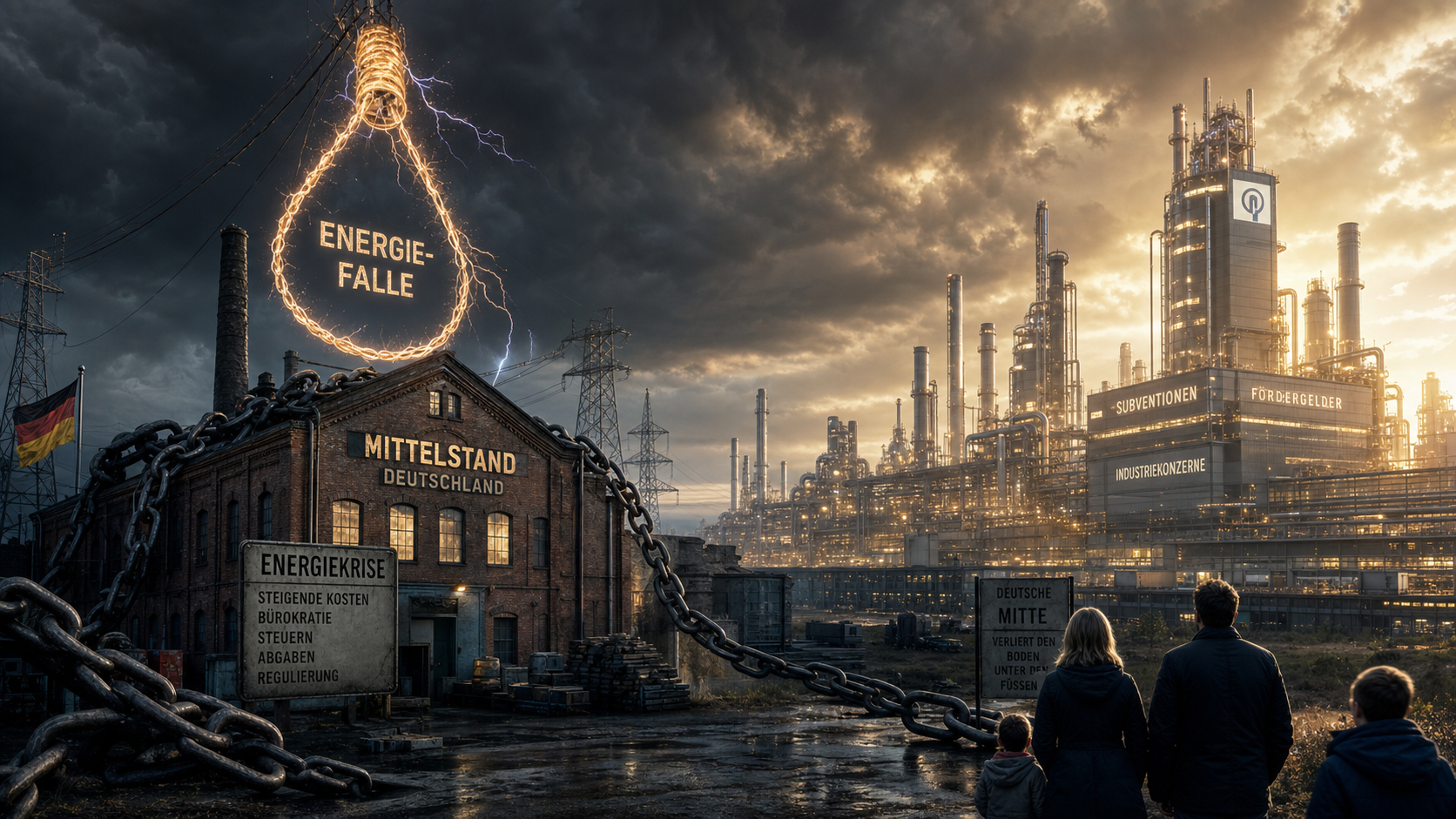
Industrial power is insufficient: This is how SMEs remain in the shadow of large corporations – Why flexibility is vital for survival – Image: Xpert.Digital
Cost control and flexibility: The underrepresented factor in the political debate
One of the most consequential blind spots in the public energy policy debate is the neglect of operational flexibility as an independent competitive factor. Flexibility – the ability of a company to react quickly to changing cost structures, actively manage energy costs, and cushion price volatility – is not a given for small and medium-sized enterprises (SMEs), but rather a structural challenge.
While large corporations employ their own energy departments, procurement specialists, and sophisticated hedging strategies, most SMEs lack the resources for professional energy management. As the German Association of Small and Medium-Sized Businesses (SMEs) points out, medium-sized companies without their own energy department face the challenge of managing uncertainties without losing their competitiveness. Digital energy monitoring systems, load management, and predictive procurement strategies are now considered strategic tools, but they involve considerable implementation effort that is hardly feasible for a small craft business with 20 employees.
Current energy policy barely addresses this flexibility problem. The rigid categorization of industrial electricity prices—which favors formally defined energy-intensive sectors while excluding functionally similar suppliers, service providers, and the manufacturing industry—further exacerbates the structural disadvantage faced by small businesses. BVMW Chairman Markus Jerger already articulated this problem during the previous program under Minister Habeck: Due to supplier relationships, virtually the entire German Mittelstand (SMEs) is subject to international competition; limiting the group of recipients of discounted electricity prices is not only wrong but also threatens their existence. This fundamental situation remains structurally unchanged under Reiche.
The irony is that, due to its typical characteristics – decentralized, flexible, and adaptable – small and medium-sized enterprises (SMEs) would actually offer the best foundation for a diversified energy policy. SME owners can react more quickly than corporations with their hierarchical decision-making structures. But rapid responsiveness requires reliable framework conditions and manageable regulations. Both are currently lacking.
Related to this:

"Birnbaum demands, Reich delivers"
One must grasp the full implications of this construct before discussing individual measures. A former high-ranking official from E.ON's inner circle now serves as Minister for Economic Affairs and Energy and is presenting reform plans that are explicitly welcomed by the current E.ON CEO. Leonhard Birnbaum, CEO of E.ON, publicly praised Reiche's approach as precisely the right one and spoke of a genuine systemic shift requiring different rules. Specifically, Birnbaum stated that what had sustained the energy transition in its first half would no longer sustain it in the second – and the rules Reiche subsequently drafted bear a striking resemblance in many details to the positions E.ON had previously publicly advocated.
This is not speculation, but a verifiable chronology. In November 2024, Reiche – still CEO of Westenergie AG, the E.ON subsidiary – published a LinkedIn article entitled "Getting the Energy Transition on Track: System Costs Are the Most Important Lever." In it, as CEO, she outlined what the next federal government needed to do: reduce feed-in tariffs, tighten grid connection rules, and link the expansion of renewable energy plants to grid capacity. A year and a half later, as Minister of Economic Affairs, she translated precisely these proposals into draft legislation. Wind power pioneer Johannes Lackmann, long-time president of the German Renewable Energy Federation, summed it up succinctly in an open letter to Birnbaum: Birnbaum demands, Reiche delivers.
The picture becomes even clearer through a specific observation: E.ON has submitted a draft for grid expansion in the state of Mecklenburg-Western Pomerania – and according to an expert familiar with the matter, Reiche's official grid package is virtually identical. According to Member of Parliament Michael Kellner (Greens), nine meetings have taken place between Reiche and E.ON CEO Birnbaum, as well as other E.ON representatives and the Federal Ministry for Economic Affairs and Energy, since she took office. This is not informal networking, but rather systematic policymaking with the participation of the most important industrial stakeholder.
The German government is selling this as neutral policy in the country's interest. LobbyControl sees things differently and warned of a clear conflict of interest on the very day Reiche took office: On the morning of her inauguration, she was still listed in the lobby register as a representative of an energy company; the entry wasn't removed until midday. LobbyControl spokesperson Christina Deckwirth clarified that Reiche, in her new role, could not avoid addressing issues affecting the business interests of Westenergie, E.ON, or other corporations – this constituted a clear conflict of interest.
What's emerging here is more than just classic lobbying. Classic lobbying means that corporations commission external representatives to place them in government ministries. The Reiche case, however, describes a qualitatively different situation: the transition from external influence to direct, personal infiltration of the government apparatus. It's not someone sitting in the anteroom asking to be heard – it's someone sitting at the cabinet table writing the laws. Even E.ON CEO Birnbaum himself made no secret of his awareness of the situation in the OMR podcast, commenting that two former E.ON executives now sit in the federal government – a remark he apparently sees not as a problem, but as a favorable circumstance.
The legal compliance of this situation is the wrong benchmark. Legally, many things can be constructed in such a way that no compliance rule is violated. The Ministry of Economic Affairs itself responded to corresponding criticism with the standardized statement that clear rules for avoiding conflicts of interest are, of course, observed. However, from a political and democratic-theoretical perspective, this statement falls short. A democracy's trust in its institutions depends not only on whether rules are formally adhered to, but also on whether citizens can recognize that decisions are genuinely made in the public interest – and not as an extension of corporate interests by other means. It is precisely this trust that is structurally damaged here. Not through shady backroom deals, but through publicly documented, professionally orchestrated policymaking, demonstratively applauded from the executive suites of the energy industry.
Public and media criticism of Katherina Reiche is increasingly focused on the revolving door between politics and business. Until taking over the ministry, Reiche was CEO of Westenergie AG, a wholly owned subsidiary of the E.ON Group, which operates both electricity and gas infrastructure. LobbyControl criticizes her for favoring gas companies with her legislation and for not giving balanced consideration to different social groups, but rather privileging them. A particularly explosive incident made headlines in April 2026: Reiche's ministry allegedly commissioned arguments from the energy company EnBW that disadvantaged battery storage compared to gas-fired power plants – essentially a one-sided commission favoring the fossil fuel industry. Furthermore, EnBW initially failed to register this document in the lobby register, even though this is mandatory for ongoing legislative procedures.
The revolving door effect is not a phenomenon limited to the wealthy. An analysis by abgeordnetenwatch.de shows that at least 670 lobbyists previously worked in the Bundestag, the government, or the federal administration. According to abgeordnetenwatch.de, the problem lies not in individual cases, but in a systemic pattern: When numerous former members of parliament and their confidants move directly into lobbying jobs, it is not an isolated incident, but a systemic problem because the transition from political power to economic interest representation is completely inadequately regulated. LobbyControl already demonstrated in a previous study that such transitions primarily provide large corporations and associations with insider knowledge and privileged contacts – resources that only financially powerful players can afford.
This is structurally significant for small and medium-sized enterprises (SMEs) because the other side of this informal power imbalance is not compensated for by clearly defined political safeguards. Large energy companies like RWE can develop concrete lobbying strategies: RWE, for example, sent a document to the German government proposing measures that would exclusively favor gas-fired power plants and effectively exclude battery storage from tenders. SMEs, which have similar vested interests, have neither comparable lobbying access nor the resources to systematically pursue such strategies.
Related to this:


The middle class as the economic foundation – and political lightweight
KfW succinctly summarizes the contradiction: In Germany, the public focus is often on large corporations. However, it is the small and medium-sized enterprises (SMEs) that significantly shape Germany's economic landscape. This diagnosis is not new, but it is gaining urgency under current energy policy.
In fact, small and medium-sized enterprises (SMEs) possess considerable resilience – equity ratios rose slightly again in 2024 to 30.7 percent, and the proportion of highly indebted companies declined. However, resilience is no guarantee of competitiveness. Investment behavior reveals the real danger: an investment rate of only 39 percent among SMEs – near an all-time low – signals that SMEs are operating on a short-term basis because they do not recognize a reliable investment foundation in the patchwork of subsidy programs, regulatory changes, and announcements of course corrections in energy policy.
Despite its economic centrality, the political influence of small and medium-sized enterprises (SMEs) is structurally limited. Their interests are diverse: craft businesses, suppliers, service providers, retailers, and family-owned companies from a wide range of sectors have different energy profiles and political preferences. This heterogeneity makes it difficult to form a unified political voice. Furthermore, while SME associations like the BVMW and ZDH are politically active, they cannot compete with the resources of large energy corporations in terms of access to ministerial bureaucracy.
The German government fully acknowledges this imbalance in political rhetoric. The finding of the NORD/LB study that almost all companies (94 percent) are calling for a more pragmatic energy policy, and the warning from KfW's chief economist that policymakers must always consider SMEs when implementing tax relief measures, are not niche positions. They reflect the broad consensus of a business landscape that feels systematically underrepresented in politics relative to its economic importance.
What the coalition is actually doing for small and medium-sized businesses
It would be analytically dishonest to categorically classify the reforms under the Reich as hostile to small and medium-sized enterprises (SMEs). The reduction of the electricity tax to the EU minimum rate applies to more than 600,000 manufacturing companies and thus also benefits a large segment of the SME sector. The investment boost with the immediate tax depreciation of 30 percent is a structurally sound measure that can provide significant liquidity advantages, especially for SMEs willing to invest. The option model for simplified taxation of partnerships strengthens family-run businesses. The reduction of bureaucracy through the repeal of the supply chain law and the moratorium on statistical reporting obligations provides SMEs with concrete relief from administrative burdens.
The power plant strategy also has a comprehensible rationale from the perspective of security of supply. Periods of low wind and solar power generation – times when neither wind nor solar power provides sufficient electricity – are not an abstract threat to manufacturing companies, but a concrete risk of operational disruption. The planned capacity of at least twelve gigawatts of dispatchable power plants, which are to be tendered in the short term, provides companies with continuous production needs a basis for supply planning.
The German government itself states that the industrial electricity price is intended to reach a significantly larger group of companies – from medium-sized businesses to large corporations. Whether this statement reflects reality depends on the specific eligibility criteria. Existing expert opinions and industry criticisms tell a different story: the program structurally fails to reach those companies where there is also high cost pressure, but the formal requirements are lacking.
Between corporate interests and the common good: A structural mismanagement
The sum of the observations paints a consistent picture of structural asymmetry in German energy policy. This asymmetry cannot be reduced to malicious intent, but rather results from a combination of incentive structures, information asymmetries, and institutional mechanisms, each of which appears plausible on its own, but together systematically weaken the representation of the interests of small and medium-sized enterprises (SMEs).
First, the logic of large corporations dominates the program definition. State aid frameworks like CISAF were designed for the specific risks of large industrial companies and cannot simply be transferred to medium-sized businesses. The industrial electricity price is not detrimental to medium-sized businesses because it was deliberately designed that way, but because it is modeled on an instrument tailored to large corporations.
Secondly, the institutional consultation logic favors actors with strong resources. When ministries demand expertise from corporations like EnBW during the drafting of legislation—even if this is not necessarily illegitimate—an information bias inevitably results. Small and medium-sized enterprises (SMEs) lack both the legal capacity and the political contacts to strategically insert their own positions into ministry documents. This is not an accusation of corruption, but rather a sober description of a structural problem.
Thirdly, an institutionalized compensation mechanism is lacking. Other EU countries have explicit SME tests for major economic policy initiatives that systematically examine the impact on small businesses. Germany lacks such a binding early warning system, which would prevent programs from structurally excluding SMEs in their specific design.
What an honest, SME-oriented energy policy should achieve
The analysis reveals a clear set of requirements for an energy policy that places small and medium-sized enterprises (SMEs) at the center not only rhetorically, but structurally.
Planning certainty requires long-term frameworks, not three-year programs. If companies are to invest in energy-efficient technologies or on-site renewable energy generation, they need horizons of five to ten years, not funding promises that could end with the next change in government. The current industrial electricity price until 2028 is not a planning framework, but rather a transitional measure.
Cost reduction and flexibility require tailored instruments for SMEs. A non-discriminatory expansion of the industrial electricity price – as demanded by the BVMW (German Association for Small and Medium-Sized Businesses) – would not only be fair but also economically sound, as it strengthens supply chains and the entire productive ecosystem of German SMEs. In addition, digital energy management systems for SMEs with low-threshold access to funding would be a cost-effective lever for strengthening individual flexibility.
International competitiveness requires a technology-neutral energy mix. The accusation that Reich's policies systematically favor gas-fired power plants over battery storage is not only a climate policy issue. It is also an economic one: If decentralized energy storage were indeed cheaper and more flexible than new gas-fired power plants—as critics argue—the preference for gas-fired power plants would, in the long run, keep electricity prices higher than necessary and thus perpetuate Germany's competitive disadvantage. This would be a bad outcome for small and medium-sized enterprises (SMEs), which are the main victims of high energy prices.
Transparency and lobby control require structural reforms. A legally mandated cooling-off period for ministerial appointments, mandatory SME audits, and full compliance with the lobby register would be minimum requirements to restore the trust of small and medium-sized enterprises (SMEs) in the integrity of economic policy decisions. As long as these institutional safeguards are lacking, the structural suspicion remains that regulatory details are shaped to benefit large corporations, without SMEs being able to effectively challenge this.
The promise and its limits
Katherina Reiche has achieved real progress with her energy policy. The reduction in electricity tax, the investment boost, and the reduction of bureaucracy are economically relevant measures that also benefit small and medium-sized enterprises. The power plant strategy addresses a legitimate problem of security of supply.
Nevertheless, the analysis shows that the structural gap between political promises to small and medium-sized enterprises (SMEs) and the actual implementation of economic policy instruments persists. The industrial electricity price is the clearest example: announced as a broad-based relief measure, in its concrete implementation it primarily affects energy-intensive large-scale industries. The 83 percent of SMEs that criticize energy policy as being tailored to large-scale industry are not reacting to a misperception, but to a measurable reality.
Germany's small and medium-sized enterprises (SMEs) have proven their resilience in times of crisis – 33 million employees and a rising equity ratio in the midst of recession are impressive evidence. What they deserve from politicians is not pity, but an economic policy that reflects their structural importance in the quality of the instruments used – and not just in empty rhetoric.





