
The German profitability problem: From world market leader to restructuring case – The structural crisis of German automotive suppliers
Xpert Pre-Release

Available in 27 languages 📢
Prefer Xpert.Digital on GoogleⓘPublished on: June 21, 2026 / Updated on: June 21, 2026 – Author: Konrad Wolfenstein
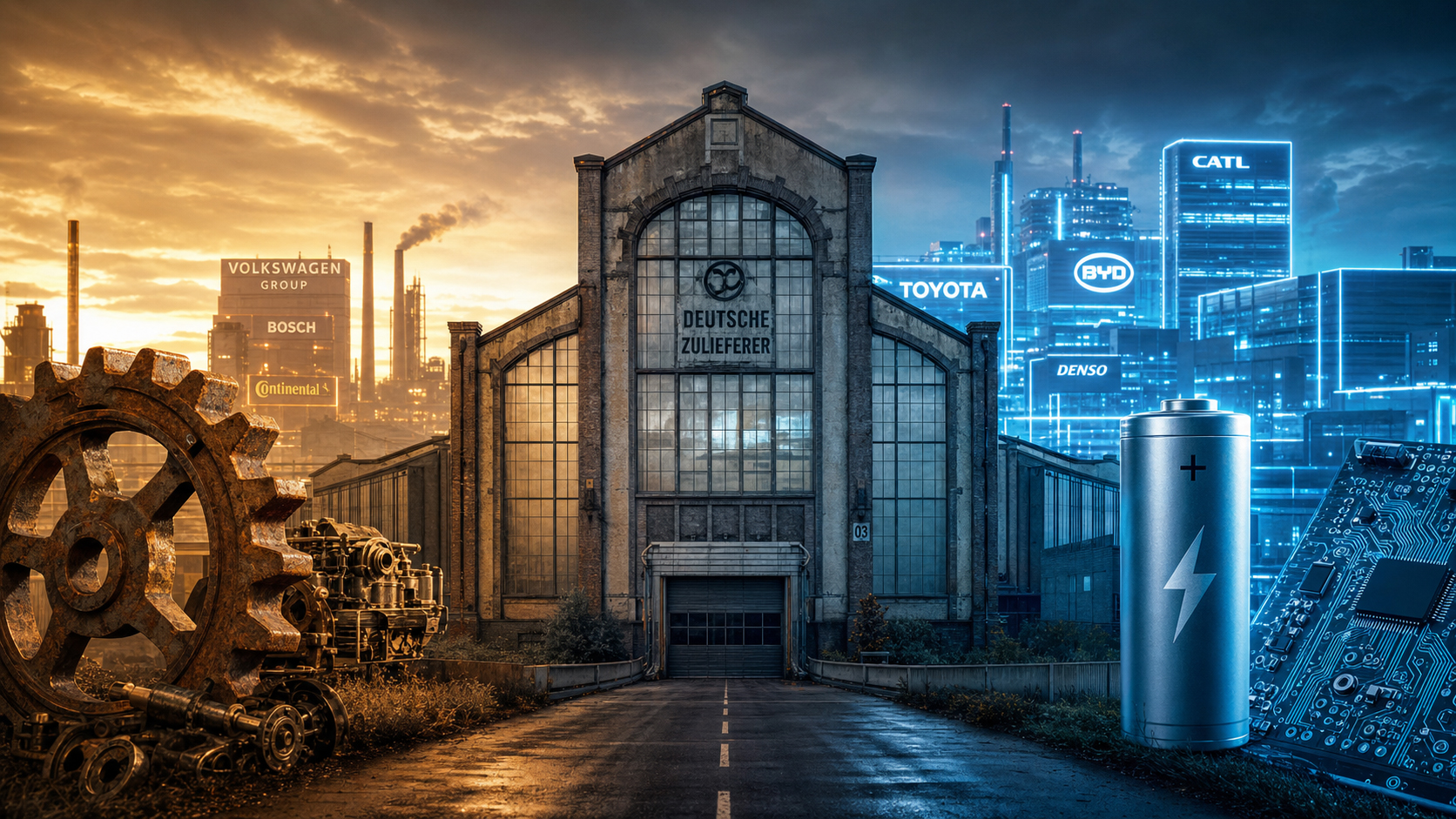
Germany's profitability problem: From world market leader to restructuring case – The structural crisis of German automotive suppliers – Image: Xpert.Digital
Red alert for Bosch, ZF & Co.: Why Germany's automotive suppliers are experiencing a massive collapse
A margin of only 1.7 percent: The bitter truth about the decline of the German automotive industry
The Japan Paradox: Why our car suppliers are failing – and others are raking in billions
The German automotive supplier industry is facing the greatest crisis in its history. While global vehicle production is rising, profits at industry giants like Bosch and ZF are plummeting. The current Berylls study for 2025 reveals a shocking reality: with an average profit margin of a meager 1.7 percent, Germany, once a flagship location, now ranks last worldwide – far behind Japan and its rapidly growing Chinese competitors. But what at first glance appears to be a typical economic downturn is turning out to be a fundamental, structural crisis. For decades, companies relied on the combustion engine and a pure drive for optimization. Now, as the market shifts radically towards electromobility, software, and artificial intelligence, this reluctance is backfiring. Those who want to survive in this toxic environment of extreme price pressure and forced transformation must abandon mere management – and rekindle the courage of their founding fathers.
Those who remain as administrators will be liquidated tomorrow: A turning point that has been a long time coming
The figures speak for themselves, and they are sobering. The total revenue of the world's 100 largest automotive suppliers fell by 4.6 percent in 2024 compared to the previous year, to €1.085 trillion – this is shown in the current TOP 100 Suppliers Study 2025 by Berylls by AlixPartners, one of the most renowned analyses of the global automotive supplier industry. Particularly alarming: This decline occurred despite rising global vehicle production. More cars, less money for suppliers – this is not a temporary dip, but rather the symptom of a profound structural shift.
What at first glance appears to be just another cyclical crisis in an already volatile industry, proves upon closer inspection to be something fundamentally different. Previous crises—whether the oil price shocks of the 1970s, the financial crisis of 2008/2009, or the pandemic-related production shutdown of 2020—all had one thing in common: the business model itself was never in question. Companies became more efficient, they waited it out, and they recovered. This time, the mechanism of taking a breath and carrying on has been disrupted. The market itself is transforming in a way that turns long-established strengths into structural weaknesses.
This development is particularly painful for Germany because the supplier industry is central to the country's industrial identity. With 17 companies in the global top 100, German suppliers rank second worldwide in terms of revenue – directly behind Japan with 21 companies. However, behind this seemingly impressive market presence lies an alarming weakness in profitability, raising questions about the long-term viability of the business model.
High sales, little profit: The German profitability problem
The truly devastating news for Germany as an industrial location lies not in the revenue ranking, but in the profitability analysis. The typical German supplier (measured by the median) generated an EBIT margin of just 1.7 percent in 2024 – the weakest figure of all major supplier nations worldwide. This puts Germany at the bottom of the ranking, even behind the crisis-ridden South Korean battery manufacturers.
The contrast with other supplier nations is striking. Japanese suppliers achieve a typical margin of 5.9 percent – more than three times the German figure. Chinese suppliers, of whom only seven of the fifteen companies in the top 100 even disclose their margins, achieved around 9.6 percent – roughly five times the German figure. These figures alone would be enough to sound the alarm. But there is another dimension that brings the problem into even sharper focus: Chinese suppliers simultaneously grew by 11 percent per year for a typical company, and eight of the ten fastest-growing suppliers in the world are from China. Germany is thus combining weak profitability with stagnant growth – a toxic double whammy.
This is exemplified by Bosch, still the world's largest automotive supplier with nearly €56 billion in revenue. Despite this impressive revenue, the company ultimately achieved a profit margin of only 1.8 percent. In fiscal year 2025, Bosch reported its first net loss since 2009 – a loss of €400 million after taxes, primarily due to €2.7 billion in job cuts and the impact of US tariffs. Adjusted earnings before interest and taxes (EBIT) plummeted by 42 percent. ZF's financial results are even more drastic: The Friedrichshafen-based supplier recorded a net loss of over €1 billion for 2024 – following a profit of €126 million in 2023. Revenue collapsed by eleven percent to €41.4 billion.
Segments as destiny: Why the product portfolio determines survival
To understand why German suppliers are performing so poorly despite their size, one must consider the segment analysis from the Berylls study. A company's profit margin is determined less by efficiency or management quality than by precisely what the company produces. The disparity between the segments is enormous.
Semiconductor manufacturers typically achieve a margin of 24.6 percent, glass manufacturers 23.2 percent, and tire manufacturers 10.2 percent. At the other end of the spectrum are powertrain components with 4.5 percent – and the battery segment with a margin of minus 11.3 percent. The battery segment is thus structurally loss-making, even though its revenue growth, at 27.9 percent per year since 2020, is the fastest of all segments. The paradox is explainable: Companies involved in battery cell production first invest billions in huge, only partially utilized factories. At the same time, there is intense price competition, driven by Chinese manufacturers like CATL and BYD, which dominate the global market.
This segment's fate affects German suppliers in two ways. First, the major German corporations are historically deeply rooted in the internal combustion engine powertrain. ZF with transmissions and chassis components, Bosch with injection systems and engine control units, Continental with conventional drive electronics – they all built their core business for decades around technologies that are simply no longer needed in electric vehicles or are significantly simplified. Second, German suppliers have not established a serious market position in the high-margin segments of the future – semiconductors, battery cells, AI-supported software platforms.
The contrast within Germany is illustrated by Infineon Technologies, a semiconductor manufacturer that achieved a margin of 21.5 percent, while ZF, in the traditional powertrain segment, saw its margin fall to minus 2.8 percent. These two German companies represent completely different worlds. The segment is the deciding factor.
The Japan Paradox: Similar starting point, fundamentally different result
The comparison with Japan is particularly revealing. In many respects, Japan is the most natural benchmark for comparison with Germany: an old, strong industrial nation with a deeply rooted automotive system, a long tradition of combustion engines, and strong domestic manufacturers as anchor customers. Japanese suppliers are also under pressure – 20 of the 22 Japanese companies represented in the top 100 experienced revenue declines in 2024. Between 2019 and 2024, Japan lost five suppliers from the top 100 ranking.
And yet, Japanese suppliers, with a typical EBIT margin of 5.9 percent, earn more than three times as much as their German competitors. Where does this difference come from, given the similar structural starting conditions? The answer lies not in the product, but in the relationship architecture between manufacturers and suppliers.
In Japan, OEMs and suppliers are often linked through interlocking ownership – Denso is largely part of the Toyota Group, as is Aisin. These close, often decades-long relationships lead to a fundamentally different crisis dynamic: The manufacturer doesn't simply drive down prices, but stands by the supplier through tough times together. Efficiency gains are not unilaterally appropriated by the manufacturer, but shared. In Germany, on the other hand, the relationship between OEM and supplier is largely transactional. Those who supply Volkswagen, Mercedes-Benz, or BMW are primarily seen as a cost center. Price pressure is passed down without compromise, and in times of crisis, the supplier is the first to be held accountable. This creates a systemic efficiency dilemma: German suppliers earn too little to invest sufficiently in their own transformation, which further erodes their competitiveness – a classic vicious cycle.
Denso, the largest Japanese automotive supplier and closely linked to Toyota, is planning an operating profit margin of 7.2 percent for fiscal year 2026 and aims for 10 percent in the long term. This places Denso, which is as deeply rooted in conventional drive technologies as the major German manufacturers, on a different profitability trajectory – a direct consequence of the systemic differences in the value chain.
The Chinese attack: Not only cheaper, but faster and broader
China is no longer just a low-cost production location for Western automakers. It has become the most dynamic competitor in the global automotive supplier industry. Four new Chinese suppliers – Huawei, Huizhou Desay, Ningbo Tuopu, and NBHX – broke into the global top 100 in 2024. Since 2019, the combined revenue of China's top 100 suppliers has grown by 139 percent. In terms of country-specific revenue, China overtook the US in 2025 and now ranks third, just behind Germany and Japan.
What's worrying isn't just profitability or growth, but the speed of transformation. Chinese companies operate with significantly shorter development and market launch times than traditional Western suppliers. While European suppliers plan for three to four years of development cycles for new vehicle systems, Chinese competitors bring comparable products to market in half the time. This speed of development isn't accidental, but rather the result of a different innovation culture and massive government subsidies – a problem that medium-sized companies from Germany or Baden-Württemberg, competing against Chinese toolmakers that receive up to 60 percent government funding, feel directly.
CATL, in particular, has established a near-monopoly in the global battery market. With a worldwide market share of approximately 38 percent for lithium-ion batteries for electric vehicles in 2024 and projected growth to 464.7 GWh in 2025 (+35.7 percent), CATL is the sole manufacturer controlling almost 40 percent of the global market. Neither Bosch, ZF, nor Continental ever seriously attempted to enter battery cell production – a decision that, in retrospect, proves rational for the companies themselves, as cell manufacturing is a capital-intensive chemical process industry that is difficult to combine with their traditional automotive business. For Germany and Europe as industrial locations, however, it was a missed opportunity of historic proportions.
Job losses as a symptom: What the job figures reveal about the situation
The devastating financial figures are having a direct impact on employment trends, and these are alarming. Bosch alone plans to cut up to 22,000 jobs in its supplier division – in addition to the originally announced 9,000 job cuts, a further 13,000 reductions have been announced by 2030. The global workforce is projected to fall to 412,774 employees by 2025, with 6,700 of the job losses occurring in Germany alone. ZF plans to eliminate up to 14,000 of its more than 50,000 German jobs, 7,600 of which are in its powertrain division. Continental intends to float its entire automotive business on the stock exchange under the name Aumovio, thereby drawing a clear line between the two companies.
Between June 2024 and June 2025, the German automotive industry lost approximately 50,000 jobs. The Berylls study identifies Germany as the only major region worldwide with a negative balance in terms of plants: ten plants closed in 2025, while only one new one opened. The German automotive supplier industry as a whole currently employs 267,000 people – a figure that is expected to withstand further downward pressure.
Job cuts are not the real problem, but rather a symptom. The real problem is the financial spiral many suppliers are maneuvering themselves into: Companies operating on a 1.7 percent margin while simultaneously having to invest billions in transformation – in software, new drive concepts, and diversification beyond the automotive industry – inevitably face a liquidity crunch. Banks either refuse loans to structurally weak companies or offer them only at prohibitively high interest rates. Berylls therefore anticipates a wave of bankruptcies and mergers in the sector by 2027/2028.
Our EU and German expertise in business development, sales and marketing

Our EU and German expertise in business development, sales and marketing - Image: Xpert.Digital
Industry focus areas: B2B, digitalization (from AI to XR), mechanical engineering, logistics, renewable energies and industry
More information here:
A thematic hub offering insights and expertise:
- Knowledge platform covering global and regional economies, innovation and industry-specific trends
- A collection of analyses, insights, and background information from our key areas of focus
- A place for expertise and information on current developments in business and technology
- A hub for companies seeking information on markets, digitalization, and industry innovations
From administrator to founder: Why suppliers now need to reinvent themselves
Bosch and ZF as start-ups: What their founding history teaches us
There is a profound irony in the current situation. Bosch was founded in 1886 by Robert Bosch in a small workshop for precision mechanics and electrical engineering in Stuttgart – a true backyard startup in today's sense. Robert Bosch himself described the first ten years or so as a "terrible struggle" – hardly any orders, tight finances, existential uncertainty. The breakthrough came when he realized that conventional magneto ignitions for automotive combustion engines were unreliable. He fundamentally improved the technology, patented it, and thus created a product that did not yet exist in that form. This was not an optimization of an existing market – this was the recognition and capture of a market that only came into being through the technology itself.
ZF, the gear factory in Friedrichshafen, was founded in 1915 with a similar pioneering spirit, emerging from a foundation with the goal of developing high-performance transmissions for the burgeoning automotive industry. Here, too, it was a highly risky bet on a technology and a market that did not yet fully exist. Continental, founded in 1871 as a rubber goods factory, transformed itself into a global automotive giant through its innovative drive and entrepreneurial courage.
What unites all these startup stories is not size, not capital, not scaling – but the willingness to see a market gap that others haven't yet seen and to bet on that gap. In the decades of success, founders became administrators. Their role shifted from shaping to optimizing, from betting to hedging, from being curious to preserving. This isn't a criticism, but a systemic logic: growth and stability reward efficiency and adherence to processes, not risky bets on unknown markets.
The bitter truth about the current situation is that this transformation from administrator back to founder is not only possible, but necessary – and that the necessary skills should already be present within companies. It's been done before. The question is whether the organizational structures, incentive systems, and above all, the corporate cultures, which have been conditioned for decades to stability and optimization, can be restructured quickly enough.
From administrator to founder: What transformation really means
There is a fundamental distinction that is often overlooked in discussions about transformation: the difference between operational transformation and strategic reinvention. Operational transformation means doing the same thing cheaper, faster, or digitally. Strategic reinvention means redefining the founding motive – asking the question: What is the market we actually want to be operating in ten years from now?
The Berylls study clearly shows that the suppliers who will emerge as winners from the crisis are precisely those engaged in this kind of strategic restructuring. Mahle, originally a manufacturer of engine components, now develops cooling modules for stationary battery storage systems – a market that has only a marginal connection to the automotive industry. Schaeffler manufactures parts for humanoid robots and cooling technology for data centers – two markets driven by the AI boom that outpace the traditional automotive business in terms of growth momentum. ZF sold its entire driver assistance division to Harman for around €1.5 billion to finance debt reduction and regain strategic flexibility.
This diversification is not a failure towards the automotive industry – it is a rationally necessary response to a market structure that is fundamentally changing. The AI boom presents both a threat and an opportunity for the supplier industry: data centers are currently snapping up the semiconductors that the automotive industry urgently needs. At the same time, the infrastructure of the AI industry is opening up huge new supply opportunities for cooling systems, mechanical components, power supply solutions, and more.
The decisive competitive advantage of successful transformers, however, is not capital or technology – it is the ability to rapidly develop new competencies. German suppliers have cultivated exceptionally high precision and quality expertise over decades, which can certainly be transferred to other industrial sectors. The question is not whether the expertise exists. The question is whether decision-makers in companies and at the political level are prepared to summon the institutional courage to relinquish business areas that have been core to their identity for decades.
Political and structural framework conditions as a stress factor
The crisis facing German suppliers is not merely a business issue – it is also a matter of economic policy. German suppliers operate under cost conditions that are among the most unfavorable globally. Producer prices in Germany rise by approximately 6.7 percent annually, compared to only 0.8 percent in China. Energy costs in Germany range from 25 to 30 cents per kilowatt-hour for industrial customers – in France, they are below ten cents. The result: structural competitive disadvantages that can hardly be offset by efficiency gains at the company level.
In addition, US import tariffs directly impact German suppliers with US production sites or US export business. At Bosch, tariffs immediately affected the 2025 annual results. Denso, the major Japanese supplier, was also forced to lower its profit forecast for the full year 2026 by almost a fifth due to the burden of US tariffs.
At the same time, almost 80 percent of German business leaders surveyed in a Bertelsmann study complain about a lack of innovation and inadequate economic policy frameworks. Nearly half see Germany lagging behind in key technologies such as artificial intelligence, big data, and digitalization. These are not fringe opinions, but rather key findings from a representative survey of nearly 1,000 German executives. The Bertelsmann Foundation speaks of a "technological gap" that cannot be closed without political structural reforms.
Since 2019, the global economy has grown by around 19 percent, while Germany recorded growth of just 0.2 percent during the same period. For an economy whose industrial backbone is formed by the automotive industry and its suppliers, this is a warning sign of historic proportions.
Scenarios for the coming years: Consolidation, reinvention, or loss of significance
What might the German automotive supplier industry look like in five years? Berylls outlines three plausible scenarios that are not mutually exclusive but could occur simultaneously. First, a wave of bankruptcies and mergers among those companies that can neither strategically realign themselves nor have the liquidity to finance the transition. This scenario is most likely for small and medium-sized suppliers with a high dependence on internal combustion engines.
Secondly, a successful reinvention by those companies that made the right bets at the right time. Companies like Schaeffler, Mahle, or ZF, after their restructuring, were able to transfer their engineering expertise to new growth markets and become more profitable in the long term than ever before – not despite the crisis, but because of it. The crisis as a painful but necessary catalyst for reinvention.
Thirdly – and this is the most worrying scenario – a gradual decline in importance, in which the number of German suppliers in the global top 100 falls below 17, not through a dramatic collapse, but through a slow gradual aging out of the ranking as Chinese competitors fill the gaps. Since 2020, China has gained eight new places in the top 100, while Japan has lost six. Germany has maintained its 17 positions – but according to Berylls study author Jürgen Simon, this will remain "very difficult".
The crucial variable in all three scenarios is time. Not the time of economic recovery—that won't come in the form it always has in the past. But the time of strategic reorientation. How quickly can organizations that have been conditioned for decades to stability and process optimization relearn to be curious? To be willing to invest again in markets that currently seem opaque and uncertain? Ultimately, this isn't a business question—it's a question of corporate culture.
The founders' lessons for the digital age
Robert Bosch said of the early years of his company's history: "A terrible struggle." He wasn't just referring to the financial difficulties, but also the fundamental uncertainty, the courage to enter a market that didn't yet exist with minimal capital. It is precisely this experience—the experience of beginnings, of learning from failures, of recognizing unseen market opportunities—that the major German suppliers lack today. Not capital, not engineers, not production facilities.
Philipp Raasch, the journalist and automotive analyst behind the Autopreneur newsletter, who adapted the Berylls study for a broad professional audience, sums it up perfectly: "From administrator back to founder." This isn't meant romantically. It's a precise strategic diagnosis: the shift from an administrative, optimizing, and hedging mode back to an investigative, risk-taking, and learning mode. Berylls study author Jürgen Simon puts it with sober clarity: "The core isn't necessarily what I've been doing for the last 100 years." And further: What's happening right now is "far from a temporary dip"—it's "more like a new reality.".
The good news – and it's real, not just talk – is this: The structural competencies that German suppliers have built up over generations have not become worthless. High-precision manufacturing expertise, a deep understanding of complex mechanical and electronic systems, and a long-established commitment to quality – these are competencies that are in demand in markets such as robotics, aerospace, medical technology, energy infrastructure, and data centers, as well as in the automotive industry. The foundation is there. What's missing is the willingness to take the risk.
The German automotive supplier industry stands at a crossroads whose historical significance can hardly be overstated. It is not simply a question of whether Bosch, ZF, and Continental will survive. It is a question of what kind of industrial nation Germany wants to be in the 2030s: one that embraces structural change as a mandate for reinvention, or one that manages its own decline—becoming ever more efficient until the very end.
🎯🎯🎯 Data-driven B2B industry hub as a quasi-in-house solution

The quasi-in-house solution: How Xpert.Digital closes operational gaps in B2B marketing and sales – Smart Content-Driven Business - Image: Xpert.Digital
Xpert.Digital is a data-driven B2B industry hub led by Konrad Wolfenstein . The company acts as an external, quasi-in-house solution for industrial partners, closing operational gaps in marketing, content, and sales – without requiring additional resources on the client side.
More information here:
Your global marketing and business development partner
☑️ Our business language is English or German
☑️ NEW: Correspondence in your native language!

Konrad Wolfenstein
I and my team are happy to be available to you as your personal advisor.
You can contact me by filling out the contact form here [email protected]:or simply call me at +49 7348 4088 965. My email address is
I'm looking forward to our joint project.










