
Innovation in the crisis narrative | Bosch and Schaeffler fleeing into robotics and defense: The strategic deception of automotive suppliers
Xpert Pre-Release

Available in 27 languages 📢
Prefer Xpert.Digital on GoogleⓘPublished on: January 18, 2026 / Updated on: January 18, 2026 – Author: Konrad Wolfenstein
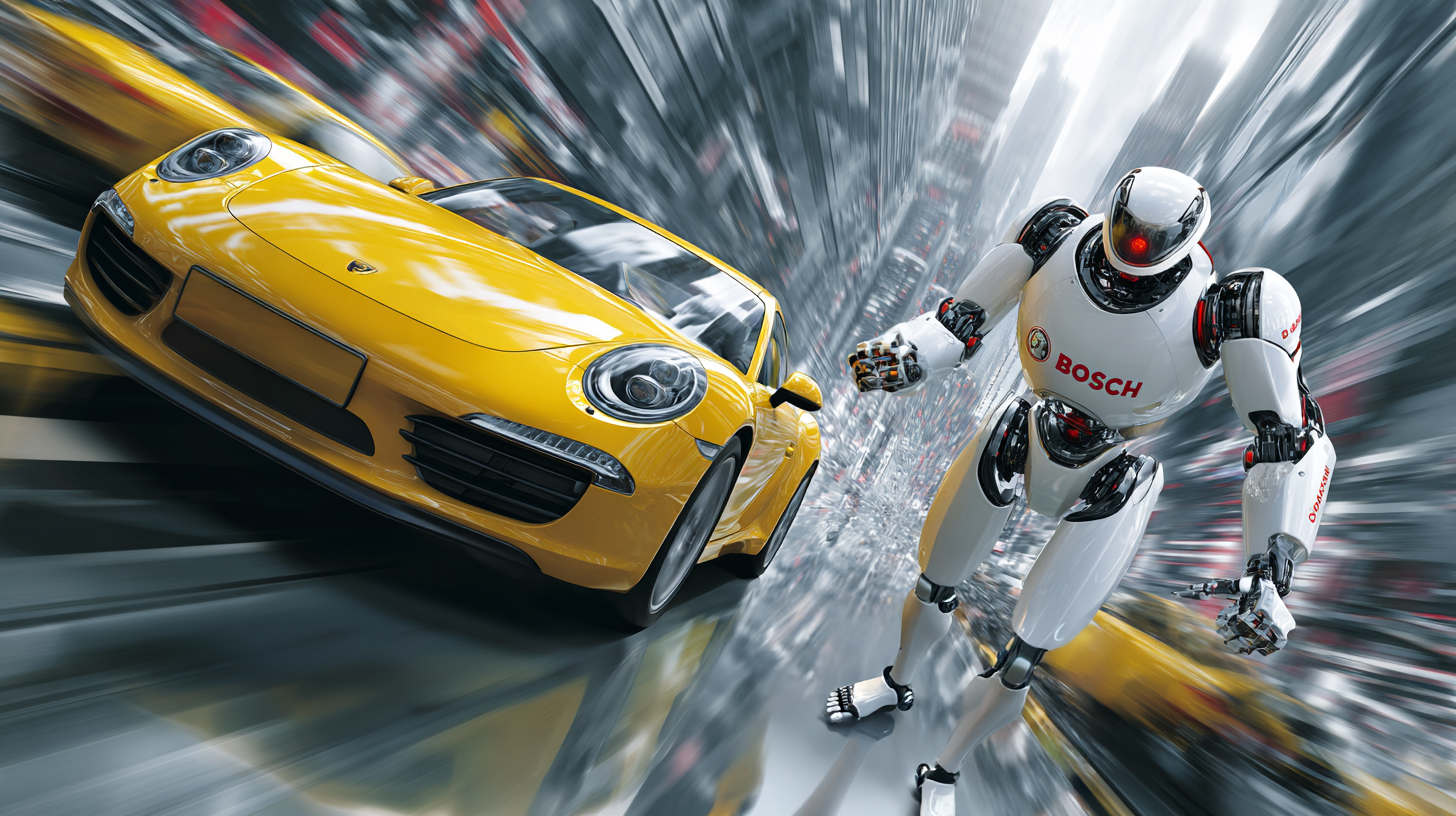
Innovation in the crisis narrative | Bosch and Schaeffler fleeing into robotics and defense: The strategic deception of automotive suppliers – Creative image: Xpert.Digital
When core competencies collapse – The accelerated search for lifelines instead of sustainable transformation
The end of core competencies: Why the “flight forward” could fail for Continental and others
Car won't start? Then we'll try a robot!
German automotive suppliers are facing an existential crisis that is calling their business models into question. Schaeffler is now presenting itself as a robotics pioneer, while other suppliers are hastily diversifying into the defense sector. These strategic shifts, however, are less the result of profound strategic realignment than a sign of panic in an industry that is losing its foundations. An analytical examination reveals remarkable discrepancies between the confident pronouncements and the economic realities of these transformations.
The real business problem: E-mobility remains a loss-making business
The German automotive supplier industry is facing a situation that can only be described as a management crisis in the truest sense. Schaeffler exemplifies this dilemma. In the first half of 2025, the E-Mobility division generated a 9.7 percent increase in revenue to €2,419 million, but incurred an operating loss of €461 million, corresponding to an EBIT margin of minus 19.0 percent. Even in the second quarter, where losses decreased relatively, the EBIT margin was still minus 15.5 percent. This business model is simply not sustainable under the current conditions. The company is producing volumes in a market that is structurally unprofitable.
The causes of this margin crisis are multifaceted and systemic. Electromobility requires fundamental changes in manufacturing processes, the supply chain, and product architecture. For example, electric vehicle production no longer needs highly complex multi-speed transmissions—a classic core product for premium suppliers—but rather simple single-speed transmissions or direct drive solutions. This significantly erodes added value and margins. At the same time, investments in new technologies, battery management systems, power electronics, and software are enormous. These costs must be borne in a market where price competition from Chinese and emerging American manufacturers is fierce.
A study conducted by Berylls by AlixPartners among European automotive suppliers in January 2026 reveals the industry's growing skepticism regarding its transformation assumptions. Only slightly less than 50 percent of the surveyed suppliers see electromobility as a clear growth driver – a continuous decline compared to previous years. Around 23 percent even expect margins to fall in the coming years, not rise. At the same time, suppliers continue to secure more than 70 percent of their revenue from conventional combustion engine technology, which, while stagnant, represents profitable business. This exposes the central dilemma: the old engine is dead, the new engine is not profitable, and the time for transformation is running out.
Schaeffler's strategic transformation: Robotics as a beacon of hope
In this situation, Schaeffler has undergone a surprising strategic shift. Following the acquisition of Vitesco Technologies in October 2024 – a strategic transaction intended to strengthen the company and integrate electromobility expertise – the company suddenly presents itself as a pioneer in humanoid robotics. In January 2026, Schaeffler announced a strategic partnership with the British company Humanoid, under which Schaeffler will not only supply actuators and components for humanoid robots but also plans to integrate several hundred humanoid robots into its own production network over the next five years. As recently as November 2025, the company had announced a similar partnership with Neura Robotics, aiming to integrate a mid-four-figure number of humanoid robots into its manufacturing processes by 2035.
These announcements must be evaluated in their proper context. At the Hannover Messe 2025, Schaeffler, together with Accenture, presented plans for how so-called Physical AI – that is, artificial intelligence in the form of physical robots – could revolutionize manufacturing. The statements are technologically plausible, and the partnerships are top-tier. Accenture and NVIDIA are renowned partners, and the technological approaches are future-oriented. However, this strategic realignment reveals a fundamental inconsistency in Schaeffler's narrative.
The company says it wants to be a leading motion technology company – a statement reiterated at the investor conference in September 2025. Its four divisions are E-Mobility, Powertrain & Chassis, Vehicle Lifetime Solutions, and Bearings & Industrial Solutions. The E-Mobility division is systematically incurring losses, the Powertrain & Chassis division is losing market share due to the decline of the internal combustion engine, and only the more stable Bearings and Vehicle Lifetime Solutions divisions are delivering consistent margins. In this context, the sudden focus on humanoid robotics is not an organic extension of its motion technology expertise, but rather a necessary diversification away from the core business, which is not performing well.
The robotics promise: Big words, small markets
The global market for automotive robotics is estimated at around US$16.3 billion for 2025 and is projected to grow to approximately US$31.7 billion by 2030. These figures initially sound impressive. However, there are two critical nuances: First, this market is not primarily an automotive assembly market, but rather a robotics systems market, dominated by established robotics manufacturers such as ABB, FANUC, and Yaskawa. Second, the integration of humanoid robots into industrial manufacturing processes has not yet been industrialized. For the time being, it remains a pilot project and a proof of concept.
Even more problematic: The German automotive industry has significantly reduced its investments in robotics. According to data from the IFR (International Federation of Robotics), the number of robot installations in the German automotive industry fell by 25 percent in 2024 – a decline that represents the weakest result in 15 years. This is not only an indication of insufficient investment, but also a signal of uncertainty about which technologies to invest in. The metalworking industry saw an increase of 23 percent, the chemical and plastics industries an increase of 71 percent – but not the core automotive sector.
For Schaeffler, this means that its entry into robotics is occurring at a time when demand from its core industry – the automotive industry – is weak and investment decisions are uncertain. Diversification into a new market is happening precisely when financial resources are being depleted by losses in core businesses. From a capital allocation perspective, this is the opposite of best practice.
📈🔵 Order acquisition and organizational development: From classic sales to a strategic business function💡

Order acquisition and organizational development - Image: Xpert.Digital
Xpert.Digital supports companies in this complex transformation, whether it's building a modern order acquisition function from the ground up or optimizing existing processes. With comprehensive expertise in marketing, sales, data analysis, digital transformation, and organizational development, we guide your company toward strategic repositioning. Our approach is holistic: We not only optimize processes but also develop the people and organizational culture necessary to achieve sustainable, measurable success.
More about it here:
Not innovation, but flight: The real crisis of the German automotive industry
Arms diversification: A political window of opportunity, not a strategic plan
Parallel to Schaeffler's robotics initiative, other suppliers have pursued an even more radical diversification strategy: entry into the defense industry. Continental is offering around 100 employees from its unprofitable brake plant in Lower Saxony the opportunity to transfer to Rheinmetall's munitions factory. Hensoldt, a specialized defense electronics manufacturer, is specifically recruiting employees from Bosch and Continental. Medium-sized companies like the stamping parts manufacturer Hapag from Engbrand near Freiberg have explicitly targeted the aerospace and defense industries.
This shift is symptomatic of the devaluation of automotive supplier status. It also reveals the deepest problem with this diversification strategy: it responds to a political window of opportunity, not to structural business realities. The European Union and Germany have announced massive rearmament programs—800 billion euros over several years, with McKinsey forecasts that European defense budgets will increase by 700 to 800 billion euros between 2022 and 2028. For suppliers whose profitability is collapsing in traditional markets, this appears to be a lifeline.
But even this calculation is unrealistic. The defense industry operates according to different principles than mass production in the automotive sector. Production volumes are very low. The German Armed Forces' planned procurement, for example, envisions approximately 50 Leopard 2 tanks per year, or about 35 Puma infantry fighting vehicles per year until series production begins. This is not comparable to the production volumes of the automotive industry. An exception is ammunition and single-use products – Rheinmetall plans to produce up to 1.1 million 155-millimeter grenades annually starting in 2027 – but even this is a specialized manufacturing process with its own technological requirements.
Furthermore, the requirements for compliance, certification, and regulation in the defense industry are considerable. The processing of specialized materials such as titanium alloys, the production of large components for armored vehicles, and adherence to security clearances for personnel represent requirements that automotive suppliers can only prepare for with significant investment and time. An expert statement makes it clear that many companies first need to familiarize themselves with these requirements, and that mass production—a core competency of the automotive industry—is hardly transferable to the defense sector. Innovation cycles are also radically different: While civilian R&D innovates annually, innovation cycles in the defense industry are more likely to span decades.
Furthermore, arms demand is subject to political fluctuations. War situations can change, governments can alter course, and international coalitions can collapse. For companies that base their capital build-up on arms contracts, this poses a significant strategic risk. A study from Baden-Württemberg explicitly points to these risks: Without the willingness to pursue manufacturing for the security and defense industry as a long-term core business and to secure the associated investment cycles, there is a considerable risk that capital commitment and delays will undermine profitability.
The question of financial substance: Diversification from a position of weakness
A crucial problem with these diversification strategies is their timing. Schaeffler is undergoing a massive restructuring. The company is cutting 4,700 jobs by 2027, 2,800 of them in Germany, to save approximately €290 million annually. The e-mobility division posted losses of €461 million in the first half of 2025. Free cash flow was negative €128 million in the first half of 2025 – only marginally better than the previous year's negative €597 million. The company promises to double its EBIT by 2028, but these are forecasts for a company currently undergoing a massive integration.
In such situations, capital allocation is crucial. The company could concentrate its limited resources on making its e-mobility division profitable—a goal that is fundamentally achievable but requires substantial changes to its business model, pricing, and cost structure. Or it could diversify into new, untested markets such as robotics and humanoids. The risk-reward ratio of this second option is questionable.
The Ifo study on diversification in German industry explicitly warns that diversifying supply chains is a long-term task that demands staying power from companies. This is difficult under pressure and with limited capital. A new market like humanoid robotics requires not only capital, but also organizational skills, talent, and a different understanding of business models. A company undergoing restructuring cannot manage this simultaneously with its core business.
The narrative of innovation vs. the reality of flight
Schaeffler and other suppliers present their diversification efforts as innovation movements. The company calls itself a “Motion Technology Company” and emphasizes its expertise in motion technologies. The leap to humanoid robotics is portrayed as a natural extension – robots need motion components, so Schaeffler is in the right place. This is a superficially plausible narrative, but it obscures the deeper reality: these diversifications are less the result of growth ambitions than emergency measures to ensure survival.
A high-ranking restructuring consultant put it succinctly: Suppliers must optimize their business model with regard to their product portfolio, production efficiency, and sustainability requirements. If they fail to do so, they will face a significant marketing risk and may no longer generate new orders. This is precisely the situation Schaeffler and its contemporaries find themselves in. The pressure to tap into new markets stems not from innovative optimism, but from the necessity for survival.
A survey of 49 European suppliers reveals a more subdued mood: Despite all the uncertainties, 63 percent report being satisfied with their own e-mobility strategy, a significant decline compared to the previous year. This is a classic sign of a divergence between self-perception and market reality. The suppliers want to cling to their narratives, but reality tells a different story.
The consolidation trap and the strategic time window
The deepest dilemma facing German automotive suppliers is structural. They find themselves in a phase that the Italian Marxist Antonio Gramsci described as an “interregnum”—a period in which “the old is dying and the new has not yet been born.” Internal combustion engine technology is moribund, its profitability continues to erode, but electromobility is not yet profitable. The suppliers' traditional business models—specialized components based on highly complex internal combustion engine technology—are losing added value. New business models have not yet been established.
In such phases, strategic options are limited. An analysis outlined by Deloitte identifies several possible scenarios: “Separate and Divest” – spinning off and selling off business units; “Separate and Restructure with External Partner” – restructuring with an external partner; “Adapt” – adjustment and further development within the existing segment; “Acquire” – acquisitions and strategic expansion. Schaeffler opted for a mix: Vitesco was acquired, the challenges of e-mobility were addressed through economies of scale, new markets were developed (robotics), and costs were aggressively reduced.
However, this multi-pronged strategy has a critical problem: it spreads limited resources across too many fronts. The fact that 92 percent of the surveyed suppliers expect a significant market shakeout within the next six years, and 50 percent see it happening within just two to three years, points to a consolidation scenario that leaves some companies little time for experimental diversification.
Innovation in the crisis narrative
Schaeffler's announcement of investments in humanoid robotics, and the broader movement of suppliers into the defense and aerospace sectors, are both legitimate strategic options. However, they should not be interpreted as signs of innovative strength, but rather as indicators of the depth of the crisis in the automotive industry. Companies with profitable core businesses would not diversify so aggressively into new markets. They would reinvest their profits and grow organically.
The German automotive supply industry is undergoing an existential transformation, with traditional value creation sources collapsing and new ones not yet profitable. Robotics may be an interesting growth market, but it's a market in which the automotive industry itself has just reduced its investments. The defense industry may offer more stable margins, but political risks and specialized requirements make it a risky gamble for companies in restructuring crises. Both strategies are signs of caution and survival instinct, not innovation. Anyone who interprets the narrative differently overlooks the economic fundamentals on which these decisions are based.
📈🔵 Ambidexterity or doom: The only management concept that still works in the triple crisis💡

When proven strategies fail: Organizational adaptability in the digital transformation of ambidexterity - Image: Xpert.Digital
We are currently experiencing a period of economic turmoil that differs fundamentally from previous recessions. A deceptive silence prevails in the boardrooms of European and international companies – broken only by the sound of failing strategies that were considered a guarantee of success just yesterday. This is not merely a cyclical downturn, but a profound structural break. The tools with which companies achieved growth for over two decades simply no longer work.
More about it here:
Your global marketing and business development partner
☑️ Our business language is English or German
☑️ NEW: Correspondence in your national language!

Konrad Wolfenstein
I would be happy to serve you and my team as a personal advisor.
You can contact me by filling out the contact form or simply call me on +49 7348 4088 965 (Munich) . My email address is: wolfenstein ∂ xpert.digital
I'm looking forward to our joint project.









