
Enormous potential, real pressure: German special-purpose machinery manufacturing between world-class status and structural change
Xpert Pre-Release

Available in 27 languages 📢
Prefer Xpert.Digital on GoogleⓘPublished on: March 28, 2026 / Updated on: March 29, 2026 – Author: Konrad Wolfenstein
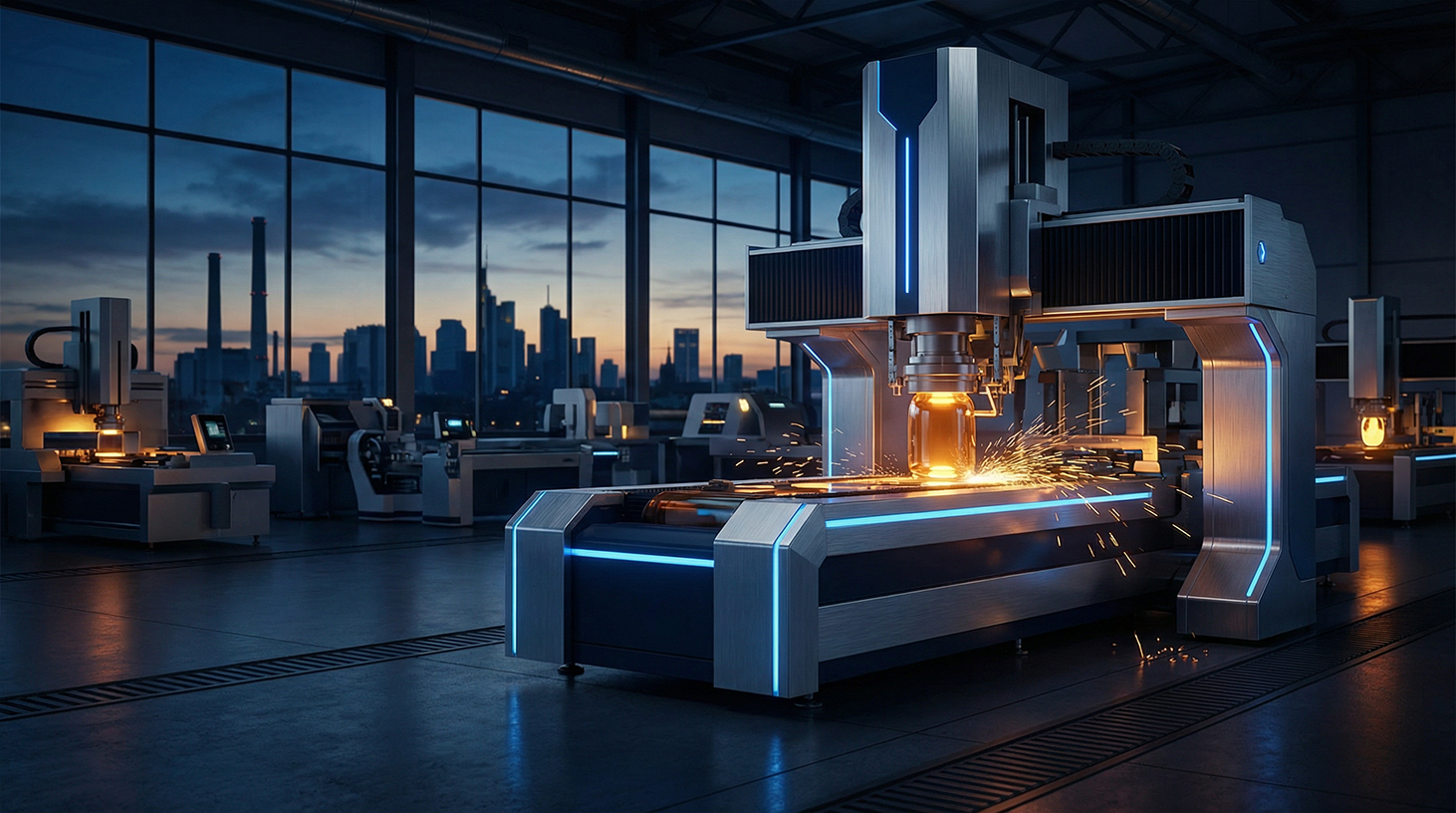
Enormous potential, real pressure: German special-purpose machinery manufacturing between world-class performance and structural change – Image: Xpert.Digital
More than just an economic downturn: The real problem facing German machine manufacturers
Survival in the global price war: How the German special machinery industry is now fighting back
For decades, German special-purpose machinery manufacturing has been considered the undisputed flagship of domestic industry. However, the days when the "Made in Germany" label served as a reliable shield against international competition are definitively over. Global market shifts, a massive technological catch-up by Chinese competitors, and a glaring shortage of skilled workers in Germany are putting an entire sector under unprecedented pressure. At the same time, digitalization is forcing traditional medium-sized companies to radically change their role: away from being purely design-oriented and towards becoming networked software and solutions partners. What is the true state of this highly complex niche industry? An in-depth look at the alarming figures, the greatest threats, and the most promising survival strategies for German special-purpose machinery manufacturing – supplemented by exclusive insights from an industry expert in Bielefeld.
Related to this:

When top performance alone is no longer enough: A highly complex niche business under global attack
The German special-purpose machinery industry stands at a crossroads. It is one of the most technologically advanced sectors Germany has produced, and yet – or perhaps precisely because of this – it finds itself in a situation characterized by conflicting forces: on the one hand, proven expertise that is unparalleled worldwide; on the other hand, a competitive environment that is changing at a pace that is increasingly putting the industry's traditional strengths under pressure. Anyone who believes that technological superiority will provide lasting protection against price pressure and strategic imitation underestimates the dynamics with which global markets are shifting.
The figures speak for themselves. As early as 2024, mechanical engineering production in Germany shrank by 5.7 percent, and a further decline of 0.6 percent was expected for 2025, while global growth in the sector reached 3.6 percent. The overall VDMA (German Engineering Federation) order decline amounted to 8 percent in 2024, with the slump being particularly severe domestically. The PwC Mechanical Engineering Barometer paints an even bleak picture for 2026: no turnaround, historically low capacity utilization, and a continuing revenue crisis. While this data applies to mechanical engineering as a whole, special-purpose machinery manufacturing – with its long project durations, highly customized requirements, and intensive engineering work – is feeling the effects of the stagnant order situation with particular delay and force.
Its strength lies in its unrepeatability
The core of German special-purpose machinery manufacturing lies in the ability to develop solutions that cannot be bought off the shelf. Meeting customer requirements from a single source, without any supply chain member relying on standard purchased parts – that is the DNA of this segment. It's not the machine as a product that counts, but the solution as a complete system: from the consulting phase through design to commissioning, service, and long-term integration into existing production processes. This depth of customer relationship fundamentally distinguishes special-purpose machinery manufacturing from standard product industries where price comparisons are directly possible.
A crucial competitive factor is mastering the entire life cycle of a system. Purchase prices tell only a fraction of the economic story. Buying a complex, custom-built system also means buying decades of maintenance, spare parts supply, software updates, and process consulting. Total cost of ownership (TCO) analyses repeatedly show that seemingly cheaper alternatives—whether from low-wage countries or less specialized suppliers—can become significantly more expensive over the entire lifespan once hidden costs for downtime, rework, and inadequate local service are factored in. This advantage, however, must be actively communicated and demonstrably proven—customers under increasing cost pressure are no longer willing to simply take it for granted.
The Chinese competitor is no longer a phantom
For the German special-purpose machinery industry, the confrontation with China is not an abstract geopolitical debate, but a tangible economic reality. With massive state support, Chinese manufacturers have systematically reduced the technological gap with German and European suppliers in recent years. While they previously competed in the mid-market segment, they are increasingly penetrating areas long considered the domain of German premium expertise. According to a recent Horváth study, three-quarters of the German mechanical engineering companies surveyed expect to lose significant EU market share to Chinese competitors – not at some point in the future, but within the current competitive cycle.
What makes this development particularly explosive is the geopolitical component. Trade tensions between China and the West have led Chinese manufacturers, who previously exported heavily to the US market, to shift their focus significantly to European markets. China's new five-year plan for 2026 to 2030 explicitly targets the domestic development of core components and specialized machinery – precisely in the segments where Germany has traditionally held a competitive advantage. In a rare display of political clarity, the VDMA (German Engineering Federation) has formulated unusually strong demands for fair competition and called for EU countervailing tariffs in cases of violations of anti-subsidy rules. The fact that a traditionally reserved association is taking this stance is itself an indicator of the extent of the perceived pressure.
Low-wage competition: The misunderstood risk
Besides China, part of the discussion focuses on the traditional competition from low-wage countries. A more nuanced analysis is warranted here, as the simple formula "lower labor costs equal cheaper machines" only applies to a limited extent to special-purpose machine manufacturing. The highly complex engineering work involved in a special-purpose machine order cannot simply be outsourced to low-wage regions – this requires not only technical expertise, but also proximity to suppliers, experienced skilled workers, and an industrial culture that has developed over decades.
Nevertheless, Germany is not immune to these challenges. The costs of energy, labor, bureaucracy, and regulation have accumulated into a structural competitive disadvantage. Two-thirds of German mechanical engineering companies anticipate a further economic downturn. According to a Horváth study, one in five jobs in the German mechanical engineering sector is slated for elimination to reduce costs. Anyone who insists in this environment that German quality comes at a price and that customers will understand this risks missing the mark – especially when customers themselves are under global price pressure and have to justify internally why they purchased a more expensive solution. The quality argument must therefore be increasingly supported by quantifiable economic benefits.
🎯🎯🎯 Data-driven B2B industry hub as a quasi-in-house solution

The quasi-in-house solution: How Xpert.Digital closes operational gaps in B2B marketing and sales – Smart Content-Driven Business - Image: Xpert.Digital
Xpert.Digital is a data-driven B2B industry hub led by Konrad Wolfenstein . The company acts as an external, quasi-in-house solution for industrial partners, closing operational gaps in marketing, content, and sales – without requiring additional resources on the client side.
More information here:
From supplier to strategic partner: Business models that save special-purpose machines
The battle for talent: Skilled worker shortage as a strategic weakness
Regardless of geopolitical upheavals and economic cycles, a structural problem pervades the entire German mechanical engineering sector, taking on a particularly acute form in special-purpose machinery manufacturing: the shortage of skilled workers. According to the VDMA (German Engineering Federation), one in three companies in the mechanical and plant engineering sector is experiencing significant difficulties filling vacancies. Only two out of three companies are able to fill the majority of their advertised skilled worker positions. Among engineers and other highly qualified experts, 78 percent of the HR managers surveyed reported shortages; for skilled tradespeople, this figure rises to 82 percent.
The special-purpose machinery sector bears a particular burden: because each project has individual technical requirements and is heavily dependent on personal experience, a lack of personnel cannot simply be compensated for through standardization. An experienced design engineer who knows a specific machine concept inside and out cannot be replaced within a few weeks. Demographics further exacerbate the problem: knowledge accumulated over years is at risk of being lost with the retirement of entire generations of employees. Over 40 percent of the surveyed companies expect the skilled worker shortage to worsen further in the next six to twelve months.
The industry is responding on several levels. Increased cooperation with vocational schools and universities, the targeted development of dual study programs in engineering, and the recruitment of international talent are important levers, but these do not promise a quick fix. At the same time, automation and robotics are gaining importance as strategies against the labor shortage – a certain irony in an industry that itself builds automation solutions for its customers.
Related to this:

Digitalization and AI: More than a trend, less than a salvation
Digital business models are fundamentally changing the special-purpose machinery industry, albeit more slowly than the technological promises of recent years suggested. Software is no longer merely a tool for machine control, but is becoming an independent value driver. A machine manufacturer that supplies a system and also offers an intelligent monitoring system, data-driven maintenance recommendations, and a control platform for the entire production process is no longer just a machine manufacturer, but a systems provider. This transformation significantly shifts the logic of competition: software is harder to imitate than metal structures, fosters deeper customer loyalty, and enables continuous revenue through licensing and service models.
Artificial intelligence is playing an increasingly central role in this context. According to a VDMA survey, the vast majority of mechanical engineering companies now see AI as a key driver for greater efficiency and new business models – and AI budgets have increased by 36 percent. A joint study by VDMA and Strategy& concludes that the targeted use of generative AI can increase profit margins in mechanical and plant engineering by up to 10.7 percent. At the same time, the same study shows that the hurdles are still considerable: 45 percent of companies cite a lack of personnel resources for AI implementation, 44 percent a return on investment that is not yet demonstrable, and 37 percent a shortage of qualified specialists. Digitalization, therefore, initially comes at a cost – in terms of know-how, time, and willingness to invest – before it delivers the promised returns.
From machine manufacturer to strategic partner: A role change fraught with pitfalls
A central theme in the current industry discussion is the demand that special-purpose machine manufacturers should position themselves more strongly as strategic partners to their customers – instead of merely reacting to specific tenders, they should proactively contribute complete solutions, handle digital integration, and cultivate long-term supplier relationships on equal footing. This demand is correct and necessary, but it also brings with it structural challenges.
Customers facing increasing cost and quality pressures today expect not only technical expertise, but also consulting expertise, speed, flexibility, and global availability – precisely what an organization needs that thinks and acts beyond the traditional engineering firm model. This transformation cannot succeed without significant investments in sales expertise, customer success structures, and international service capacities. For medium-sized special-purpose machine manufacturers whose DNA is geared toward technical brilliance rather than global service logistics, this represents a real challenge. The ability to integrate fresh ideas – developed in collaboration with international teams from vocational schools and universities, drawing on knowledge from the Czech Republic, China, India, and the USA – into their own service portfolio is becoming the decisive differentiator.
Optimism with a firm grasp: The right attitude for turbulent times
Anyone who has experienced 20 years of global competition knows how quickly market positions can shift – in both directions. Germany has proven in the mechanical engineering sector that even a high-wage location doesn't necessarily succumb under pressure if the right solutions are found. The VDMA's economic survey from January 2026 signals at least a slight improvement: Almost 30 percent of the companies surveyed are optimistic about the next six months, compared to only 21 percent a few months earlier. Orders from both domestic and international markets showed a real increase of 3 percent in the fourth quarter of 2025, the first such increase since the start of the pandemic.
But optimism should not be mistaken for complacency. Special-purpose machine manufacturing is not a dying breed – it remains the technological backbone of an industry that cannot function without highly specialized manufacturing solutions. However, the enormous potential inherent in this sector will only be realized if structural change – demographic, digital, geopolitical – is tackled with the necessary determination and the right team. Machine manufacturers who optimize the entire lifecycle of their systems, use AI as a genuine tool rather than a marketing buzzword, invest early in quality assurance for their solutions, and understand innovation – whether from within their own company or from international collaborations – as a key driver of growth will weather the next downturn better and capitalize on the next upswing sooner.
The key ultimately lies in a clear strategic positioning: not as a low-cost alternative provider, not as a mere machine manufacturer, but as an indispensable partner for customers who must remain competitive in production in a rapidly changing world. This is the opportunity – and the responsibility – of the German special-purpose machinery industry.
Your global marketing and business development partner
☑️ Our business language is English or German
☑️ NEW: Correspondence in your native language!

Konrad Wolfenstein
I and my team are happy to be available to you as your personal advisor.
You can contact me by filling out the contact form here or simply call me at +49 7348 4088 965. My email address is: [email protected]
I'm looking forward to our joint project.










