
When the state points the finger at others while dipping into its own coffers
Xpert Pre-Release

Available in 27 languages 📢
Prefer Xpert.Digital on GoogleⓘPublished on: August 7, 2026 / Updated on: August 7, 2026 – Author: Konrad Wolfenstein
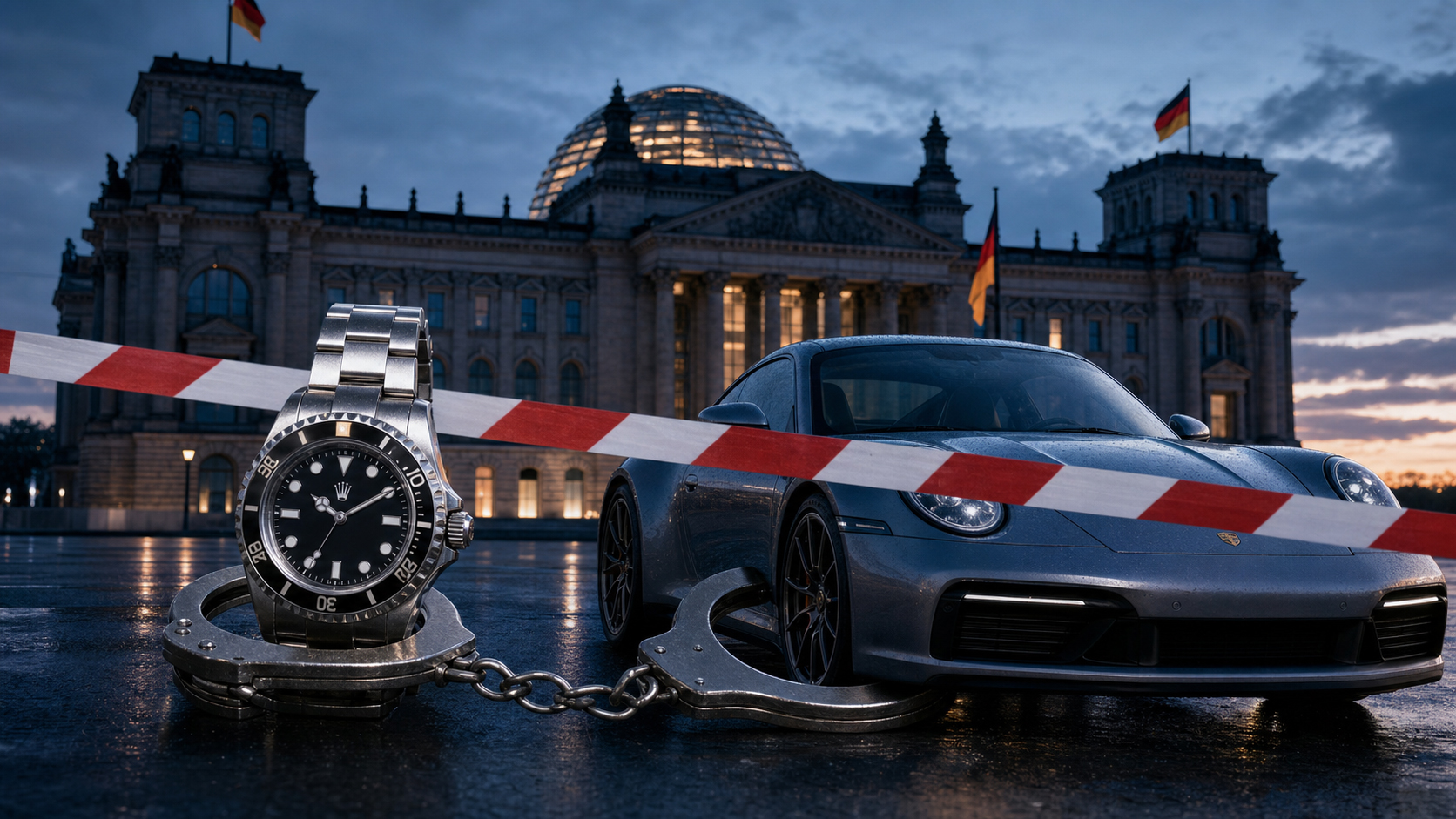
When the state points the finger at others while dipping into its own coffers – Image: Xpert.Digital
How a finance minister stirs up envy while the Bundestag squanders taxpayers' money on luxury electronics
Double standards in the Bundestag: Klingbeil criticizes the rich, politicians order luxury cell phones
It's a political double standard that leaves one speechless: While Federal Finance Minister Lars Klingbeil lashes out at Porsche drivers and Rolex wearers with bold words and elaborate videos, members of parliament shamelessly help themselves to taxpayer money. Thousands of expensive smartphones and tablets are being handed out to parliamentarians at the taxpayers' expense – sometimes in such large quantities that the suspicion of taxpayer-funded gifts for their own relatives is obvious. But this brazen tech battle in the Bundestag is just the tip of the iceberg. Behind the populist debate fueled by envy lies a system that systematically penalizes the true contributors to society: Those who work hard and earn good money are first fleeced by top tax rates and then completely excluded from government support. A stark look at the hypocrisy of Berlin politics, the growing gap between aspiration and reality, and a working middle class that ultimately loses out.
1,670 luxury devices at taxpayers' expense: How the Bundestag shamelessly helps itself
Mobile phones for politicians, strict rules for citizens: The blatant self-enrichment in the Bundestag
When the state points the finger at others while dipping into its own coffers: Federal Finance Minister Lars Klingbeil is staging a media-savvy image as a tough fighter against tax evasion, blatantly targeting Porsche drivers and Rolex wearers. But while politicians are stoking populist debates fueled by envy, members of parliament are apparently shamelessly helping themselves: Thousands of expensive smartphones and tablets are being ordered at taxpayers' expense – often as tax-funded gifts for relatives. This blatant double standard, however, is just the tip of the iceberg. Beyond these crude luxury clichés, a system of "redistribution squared" is revealed in Germany, one that primarily penalizes the high earners in society. Those who earn good money are first hit with top tax rates and then systematically excluded from government support. A look at a contradictory policy that oscillates between symbolic toughness, institutional self-enrichment, and the disadvantaging of the working middle class.
Do as I say, not as I do: Klingbeil's critique of luxury and the tech craze in the Bundestag
Lars Klingbeil caused a stir with a staged video in which he declared war on tax evaders, explicitly using the Rolex and Porsche brands as symbols of illegally acquired wealth. Almost simultaneously, it came to light that members of parliament were ordering smartphones and tablets on a large scale at taxpayers' expense, without any comparable public outrage from the finance minister. These two events shed a revealing light on the contradictions of current political communication in Germany, where symbolic toughness towards the supposedly wealthy goes hand in hand with tacit leniency towards institutional privileges.
A video as a stage: How the finance minister links prosperity with crime
On July 18, Federal Finance Minister Lars Klingbeil released an elaborately produced, documentary-style video in which he and Federal Justice Minister Stefanie Hubig presented an action plan against tax fraud and financial crime. Set to dramatic film music, Klingbeil declared that they would take action against those who defraud the state, adding the now-famous line that their Rolexes and Porsches would be confiscated. The action plan itself includes substantial measures such as 1,500 new positions at customs, an end to the practice of self-reporting that grants immunity from prosecution, and the increased use of artificial intelligence to detect fraud patterns.
The problem, however, lies not in the content of the action plan, but in the chosen imagery. By selecting a Swiss watch brand and a German sports car manufacturer as symbols for criminal behavior, the Finance Minister implicitly cast suspicion on everyone who wears a Rolex or drives a Porsche. Critics like Focus chief correspondent Ulrich Reitz described this as blatant social populism and a diversionary tactic that operates with derision towards people who have achieved prosperity. Bavarian Economics Minister Hubert Aiwanger also voiced sharp criticism, accusing the campaign of ultimately creating more leeway for other forms of rule-breaking while defaming honestly earned wealth.
Symbolic politics without a data basis: The gap in the action plan
A key criticism of Klingbeil's presentation concerns the lack of a sound data basis. There is neither a reliable estimate of the actual annual tax losses due to tax evasion and VAT fraud in Germany, nor is there a forecast of the specific fiscal effect the new action plan is intended to achieve. Instead, public communication was dominated by class-struggle rhetoric, more reminiscent of partisan infighting than a fact-based government statement. The comparison of the planned maximum penalty for tax offenses with that for murder further raised eyebrows among observers, who accused the minister of overstepping the bounds of sound legal policy with this proportionality.
It is also noteworthy that the choice of symbols does not appear random. While a private jet or a yacht several meters long would represent significantly higher levels of wealth, the finance minister opted for two products that are affordable for a broader segment of the population and are visible in everyday life. A Rolex watch costs on average several thousand euros, and an entry-level Porsche model is often priced similarly to upper-mid-range vehicles from premium German manufacturers. This selection can be interpreted as a deliberate attempt to connect with the lifestyle of the video's target audience, who were primarily to be reached via social media platforms like Instagram and TikTok. At the same time, the symbolism targets precisely that German car manufacturer which, at the time of the video's release, was already struggling with significant job cuts and financial difficulties, lending the criticism of the campaign an additional layer of perceived injustice towards the affected employees.
The other side of the coin: Taxpayer money for company cell phones without any discernible limits
While the finance minister publicly demonstrated a tough stance against alleged tax evaders, internal figures from the Bundestag administration revealed a completely different picture of spending discipline within parliament itself. In 2025, the then 630 members of the Bundestag ordered a total of 1,670 new smartphones and tablets, including 950 iPhones, 420 iPads, 257 Samsung smartphones, and 43 Samsung tablets. The total cost amounted to €1,464,567, entirely financed by tax revenue. This equates to roughly 2.6 devices per member of parliament per year, which, extrapolated over a regular four-year legislative term, results in more than ten smartphones or tablets per parliamentarian.
Particularly noteworthy is the timing of these orders. Around 43.5 percent of all devices were purchased in the last quarter of the year, with 402 iPhones and 191 iPads worth nearly €550,000 ordered between October and December alone. This pattern suggests that many members of parliament deliberately exhaust their annual allowance for office equipment at the end of the year – an account over which they have largely independent control. Reports from within parliament indicate that a significant portion of these devices are subsequently given away as private gifts to spouses, children, or party members, without any requirement to prove that they were used exclusively for official purposes.
Eighty MPs in the spotlight: The specific outliers
The aggregated figures are already alarming, but the distribution within the parliamentary groups paints an even clearer picture of individual expectations. A total of 80 members of parliament ordered five or more devices within a single year; four politicians even ordered nine new devices, five others eight, and ten members of parliament seven each. This is happening with a current monthly allowance of just under €12,000 gross, which corresponds to a net income of well over €10,000. In addition, members of parliament receive €1,000 per month tax-free for office supplies, an amount that, in itself, far exceeds what the average taxpayer has available for comparable purposes.
What makes this particularly troubling is that even members of parliament who have already left the Bundestag received reimbursements for devices at taxpayers' expense – specifically, four tablets and eight smartphones. According to estimates from within parliament, devices worth around €270,000 are billed annually in this way, without ever having served any discernible official purpose. In this context, the Federation of German Taxpayers criticized the underlying system of the benefits account, arguing that its largely independent power of disposal for members of parliament structurally invites abuse and requires fundamental reform.
The contrast that counts: Symbolic harshness versus real waste
The real core of the public outrage lies less in the absolute amount of the expenditure, which appears small compared to the overall federal budget, but rather in the moral contrast between public rhetoric and institutional practice. While the finance minister stages a media-savvy fight against tax evaders, deliberately stoking envy of wealthy citizens, a remarkable negligence in the handling of public funds is evident within the parliamentary system itself. The average taxpayer, who typically uses their personal smartphone for several years because a new device can now easily cost over €1,000, is likely to perceive this practice of institutional self-enrichment as a double standard.
This asymmetry between aspiration and reality is not a new phenomenon in political communication, but it gains particular urgency due to the close temporal proximity of the two events. Those who publicly demonstrate toughness towards alleged tax evaders should at least ensure order with comparable consistency within their own institutional sphere. A smartphone and a tablet every two to three years, as is typical for most citizens, would generally be perfectly sufficient for parliamentary work without impairing the parliament's functionality in any way.
Redistribution squared: When high earners are asked to pay twice
Beyond the specific episode involving Klingbeil's video and the procurement of the equipment, a deeper structural pattern can be discerned in German social and tax policy, which former Finance Minister Christian Lindner aptly described as "redistribution squared." This refers to a mechanism in which higher earners initially contribute disproportionately to financing the public sector through a progressive tax and contribution system, and are subsequently systematically excluded from numerous government support programs and subsidies without their prior contributions being credited in any way.
This principle is particularly evident in the case of parental allowance. Since April 1, 2025, the income threshold above which entitlement to parental allowance is completely forfeited has been €175,000 in taxable income for both couples and single parents. This threshold has been lowered several times in recent years, from an initial €300,000 for couples to €200,000, and finally to the current level. It is noteworthy that this is a hard limit without any transitional provisions. Anyone exceeding the threshold by even a single euro loses their entire entitlement, which, with a potential benefit period of fourteen months and a maximum monthly rate of €1,800, can mean a loss of up to €25,200.
Similar mechanisms exist in other government subsidy programs. For the new electric car subsidy, the income threshold for taxable household income is €80,000 for childless households and €90,000 for families with two or more children. The subsidy amount is further tiered based on income, increasing with decreasing income. Those whose income exceeds this threshold receive no financial support whatsoever when purchasing an electric vehicle, regardless of their previous contributions to the state budget through income and sales tax.
Six examples of double exclusion
Besides parental leave benefits and subsidies for electric cars, there are a number of other programs from which high-income households miss out despite above-average tax burdens. For the Federal Training Assistance Act (BAföG), eligibility is eliminated even with relatively moderate parental incomes, with the exact limit depending on the number of children and other allowances. For employer-provided savings plans (Vermögenswirksame Leistungen) and the housing construction premium, there are also income limits in the range of approximately €35,000 to €40,000 of taxable income, above which no government subsidy is granted. Similarly, the subsidy for heat pumps as part of energy-efficient building renovations is income-dependent, with higher-income households receiving a significantly lower percentage subsidy than lower-income households.
The common thread running through these six examples is that the assessment basis is generally taxable income – that is, the amount remaining after deducting all tax-relevant allowances and pension contributions. Those who earn this income have already paid a significant portion of their gross income to the state in the form of income tax, the solidarity surcharge, and social security contributions. The subsequent exclusion from subsidies thus represents a double burden: first, through the disproportionate tax burden during their working lives, and second, through the foregoing of those state benefits that lower and middle-income groups can access.
The incentive effect on motivation and life planning
From an economic perspective, this interplay of high tax progression and income-dependent exclusion from subsidies raises the fundamental question of the incentive effects on the willingness to work. If, on the one hand, additional gross income is increasingly diminished by rising tax rates and levies, and on the other hand, access to numerous government subsidy programs is blocked, a de facto marginal tax rate emerges in certain income brackets, significantly reducing the actual financial advantage of overtime or career advancement. For skilled workers who could increase their income through additional qualifications, overtime, or assuming management responsibilities, the economic benefit of such a step may appear considerably smaller than initially assumed, given the double burden of tax progression and exclusion from subsidies.
This is especially true for young people at the beginning of their careers who, after several years of education and training, might eventually reach an income bracket where, although they are among the top earners in terms of gross income, their net disposable income is significantly lower than the gross figures suggest. At the same time, they remain excluded from numerous support programs that were available to them in an earlier, lower-income phase of their lives. In the long term, this situation can diminish the attractiveness of investing in education and career advancement if the economic benefits of higher qualifications are offset by the interplay of progressive taxation and exclusion from support programs.
Political communication between symbolism and structural reality
The connection between Klingbeil's video and the described redistribution logic lies in the way political communication reduces complexity, sometimes producing distorting simplifications. While media attention focuses on striking symbols like Rolex and Porsche, the structurally far more significant issue of "redistribution squared" remains largely outside the public debate. This problem affects not only a small group of the extremely wealthy, but a broader range of skilled workers, self-employed individuals, and dual-income households who occupy the upper middle of the income distribution and cannot be considered either tax evaders or crisis profiteers.
A nuanced economic policy debate would therefore need to distinguish more clearly between ill-gotten gains acquired through tax evasion and financial crime on the one hand, and legitimately earned prosperity through hard work, responsibility, and entrepreneurial risk on the other. Merging these two categories into a single symbolic narrative, as expressed in Klingbeil's video, contributes little to solving the actual problem of tax evasion. Rather, it damages the social climate by further fueling envy of economic success and undermining the trust of hard-working citizens in fair treatment by the state.
A contradictory dual strategy
Ultimately, the juxtaposition of Klingbeil's media-savvy declaration of war against tax evaders and the simultaneously revealed self-serving practices in the Bundestag exposes a deeper pattern of political inconsistency. Anyone who publicly demonstrates toughness while generous spending practices continue unchecked within their own institutional environment risks a significant loss of trust among that segment of the population which neither benefits from tax evasion nor has access to lavish parliamentary budgets. At the same time, the analysis of this "redistribution squared" shows that the real economic policy challenge lies not only in combating criminal tax evasion, but also in the question of how honestly earned wealth will be treated fairly in the future without being doubly burdened by a combination of high tax progression and systematic exclusion from subsidies.





